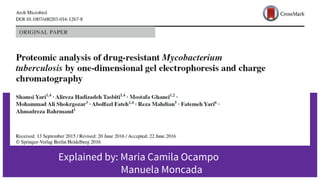
Explained by: Maria Camila Ocampo
Manuela Moncada
INTRODUCTION
● GENDER: Mycobacterium
● SPECIES: Tuberculosis (TB)
- Robert Koch described it on march, 1882.
- Gram Positives Bacilli and aerobic
- Mycobacterium TB can survive for months in sputum and for weeks in carpets,
dead, clothes and dust.
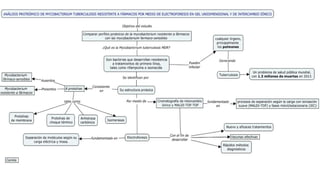
- it’s resistant to cold and desiccation
- the natural reservoir is the human
- It infects in most cases the lungs
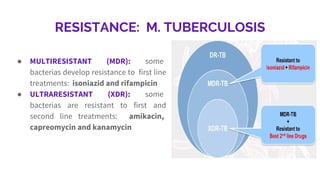
RESISTANCE: M. TUBERCULOSIS
● MULTIRESISTANT (MDR): some
bacterias develop resistance to first line
treatments: isoniazid and rifampicin
● ULTRARESISTANT (XDR): some
bacterias are resistant to first and
second line treatments: amikacin,
capreomycin and kanamycin
ANTIMICROBIAL RESISTANCE
● TYPES:
- Intrinsic or natural resistance
- Extrinsic or acquired resistance
- Cross resistance
- Associated resistance
● ANTIMICROBIAL RESISTANCE:
- Mechanisms:
1. enzymatic inactivation of antibiotics
2. Impermeability of the membrane or cell
wall
3. Expulsion by active mechanisms of
antibiotic
4. Modification the target site the antibiotic
in the bacteria
- Specific Mechanisms:
- gene rpoB mutation.
● PROTEOMIC:
- Definition: Proteomic
focuses in the protein
expression analysis of a cell
or an organism across
multiple conditions.
● PROTEOMIC:
- Uses:
- identify new markers for disease
diagnosis (biomarkers)
- identify new Drugs
- Determine molecular mechanisms
involved in the pathogenesis of
diseases
- Analysis of Signal transduction
pathways
● ELECTROPHORESIS:
- Chromatography: it’s a technique
commonly used to purificating and
separating a mixture of chemical
substances into its individual
components
- This technique separates protein
depending their charge and molecular
weight
- ION EXCHANGE CHROMATOGRAPHY
Principal causative of
human tuberculosis
MYCOBACTERIUM
TUBERCULOSIS
ANTIMICROBIAL
RESISTANCE
proteomics
chromatography
GENERAL OBJECTIVE
The aim of this study was to
compare the protein profiles of
MDR-TB with sensitive isolates
to identify proteins which could
be used as a drug target or
diagnostic marker for future
designing of valuable TB
vaccine or TB rapid test.
MATERIALES Y MÉTODOS
● se aislaron cinco cepas de tuberculosis multidrogoresistentes y cinco cepas
sensitivas
● CEPAS:
- Las cepas en este estudio fueron esenciales para el estudio de resistencia a los
antibióticos de rifampicina e isoniazida
- se encontraron cepas patógenas y virulentas asociadas a la mycobacterium
tuberculosis en pacientes infectados.
● ESPECTROMETRÍA DE MASA:
- Mide la relación masa/carga de una molécula, es la principal herramienta de la
proteómica.
- En este estudio la espectrometría de masas fue utilizada para el análisis rápido y
automatizado de muchas proteínas en un corto periodo de tiempo.
● CROMATOGRAFÍA DE INTERCAMBIO DE IONES
● Permite la separación de moléculas basadas en sus propiedades de carga eléctrica
tales como tipo de carga y fuerza de carga. Está compuesta por una fase estacionaria
y una fase móvil.
● En este método se da una adsorción reversible de solutos cargados de moléculas por
el intercambio de iones inmovilizados de carga opuesta.
- se usa para identificar proteínas durante un proceso de purificación, se utiliza un
tamaño estándar y la movilidad está determinada por el peso molecular y la carga
eléctrica de la molécula.
- el SDS desnaturaliza las proteínas y rompe las interacciones no covalentes que
determinan la estructura terciaria y cuaternaria
● SDS-PAGE(Sodio Duodecil Sulfato- Poliacrilamida Gel
Electroforesis)
● MALDI-TOF
- MALDI: desorción/ionización
mediante láser asistida por Matriz.
- Técnica de ionización suave,
permite el análisis de biomoléculas
y macromoléculas orgánicas
- TOF: tiempo de vuelo.
- analiza y determina la masa en una
región de alto vacío desde el
tiempo de la aceleración de los
iones en la fuente hasta que
impactan con el detector.
RESULTADOS
•Por medio de IEC se
hallaron 5 picos de
proteínas que fueron
detectadas en MDR-TB
y en mycobacterium
tuberculosis sensible.
RESULTADOS
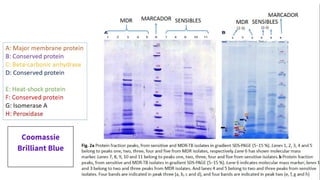
ELECTROPHORESIS
Coomassie
Brilliant Blue
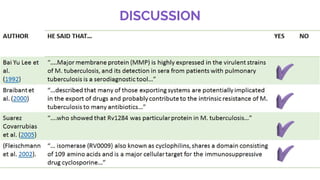
DISCUSSION
CONCLUSION
•MDR-Tuberculosis is a global public health problem, and its treatment
should be more cheap and effective.
•The proteins that compose the mycobacterium tuberculosis is a
suitable study tool for search of new drugs and quick diagnostic test.
•Major membrane protein (MMP) associated with membrane
preparations from M. tuberculosis is a significant evidence of this
disease.
•Multidrug resistance consist in a complex signaling mechanism, in order
to activate the ABC transporters.
THANKS
BIBLIOGRAFÍA
● Characterization of the Major Membrane Protein of Virulent Mycobacterium
tuberculosis. B. lee; A. Hefta; J. Brennan. (1992)
● Bioquímica. Charlotte W. Pratt, Cornely Kathleen. (2012)
● Dr en C.; Pando-Robles RV, Lanz-Mendoza H. (Enero, 2009). La importancia de
la proteómica en la Salud Pública. Scielo Public Health. Ultimo ingreso: 4 de
septiembre. Disponible en:
http://www.scielosp.org/scielo.php?script=sci_arttext&pid=S0036-363420090
00900004
● Departamento de agricultura. La resistencia a los antimicrobianos, sus
mecanismos y epidemiología. Depósitos de documentos de la FAO. ultimo
ingreso: 4 de septiembre. Disponible en:
http://www.fao.org/docrep/007/y5468s/y5468s0d.htm

Seminary

  • 1.
    Explained by: MariaCamila Ocampo Manuela Moncada
  • 2.
    INTRODUCTION ● GENDER: Mycobacterium ●SPECIES: Tuberculosis (TB) - Robert Koch described it on march, 1882. - Gram Positives Bacilli and aerobic - Mycobacterium TB can survive for months in sputum and for weeks in carpets, dead, clothes and dust. - it’s resistant to cold and desiccation - the natural reservoir is the human - It infects in most cases the lungs
  • 3.
    RESISTANCE: M. TUBERCULOSIS ●MULTIRESISTANT (MDR): some bacterias develop resistance to first line treatments: isoniazid and rifampicin ● ULTRARESISTANT (XDR): some bacterias are resistant to first and second line treatments: amikacin, capreomycin and kanamycin
  • 4.
    ANTIMICROBIAL RESISTANCE ● TYPES: -Intrinsic or natural resistance - Extrinsic or acquired resistance - Cross resistance - Associated resistance
  • 5.
    ● ANTIMICROBIAL RESISTANCE: -Mechanisms: 1. enzymatic inactivation of antibiotics 2. Impermeability of the membrane or cell wall 3. Expulsion by active mechanisms of antibiotic 4. Modification the target site the antibiotic in the bacteria - Specific Mechanisms: - gene rpoB mutation.
  • 6.
    ● PROTEOMIC: - Definition:Proteomic focuses in the protein expression analysis of a cell or an organism across multiple conditions.
  • 7.
    ● PROTEOMIC: - Uses: -identify new markers for disease diagnosis (biomarkers) - identify new Drugs - Determine molecular mechanisms involved in the pathogenesis of diseases - Analysis of Signal transduction pathways
  • 8.
    ● ELECTROPHORESIS: - Chromatography:it’s a technique commonly used to purificating and separating a mixture of chemical substances into its individual components - This technique separates protein depending their charge and molecular weight - ION EXCHANGE CHROMATOGRAPHY
  • 9.
    Principal causative of humantuberculosis MYCOBACTERIUM TUBERCULOSIS ANTIMICROBIAL RESISTANCE proteomics chromatography
  • 10.
    GENERAL OBJECTIVE The aimof this study was to compare the protein profiles of MDR-TB with sensitive isolates to identify proteins which could be used as a drug target or diagnostic marker for future designing of valuable TB vaccine or TB rapid test.
  • 11.
    MATERIALES Y MÉTODOS ●se aislaron cinco cepas de tuberculosis multidrogoresistentes y cinco cepas sensitivas ● CEPAS: - Las cepas en este estudio fueron esenciales para el estudio de resistencia a los antibióticos de rifampicina e isoniazida - se encontraron cepas patógenas y virulentas asociadas a la mycobacterium tuberculosis en pacientes infectados.
  • 12.
    ● ESPECTROMETRÍA DEMASA: - Mide la relación masa/carga de una molécula, es la principal herramienta de la proteómica. - En este estudio la espectrometría de masas fue utilizada para el análisis rápido y automatizado de muchas proteínas en un corto periodo de tiempo.
  • 13.
    ● CROMATOGRAFÍA DEINTERCAMBIO DE IONES ● Permite la separación de moléculas basadas en sus propiedades de carga eléctrica tales como tipo de carga y fuerza de carga. Está compuesta por una fase estacionaria y una fase móvil. ● En este método se da una adsorción reversible de solutos cargados de moléculas por el intercambio de iones inmovilizados de carga opuesta.
  • 14.
    - se usapara identificar proteínas durante un proceso de purificación, se utiliza un tamaño estándar y la movilidad está determinada por el peso molecular y la carga eléctrica de la molécula. - el SDS desnaturaliza las proteínas y rompe las interacciones no covalentes que determinan la estructura terciaria y cuaternaria ● SDS-PAGE(Sodio Duodecil Sulfato- Poliacrilamida Gel Electroforesis)
  • 15.
    ● MALDI-TOF - MALDI:desorción/ionización mediante láser asistida por Matriz. - Técnica de ionización suave, permite el análisis de biomoléculas y macromoléculas orgánicas - TOF: tiempo de vuelo. - analiza y determina la masa en una región de alto vacío desde el tiempo de la aceleración de los iones en la fuente hasta que impactan con el detector.
  • 16.
    RESULTADOS •Por medio deIEC se hallaron 5 picos de proteínas que fueron detectadas en MDR-TB y en mycobacterium tuberculosis sensible.
  • 17.
  • 18.
  • 19.
  • 20.
  • 21.
    CONCLUSION •MDR-Tuberculosis is aglobal public health problem, and its treatment should be more cheap and effective. •The proteins that compose the mycobacterium tuberculosis is a suitable study tool for search of new drugs and quick diagnostic test. •Major membrane protein (MMP) associated with membrane preparations from M. tuberculosis is a significant evidence of this disease. •Multidrug resistance consist in a complex signaling mechanism, in order to activate the ABC transporters.
  • 24.
  • 25.
    BIBLIOGRAFÍA ● Characterization ofthe Major Membrane Protein of Virulent Mycobacterium tuberculosis. B. lee; A. Hefta; J. Brennan. (1992) ● Bioquímica. Charlotte W. Pratt, Cornely Kathleen. (2012) ● Dr en C.; Pando-Robles RV, Lanz-Mendoza H. (Enero, 2009). La importancia de la proteómica en la Salud Pública. Scielo Public Health. Ultimo ingreso: 4 de septiembre. Disponible en: http://www.scielosp.org/scielo.php?script=sci_arttext&pid=S0036-363420090 00900004 ● Departamento de agricultura. La resistencia a los antimicrobianos, sus mecanismos y epidemiología. Depósitos de documentos de la FAO. ultimo ingreso: 4 de septiembre. Disponible en: http://www.fao.org/docrep/007/y5468s/y5468s0d.htm