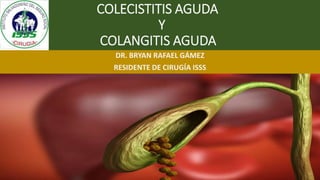
COLECISTITIS AGUDA
Y
COLANGITIS AGUDA
DR. BRYAN RAFAEL GÁMEZ
RESIDENTE DE CIRUGÍA ISSS
OBJETIVOS
• Exponer la fisiopatología de la colangitis aguda y colecistitis
aguda calculosa.
• Enlistar los criterios diagnósticos de la colangitis aguda y
colecistitis aguda
• Describir los principios generales del tratamiento de la
colangitis aguda y colecistitis aguda
COLECISTITIS AGUDA
• Síndrome de dolor en el
cuadrante superior derecho,
fiebre y leucocitosis asociado
con inflamación de la vesícula
biliar.
• Se desarrolla en 6 a 11 % de
pacientes con cálculos biliares
sintomáticos
.MORRIS CR, HOHF RP, IVY AC. Un estudio experimental del
papel de la estasis en la etiología de la colecistitis. Cirugía
1952; 32:673.
FISIOPATOLOGÍA
Roslyn JJ, DenBesten L, Thompson JE Jr, Silverman BF. Papeles de la bilis litogénica y la oclusión del conducto
cístico en la patogenia de la colecistitis aguda. Am J Surg 1980; 140:126.
DIAGNÓSTICO
1. INFLAMACIÓN LOCAL
• Signo de Murphy
• Dolor, masa o molestia en HCD
2. INFLAMACIÓN SISTÉMICA
• Fiebre
• Leucocitosis
• PCR >3.0mg/dL
3. HALLAZGOS
RADIOLÓGICOS*
Shea JA, Berlín JA, Escarce JJ, et al. Estimaciones revisadas de la sensibilidad y especificidad de las
pruebas diagnósticas en la sospecha de enfermedad del tracto biliar. Arch Intern Med 1994; 154:2573.
Tokyo Guidelines 2018: flowchart for the management of acute cholecystitis
J Hepato Biliary Pancreat, Volume: 25, Issue: 1, Pages: 55-72, First published: 16 October 2017, jDOI: (10.1002/hbp.516)
Grade I.
λ, CCI 5 or less and/or ASA class II or less (low risk);
µ, CCI 6 or greater and/or ASA class III or greater (not low risk)
ALGORITMO DE MANEJO
ALGORITMO DE MANEJO
J Hepato Biliary Pancreat, Volume: 25, Issue: 1, Pages: 55-72, First published: 16 October 2017, DOI: (10.1002/jhbp.516)
Grade II.
α, antibiotics and general supportive care successful;
ϕ, antibiotics and general supportive care fail to control inflammation;
λ, CCI 5 or less and/or ASA-PS class II or less (low risk);
µ, CCI 6 or greater and/or ASA-PS class III or greater (not low risk);
ALGORITMO DE MANEJO
Grade III.
#, negative predictive factors: jaundice (TBil ≥2), neurological dysfunction, respiratory dysfunction;
Φ, FOSF: favorable organ system failure = cardiovascular or renal organ system failure which is rapidly reversible after admission and
before early LC in AC.
in cases of Grade III, CCI (Charlson comorbidity index) 4 or greater, ASA-PS 3 or greater are high risk;
J Hepato Biliary Pancreat, Volume: 25, Issue: 1, Pages: 55-72, First published: 16 October 2017, DOI: (10.1002/jhbp.516)
COLANGITIS
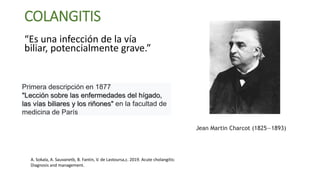
“Es una infección de la vía
biliar, potencialmente grave.”
Jean Martin Charcot (1825—1893)
Primera descripción en 1877
"Lección sobre las enfermedades del hígado,
las vías biliares y los riñones" en la facultad de
medicina de París
A. Sokala, A. Sauvanetb, B. Fantin, V. de Lastoursa,c. 2019. Acute cholangitis:
Diagnosis and management.
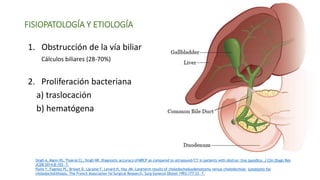
FISIOPATOLOGÍA Y ETIOLOGÍA
1. Obstrucción de la vía biliar
Cálculos biliares (28-70%)
2. Proliferación bacteriana
a) traslocación
b) hematógena
Singh A, Mann HS, Thukral CL, Singh NR. Diagnostic accuracy ofMRCP as compared to ultrasound/CT in patients with obstruc-tive jaundice. J Clin Diagn Res
JCDR 2014;8:103—7.
Panis Y, Fagniez PL, Brisset D, Lacaine F, Levard H, Hay JM. Longterm results of choledochoduodenostomy versus choledochoje- junostomy for
choledocholithiasis. The French Association forSurgical Research. Surg Gynecol Obstet 1993;177:33—7.
MICROBIOLOGÍA
Table 4 Micro-organisms
cholangitis.
responsible for acute
Germ Hemoculture
(%)
Biliary
cultures (%)
Gram negative bacilli
Escherichia coli 35—62 31—44
Klebsiella spp. 12—28 9—20
Pseudomonas spp. 4—14 0.5—19
Enterobacter spp. 2—7 5—9
Citrobacter spp. 2—6
Acinetobacter spp. 3
Gram-positive cocci
Enterococcus spp. 10—23 3—34
Streptococcus spp. 6—9 2—10
Staphylococcus spp. 2 0
Anaerobia 1 4—20
Others 17
Adapted from Tokyo Guidelines 2018.
Gomi H, Solomkin JS, Schlossberg D, et al. Tokyo Guidelines 2018: antimicrobial therapy for acute cholangitis and chole- cystitis. J Hepato-
Biliary-Pancreat Sci 2018;25:3—16.
MANIFESTACIONES CLÍNICAS
80%
50-75%
Nezman H. Afdhal, MD., Colangitis aguda: manifestaciones clínicas, diagnóstico y manejo. UptoDate. 2022.
DIAGNÓSTICO
Tokyo Guidelines (TG)
2007-2013-2018
Sensibilidad 92%
Especificidad 78%
Table 2 TG2013/2018 diagnostic criteria.
Criteria Threshold
A-Systemic
inflammation
A-1 Fever or chills > 38 ◦C
A-2 Biological Leukocytes < 4
inflammatory or > 10G/L
syndrome CRP≥10 mg/L
B-Cholestasis
B-1 Icterus/jaundice Total biliru-
bin ≥ 34 µmol/L
B-2 Abnormal liver ASAT, ALAT,
function test PAL and
gamma-
GT > 1.5 × ULN
C-Imagery
C-1 Bile duct
dilatation
C-2 Imagery
providing proof of
etiology
Suspected diagnosis One item in
A + one item in
B or C
Certain diagnosis One item in A,
B and C
CRP: C reactive protein; ASAT: aspartate aminotransferase;
ALAT: alanine aminotransferase; ULN: upper limit of normal.
Yokoe M, Hata J, Takada T, et al. Tokyo Guidelines 2018: diag- nostic
criteria and severity grading of acute cholecystitis (with videos). J
Hepato-Biliary-Pancreat Sci 2018;25:41—54.
CRITERIOS DE GRAVEDAD
Se asocian con un aumento de la
mortalidad.
Grado 1: 1,2 %
Grado 2: 2,6 %
Grado 3: más del 5 %
Table 3 TG severity criteria 2013/2018.
Grade Criteria Threshold
Grade 3: Cardiovascular Dopamine > 5 µg/kg/
Severe dysfunction min or any dose of
At least 1 noradrenalin
criterium
Neurological Consciousness
dysfunction disorders
Respiratory PaO2/FiO2 < 300
dysfunction
Renal dysfunction Creatininuria > 176
µmol/L or oliguria
Liver dysfunction INR > 1.5
Hematological Platelets < 100,000/
dysfunction mm3
Grade 2: Leucocytes < 4 G/L or > 12G/L
Moderate
At least 2
criteria
Fever > 39 ◦C
Age > 75 years
Bilirubinemia 85 µmol/L
Hypoalbuminemia < 0.7 × ILN
Grade 1: Mild
No criteria 2
or 3
PaO2: partial pressure of oxygen; FiO2: fraction of inspired
oxygen; INR: International normalized ratio; ILN: inferior limit
of the normal.
Kiriyama S, Kozaka K, Takada T, et al. Tokyo Guidelines 2018: diagnostic criteria and
severity grading of acute cholangitis (with videos). J Hepato-Biliary-Pancreat Sci
2018;25:17—30.
TRATAMIENTO
ANTIBIOTICOTERAPIA DRENAJE DE LA VÍA BILIAR
Solomkin JS, Mazuski JE, Bradley JS, et al. Diagnosis and mana- gement of complicated intra-abdominal infection in adults and children:
guidelines by the Surgical Infection Society and the Infectious Diseases Society of America. Clin Infect Dis 2010;50:133—64.
DRENAJE DE LA VÍA BILIAR
Tres modalidades:
Tratamiento quirúrgico: (hoy excepcional por su alta morbimortalidad
en comparación con el tratamiento endoscópico).
Drenaje endoscópico (CPRE o EE):
Mediante la instalación de una prótesis metálica o plástica o una
prótesis biliar, drenaje biliar
Drenaje biliar transhepático percutáneo.
Miura F, Okamoto K, Takada T, et al. Tokyo Guidelines 2018: initial management of acute biliary infection and flowchart for acute cholangitis. J
Hepato-Biliary-Pancreat Sci 2018;25:31—40.
Lai ECS, Mok FPT, Tan ESY, et al. Endoscopic biliary drainage for severe acute cholangitis. N Engl J Med 1992;326:1582—6.
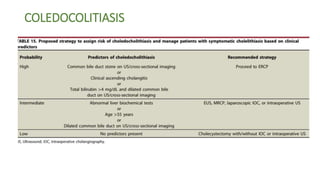
COLEDOCOLITIASIS
BIBLIOGRAFÍA
• Kiriyama S, Kozaka K, Takada T, et al. Tokyo Guidelines 2018: diagnostic criteria and severity grading of acute cholangitis (with videos). J
Hepato-Biliary-Pancreat Sci 2018;25:17—30.
• Lai ECS, Mok FPT, Tan ESY, et al. Endoscopic biliary drainage for severe acute cholangitis. N Engl J Med 1992;326:1582—6.
• Miura F, Okamoto K, Takada T, et al. Tokyo Guidelines 2018: initial management of acute biliary infection and flowchart for acute
cholangitis. J Hepato-Biliary-Pancreat Sci 2018;25:31—40.
• MORRIS CR, HOHF RP, IVY AC. Un estudio experimental del papel de la estasis en la etiología de la colecistitis. Cirugía 1952; 32:673.
• Roslyn JJ, DenBesten L, Thompson JE Jr, Silverman BF. Papeles de la bilis litogénica y la oclusión del conducto cístico en la patogenia
de la colecistitis aguda. Am J Surg 1980; 140:126.
• Shea JA, Berlín JA, Escarce JJ, et al. Estimaciones revisadas de la sensibilidad y especificidad de las pruebas diagnósticas en la
sospecha de enfermedad del tracto biliar. Arch Intern Med 1994; 154:2573.
• Solomkin JS, Mazuski JE, Bradley JS, et al. Diagnosis and mana- gement of complicated intra-abdominal infection in adults and children:
guidelines by the Surgical Infection Society and the Infectious Diseases Society of America. Clin Infect Dis 2010;50:133—64.
• Tokyo Guidelines 2018: flowchart for the management of acute cholecystitis
• Yokoe M, Hata J, Takada T, et al. Tokyo Guidelines 2018: diag- nostic criteria and severity grading of acute cholecystitis (with videos). J
Hepato-Biliary-Pancreat Sci 2018;25:41—54.

COLANGITIS COLECISTITIS.pptx

  • 1.
    COLECISTITIS AGUDA Y COLANGITIS AGUDA DR.BRYAN RAFAEL GÁMEZ RESIDENTE DE CIRUGÍA ISSS
  • 2.
    OBJETIVOS • Exponer lafisiopatología de la colangitis aguda y colecistitis aguda calculosa. • Enlistar los criterios diagnósticos de la colangitis aguda y colecistitis aguda • Describir los principios generales del tratamiento de la colangitis aguda y colecistitis aguda
  • 3.
    COLECISTITIS AGUDA • Síndromede dolor en el cuadrante superior derecho, fiebre y leucocitosis asociado con inflamación de la vesícula biliar. • Se desarrolla en 6 a 11 % de pacientes con cálculos biliares sintomáticos .MORRIS CR, HOHF RP, IVY AC. Un estudio experimental del papel de la estasis en la etiología de la colecistitis. Cirugía 1952; 32:673.
  • 4.
    FISIOPATOLOGÍA Roslyn JJ, DenBestenL, Thompson JE Jr, Silverman BF. Papeles de la bilis litogénica y la oclusión del conducto cístico en la patogenia de la colecistitis aguda. Am J Surg 1980; 140:126.
  • 5.
    DIAGNÓSTICO 1. INFLAMACIÓN LOCAL •Signo de Murphy • Dolor, masa o molestia en HCD 2. INFLAMACIÓN SISTÉMICA • Fiebre • Leucocitosis • PCR >3.0mg/dL 3. HALLAZGOS RADIOLÓGICOS* Shea JA, Berlín JA, Escarce JJ, et al. Estimaciones revisadas de la sensibilidad y especificidad de las pruebas diagnósticas en la sospecha de enfermedad del tracto biliar. Arch Intern Med 1994; 154:2573.
  • 6.
    Tokyo Guidelines 2018:flowchart for the management of acute cholecystitis
  • 7.
    J Hepato BiliaryPancreat, Volume: 25, Issue: 1, Pages: 55-72, First published: 16 October 2017, jDOI: (10.1002/hbp.516) Grade I. λ, CCI 5 or less and/or ASA class II or less (low risk); µ, CCI 6 or greater and/or ASA class III or greater (not low risk) ALGORITMO DE MANEJO
  • 8.
    ALGORITMO DE MANEJO JHepato Biliary Pancreat, Volume: 25, Issue: 1, Pages: 55-72, First published: 16 October 2017, DOI: (10.1002/jhbp.516) Grade II. α, antibiotics and general supportive care successful; ϕ, antibiotics and general supportive care fail to control inflammation; λ, CCI 5 or less and/or ASA-PS class II or less (low risk); µ, CCI 6 or greater and/or ASA-PS class III or greater (not low risk);
  • 9.
    ALGORITMO DE MANEJO GradeIII. #, negative predictive factors: jaundice (TBil ≥2), neurological dysfunction, respiratory dysfunction; Φ, FOSF: favorable organ system failure = cardiovascular or renal organ system failure which is rapidly reversible after admission and before early LC in AC. in cases of Grade III, CCI (Charlson comorbidity index) 4 or greater, ASA-PS 3 or greater are high risk; J Hepato Biliary Pancreat, Volume: 25, Issue: 1, Pages: 55-72, First published: 16 October 2017, DOI: (10.1002/jhbp.516)
  • 10.
    COLANGITIS “Es una infecciónde la vía biliar, potencialmente grave.” Jean Martin Charcot (1825—1893) Primera descripción en 1877 "Lección sobre las enfermedades del hígado, las vías biliares y los riñones" en la facultad de medicina de París A. Sokala, A. Sauvanetb, B. Fantin, V. de Lastoursa,c. 2019. Acute cholangitis: Diagnosis and management.
  • 11.
    FISIOPATOLOGÍA Y ETIOLOGÍA 1.Obstrucción de la vía biliar Cálculos biliares (28-70%) 2. Proliferación bacteriana a) traslocación b) hematógena Singh A, Mann HS, Thukral CL, Singh NR. Diagnostic accuracy ofMRCP as compared to ultrasound/CT in patients with obstruc-tive jaundice. J Clin Diagn Res JCDR 2014;8:103—7. Panis Y, Fagniez PL, Brisset D, Lacaine F, Levard H, Hay JM. Longterm results of choledochoduodenostomy versus choledochoje- junostomy for choledocholithiasis. The French Association forSurgical Research. Surg Gynecol Obstet 1993;177:33—7.
  • 12.
    MICROBIOLOGÍA Table 4 Micro-organisms cholangitis. responsiblefor acute Germ Hemoculture (%) Biliary cultures (%) Gram negative bacilli Escherichia coli 35—62 31—44 Klebsiella spp. 12—28 9—20 Pseudomonas spp. 4—14 0.5—19 Enterobacter spp. 2—7 5—9 Citrobacter spp. 2—6 Acinetobacter spp. 3 Gram-positive cocci Enterococcus spp. 10—23 3—34 Streptococcus spp. 6—9 2—10 Staphylococcus spp. 2 0 Anaerobia 1 4—20 Others 17 Adapted from Tokyo Guidelines 2018. Gomi H, Solomkin JS, Schlossberg D, et al. Tokyo Guidelines 2018: antimicrobial therapy for acute cholangitis and chole- cystitis. J Hepato- Biliary-Pancreat Sci 2018;25:3—16.
  • 13.
    MANIFESTACIONES CLÍNICAS 80% 50-75% Nezman H.Afdhal, MD., Colangitis aguda: manifestaciones clínicas, diagnóstico y manejo. UptoDate. 2022.
  • 14.
    DIAGNÓSTICO Tokyo Guidelines (TG) 2007-2013-2018 Sensibilidad92% Especificidad 78% Table 2 TG2013/2018 diagnostic criteria. Criteria Threshold A-Systemic inflammation A-1 Fever or chills > 38 ◦C A-2 Biological Leukocytes < 4 inflammatory or > 10G/L syndrome CRP≥10 mg/L B-Cholestasis B-1 Icterus/jaundice Total biliru- bin ≥ 34 µmol/L B-2 Abnormal liver ASAT, ALAT, function test PAL and gamma- GT > 1.5 × ULN C-Imagery C-1 Bile duct dilatation C-2 Imagery providing proof of etiology Suspected diagnosis One item in A + one item in B or C Certain diagnosis One item in A, B and C CRP: C reactive protein; ASAT: aspartate aminotransferase; ALAT: alanine aminotransferase; ULN: upper limit of normal. Yokoe M, Hata J, Takada T, et al. Tokyo Guidelines 2018: diag- nostic criteria and severity grading of acute cholecystitis (with videos). J Hepato-Biliary-Pancreat Sci 2018;25:41—54.
  • 15.
    CRITERIOS DE GRAVEDAD Seasocian con un aumento de la mortalidad. Grado 1: 1,2 % Grado 2: 2,6 % Grado 3: más del 5 % Table 3 TG severity criteria 2013/2018. Grade Criteria Threshold Grade 3: Cardiovascular Dopamine > 5 µg/kg/ Severe dysfunction min or any dose of At least 1 noradrenalin criterium Neurological Consciousness dysfunction disorders Respiratory PaO2/FiO2 < 300 dysfunction Renal dysfunction Creatininuria > 176 µmol/L or oliguria Liver dysfunction INR > 1.5 Hematological Platelets < 100,000/ dysfunction mm3 Grade 2: Leucocytes < 4 G/L or > 12G/L Moderate At least 2 criteria Fever > 39 ◦C Age > 75 years Bilirubinemia 85 µmol/L Hypoalbuminemia < 0.7 × ILN Grade 1: Mild No criteria 2 or 3 PaO2: partial pressure of oxygen; FiO2: fraction of inspired oxygen; INR: International normalized ratio; ILN: inferior limit of the normal. Kiriyama S, Kozaka K, Takada T, et al. Tokyo Guidelines 2018: diagnostic criteria and severity grading of acute cholangitis (with videos). J Hepato-Biliary-Pancreat Sci 2018;25:17—30.
  • 16.
    TRATAMIENTO ANTIBIOTICOTERAPIA DRENAJE DELA VÍA BILIAR Solomkin JS, Mazuski JE, Bradley JS, et al. Diagnosis and mana- gement of complicated intra-abdominal infection in adults and children: guidelines by the Surgical Infection Society and the Infectious Diseases Society of America. Clin Infect Dis 2010;50:133—64.
  • 17.
    DRENAJE DE LAVÍA BILIAR Tres modalidades: Tratamiento quirúrgico: (hoy excepcional por su alta morbimortalidad en comparación con el tratamiento endoscópico). Drenaje endoscópico (CPRE o EE): Mediante la instalación de una prótesis metálica o plástica o una prótesis biliar, drenaje biliar Drenaje biliar transhepático percutáneo. Miura F, Okamoto K, Takada T, et al. Tokyo Guidelines 2018: initial management of acute biliary infection and flowchart for acute cholangitis. J Hepato-Biliary-Pancreat Sci 2018;25:31—40. Lai ECS, Mok FPT, Tan ESY, et al. Endoscopic biliary drainage for severe acute cholangitis. N Engl J Med 1992;326:1582—6.
  • 18.
  • 19.
    BIBLIOGRAFÍA • Kiriyama S,Kozaka K, Takada T, et al. Tokyo Guidelines 2018: diagnostic criteria and severity grading of acute cholangitis (with videos). J Hepato-Biliary-Pancreat Sci 2018;25:17—30. • Lai ECS, Mok FPT, Tan ESY, et al. Endoscopic biliary drainage for severe acute cholangitis. N Engl J Med 1992;326:1582—6. • Miura F, Okamoto K, Takada T, et al. Tokyo Guidelines 2018: initial management of acute biliary infection and flowchart for acute cholangitis. J Hepato-Biliary-Pancreat Sci 2018;25:31—40. • MORRIS CR, HOHF RP, IVY AC. Un estudio experimental del papel de la estasis en la etiología de la colecistitis. Cirugía 1952; 32:673. • Roslyn JJ, DenBesten L, Thompson JE Jr, Silverman BF. Papeles de la bilis litogénica y la oclusión del conducto cístico en la patogenia de la colecistitis aguda. Am J Surg 1980; 140:126. • Shea JA, Berlín JA, Escarce JJ, et al. Estimaciones revisadas de la sensibilidad y especificidad de las pruebas diagnósticas en la sospecha de enfermedad del tracto biliar. Arch Intern Med 1994; 154:2573. • Solomkin JS, Mazuski JE, Bradley JS, et al. Diagnosis and mana- gement of complicated intra-abdominal infection in adults and children: guidelines by the Surgical Infection Society and the Infectious Diseases Society of America. Clin Infect Dis 2010;50:133—64. • Tokyo Guidelines 2018: flowchart for the management of acute cholecystitis • Yokoe M, Hata J, Takada T, et al. Tokyo Guidelines 2018: diag- nostic criteria and severity grading of acute cholecystitis (with videos). J Hepato-Biliary-Pancreat Sci 2018;25:41—54.

Notas del editor

  • #8 TG18 flowchart for the management of acute cholecystitis Grade I. λ, CCI 5 or less and/or ASA class II or less (low risk); µ, CCI 6 or greater and/or ASA class III or greater (not low risk); ▵, in case of serious operative difficulty, bail‐out procedures including conversion should be used. ASA‐PS American Society of Anesthesiologists physical status. IF THIS IMAGE HAS BEEN PROVIDED BY OR IS OWNED BY A THIRD PARTY, AS INDICATED IN THE CAPTION LINE, THEN FURTHER PERMISSION MAY BE NEEDED BEFORE ANY FURTHER USE. PLEASE CONTACT WILEY'S PERMISSIONS DEPARTMENT ON PERMISSIONS@WILEY.COM OR USE THE RIGHTSLINK SERVICE BY CLICKING ON THE 'REQUEST PERMISSIONS' LINK ACCOMPANYING THIS ARTICLE. WILEY OR AUTHOR OWNED IMAGES MAY BE USED FOR NON-COMMERCIAL PURPOSES, SUBJECT TO PROPER CITATION OF THE ARTICLE, AUTHOR, AND PUBLISHER.