CORE STABILITY
ABRIL2016
Universidad Nacional de La Matanza
Lic. Leonardo A. Mensi
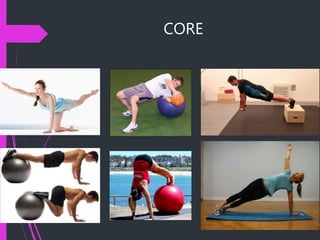
CORE
CORE
¿ A qué le llamamos “CORE”?
Core=Núcleo
“ Es una CAJA MUSCULAR “ (Muscular box) con:
-Musculatura Abdominal en el FRENTE
-Paraespinales y glúteos por DETRÁS
-Diafragma como TECHO
-Músculos del piso pélvico y de la articulación de la cadera como
PISO
Richardson, C., G. Jull, P. Hodges, and J. Hides.
Therapeutic exercise for Spinal Segmental Stabilization in Low Back Pain:
Scientific Basis and Clinical Approach.
Edinburgh, NY: Churchill Livingstone, 1999
Esquema
CORE
¿ Para qué sirve el “CORE”?
-29 PARES de músculos
“SU FUNCIÓN ES ESTABILIZAR COLUMNA (ALGUNOS INCLUYEN PELVIS Y
CADERA) DURANTE MOVIMIENTOS FUNCIONALES”
“SIN ESTOS MÚSCULOS, LA COLUMNA SERÍA BIOMECÁNICAMENTE INESTABLE
FRENTE A CARGAS TAN BAJAS COMO EL SÓLO PESO DEL TRONCO, BRAZOS Y
CABEZA”
Crisco, J.J., M.M. Panjabi, I. Yamamoto, and T.R. Oxland.
Stability of the human ligamentous lumbar spine. Part II: experiment.
Clin. Biomech, 1992
CORE
¿ Para qué sirve el “CORE”?
“ESTABILIDAD PROXIMAL PARA
POTENCIA Y MOVILIDAD DISTAL”
Kibler, W.B., J. Press, and A. Sciascia.
The role of core stability in athletic function.
Sports Med, 2006
CORE
PROFUNDIZANDO
¿Cómo definimos “inestabilidad”?
“ ES LA PÉRDIDA DE LA CAPACIDAD DE LA COLUMNA DE MANTENER SUS
PATRONES DE DESPLAZAMIENTO BAJO CARGAS FISIOLÓGICAS, DE MANERA
QUE NO HAYA DÉFICITS NEUROLÓGICOS, DESVIACIONES, NI DOLOR
INCAPACITANTE “ (Panjabi)
EL SISTEMA ESTABILIZADOR COMPRENDE:
-Sistema pasivo (osteoligamentario)
-Sistema activo (muscular)
-Control neural
CORE
PROFUNDIZANDO
 O sea, la ESTABILIDAD DE LA COLUMNA NO SÓLO DEPENDE DE LA FUERZA
MUSCULAR.
 EL CONTROL NEUROMUSCULAR ES CLAVE.
 El input sensorial que alerta al SNC sobre la interacción del cuerpo con el
medio, proveyendo feedback constante y permitiendo REFINAR el
movimiento….ES FUNDAMENTAL!!!!
Hodges, P.W.
Core stability exercise in chronic low back pain.
Orthop.Clin. North Am, 2003
POLEMICORE
29 pares de músculos????? O menos??????
 La mayoría de los autores describen sólo a músculos profundos con
predominancia de fibras tónicas como únicos “core muscles”
-Multífido
-TRANSVERSO DEL ABDOMEN
-Oblicuo menor (en menor medida)
-Piso pélvico
Richardson, C., G. Jull, P. Hodges, and J. Hides.
Therapeutic exercise for Spinal Segmental Stabilization in Low Back Pain:
Scientific Basis and Clinical Approach.
Edinburgh, NY: Churchill Livingstone, 1999
POLEMICORE
29 pares de músculos????? O menos??????
 Stewart McGill postula que la estabilidad lumbar se da por un INTERJUEGO
ENTRE PROFUNDOS (ESTABILIZADORES PROPIAMENTE DICHOS) Y
MOTORES PRIMARIOS MÁS SUPERFICIALES, como el cuadrado lumbar,
oblicuo mayor, glúteos, etc.
McGill, S.
Low Back Disorders: Evidence-Based Prevention and Rehabilitation.
Human Kinetics, 2002.
Akuthota, V., and S.F. Nadler.
Core strengthening.
Arch. Phys. Med.Rehabil. , 2004
La vedette-El transverso
Transverso del abdomen
• Crea un “corsé”, sobre todo sus fibras más superiores
(horizontales).“Meter panza” lo activa.
• TA Y MULTÍFIDO SE ACTIVAN 30ms ANTES DE MOVIMIENTOS
DEL HOMBRO Y 110ms ANTES DE LOS MOVIMIENTOS DE
CADERA, PARA ESTABILIZAR LA COLUMNA DURANTE DICHOS
MOVIMIENTOS”.
• Pacientes con LBP tienen contracciones tardías frente a
movimientos de miembros
Hodges, P.W., and C.A. Richardson.
Altered trunk muscle recruitment in people with low back pain with upper limb movement at different speeds.
Arch. Phys. Med. Rehabil. , 1999.
Hodges, P.W., and C.A. Richardson.
Inefficient muscular stabilization of the lumbarspine associated with low back pain.
A motor control evaluation of transversus abdominis.
Spine, 1996.
Y?????
• Esas activaciones de baja intensidad (10-15%), le dan
la rigidez necesaria a la columna para afrontar
desequilibrios sin desplazamientos excesivos de sus
segmentos
• PALABRA CLAVE: CONTROL!!!!
• El ENTRENAMIENTO CORE BUSCA FORTALECER, PERO
PREPONDERANTEMENTE BUSCA RAPIDEZ Y CONTROL
PÁRRAFO APARTE
• Glúteo mayor y medio.
• Grandes estabilizadores de tronco
Durante la marcha
LBP y activación tardía de glúteos han sido descriptas
como correlativas. Así como dicha “lentitud”
correlacionaría con esguinces de tobillo.
Lyons, K., J. Perry, J.K. Gronley, et al.
Timing and relative intensity of hip extensor and abductor muscle action during level and stair ambulation.
An EMG study.
Phys. Ther. , 1983.
Beckman, S.M., and T.S. Buchanan.
Ankle inversion injury and hypermobility: effect on hip and ankle muscle electromyography onset latency. Arch. Phys. Med.
Rehabil., 1995.
PISO Y TECHO
DIAFRAGMA: su contracción aumenta la presión
intraabdominal----más estabilidad.
PISO PÉLVICO: es sinérgico con el TA, coactivan.
Desacoples en la contracción sinérgica de TA, con piso
pélvico y diafragma se han descripto en casos de dolor
sacroilíaco.
O’Sullivan, P.B., D.J. Beales, J.A. Beetham, et al.
Altered motor control strategies in subjects with sacroiliac joint pain during the active straightleg-raise test.
Spine. , 2002
Descripto el sistema….
¿CÓMO SE ENTRENA?
¿CÓMO SE EVALÚA?
¿AYUDA A PREVENIR LESIONES?
Del cómo
No se trata de fortalecer, sino de “REAPRENDIZAJE
MOTOR” de los músculos debilitados o inhibidos del
complejo CORE.
Del cómo
-Progresión gradual
-Etapas
-Empezar adecuando la longitud muscular (elongación,
flexibilidad)
-Mejorar balance de músculos agonistas
cortos y dominantes frente a antagonistas
inhibidos y débiles
Del cómo-ETAPAS
1) Adecuar longitud
2) Trabajo de músculos profundos (transverso y
multífido, por ejemplo)
3) Challenge the core
4) Trabajo en posición funcional (de pie, en general)
LA META ES ENTRENAR MOVIMIENTOS FUNCIONALES, NO
MÚSCULOS EN FORMA PARTICULAR
Fredericson, M., and T. Moore.
Muscular balance, core stability, and injury prevention for middle- and long-distance runners.
Phys. Med.Rehabil. Clin. N. Am. , 2005
Detallando el cómo
1- Ejercicios de stretching y movilidad de columna.
2- Reconocimiento de la posición “neutra”
Akuthota, V., and S.F. Nadler.
Core strengthening.
Arch. Phys. Med.Rehabil. , 2004.
Detallando el cómo
3- Enseñar a activar la musculatura abdominal profunda.
Abdominal Hollowing vs Abdominal bracing
NO ABDOMINAL COMÚN (curl) !!!! No activa core
Detallando el cómo
4- Luego….
a) Curl up
b) Puente lateral
c) Bird dog
Detallando el cómo
4- Luego….
C´) Puente prono
d) Puente supino
O “Pelvic Bridging”
Fredericson, M., and T. Moore.
Muscular balance, core stability, and injury prevention for middle- and long-distance runners.
Phys. Med.Rehabil. Clin. N. Am. , 2005.
Detallando el cómo
-SE RECOMIENDA HACER EN DECÚBITOS
-SE RECOMIENDA MANTENER LA COLUMNA “NEUTRA”
-DEBE HABER CONCIENTIZADO LA CONTRACCIÓN DEL
TRANSVERSO PREVIAMENTE
-SE RECOMIENDA QUE LA PELVIS ESTÉ “NEUTRA” TAMBIÉN
-RESPIRACIÓN DIAFRAGMATICA NORMAL!!!
Arokoski, J.P., T. Valta, M. Kankaanpaa, and O. Airaksinen.
Activation of lumbar paraspinal and abdominal muscles during therapeutic exercises in chronic low back pain
patients.
Arch. Phys. Med. Rehabil., 2004.
Una vez dominado esto….
“CHALLENGING THE CORE”-DESESTABILIZAR
Core AVANZADO
-SENTADO, PARADO O CAMINANDO
-MOVIMIENTOS FUNCIONALES EN LOS 3 PLANOS DEL
ESPACIO, MANTENIENDO POSTURA NEUTRA.
-MOVIMIENTOS ESPECÍFICOS
-ACELERACIONES, DESACELERACIONES
-ARRANCAR CON HOLLOWING O BRACING SIEMPRE, PARA
CONCIENTIZAR
Core AVANZADO
OJO
-Ciertas ejercitaciones pueden ser nocivas.
-Flexiones máximas de columna.
-Torsiones máximas repetidas.
-Luego de una hora de despertarse (++P hidrostática)
A QUIÉNES?
Según Hicks et al (2005)
- Sub 40
-Flexibles
-Inestabilidad en Prone Instabilty test
-Arco de movimiento doloroso o
anormalidad del ritmo lumbopélvico
Patologías: LBP, pubalgias, sacroileitis, inestabilidades
de hombro, rodilla, cadera, tobillo, etc
Previene lesiones?
-Leeton (2004) descubre la relación entre lesiones de
RODILLA y debilidad de ABDUCTORES Y ROTADORES
EXTERNOS DE CADERA.
-Hewett (1999) demuestra eficacia en la prevención de
lesiones de LCA en mujeres futbolistas.
Willardson (2007) sugiere que proporcionará una base
más segura, la cual permitirá una mayor producción y
transferencia de fuerza hacia las extremidades
superiores e inferiores.
Cómo evalúo???
-GRAN DILEMA!!!!!
Antiguamente: Prone instabilty test
Cómo evalúo???
AHORA: dos corrientes:
a) Básicamente se busca que el paciente realice los
ejercicios básicos con calidad en la ejecución.
Una vez entrenados los músculos core, dichos ejercicios
se harán con una calidad y duración mayores
Okada, T.
Relationship between Core stability, functional movement and performance.
Journal of strength and conditioning Res, 2011
Cómo evalúo???
EJEMPLOS:
1) One leg-stance
2) Side bridge
3) Tres planos
Cómo evalúo???
Segunda corriente McGill:
a)Trunk flexor test
b)Trunk extensor test
c)Lateral musculature test
Práctica Planteada
5 estaciones de trabajo
1) Concientizando
2) Testing the core
3) General core
4) Lower core
5) Upper core
Práctica Planteada
1) Concientizando
Práctica Planteada
2) Testing (cronometrar, filmar)
Práctica Planteada
3) General
Tres puentes básicos +
Práctica Planteada
4) Lower core
Práctica Planteada
5) Upper core
Thanks

Core Stability

  • 1.
    CORE STABILITY ABRIL2016 Universidad Nacionalde La Matanza Lic. Leonardo A. Mensi
  • 2.
  • 3.
    CORE ¿ A quéle llamamos “CORE”? Core=Núcleo “ Es una CAJA MUSCULAR “ (Muscular box) con: -Musculatura Abdominal en el FRENTE -Paraespinales y glúteos por DETRÁS -Diafragma como TECHO -Músculos del piso pélvico y de la articulación de la cadera como PISO Richardson, C., G. Jull, P. Hodges, and J. Hides. Therapeutic exercise for Spinal Segmental Stabilization in Low Back Pain: Scientific Basis and Clinical Approach. Edinburgh, NY: Churchill Livingstone, 1999
  • 4.
  • 5.
    CORE ¿ Para quésirve el “CORE”? -29 PARES de músculos “SU FUNCIÓN ES ESTABILIZAR COLUMNA (ALGUNOS INCLUYEN PELVIS Y CADERA) DURANTE MOVIMIENTOS FUNCIONALES” “SIN ESTOS MÚSCULOS, LA COLUMNA SERÍA BIOMECÁNICAMENTE INESTABLE FRENTE A CARGAS TAN BAJAS COMO EL SÓLO PESO DEL TRONCO, BRAZOS Y CABEZA” Crisco, J.J., M.M. Panjabi, I. Yamamoto, and T.R. Oxland. Stability of the human ligamentous lumbar spine. Part II: experiment. Clin. Biomech, 1992
  • 6.
    CORE ¿ Para quésirve el “CORE”? “ESTABILIDAD PROXIMAL PARA POTENCIA Y MOVILIDAD DISTAL” Kibler, W.B., J. Press, and A. Sciascia. The role of core stability in athletic function. Sports Med, 2006
  • 7.
    CORE PROFUNDIZANDO ¿Cómo definimos “inestabilidad”? “ES LA PÉRDIDA DE LA CAPACIDAD DE LA COLUMNA DE MANTENER SUS PATRONES DE DESPLAZAMIENTO BAJO CARGAS FISIOLÓGICAS, DE MANERA QUE NO HAYA DÉFICITS NEUROLÓGICOS, DESVIACIONES, NI DOLOR INCAPACITANTE “ (Panjabi) EL SISTEMA ESTABILIZADOR COMPRENDE: -Sistema pasivo (osteoligamentario) -Sistema activo (muscular) -Control neural
  • 8.
    CORE PROFUNDIZANDO  O sea,la ESTABILIDAD DE LA COLUMNA NO SÓLO DEPENDE DE LA FUERZA MUSCULAR.  EL CONTROL NEUROMUSCULAR ES CLAVE.  El input sensorial que alerta al SNC sobre la interacción del cuerpo con el medio, proveyendo feedback constante y permitiendo REFINAR el movimiento….ES FUNDAMENTAL!!!! Hodges, P.W. Core stability exercise in chronic low back pain. Orthop.Clin. North Am, 2003
  • 9.
    POLEMICORE 29 pares demúsculos????? O menos??????  La mayoría de los autores describen sólo a músculos profundos con predominancia de fibras tónicas como únicos “core muscles” -Multífido -TRANSVERSO DEL ABDOMEN -Oblicuo menor (en menor medida) -Piso pélvico Richardson, C., G. Jull, P. Hodges, and J. Hides. Therapeutic exercise for Spinal Segmental Stabilization in Low Back Pain: Scientific Basis and Clinical Approach. Edinburgh, NY: Churchill Livingstone, 1999
  • 10.
    POLEMICORE 29 pares demúsculos????? O menos??????  Stewart McGill postula que la estabilidad lumbar se da por un INTERJUEGO ENTRE PROFUNDOS (ESTABILIZADORES PROPIAMENTE DICHOS) Y MOTORES PRIMARIOS MÁS SUPERFICIALES, como el cuadrado lumbar, oblicuo mayor, glúteos, etc. McGill, S. Low Back Disorders: Evidence-Based Prevention and Rehabilitation. Human Kinetics, 2002. Akuthota, V., and S.F. Nadler. Core strengthening. Arch. Phys. Med.Rehabil. , 2004
  • 11.
  • 12.
  • 13.
    Transverso del abdomen •Crea un “corsé”, sobre todo sus fibras más superiores (horizontales).“Meter panza” lo activa. • TA Y MULTÍFIDO SE ACTIVAN 30ms ANTES DE MOVIMIENTOS DEL HOMBRO Y 110ms ANTES DE LOS MOVIMIENTOS DE CADERA, PARA ESTABILIZAR LA COLUMNA DURANTE DICHOS MOVIMIENTOS”. • Pacientes con LBP tienen contracciones tardías frente a movimientos de miembros Hodges, P.W., and C.A. Richardson. Altered trunk muscle recruitment in people with low back pain with upper limb movement at different speeds. Arch. Phys. Med. Rehabil. , 1999. Hodges, P.W., and C.A. Richardson. Inefficient muscular stabilization of the lumbarspine associated with low back pain. A motor control evaluation of transversus abdominis. Spine, 1996.
  • 14.
    Y????? • Esas activacionesde baja intensidad (10-15%), le dan la rigidez necesaria a la columna para afrontar desequilibrios sin desplazamientos excesivos de sus segmentos • PALABRA CLAVE: CONTROL!!!! • El ENTRENAMIENTO CORE BUSCA FORTALECER, PERO PREPONDERANTEMENTE BUSCA RAPIDEZ Y CONTROL
  • 15.
    PÁRRAFO APARTE • Glúteomayor y medio. • Grandes estabilizadores de tronco Durante la marcha LBP y activación tardía de glúteos han sido descriptas como correlativas. Así como dicha “lentitud” correlacionaría con esguinces de tobillo. Lyons, K., J. Perry, J.K. Gronley, et al. Timing and relative intensity of hip extensor and abductor muscle action during level and stair ambulation. An EMG study. Phys. Ther. , 1983. Beckman, S.M., and T.S. Buchanan. Ankle inversion injury and hypermobility: effect on hip and ankle muscle electromyography onset latency. Arch. Phys. Med. Rehabil., 1995.
  • 16.
    PISO Y TECHO DIAFRAGMA:su contracción aumenta la presión intraabdominal----más estabilidad. PISO PÉLVICO: es sinérgico con el TA, coactivan. Desacoples en la contracción sinérgica de TA, con piso pélvico y diafragma se han descripto en casos de dolor sacroilíaco. O’Sullivan, P.B., D.J. Beales, J.A. Beetham, et al. Altered motor control strategies in subjects with sacroiliac joint pain during the active straightleg-raise test. Spine. , 2002
  • 17.
    Descripto el sistema…. ¿CÓMOSE ENTRENA? ¿CÓMO SE EVALÚA? ¿AYUDA A PREVENIR LESIONES?
  • 18.
    Del cómo No setrata de fortalecer, sino de “REAPRENDIZAJE MOTOR” de los músculos debilitados o inhibidos del complejo CORE.
  • 19.
    Del cómo -Progresión gradual -Etapas -Empezaradecuando la longitud muscular (elongación, flexibilidad) -Mejorar balance de músculos agonistas cortos y dominantes frente a antagonistas inhibidos y débiles
  • 20.
    Del cómo-ETAPAS 1) Adecuarlongitud 2) Trabajo de músculos profundos (transverso y multífido, por ejemplo) 3) Challenge the core 4) Trabajo en posición funcional (de pie, en general) LA META ES ENTRENAR MOVIMIENTOS FUNCIONALES, NO MÚSCULOS EN FORMA PARTICULAR Fredericson, M., and T. Moore. Muscular balance, core stability, and injury prevention for middle- and long-distance runners. Phys. Med.Rehabil. Clin. N. Am. , 2005
  • 21.
    Detallando el cómo 1-Ejercicios de stretching y movilidad de columna. 2- Reconocimiento de la posición “neutra” Akuthota, V., and S.F. Nadler. Core strengthening. Arch. Phys. Med.Rehabil. , 2004.
  • 22.
    Detallando el cómo 3-Enseñar a activar la musculatura abdominal profunda. Abdominal Hollowing vs Abdominal bracing NO ABDOMINAL COMÚN (curl) !!!! No activa core
  • 23.
    Detallando el cómo 4-Luego…. a) Curl up b) Puente lateral c) Bird dog
  • 24.
    Detallando el cómo 4-Luego…. C´) Puente prono d) Puente supino O “Pelvic Bridging” Fredericson, M., and T. Moore. Muscular balance, core stability, and injury prevention for middle- and long-distance runners. Phys. Med.Rehabil. Clin. N. Am. , 2005.
  • 25.
    Detallando el cómo -SERECOMIENDA HACER EN DECÚBITOS -SE RECOMIENDA MANTENER LA COLUMNA “NEUTRA” -DEBE HABER CONCIENTIZADO LA CONTRACCIÓN DEL TRANSVERSO PREVIAMENTE -SE RECOMIENDA QUE LA PELVIS ESTÉ “NEUTRA” TAMBIÉN -RESPIRACIÓN DIAFRAGMATICA NORMAL!!! Arokoski, J.P., T. Valta, M. Kankaanpaa, and O. Airaksinen. Activation of lumbar paraspinal and abdominal muscles during therapeutic exercises in chronic low back pain patients. Arch. Phys. Med. Rehabil., 2004.
  • 26.
    Una vez dominadoesto…. “CHALLENGING THE CORE”-DESESTABILIZAR
  • 27.
    Core AVANZADO -SENTADO, PARADOO CAMINANDO -MOVIMIENTOS FUNCIONALES EN LOS 3 PLANOS DEL ESPACIO, MANTENIENDO POSTURA NEUTRA. -MOVIMIENTOS ESPECÍFICOS -ACELERACIONES, DESACELERACIONES -ARRANCAR CON HOLLOWING O BRACING SIEMPRE, PARA CONCIENTIZAR
  • 28.
  • 29.
    OJO -Ciertas ejercitaciones puedenser nocivas. -Flexiones máximas de columna. -Torsiones máximas repetidas. -Luego de una hora de despertarse (++P hidrostática)
  • 30.
    A QUIÉNES? Según Hickset al (2005) - Sub 40 -Flexibles -Inestabilidad en Prone Instabilty test -Arco de movimiento doloroso o anormalidad del ritmo lumbopélvico Patologías: LBP, pubalgias, sacroileitis, inestabilidades de hombro, rodilla, cadera, tobillo, etc
  • 31.
    Previene lesiones? -Leeton (2004)descubre la relación entre lesiones de RODILLA y debilidad de ABDUCTORES Y ROTADORES EXTERNOS DE CADERA. -Hewett (1999) demuestra eficacia en la prevención de lesiones de LCA en mujeres futbolistas. Willardson (2007) sugiere que proporcionará una base más segura, la cual permitirá una mayor producción y transferencia de fuerza hacia las extremidades superiores e inferiores.
  • 32.
  • 33.
    Cómo evalúo??? AHORA: doscorrientes: a) Básicamente se busca que el paciente realice los ejercicios básicos con calidad en la ejecución. Una vez entrenados los músculos core, dichos ejercicios se harán con una calidad y duración mayores Okada, T. Relationship between Core stability, functional movement and performance. Journal of strength and conditioning Res, 2011
  • 34.
    Cómo evalúo??? EJEMPLOS: 1) Oneleg-stance 2) Side bridge 3) Tres planos
  • 35.
    Cómo evalúo??? Segunda corrienteMcGill: a)Trunk flexor test b)Trunk extensor test c)Lateral musculature test
  • 36.
    Práctica Planteada 5 estacionesde trabajo 1) Concientizando 2) Testing the core 3) General core 4) Lower core 5) Upper core
  • 37.
  • 38.
    Práctica Planteada 2) Testing(cronometrar, filmar)
  • 39.
  • 40.
  • 41.
  • 42.