Gramática inglesa
LOS NOMBRES 2
LOS ARTÍCULOS 4
LOS ADJETIVOS 5
LOS PRONOMBRES PERSONALES 6
LOS ADJETIVOS Y PRONOMBRES POSESIVOS 7
LAS PREPOSICIONES 8
LOS ADVERBIOS 10
LOS VERBOS 11
VERBOS IRREGULARES DEL INGLÉS 14
LOS NÚMEROS 18
LA FECHA 19
LA HORA 20
FALSOS AMIGOS 21
Los nombres
1. Los nombres y sus plurales
 Plurales regulares
En inglés, la mayor parte de los plurales se forman añadiendo una –s:
shop –> shops bike –> bikes
car –> cars hand –> hands
Sin embargo, algunos plurales se forman de otra manera:
 -es
Se añade –es a los nombres que terminan en –s, -sh, -ch o –x:
bus –> buses box –> boxes
dish –> dishes watch –> watches
 -y -> ies
La –y se transforma en –ies en nombres que terminan en “consonante + y”
baby –> babies city –> cities
 -f o –fe –> -ves
La mayor parte de los nombres que terminan en –f o –fe cambian la terminación por
–ves:
calf –> calves life –> lives
Plurales irregulares
 Fíjate cómo cambia la vocal en los siguientes casos:
foot –> feet tooth –> teeth
man –> men mouse –> mice
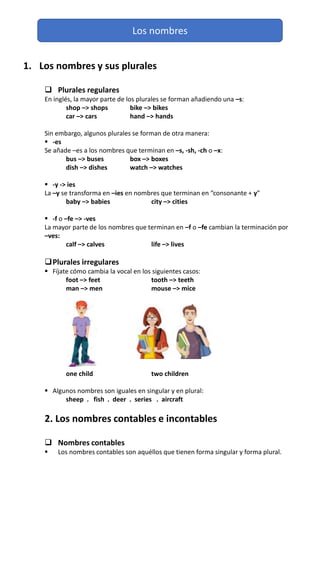
one child two children
 Algunos nombres son iguales en singular y en plural:
sheep . fish . deer . series . aircraft
2. Los nombres contables e incontables
 Nombres contables
 Los nombres contables son aquéllos que tienen forma singular y forma plural.
 Delante de nombres contables se puede usar a, the, some o un número:
Singular Plural
a book some books
the book the books
one book three books
 Nombres contables
 Los nombres incontables sólo tienen una forma. Se les llama incontables porque no
se pueden contar:
money . snow . water . food . rain . advice
 Delante de un nombre contable NO se puede poner a/an o un número. Sí que
pueden ir acompañados de the o same:
Can you lend me some money? I want some toast.
I want some food. I need some advice.
He’s playing in the snow. Where’s the milk?
3. El genitivo sajón
 Formas
En inglés se suele utilizar la terminación –’s para indicar la posesión:
 A los nombres singulares se añade –’s:
Lucy’s tent . Tom’s apple
 A los nombres con plural regular se añade –’:
the student’s textbooks . the boy’s father
 A los nombres con plural irregular se añade –’s:
children’s toys . men’s clothes
Uso
 El nombre con genitivo va delante del nombre de la cosa poseída:
our uncles’ houses (= the houses of our uncles)
 El nombre con genitivo puede aparecer en solitario después del verbo to be:
That bag over there, is it Lucy’s?
 El nombre con genitivo se utiliza a menudo en solitario para referirse a una tienda:
Dad has gone to the butcher’s. (= the butcher’s shop)
I am going to the newsagent’s. (= the newsagent’s shop)
 El genitivo puede utilizarse también para especificar un periodo de tiempo:
I took a week’s holiday at Easter.
-’s O of?
 El apóstrofo se utiliza normalmente con personas:
Lucy’s tent (Y NO the tent of Lucy)
 La construcción con of se utiliza normalmente con cosas:
the corner of the room (Y NO the room’s corner)
Los artículos
Hay dos tipos de artículo en inglés: el indeterminado y el determinado.
1. El artículo indeterminado: ‘a’ o ‘an’
 Formas
 El artículo a se usa delante de palabras que comienzan
con consonante: a cup . a game -an owl
 a también se usa delante de palabras que empiezan
con u cuando la ‘u’ se pronuncia como la palabra
you: a university . a unión
 an también se usa delante de palabras que comienzan
con una ‘h’ muda:
an honour . an hour -a Branch
Uso
 a y an sólo se usan con nombres contables en singular (-> página 2).
 a y an se utilizan para referirse a una cosa o persona por primera vez:
Adam has bought a new computer game.
 a se utiliza delante de ciertos números:
a dozen . a hundred . a thousand . a million
 a y an se usan para describir la profesión de alguien:
Tom’s father is an engineer.
Ten cuidado de no confundir a o an con el numeral one.
Compara: - A car is no good. We need a van.
- One car is no good. We need two or three.
2. El artículo determinado: ‘the’
 Forma
 the es el artículo determinado que se usa con todos los nombres:
the table . the world . the glass
Uso
 the se usa para indicar que la persona o cosa a la que acompaña es un ejemplo
específico:
Tom dropped a book and a pen. The pen is green.
 the se utiliza cuando sólo hay una persona o cosa:
Lucy met the Queen . The sun is shining.
 the se utiliza con instrumentos musicales: Adam plays the piano.
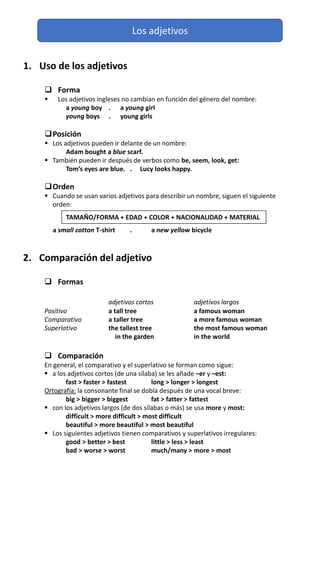
Los adjetivos
1. Uso de los adjetivos
 Forma
 Los adjetivos ingleses no cambian en función del género del nombre:
a young boy . a young girl
young boys . young girls
Posición
 Los adjetivos pueden ir delante de un nombre:
Adam bought a blue scarf.
 También pueden ir después de verbos como be, seem, look, get:
Tom’s eyes are blue. . Lucy looks happy.
Orden
 Cuando se usan varios adjetivos para describir un nombre, siguen el siguiente
orden:
a small cotton T-shirt . a new yellow bicycle
TAMAÑO/FORMA + EDAD + COLOR + NACIONALIDAD + MATERIAL
2. Comparación del adjetivo
 Formas
adjetivos cortos adjetivos largos
Positivo a tall tree a famous woman
Comparativo a taller tree a more famous woman
Superlativo the tallest tree the most famous woman
in the garden in the world
 Comparación
En general, el comparativo y el superlativo se forman como sigue:
 a los adjetivos cortos (de una sílaba) se les añade –er y –est:
fast > faster > fastest long > longer > longest
Ortografía: la consonante final se dobla después de una vocal breve:
big > bigger > biggest fat > fatter > fattest
 con los adjetivos largos (de dos sílabas o más) se usa more y most:
difficult > more difficult > most difficult
beautiful > more beautiful > most beautiful
 Los siguientes adjetivos tienen comparativos y superlativos irregulares:
good > better > best little > less > least
bad > worse > worst much/many > more > most
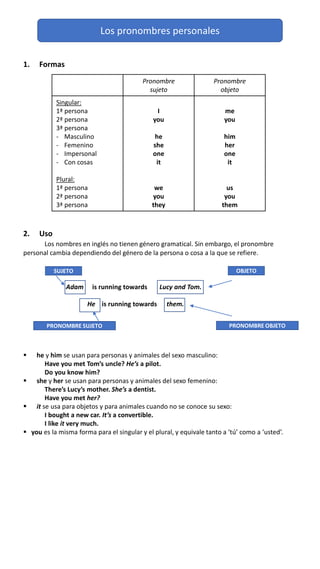
Los pronombres personales
1. Formas
2. Uso
Los nombres en inglés no tienen género gramatical. Sin embargo, el pronombre
personal cambia dependiendo del género de la persona o cosa a la que se refiere.
Adam is running towards Lucy and Tom.
He is running towards them.
 he y him se usan para personas y animales del sexo masculino:
Have you met Tom’s uncle? He’s a pilot.
Do you know him?
 she y her se usan para personas y animales del sexo femenino:
There’s Lucy’s mother. She’s a dentist.
Have you met her?
 it se usa para objetos y para animales cuando no se conoce su sexo:
I bought a new car. It’s a convertible.
I like it very much.
 you es la misma forma para el singular y el plural, y equivale tanto a ‘tú’ como a ‘usted’.
Pronombre
sujeto
Pronombre
objeto
Singular:
1ª persona
2ª persona
3ª persona
- Masculino
- Femenino
- Impersonal
- Con cosas
Plural:
1ª persona
2ª persona
3ª persona
I
you
he
she
one
it
we
you
they
me
you
him
her
one
it
us
you
them
SUJETO OBJETO
PRONOMBRE SUJETO PRONOMBRE OBJETO
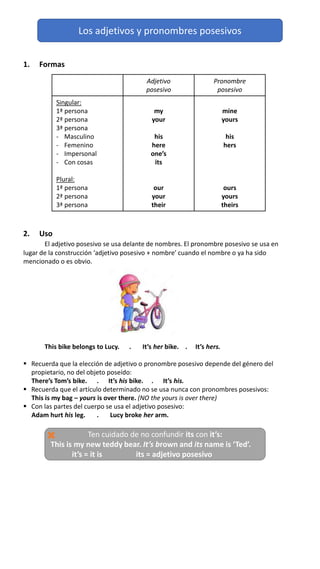
Los adjetivos y pronombres posesivos
1. Formas
2. Uso
El adjetivo posesivo se usa delante de nombres. El pronombre posesivo se usa en
lugar de la construcción ‘adjetivo posesivo + nombre’ cuando el nombre o ya ha sido
mencionado o es obvio.
This bike belongs to Lucy. . It’s her bike. . It’s hers.
 Recuerda que la elección de adjetivo o pronombre posesivo depende del género del
propietario, no del objeto poseído:
There’s Tom’s bike. . It’s his bike. . It’s his.
 Recuerda que el artículo determinado no se usa nunca con pronombres posesivos:
This is my bag – yours is over there. (NO the yours is over there)
 Con las partes del cuerpo se usa el adjetivo posesivo:
Adam hurt his leg. . Lucy broke her arm.
Adjetivo
posesivo
Pronombre
posesivo
Singular:
1ª persona
2ª persona
3ª persona
- Masculino
- Femenino
- Impersonal
- Con cosas
Plural:
1ª persona
2ª persona
3ª persona
my
your
his
here
one’s
its
our
your
their
mine
yours
his
hers
ours
yours
theirs
Ten cuidado de no confundir its con it’s:
This is my new teddy bear. It’s brown and its name is ‘Ted’.
it’s = it is its = adjetivo posesivo
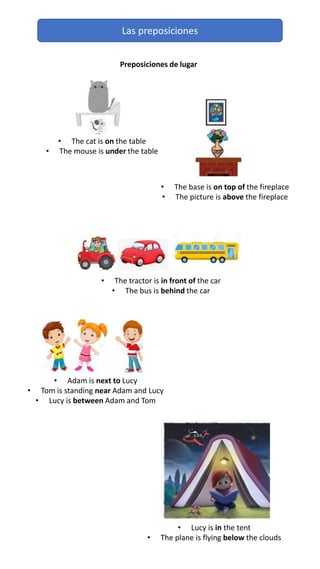
Las preposiciones
Preposiciones de lugar
• The cat is on the table
• The mouse is under the table
• The base is on top of the fireplace
• The picture is above the fireplace
• The tractor is in front of the car
• The bus is behind the car
• Adam is next to Lucy
• Tom is standing near Adam and Lucy
• Lucy is between Adam and Tom
• Lucy is in the tent
• The plane is flying below the clouds
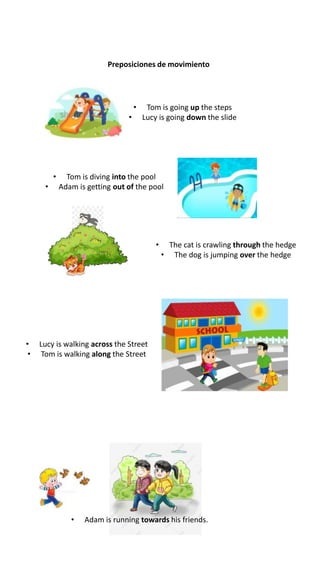
Preposiciones de movimiento
• Tom is going up the steps
• Lucy is going down the slide
• Tom is diving into the pool
• Adam is getting out of the pool
• The cat is crawling through the hedge
• The dog is jumping over the hedge
• Lucy is walking across the Street
• Tom is walking along the Street
• Adam is running towards his friends.
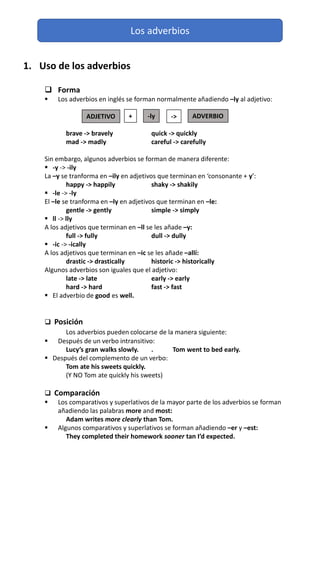
Los adverbios
1. Uso de los adverbios
 Forma
 Los adverbios en inglés se forman normalmente añadiendo –ly al adjetivo:
brave -> bravely quick -> quickly
mad -> madly careful -> carefully
Sin embargo, algunos adverbios se forman de manera diferente:
 -y -> -ily
La –y se tranforma en –ily en adjetivos que terminan en ‘consonante + y’:
happy -> happily shaky -> shakily
 -le -> -ly
El –le se tranforma en –ly en adjetivos que terminan en –le:
gentle -> gently simple -> simply
 ll -> lly
A los adjetivos que terminan en –ll se les añade –y:
full -> fully dull -> dully
 -ic -> -ically
A los adjetivos que terminan en –ic se les añade –allí:
drastic -> drastically historic -> historically
Algunos adverbios son iguales que el adjetivo:
late -> late early -> early
hard -> hard fast -> fast
 El adverbio de good es well.
 Posición
Los adverbios pueden colocarse de la manera siguiente:
 Después de un verbo intransitivo:
Lucy’s gran walks slowly. . Tom went to bed early.
 Después del complemento de un verbo:
Tom ate his sweets quickly.
(Y NO Tom ate quickly his sweets)
 Comparación
 Los comparativos y superlativos de la mayor parte de los adverbios se forman
añadiendo las palabras more and most:
Adam writes more clearly than Tom.
 Algunos comparativos y superlativos se forman añadiendo –er y –est:
They completed their homework sooner tan I’d expected.
ADJETIVO + -ly -> ADVERBIO
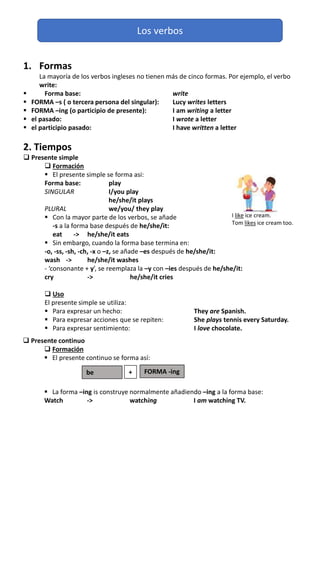
Los verbos
1. Formas
La mayoría de los verbos ingleses no tienen más de cinco formas. Por ejemplo, el verbo
write:
 Forma base: write
 FORMA –s ( o tercera persona del singular): Lucy writes letters
 FORMA –ing (o participio de presente): I am writing a letter
 el pasado: I wrote a letter
 el participio pasado: I have written a letter
2. Tiempos
 Presente simple
 Formación
 El presente simple se forma asi:
Forma base: play
SINGULAR I/you play
he/she/it plays
PLURAL we/you/ they play
 Con la mayor parte de los verbos, se añade
-s a la forma base después de he/she/it:
eat -> he/she/it eats
 Sin embargo, cuando la forma base termina en:
-o, -ss, -sh, -ch, -x o –z, se añade –es después de he/she/it:
wash -> he/she/it washes
- ‘consonante + y’, se reemplaza la –y con –ies después de he/she/it:
cry -> he/she/it cries
 Uso
El presente simple se utiliza:
 Para expresar un hecho: They are Spanish.
 Para expresar acciones que se repiten: She plays tennis every Saturday.
 Para expresar sentimiento: I love chocolate.
 Presente continuo
 Formación
 El presente continuo se forma así:
 La forma –ing is construye normalmente añadiendo –ing a la forma base:
Watch -> watching I am watching TV.
be + FORMA -ing
I like ice cream.
Tom likes ice cream too.
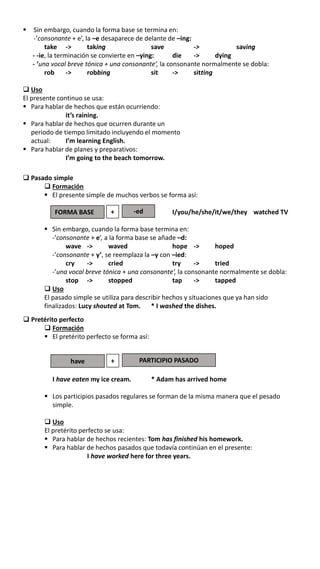
 Sin embargo, cuando la forma base se termina en:
-’consonante + e’, la –e desaparece de delante de –ing:
take -> taking save -> saving
- -ie, la terminación se convierte en –ying: die -> dying
- ‘una vocal breve tónica + una consonante’, la consonante normalmente se dobla:
rob -> robbing sit -> sitting
 Uso
El presente continuo se usa:
 Para hablar de hechos que están ocurriendo:
it’s raining.
 Para hablar de hechos que ocurren durante un
periodo de tiempo limitado incluyendo el momento
actual: I’m learning English.
 Para hablar de planes y preparativos:
I’m going to the beach tomorrow.
 Pasado simple
 Formación
 El presente simple de muchos verbos se forma así:
I/you/he/she/it/we/they watched TV
 Sin embargo, cuando la forma base termina en:
-’consonante + e’, a la forma base se añade –d:
wave -> waved hope -> hoped
-’consonante + y’, se reemplaza la –y con –ied:
cry -> cried try -> tried
-’una vocal breve tónica + una consonante’, la consonante normalmente se dobla:
stop -> stopped tap -> tapped
 Uso
El pasado simple se utiliza para describir hechos y situaciones que ya han sido
finalizados: Lucy shouted at Tom. * I washed the dishes.
FORMA BASE + -ed
 Pretérito perfecto
 Formación
 El pretérito perfecto se forma así:
I have eaten my ice cream. * Adam has arrived home
 Los participios pasados regulares se forman de la misma manera que el pesado
simple.
 Uso
El pretérito perfecto se usa:
 Para hablar de hechos recientes: Tom has finished his homework.
 Para hablar de hechos pasados que todavía continúan en el presente:
I have worked here for three years.
have + PARTICIPIO PASADO
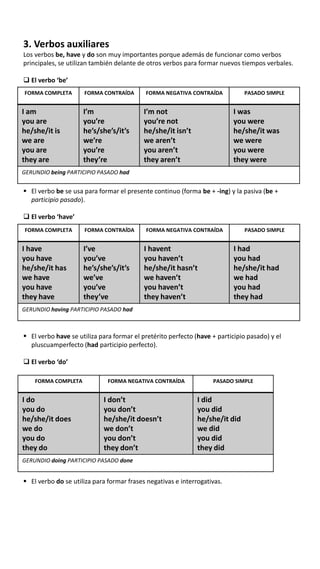
3. Verbos auxiliares
Los verbos be, have y do son muy importantes porque además de funcionar como verbos
principales, se utilizan también delante de otros verbos para formar nuevos tiempos verbales.
 El verbo ‘be’
 El verbo be se usa para formar el presente continuo (forma be + -ing) y la pasiva (be +
participio pasado).
 El verbo ‘have’
 El verbo have se utiliza para formar el pretérito perfecto (have + participio pasado) y el
pluscuamperfecto (had participio perfecto).
 El verbo ‘do’
 El verbo do se utiliza para formar frases negativas e interrogativas.
FORMA COMPLETA FORMA CONTRAÍDA FORMA NEGATIVA CONTRAÍDA PASADO SIMPLE
I am
you are
he/she/it is
we are
you are
they are
I’m
you’re
he’s/she’s/it’s
we’re
you’re
they’re
I’m not
you’re not
he/she/it isn’t
we aren’t
you aren’t
they aren’t
I was
you were
he/she/it was
we were
you were
they were
GERUNDIO being PARTICIPIO PASADO had
FORMA COMPLETA FORMA CONTRAÍDA FORMA NEGATIVA CONTRAÍDA PASADO SIMPLE
I have
you have
he/she/it has
we have
you have
they have
I’ve
you’ve
he’s/she’s/it’s
we’ve
you’ve
they’ve
I havent
you haven’t
he/she/it hasn’t
we haven’t
you haven’t
they haven’t
I had
you had
he/she/it had
we had
you had
they had
GERUNDIO having PARTICIPIO PASADO had
FORMA COMPLETA FORMA NEGATIVA CONTRAÍDA PASADO SIMPLE
I do
you do
he/she/it does
we do
you do
they do
I don’t
you don’t
he/she/it doesn’t
we don’t
you don’t
they don’t
I did
you did
he/she/it did
we did
you did
they did
GERUNDIO doing PARTICIPIO PASADO done
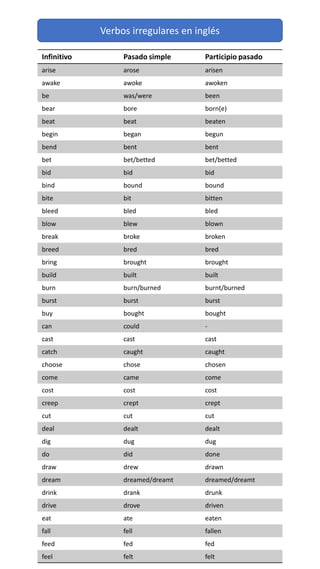
Verbos irregulares en inglés
Infinitivo Pasado simple Participio pasado
arise arose arisen
awake awoke awoken
be was/were been
bear bore born(e)
beat beat beaten
begin began begun
bend bent bent
bet bet/betted bet/betted
bid bid bid
bind bound bound
bite bit bitten
bleed bled bled
blow blew blown
break broke broken
breed bred bred
bring brought brought
build built built
burn burn/burned burnt/burned
burst burst burst
buy bought bought
can could -
cast cast cast
catch caught caught
choose chose chosen
come came come
cost cost cost
creep crept crept
cut cut cut
deal dealt dealt
dig dug dug
do did done
draw drew drawn
dream dreamed/dreamt dreamed/dreamt
drink drank drunk
drive drove driven
eat ate eaten
fall fell fallen
feed fed fed
feel felt felt
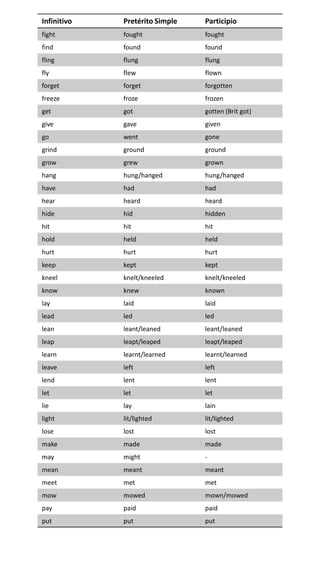
Infinitivo Pretérito Simple Participio
fight fought fought
find found found
fling flung flung
fly flew flown
forget forget forgotten
freeze froze frozen
get got gotten (Brit got)
give gave given
go went gone
grind ground ground
grow grew grown
hang hung/hanged hung/hanged
have had had
hear heard heard
hide hid hidden
hit hit hit
hold held held
hurt hurt hurt
keep kept kept
kneel knelt/kneeled knelt/kneeled
know knew known
lay laid laid
lead led led
lean leant/leaned leant/leaned
leap leapt/leaped leapt/leaped
learn learnt/learned learnt/learned
leave left left
lend lent lent
let let let
lie lay lain
light lit/lighted lit/lighted
lose lost lost
make made made
may might -
mean meant meant
meet met met
mow mowed mown/mowed
pay paid paid
put put put
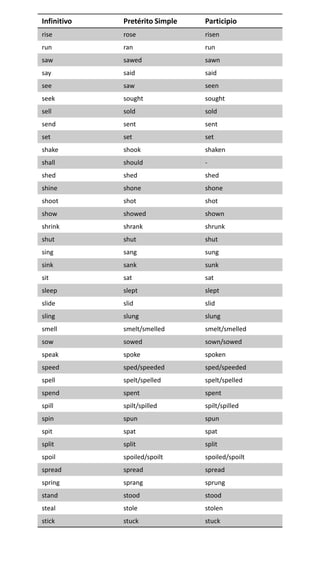
Infinitivo Pretérito Simple Participio
rise rose risen
run ran run
saw sawed sawn
say said said
see saw seen
seek sought sought
sell sold sold
send sent sent
set set set
shake shook shaken
shall should -
shed shed shed
shine shone shone
shoot shot shot
show showed shown
shrink shrank shrunk
shut shut shut
sing sang sung
sink sank sunk
sit sat sat
sleep slept slept
slide slid slid
sling slung slung
smell smelt/smelled smelt/smelled
sow sowed sown/sowed
speak spoke spoken
speed sped/speeded sped/speeded
spell spelt/spelled spelt/spelled
spend spent spent
spill spilt/spilled spilt/spilled
spin spun spun
spit spat spat
split split split
spoil spoiled/spoilt spoiled/spoilt
spread spread spread
spring sprang sprung
stand stood stood
steal stole stolen
stick stuck stuck
Infinitivo Pretérito Simple Participio
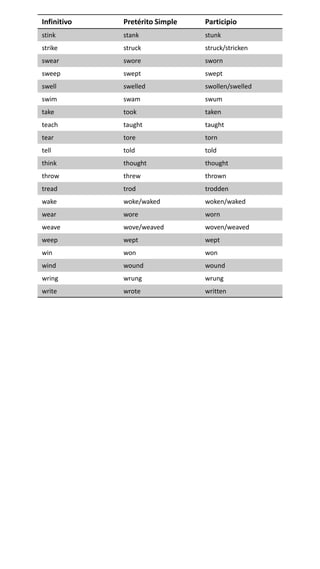
stink stank stunk
strike struck struck/stricken
swear swore sworn
sweep swept swept
swell swelled swollen/swelled
swim swam swum
take took taken
teach taught taught
tear tore torn
tell told told
think thought thought
throw threw thrown
tread trod trodden
wake woke/waked woken/waked
wear wore worn
weave wove/weaved woven/weaved
weep wept wept
win won won
wind wound wound
wring wrung wrung
write wrote written
Los números
1. Números cardinales
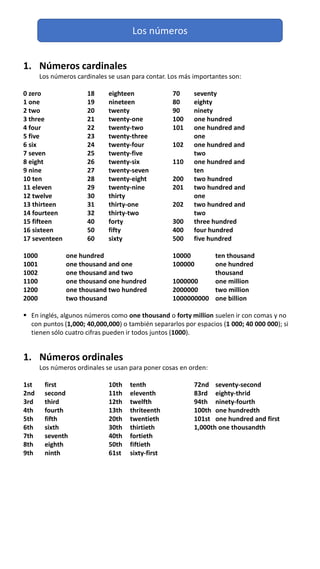
Los números cardinales se usan para contar. Los más importantes son:
0 zero 18 eighteen 70 seventy
1 one 19 nineteen 80 eighty
2 two 20 twenty 90 ninety
3 three 21 twenty-one 100 one hundred
4 four 22 twenty-two 101 one hundred and
5 five 23 twenty-three one
6 six 24 twenty-four 102 one hundred and
7 seven 25 twenty-five two
8 eight 26 twenty-six 110 one hundred and
9 nine 27 twenty-seven ten
10 ten 28 twenty-eight 200 two hundred
11 eleven 29 twenty-nine 201 two hundred and
12 twelve 30 thirty one
13 thirteen 31 thirty-one 202 two hundred and
14 fourteen 32 thirty-two two
15 fifteen 40 forty 300 three hundred
16 sixteen 50 fifty 400 four hundred
17 seventeen 60 sixty 500 five hundred
1000 one hundred 10000 ten thousand
1001 one thousand and one 100000 one hundred
1002 one thousand and two thousand
1100 one thousand one hundred 1000000 one million
1200 one thousand two hundred 2000000 two million
2000 two thousand 1000000000 one billion
 En inglés, algunos números como one thousand o forty million suelen ir con comas y no
con puntos (1,000; 40,000,000) o también separarlos por espacios (1 000; 40 000 000); si
tienen sólo cuatro cifras pueden ir todos juntos (1000).
1. Números ordinales
Los números ordinales se usan para poner cosas en orden:
1st first 10th tenth 72nd seventy-second
2nd second 11th eleventh 83rd eighty-thrid
3rd third 12th twelfth 94th ninety-fourth
4th fourth 13th thriteenth 100th one hundredth
5th fifth 20th twentieth 101st one hundred and first
6th sixth 30th thirtieth 1,000th one thousandth
7th seventh 40th fortieth
8th eighth 50th fiftieth
9th ninth 61st sixty-first
La fecha
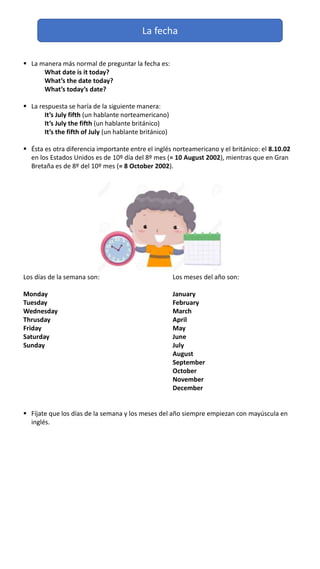
 La manera más normal de preguntar la fecha es:
What date is it today?
What’s the date today?
What’s today’s date?
 La respuesta se haría de la siguiente manera:
It’s July fifth (un hablante norteamericano)
It’s July the fifth (un hablante británico)
It’s the fifth of July (un hablante británico)
 Ésta es otra diferencia importante entre el inglés norteamericano y el británico: el 8.10.02
en los Estados Unidos es de 10º día del 8º mes (= 10 August 2002), mientras que en Gran
Bretaña es de 8º del 10º mes (= 8 October 2002).
Los días de la semana son: Los meses del año son:
Monday January
Tuesday February
Wednesday March
Thrusday April
Friday May
Saturday June
Sunday July
August
September
October
November
December
 Fíjate que los días de la semana y los meses del año siempre empiezan con mayúscula en
inglés.
La hora
 La manera más normal de preguntar la hora es:
What time is it?
What’s the time?
 Éstas son algunas de las posibles respuestas:
[Am = inglés normalmente americano; Br = inglés británico]
it’s five o’clock OR it’s five it’s five past five /
a.m. / p.m. Five after five AM
it’s (a) quarter past five it’s five thirty /
(a) quarter after five AM half past five Br
it’s twenty-five to six / it’s (a) quarter to six /
twenty-five of six AM (a) quarter of six AM
it’s one o’clock (in the it’s twelve noon /
morning / afternoon) it’s midnight
Falsos amigos
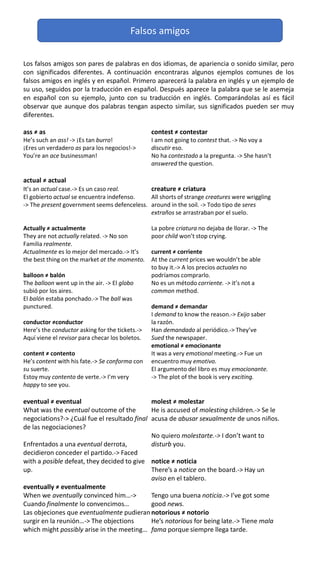
Los falsos amigos son pares de palabras en dos idiomas, de apariencia o sonido similar, pero
con significados diferentes. A continuación encontraras algunos ejemplos comunes de los
falsos amigos en inglés y en español. Primero aparecerá la palabra en inglés y un ejemplo de
su uso, seguidos por la traducción en español. Después aparece la palabra que se le asemeja
en español con su ejemplo, junto con su traducción en inglés. Comparándolas así es fácil
observar que aunque dos palabras tengan aspecto similar, sus significados pueden ser muy
diferentes.
ass ≠ as contest ≠ contestar
He’s such an ass! -> ¡Es tan burro! I am not going to contest that. -> No voy a
¡Eres un verdadero as para los negocios!-> discutir eso.
You’re an ace businessman! No ha contestado a la pregunta. -> She hasn’t
answered the question.
actual ≠ actual
It’s an actual case.-> Es un caso real. creature ≠ criatura
El gobierto actual se encuentra indefenso. All shorts of strange creatures were wriggling
-> The present government seems defenceless. around in the soil. -> Todo tipo de seres
extraños se arrastraban por el suelo.
Actually ≠ actualmente La pobre criatura no dejaba de llorar. -> The
They are not actually related. -> No son poor child won’t stop crying.
Familia realmente.
Actualmente es lo mejor del mercado.-> It’s current ≠ corriente
the best thing on the market at the momento. At the current prices we wouldn’t be able
to buy it.-> A los precios actuales no
balloon ≠ balón podríamos comprarlo.
The balloon went up in the air. -> El globo No es un método corriente. -> it’s not a
subió por los aires. common method.
El balón estaba ponchado.-> The ball was
punctured. demand ≠ demandar
I demand to know the reason.-> Exijo saber
conductor ≠conductor la razón.
Here’s the conductor asking for the tickets.-> Han demandado al periódico.-> They’ve
Aquí viene el revisor para checar los boletos. Sued the newspaper.
emotional ≠ emocionante
content ≠ contento It was a very emotional meeting.-> Fue un
He’s content with his fate.-> Se conforma con encuentro muy emotivo.
su suerte. El argumento del libro es muy emocionante.
Estoy muy contento de verte.-> I’m very -> The plot of the book is very exciting.
happy to see you.
eventual ≠ eventual molest ≠ molestar
What was the eventual outcome of the He is accused of molesting children.-> Se le
negociations?-> ¿Cuál fue el resultado final acusa de abusar sexualmente de unos niños.
de las negociaciones?
No quiero molestarte.-> I don’t want to
Enfrentados a una eventual derrota, disturb you.
decidieron conceder el partido.-> Faced
with a posible defeat, they decided to give notice ≠ noticia
up. There’s a notice on the board.-> Hay un
aviso en el tablero.
eventually ≠ eventualmente
When we aventually convinced him…-> Tengo una buena noticia.-> I’ve got some
Cuando finalmente lo convencimos… good news.
Las objeciones que eventualmente pudieran notorious ≠ notorio
surgir en la reunión…-> The objections He’s notorious for being late.-> Tiene mala
which might possibly arise in the meeting… fama porque siempre llega tarde.
fastidious ≠ fastidioso Su interés era notorio.-> His interest was
She is very fastidious with her food.-> Es obvious.
Muy maniática para la comida.
¡Qué hombre más fastidioso! -> What an pan ≠ pan
irritating man! Put a litre of milk in a pan.-> Pon un litro de
leche en una cacerola.
floor ≠ flor Saca el pan del horno.-> Take the bread out
I had left my jacket on the floor.-> Había of the oven.
dejado la chaqueta en el suelo.
No pises las flores.->Keep off the flowers. to be particular ≠ ser particular
gracious ≠ gracioso He’s very particular about his clothes.-> Es
She gave me a gracious smile.-> Me dirigió muy especial para la ropa.
una sonrisa cortés. Es un tipo muy particular.-> He is a very
Es muy graciosa.-> She´s very funny. peculiar person.
humid ≠ húmedo pie ≠pie
A very humid climate.-> Un clima muy Warm the pies in the oven.-> Calienta las
bochornoso. empanadas en el horno.
La pared está húmeda.-> The wall is damp.
Unos calcetines que mantienen los pies
library ≠ librería calientes.-> A pair of socks that keep your
I have to return these books to the library. feet warm.
-> Tengo que devolver estos libros a la
biblioteca. rest ≠ restar
Una librería especializada en literatura Let’s rest for a while -> Vamos a descansar un
infantil.-> A bookshop specialising in poco.
children’s literature. Intentó restar la cantidad mentalmente->
He tried to subtract the amount in his head.
luxury ≠ lujuria
The shop sells luxury ítems.-> La tienda
vende artículos de lujo.
Una mirada de lujuria.-> A lecherous look.
senior ≠ señor sympathetic ≠ simpático
Mr Abraham senior.-> El señor Abraham Try to be a bit more sympathetic.-> Intenta
padre. ser un poco más comprensivo.
El señor Ramírez al teléfono.-> Mr Ramírez Tu hermana es muy simpática.-> Your sister
on the phone. is very friendly.
Sensible ≠ sensible tap ≠ tap
Be sensible! You can’t do it on your own.-> Turn the tap on.-> Abre el grifo.
Se razonable, no lo puedes hacer tú sola. Se ha roto la tapa.-> The lid is broken.
Es un niño muy sensible al que se le puede
hacer daño fácilmente.-> He’s a very vase ≠ vaso
sensitive child and gets hurt easily. Put the flowers in a vase.->Pon las flores en
un jarrón.
support ≠ soportar ¿Me das un vaso de agua?-> Could I have a
These columns support the weight.-> Estas glass of water?
Columnas aguantan el peso.
No soporto a su marido.-> I can’t stand her
husband.

Dramatica inglesa

  • 1.
    Gramática inglesa LOS NOMBRES2 LOS ARTÍCULOS 4 LOS ADJETIVOS 5 LOS PRONOMBRES PERSONALES 6 LOS ADJETIVOS Y PRONOMBRES POSESIVOS 7 LAS PREPOSICIONES 8 LOS ADVERBIOS 10 LOS VERBOS 11 VERBOS IRREGULARES DEL INGLÉS 14 LOS NÚMEROS 18 LA FECHA 19 LA HORA 20 FALSOS AMIGOS 21
  • 2.
    Los nombres 1. Losnombres y sus plurales  Plurales regulares En inglés, la mayor parte de los plurales se forman añadiendo una –s: shop –> shops bike –> bikes car –> cars hand –> hands Sin embargo, algunos plurales se forman de otra manera:  -es Se añade –es a los nombres que terminan en –s, -sh, -ch o –x: bus –> buses box –> boxes dish –> dishes watch –> watches  -y -> ies La –y se transforma en –ies en nombres que terminan en “consonante + y” baby –> babies city –> cities  -f o –fe –> -ves La mayor parte de los nombres que terminan en –f o –fe cambian la terminación por –ves: calf –> calves life –> lives Plurales irregulares  Fíjate cómo cambia la vocal en los siguientes casos: foot –> feet tooth –> teeth man –> men mouse –> mice one child two children  Algunos nombres son iguales en singular y en plural: sheep . fish . deer . series . aircraft 2. Los nombres contables e incontables  Nombres contables  Los nombres contables son aquéllos que tienen forma singular y forma plural.
  • 3.
     Delante denombres contables se puede usar a, the, some o un número: Singular Plural a book some books the book the books one book three books  Nombres contables  Los nombres incontables sólo tienen una forma. Se les llama incontables porque no se pueden contar: money . snow . water . food . rain . advice  Delante de un nombre contable NO se puede poner a/an o un número. Sí que pueden ir acompañados de the o same: Can you lend me some money? I want some toast. I want some food. I need some advice. He’s playing in the snow. Where’s the milk? 3. El genitivo sajón  Formas En inglés se suele utilizar la terminación –’s para indicar la posesión:  A los nombres singulares se añade –’s: Lucy’s tent . Tom’s apple  A los nombres con plural regular se añade –’: the student’s textbooks . the boy’s father  A los nombres con plural irregular se añade –’s: children’s toys . men’s clothes Uso  El nombre con genitivo va delante del nombre de la cosa poseída: our uncles’ houses (= the houses of our uncles)  El nombre con genitivo puede aparecer en solitario después del verbo to be: That bag over there, is it Lucy’s?  El nombre con genitivo se utiliza a menudo en solitario para referirse a una tienda: Dad has gone to the butcher’s. (= the butcher’s shop) I am going to the newsagent’s. (= the newsagent’s shop)  El genitivo puede utilizarse también para especificar un periodo de tiempo: I took a week’s holiday at Easter. -’s O of?  El apóstrofo se utiliza normalmente con personas: Lucy’s tent (Y NO the tent of Lucy)  La construcción con of se utiliza normalmente con cosas: the corner of the room (Y NO the room’s corner)
  • 4.
    Los artículos Hay dostipos de artículo en inglés: el indeterminado y el determinado. 1. El artículo indeterminado: ‘a’ o ‘an’  Formas  El artículo a se usa delante de palabras que comienzan con consonante: a cup . a game -an owl  a también se usa delante de palabras que empiezan con u cuando la ‘u’ se pronuncia como la palabra you: a university . a unión  an también se usa delante de palabras que comienzan con una ‘h’ muda: an honour . an hour -a Branch Uso  a y an sólo se usan con nombres contables en singular (-> página 2).  a y an se utilizan para referirse a una cosa o persona por primera vez: Adam has bought a new computer game.  a se utiliza delante de ciertos números: a dozen . a hundred . a thousand . a million  a y an se usan para describir la profesión de alguien: Tom’s father is an engineer. Ten cuidado de no confundir a o an con el numeral one. Compara: - A car is no good. We need a van. - One car is no good. We need two or three. 2. El artículo determinado: ‘the’  Forma  the es el artículo determinado que se usa con todos los nombres: the table . the world . the glass Uso  the se usa para indicar que la persona o cosa a la que acompaña es un ejemplo específico: Tom dropped a book and a pen. The pen is green.  the se utiliza cuando sólo hay una persona o cosa: Lucy met the Queen . The sun is shining.  the se utiliza con instrumentos musicales: Adam plays the piano.
  • 5.
    Los adjetivos 1. Usode los adjetivos  Forma  Los adjetivos ingleses no cambian en función del género del nombre: a young boy . a young girl young boys . young girls Posición  Los adjetivos pueden ir delante de un nombre: Adam bought a blue scarf.  También pueden ir después de verbos como be, seem, look, get: Tom’s eyes are blue. . Lucy looks happy. Orden  Cuando se usan varios adjetivos para describir un nombre, siguen el siguiente orden: a small cotton T-shirt . a new yellow bicycle TAMAÑO/FORMA + EDAD + COLOR + NACIONALIDAD + MATERIAL 2. Comparación del adjetivo  Formas adjetivos cortos adjetivos largos Positivo a tall tree a famous woman Comparativo a taller tree a more famous woman Superlativo the tallest tree the most famous woman in the garden in the world  Comparación En general, el comparativo y el superlativo se forman como sigue:  a los adjetivos cortos (de una sílaba) se les añade –er y –est: fast > faster > fastest long > longer > longest Ortografía: la consonante final se dobla después de una vocal breve: big > bigger > biggest fat > fatter > fattest  con los adjetivos largos (de dos sílabas o más) se usa more y most: difficult > more difficult > most difficult beautiful > more beautiful > most beautiful  Los siguientes adjetivos tienen comparativos y superlativos irregulares: good > better > best little > less > least bad > worse > worst much/many > more > most
  • 6.
    Los pronombres personales 1.Formas 2. Uso Los nombres en inglés no tienen género gramatical. Sin embargo, el pronombre personal cambia dependiendo del género de la persona o cosa a la que se refiere. Adam is running towards Lucy and Tom. He is running towards them.  he y him se usan para personas y animales del sexo masculino: Have you met Tom’s uncle? He’s a pilot. Do you know him?  she y her se usan para personas y animales del sexo femenino: There’s Lucy’s mother. She’s a dentist. Have you met her?  it se usa para objetos y para animales cuando no se conoce su sexo: I bought a new car. It’s a convertible. I like it very much.  you es la misma forma para el singular y el plural, y equivale tanto a ‘tú’ como a ‘usted’. Pronombre sujeto Pronombre objeto Singular: 1ª persona 2ª persona 3ª persona - Masculino - Femenino - Impersonal - Con cosas Plural: 1ª persona 2ª persona 3ª persona I you he she one it we you they me you him her one it us you them SUJETO OBJETO PRONOMBRE SUJETO PRONOMBRE OBJETO
  • 7.
    Los adjetivos ypronombres posesivos 1. Formas 2. Uso El adjetivo posesivo se usa delante de nombres. El pronombre posesivo se usa en lugar de la construcción ‘adjetivo posesivo + nombre’ cuando el nombre o ya ha sido mencionado o es obvio. This bike belongs to Lucy. . It’s her bike. . It’s hers.  Recuerda que la elección de adjetivo o pronombre posesivo depende del género del propietario, no del objeto poseído: There’s Tom’s bike. . It’s his bike. . It’s his.  Recuerda que el artículo determinado no se usa nunca con pronombres posesivos: This is my bag – yours is over there. (NO the yours is over there)  Con las partes del cuerpo se usa el adjetivo posesivo: Adam hurt his leg. . Lucy broke her arm. Adjetivo posesivo Pronombre posesivo Singular: 1ª persona 2ª persona 3ª persona - Masculino - Femenino - Impersonal - Con cosas Plural: 1ª persona 2ª persona 3ª persona my your his here one’s its our your their mine yours his hers ours yours theirs Ten cuidado de no confundir its con it’s: This is my new teddy bear. It’s brown and its name is ‘Ted’. it’s = it is its = adjetivo posesivo
  • 8.
    Las preposiciones Preposiciones delugar • The cat is on the table • The mouse is under the table • The base is on top of the fireplace • The picture is above the fireplace • The tractor is in front of the car • The bus is behind the car • Adam is next to Lucy • Tom is standing near Adam and Lucy • Lucy is between Adam and Tom • Lucy is in the tent • The plane is flying below the clouds
  • 9.
    Preposiciones de movimiento •Tom is going up the steps • Lucy is going down the slide • Tom is diving into the pool • Adam is getting out of the pool • The cat is crawling through the hedge • The dog is jumping over the hedge • Lucy is walking across the Street • Tom is walking along the Street • Adam is running towards his friends.
  • 10.
    Los adverbios 1. Usode los adverbios  Forma  Los adverbios en inglés se forman normalmente añadiendo –ly al adjetivo: brave -> bravely quick -> quickly mad -> madly careful -> carefully Sin embargo, algunos adverbios se forman de manera diferente:  -y -> -ily La –y se tranforma en –ily en adjetivos que terminan en ‘consonante + y’: happy -> happily shaky -> shakily  -le -> -ly El –le se tranforma en –ly en adjetivos que terminan en –le: gentle -> gently simple -> simply  ll -> lly A los adjetivos que terminan en –ll se les añade –y: full -> fully dull -> dully  -ic -> -ically A los adjetivos que terminan en –ic se les añade –allí: drastic -> drastically historic -> historically Algunos adverbios son iguales que el adjetivo: late -> late early -> early hard -> hard fast -> fast  El adverbio de good es well.  Posición Los adverbios pueden colocarse de la manera siguiente:  Después de un verbo intransitivo: Lucy’s gran walks slowly. . Tom went to bed early.  Después del complemento de un verbo: Tom ate his sweets quickly. (Y NO Tom ate quickly his sweets)  Comparación  Los comparativos y superlativos de la mayor parte de los adverbios se forman añadiendo las palabras more and most: Adam writes more clearly than Tom.  Algunos comparativos y superlativos se forman añadiendo –er y –est: They completed their homework sooner tan I’d expected. ADJETIVO + -ly -> ADVERBIO
  • 11.
    Los verbos 1. Formas Lamayoría de los verbos ingleses no tienen más de cinco formas. Por ejemplo, el verbo write:  Forma base: write  FORMA –s ( o tercera persona del singular): Lucy writes letters  FORMA –ing (o participio de presente): I am writing a letter  el pasado: I wrote a letter  el participio pasado: I have written a letter 2. Tiempos  Presente simple  Formación  El presente simple se forma asi: Forma base: play SINGULAR I/you play he/she/it plays PLURAL we/you/ they play  Con la mayor parte de los verbos, se añade -s a la forma base después de he/she/it: eat -> he/she/it eats  Sin embargo, cuando la forma base termina en: -o, -ss, -sh, -ch, -x o –z, se añade –es después de he/she/it: wash -> he/she/it washes - ‘consonante + y’, se reemplaza la –y con –ies después de he/she/it: cry -> he/she/it cries  Uso El presente simple se utiliza:  Para expresar un hecho: They are Spanish.  Para expresar acciones que se repiten: She plays tennis every Saturday.  Para expresar sentimiento: I love chocolate.  Presente continuo  Formación  El presente continuo se forma así:  La forma –ing is construye normalmente añadiendo –ing a la forma base: Watch -> watching I am watching TV. be + FORMA -ing I like ice cream. Tom likes ice cream too.
  • 12.
     Sin embargo,cuando la forma base se termina en: -’consonante + e’, la –e desaparece de delante de –ing: take -> taking save -> saving - -ie, la terminación se convierte en –ying: die -> dying - ‘una vocal breve tónica + una consonante’, la consonante normalmente se dobla: rob -> robbing sit -> sitting  Uso El presente continuo se usa:  Para hablar de hechos que están ocurriendo: it’s raining.  Para hablar de hechos que ocurren durante un periodo de tiempo limitado incluyendo el momento actual: I’m learning English.  Para hablar de planes y preparativos: I’m going to the beach tomorrow.  Pasado simple  Formación  El presente simple de muchos verbos se forma así: I/you/he/she/it/we/they watched TV  Sin embargo, cuando la forma base termina en: -’consonante + e’, a la forma base se añade –d: wave -> waved hope -> hoped -’consonante + y’, se reemplaza la –y con –ied: cry -> cried try -> tried -’una vocal breve tónica + una consonante’, la consonante normalmente se dobla: stop -> stopped tap -> tapped  Uso El pasado simple se utiliza para describir hechos y situaciones que ya han sido finalizados: Lucy shouted at Tom. * I washed the dishes. FORMA BASE + -ed  Pretérito perfecto  Formación  El pretérito perfecto se forma así: I have eaten my ice cream. * Adam has arrived home  Los participios pasados regulares se forman de la misma manera que el pesado simple.  Uso El pretérito perfecto se usa:  Para hablar de hechos recientes: Tom has finished his homework.  Para hablar de hechos pasados que todavía continúan en el presente: I have worked here for three years. have + PARTICIPIO PASADO
  • 13.
    3. Verbos auxiliares Losverbos be, have y do son muy importantes porque además de funcionar como verbos principales, se utilizan también delante de otros verbos para formar nuevos tiempos verbales.  El verbo ‘be’  El verbo be se usa para formar el presente continuo (forma be + -ing) y la pasiva (be + participio pasado).  El verbo ‘have’  El verbo have se utiliza para formar el pretérito perfecto (have + participio pasado) y el pluscuamperfecto (had participio perfecto).  El verbo ‘do’  El verbo do se utiliza para formar frases negativas e interrogativas. FORMA COMPLETA FORMA CONTRAÍDA FORMA NEGATIVA CONTRAÍDA PASADO SIMPLE I am you are he/she/it is we are you are they are I’m you’re he’s/she’s/it’s we’re you’re they’re I’m not you’re not he/she/it isn’t we aren’t you aren’t they aren’t I was you were he/she/it was we were you were they were GERUNDIO being PARTICIPIO PASADO had FORMA COMPLETA FORMA CONTRAÍDA FORMA NEGATIVA CONTRAÍDA PASADO SIMPLE I have you have he/she/it has we have you have they have I’ve you’ve he’s/she’s/it’s we’ve you’ve they’ve I havent you haven’t he/she/it hasn’t we haven’t you haven’t they haven’t I had you had he/she/it had we had you had they had GERUNDIO having PARTICIPIO PASADO had FORMA COMPLETA FORMA NEGATIVA CONTRAÍDA PASADO SIMPLE I do you do he/she/it does we do you do they do I don’t you don’t he/she/it doesn’t we don’t you don’t they don’t I did you did he/she/it did we did you did they did GERUNDIO doing PARTICIPIO PASADO done
  • 14.
    Verbos irregulares eninglés Infinitivo Pasado simple Participio pasado arise arose arisen awake awoke awoken be was/were been bear bore born(e) beat beat beaten begin began begun bend bent bent bet bet/betted bet/betted bid bid bid bind bound bound bite bit bitten bleed bled bled blow blew blown break broke broken breed bred bred bring brought brought build built built burn burn/burned burnt/burned burst burst burst buy bought bought can could - cast cast cast catch caught caught choose chose chosen come came come cost cost cost creep crept crept cut cut cut deal dealt dealt dig dug dug do did done draw drew drawn dream dreamed/dreamt dreamed/dreamt drink drank drunk drive drove driven eat ate eaten fall fell fallen feed fed fed feel felt felt
  • 15.
    Infinitivo Pretérito SimpleParticipio fight fought fought find found found fling flung flung fly flew flown forget forget forgotten freeze froze frozen get got gotten (Brit got) give gave given go went gone grind ground ground grow grew grown hang hung/hanged hung/hanged have had had hear heard heard hide hid hidden hit hit hit hold held held hurt hurt hurt keep kept kept kneel knelt/kneeled knelt/kneeled know knew known lay laid laid lead led led lean leant/leaned leant/leaned leap leapt/leaped leapt/leaped learn learnt/learned learnt/learned leave left left lend lent lent let let let lie lay lain light lit/lighted lit/lighted lose lost lost make made made may might - mean meant meant meet met met mow mowed mown/mowed pay paid paid put put put
  • 16.
    Infinitivo Pretérito SimpleParticipio rise rose risen run ran run saw sawed sawn say said said see saw seen seek sought sought sell sold sold send sent sent set set set shake shook shaken shall should - shed shed shed shine shone shone shoot shot shot show showed shown shrink shrank shrunk shut shut shut sing sang sung sink sank sunk sit sat sat sleep slept slept slide slid slid sling slung slung smell smelt/smelled smelt/smelled sow sowed sown/sowed speak spoke spoken speed sped/speeded sped/speeded spell spelt/spelled spelt/spelled spend spent spent spill spilt/spilled spilt/spilled spin spun spun spit spat spat split split split spoil spoiled/spoilt spoiled/spoilt spread spread spread spring sprang sprung stand stood stood steal stole stolen stick stuck stuck
  • 17.
    Infinitivo Pretérito SimpleParticipio stink stank stunk strike struck struck/stricken swear swore sworn sweep swept swept swell swelled swollen/swelled swim swam swum take took taken teach taught taught tear tore torn tell told told think thought thought throw threw thrown tread trod trodden wake woke/waked woken/waked wear wore worn weave wove/weaved woven/weaved weep wept wept win won won wind wound wound wring wrung wrung write wrote written
  • 18.
    Los números 1. Númeroscardinales Los números cardinales se usan para contar. Los más importantes son: 0 zero 18 eighteen 70 seventy 1 one 19 nineteen 80 eighty 2 two 20 twenty 90 ninety 3 three 21 twenty-one 100 one hundred 4 four 22 twenty-two 101 one hundred and 5 five 23 twenty-three one 6 six 24 twenty-four 102 one hundred and 7 seven 25 twenty-five two 8 eight 26 twenty-six 110 one hundred and 9 nine 27 twenty-seven ten 10 ten 28 twenty-eight 200 two hundred 11 eleven 29 twenty-nine 201 two hundred and 12 twelve 30 thirty one 13 thirteen 31 thirty-one 202 two hundred and 14 fourteen 32 thirty-two two 15 fifteen 40 forty 300 three hundred 16 sixteen 50 fifty 400 four hundred 17 seventeen 60 sixty 500 five hundred 1000 one hundred 10000 ten thousand 1001 one thousand and one 100000 one hundred 1002 one thousand and two thousand 1100 one thousand one hundred 1000000 one million 1200 one thousand two hundred 2000000 two million 2000 two thousand 1000000000 one billion  En inglés, algunos números como one thousand o forty million suelen ir con comas y no con puntos (1,000; 40,000,000) o también separarlos por espacios (1 000; 40 000 000); si tienen sólo cuatro cifras pueden ir todos juntos (1000). 1. Números ordinales Los números ordinales se usan para poner cosas en orden: 1st first 10th tenth 72nd seventy-second 2nd second 11th eleventh 83rd eighty-thrid 3rd third 12th twelfth 94th ninety-fourth 4th fourth 13th thriteenth 100th one hundredth 5th fifth 20th twentieth 101st one hundred and first 6th sixth 30th thirtieth 1,000th one thousandth 7th seventh 40th fortieth 8th eighth 50th fiftieth 9th ninth 61st sixty-first
  • 19.
    La fecha  Lamanera más normal de preguntar la fecha es: What date is it today? What’s the date today? What’s today’s date?  La respuesta se haría de la siguiente manera: It’s July fifth (un hablante norteamericano) It’s July the fifth (un hablante británico) It’s the fifth of July (un hablante británico)  Ésta es otra diferencia importante entre el inglés norteamericano y el británico: el 8.10.02 en los Estados Unidos es de 10º día del 8º mes (= 10 August 2002), mientras que en Gran Bretaña es de 8º del 10º mes (= 8 October 2002). Los días de la semana son: Los meses del año son: Monday January Tuesday February Wednesday March Thrusday April Friday May Saturday June Sunday July August September October November December  Fíjate que los días de la semana y los meses del año siempre empiezan con mayúscula en inglés.
  • 20.
    La hora  Lamanera más normal de preguntar la hora es: What time is it? What’s the time?  Éstas son algunas de las posibles respuestas: [Am = inglés normalmente americano; Br = inglés británico] it’s five o’clock OR it’s five it’s five past five / a.m. / p.m. Five after five AM it’s (a) quarter past five it’s five thirty / (a) quarter after five AM half past five Br it’s twenty-five to six / it’s (a) quarter to six / twenty-five of six AM (a) quarter of six AM it’s one o’clock (in the it’s twelve noon / morning / afternoon) it’s midnight
  • 21.
    Falsos amigos Los falsosamigos son pares de palabras en dos idiomas, de apariencia o sonido similar, pero con significados diferentes. A continuación encontraras algunos ejemplos comunes de los falsos amigos en inglés y en español. Primero aparecerá la palabra en inglés y un ejemplo de su uso, seguidos por la traducción en español. Después aparece la palabra que se le asemeja en español con su ejemplo, junto con su traducción en inglés. Comparándolas así es fácil observar que aunque dos palabras tengan aspecto similar, sus significados pueden ser muy diferentes. ass ≠ as contest ≠ contestar He’s such an ass! -> ¡Es tan burro! I am not going to contest that. -> No voy a ¡Eres un verdadero as para los negocios!-> discutir eso. You’re an ace businessman! No ha contestado a la pregunta. -> She hasn’t answered the question. actual ≠ actual It’s an actual case.-> Es un caso real. creature ≠ criatura El gobierto actual se encuentra indefenso. All shorts of strange creatures were wriggling -> The present government seems defenceless. around in the soil. -> Todo tipo de seres extraños se arrastraban por el suelo. Actually ≠ actualmente La pobre criatura no dejaba de llorar. -> The They are not actually related. -> No son poor child won’t stop crying. Familia realmente. Actualmente es lo mejor del mercado.-> It’s current ≠ corriente the best thing on the market at the momento. At the current prices we wouldn’t be able to buy it.-> A los precios actuales no balloon ≠ balón podríamos comprarlo. The balloon went up in the air. -> El globo No es un método corriente. -> it’s not a subió por los aires. common method. El balón estaba ponchado.-> The ball was punctured. demand ≠ demandar I demand to know the reason.-> Exijo saber conductor ≠conductor la razón. Here’s the conductor asking for the tickets.-> Han demandado al periódico.-> They’ve Aquí viene el revisor para checar los boletos. Sued the newspaper. emotional ≠ emocionante content ≠ contento It was a very emotional meeting.-> Fue un He’s content with his fate.-> Se conforma con encuentro muy emotivo. su suerte. El argumento del libro es muy emocionante. Estoy muy contento de verte.-> I’m very -> The plot of the book is very exciting. happy to see you. eventual ≠ eventual molest ≠ molestar What was the eventual outcome of the He is accused of molesting children.-> Se le negociations?-> ¿Cuál fue el resultado final acusa de abusar sexualmente de unos niños. de las negociaciones? No quiero molestarte.-> I don’t want to Enfrentados a una eventual derrota, disturb you. decidieron conceder el partido.-> Faced with a posible defeat, they decided to give notice ≠ noticia up. There’s a notice on the board.-> Hay un aviso en el tablero. eventually ≠ eventualmente When we aventually convinced him…-> Tengo una buena noticia.-> I’ve got some Cuando finalmente lo convencimos… good news. Las objeciones que eventualmente pudieran notorious ≠ notorio surgir en la reunión…-> The objections He’s notorious for being late.-> Tiene mala which might possibly arise in the meeting… fama porque siempre llega tarde.
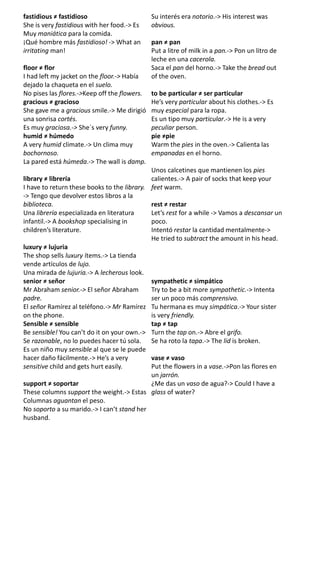
  • 22.
    fastidious ≠ fastidiosoSu interés era notorio.-> His interest was She is very fastidious with her food.-> Es obvious. Muy maniática para la comida. ¡Qué hombre más fastidioso! -> What an pan ≠ pan irritating man! Put a litre of milk in a pan.-> Pon un litro de leche en una cacerola. floor ≠ flor Saca el pan del horno.-> Take the bread out I had left my jacket on the floor.-> Había of the oven. dejado la chaqueta en el suelo. No pises las flores.->Keep off the flowers. to be particular ≠ ser particular gracious ≠ gracioso He’s very particular about his clothes.-> Es She gave me a gracious smile.-> Me dirigió muy especial para la ropa. una sonrisa cortés. Es un tipo muy particular.-> He is a very Es muy graciosa.-> She´s very funny. peculiar person. humid ≠ húmedo pie ≠pie A very humid climate.-> Un clima muy Warm the pies in the oven.-> Calienta las bochornoso. empanadas en el horno. La pared está húmeda.-> The wall is damp. Unos calcetines que mantienen los pies library ≠ librería calientes.-> A pair of socks that keep your I have to return these books to the library. feet warm. -> Tengo que devolver estos libros a la biblioteca. rest ≠ restar Una librería especializada en literatura Let’s rest for a while -> Vamos a descansar un infantil.-> A bookshop specialising in poco. children’s literature. Intentó restar la cantidad mentalmente-> He tried to subtract the amount in his head. luxury ≠ lujuria The shop sells luxury ítems.-> La tienda vende artículos de lujo. Una mirada de lujuria.-> A lecherous look. senior ≠ señor sympathetic ≠ simpático Mr Abraham senior.-> El señor Abraham Try to be a bit more sympathetic.-> Intenta padre. ser un poco más comprensivo. El señor Ramírez al teléfono.-> Mr Ramírez Tu hermana es muy simpática.-> Your sister on the phone. is very friendly. Sensible ≠ sensible tap ≠ tap Be sensible! You can’t do it on your own.-> Turn the tap on.-> Abre el grifo. Se razonable, no lo puedes hacer tú sola. Se ha roto la tapa.-> The lid is broken. Es un niño muy sensible al que se le puede hacer daño fácilmente.-> He’s a very vase ≠ vaso sensitive child and gets hurt easily. Put the flowers in a vase.->Pon las flores en un jarrón. support ≠ soportar ¿Me das un vaso de agua?-> Could I have a These columns support the weight.-> Estas glass of water? Columnas aguantan el peso. No soporto a su marido.-> I can’t stand her husband.