Ignacio Alfredo Valerio Morales
Residente de 4° año de Medicina Interna
¿Qué es?
Emergencia metabólica que sucede usualmente

en pacientes con Diabetes Mellitus tipo 2.

Caracterizada por:
Hiperglucemia descontrolada que perpetúa

HIPEROSMOLARIDAD, así como
DESHIDRATACION <severa sin Cetoacidosis
significativa.
Números
Incidencia: 1/1000-personas/años
500-1000 pacientes por año
Mortalidad: 10-50%
Enfermedad
concomitante
Insulinemia
& Hormonas
contrarreguladoras.

Fisiopatología
Deshidratación

Depuracion renal y
urtilización periférica
de la glucosa.

Pérdida de
Electrolitos y agua.

Hiperglicemia

Diuresis osmótica

Hiperosmolaridad

Deshidratación intracelular.

lipolisis

´s

Met Aag

no cetogénesis
Características diagnósticas:
• Glucemia >600mg/dl
• Osmolaridad sérica efectiva de 320 mOsm/kg o más.
• Deshidratación severa (8-12 L) con azoemia y una

relación BUN/sCr elevada.
• Cetonuria leve o ausente así como cetonemia leve o
ausente.
• Concentración de HCO3 > 15 mEq/L
• Alteración del estado de conciencia.
Causas
 Deshidratación
 Neumonía
 IVU
 Hormonas contrarreguladoras
 Falta de Apego al tratamiento.

Medicamentos

Diureticos
- B-bloqueadores.
- Bloqueadores H2
- Antipsicotics (Clozapine,
Olanzapine)
- Alcohol y cocaina
- Dialisis, NPT, Soluciones
Glucosadas.
Características Clínicas
Ocurre sólo en DM2
Es habitual que sea el cuadro de presentación de la

DM2
Adultos mayores.
Obnubilación y coma.
Invariable la presencia de deshidratación severa.
Puede existir acidosis láctica.
Factores precipitantes semajantes a la DKA
Tasa de mortalidad elevada.
Síntomas
Síntomas de hiperglicemia:
 Polidipsia
 Poliuria
 Letargia

Otros :
 Pérdida peso
 Pérdida del estado de alerta
Cambios neurólogicos observados:
 Mareo y letargia
 Delirium
 Coma
 Convulsiones focales o generalizadas
 Alteraciones visuales
 Hemiparesia
 Déficit sensoriales
Exámen físico :
Deshidratación: Piel y mucosas secas, périda de la

turgencia dérmica.

Signos vitales : Taquicardia, Hipotensión, Fiebre.
EF meticulosa para descartar causas.
Diagnóstico diferencial
Acidosis alcoholica
Delirium
Demencia
Sobredosis
Tirotoxicosis.
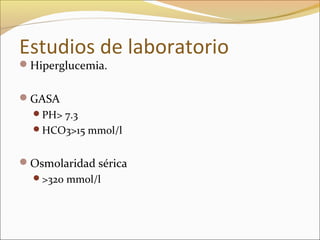
Estudios de laboratorio
Hiperglucemia.
GASA
PH> 7.3
HCO3>15 mmol/l

Osmolaridad sérica
>320 mmol/l
Otros
Urinanalisis
Excluir IVU
Proteinuria

Cetonemia
Electrolitos séricos
Azoados
Glucemia en ayuno
CK
Estudios de Imagen
CXR: Neumonía
TAC Cráneo
EVC
Edema cerebral.
Manejo intrahospitalario
 ABC
 Laboratorio y gabinete
 Reponer Déficit de líquido.
 1-2 L NaCl 0.0% en las primeras 2 hrs. Correción de hiponatremia de

acuerdo a lineamientos.

 NaCl 0.45% en cuanto TA y uresis sea normales.
 Cuando sGlucosa = 250mg/dl, cambiar a sol Glucosada al 5%.
Complicaciones
Edema cerebral
SIRA
Acidosis Metabólica hiperclorémica
Trombosis vascular
Hipoglicemia e hipokalemia

Ehnc 2010

Notas del editor

  • #5 PATOGENIA
  • #19 Cerebral edema Fortunately, symptomatic cerebral edema occurs rarely in adults with diabetes who receive treatment for DKA or HHS. There is evidence, however, from electroencephalograms and CT scans in adults and pediatric patients, that the development of subclinical cerebral edema is not uncommon during the first 24 hours of DKA therapy.4 Multiple factors in the treatment of DKA and HHS may contribute to the cerebral edema. These include (a) the idiogenic osmoles, which cannot be dissipated rapidly during rehydration, thus creating a gradient and a shift of water into the cells;4 (b) insulin therapy per se, which may promote the entry of osmotically active particles into the intracellular space; and (c) rapid replacement of sodium deficits.11,12 To reduce the risk of cerebral edema, it is recommended that physicians correct sodium and water deficits gradually and avoid the rapid decline in plasma glucose Concentration. Adult respiratory distress syndrome Adult respiratory distress syndrome, or noncardiogenic pulmonary edema, is a potentially fatal complication of DKA that fortunately occurs rarely.4 The partial pressure of oxygen, which is normal on admission, decreases progressively during treatment to unexpectedly low levels. This change is believed to be due to increased water in the lungs and reduced lung compliance. These changes may be similar to those occurring in brain cells leading to cerebral edema, which suggests that it is a common biological phenomenon in tissues. Hyperchloremic metabolic acidosis This phenomenon is not uncommon during the treatment of DKA.9 A major mechanism is the loss of substrates (ketoanions) in the urine that are necessary for bicarbonate regeneration.9,35 Other mechanisms include (a) intravenous fluids containing chloride concentrations exceeding that of plasma,6,35 (b) volume expansion with bicarbonate-free fluids6,35 and (c) intracellular shift of sodium bicarbonate during correction of DKA.36 This acidosis usually has no adverse effect and is corrected spontaneously in the subsequent 24–48 hours through enhanced renal acid excretion. Vascular thrombosis Many features of DKA and HHS predispose the patient to thrombosis: dehydration and contracted vascular volume, low cardiac output, increased blood viscosity and the frequent presence of underlying atherosclerosis.5,19 In addition, a number of hemostatic changes favour thrombosis.38 This complication is more likely to happen when osmolality is very high. Low-dose or low-molecular-weight heparin therapy should be considered for prophylaxis in patients at high risk of thrombosis. However, there are no data demonstrating its safety or efficacy. Hypoglycemia and hypokalemia These complications are less common with current lowdose insulin therapy.4,27,28 The potassium deficit should be adequately corrected and 5% dextrose should be added to infusion fluids as soon as the plasma glucose level decreases below 12–14 mmol/L.