Piet MondrianPiet Mondrian
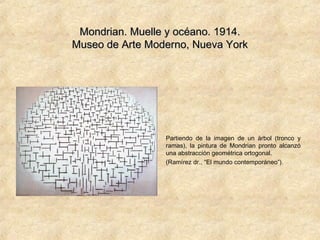
Mondrian. Muelle y océano. 1914.Mondrian. Muelle y océano. 1914.
Museo de Arte Moderno, Nueva YorkMuseo de Arte Moderno, Nueva York
Partiendo de la imagen de un árbol (tronco y
ramas), la pintura de Mondrian pronto alcanzó
una abstracción geométrica ortogonal.
(Ramírez dr., “El mundo contemporáneo”).
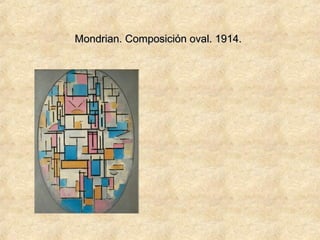
Mondrian. Composición oval. 1914.Mondrian. Composición oval. 1914.
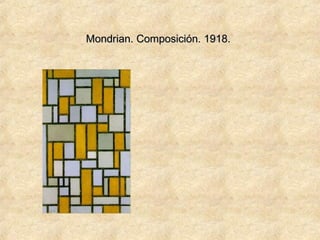
Mondrian. Composición. 1918.Mondrian. Composición. 1918.
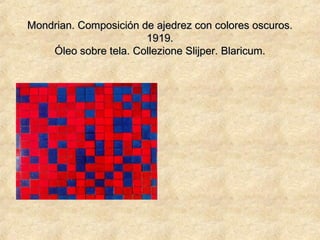
Mondrian. Composición de ajedrez con colores oscuros.Mondrian. Composición de ajedrez con colores oscuros.
1919.1919.
Óleo sobre tela.Óleo sobre tela. Collezione Slijper. Blaricum.Collezione Slijper. Blaricum.
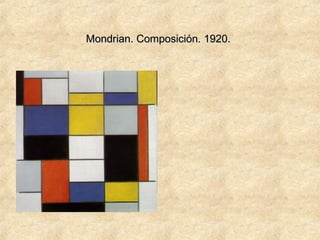
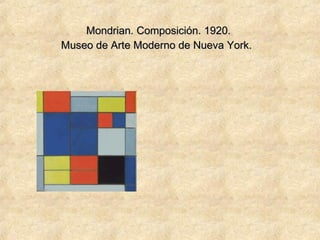
Mondrian. Composición. 1920.Mondrian. Composición. 1920.
Museo de Arte Moderno de Nueva York.Museo de Arte Moderno de Nueva York.
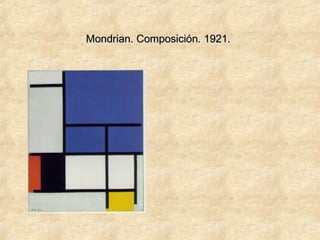
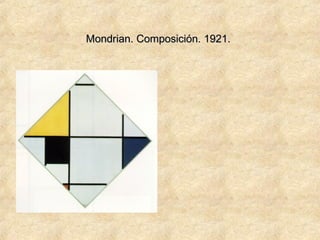
Mondrian. Composición. 1921.Mondrian. Composición. 1921.
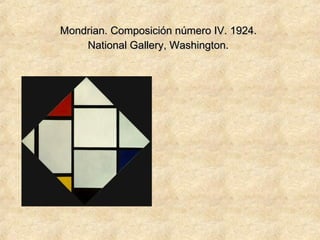
Mondrian. Composición número IV. 1924.Mondrian. Composición número IV. 1924.
National Gallery, Washington.National Gallery, Washington.
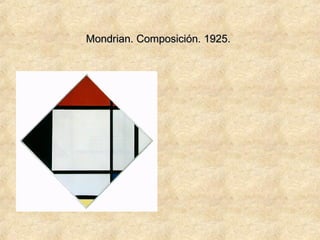
Mondrian. Composición. 1925.Mondrian. Composición. 1925.
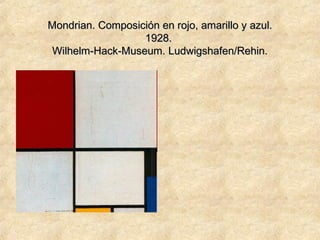
Mondrian.Mondrian. Composición en rojo, amarillo y azul.Composición en rojo, amarillo y azul.
1928.1928.
Wilhelm-Hack-Museum. Ludwigshafen/Rehin.Wilhelm-Hack-Museum. Ludwigshafen/Rehin.
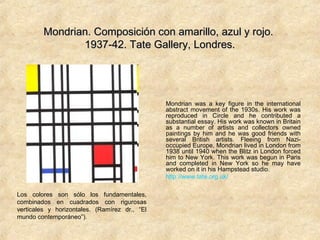
Mondrian. Composición con amarillo, azul y rojo.Mondrian. Composición con amarillo, azul y rojo.
1937-42. Tate Gallery, Londres.1937-42. Tate Gallery, Londres.
Mondrian was a key figure in the international
abstract movement of the 1930s. His work was
reproduced in Circle and he contributed a
substantial essay. His work was known in Britain
as a number of artists and collectors owned
paintings by him and he was good friends with
several British artists. Fleeing from Nazi-
occupied Europe, Mondrian lived in London from
1938 until 1940 when the Blitz in London forced
him to New York. This work was begun in Paris
and completed in New York so he may have
worked on it in his Hampstead studio.
http://www.tate.org.uk/
Los colores son sólo los fundamentales,
combinados en cuadrados con rigurosas
verticales y horizontales. (Ramírez dr., “El
mundo contemporáneo”).
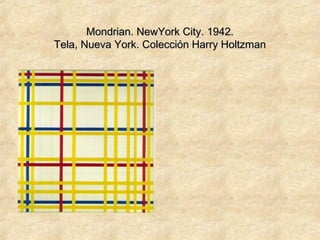
Mondrian. NewYork City. 1942.Mondrian. NewYork City. 1942.
Tela, Nueva York. Colección Harry HoltzmanTela, Nueva York. Colección Harry Holtzman
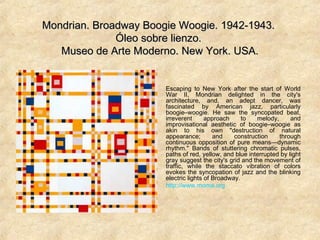
Mondrian. Broadway Boogie Woogie. 1942-1943.Mondrian. Broadway Boogie Woogie. 1942-1943.
Óleo sobre lienzo.Óleo sobre lienzo.
Museo de Arte Moderno. New York. USA.Museo de Arte Moderno. New York. USA.
Escaping to New York after the start of World
War II, Mondrian delighted in the city's
architecture, and, an adept dancer, was
fascinated by American jazz, particularly
boogie–woogie. He saw the syncopated beat,
irreverent approach to melody, and
improvisational aesthetic of boogie–woogie as
akin to his own "destruction of natural
appearance; and construction through
continuous opposition of pure means—dynamic
rhythm." Bands of stuttering chromatic pulses,
paths of red, yellow, and blue interrupted by light
gray suggest the city's grid and the movement of
traffic, while the staccato vibration of colors
evokes the syncopation of jazz and the blinking
electric lights of Broadway.
http://www.moma.org
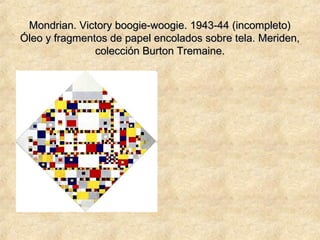
Mondrian. Victory boogie-woogie. 1943-44 (incompleto)Mondrian. Victory boogie-woogie. 1943-44 (incompleto)
Óleo y fragmentos de papel encolados sobre tela. Meriden,Óleo y fragmentos de papel encolados sobre tela. Meriden,
colección Burton Tremaine.colección Burton Tremaine.

Mondrian

  • 1.
  • 2.
    Mondrian. Muelle yocéano. 1914.Mondrian. Muelle y océano. 1914. Museo de Arte Moderno, Nueva YorkMuseo de Arte Moderno, Nueva York Partiendo de la imagen de un árbol (tronco y ramas), la pintura de Mondrian pronto alcanzó una abstracción geométrica ortogonal. (Ramírez dr., “El mundo contemporáneo”).
  • 3.
    Mondrian. Composición oval.1914.Mondrian. Composición oval. 1914.
  • 4.
  • 5.
    Mondrian. Composición deajedrez con colores oscuros.Mondrian. Composición de ajedrez con colores oscuros. 1919.1919. Óleo sobre tela.Óleo sobre tela. Collezione Slijper. Blaricum.Collezione Slijper. Blaricum.
  • 6.
  • 7.
    Mondrian. Composición. 1920.Mondrian.Composición. 1920. Museo de Arte Moderno de Nueva York.Museo de Arte Moderno de Nueva York.
  • 8.
  • 9.
  • 10.
    Mondrian. Composición númeroIV. 1924.Mondrian. Composición número IV. 1924. National Gallery, Washington.National Gallery, Washington.
  • 11.
  • 12.
    Mondrian.Mondrian. Composición enrojo, amarillo y azul.Composición en rojo, amarillo y azul. 1928.1928. Wilhelm-Hack-Museum. Ludwigshafen/Rehin.Wilhelm-Hack-Museum. Ludwigshafen/Rehin.
  • 13.
    Mondrian. Composición conamarillo, azul y rojo.Mondrian. Composición con amarillo, azul y rojo. 1937-42. Tate Gallery, Londres.1937-42. Tate Gallery, Londres. Mondrian was a key figure in the international abstract movement of the 1930s. His work was reproduced in Circle and he contributed a substantial essay. His work was known in Britain as a number of artists and collectors owned paintings by him and he was good friends with several British artists. Fleeing from Nazi- occupied Europe, Mondrian lived in London from 1938 until 1940 when the Blitz in London forced him to New York. This work was begun in Paris and completed in New York so he may have worked on it in his Hampstead studio. http://www.tate.org.uk/ Los colores son sólo los fundamentales, combinados en cuadrados con rigurosas verticales y horizontales. (Ramírez dr., “El mundo contemporáneo”).
  • 14.
    Mondrian. NewYork City.1942.Mondrian. NewYork City. 1942. Tela, Nueva York. Colección Harry HoltzmanTela, Nueva York. Colección Harry Holtzman
  • 15.
    Mondrian. Broadway BoogieWoogie. 1942-1943.Mondrian. Broadway Boogie Woogie. 1942-1943. Óleo sobre lienzo.Óleo sobre lienzo. Museo de Arte Moderno. New York. USA.Museo de Arte Moderno. New York. USA. Escaping to New York after the start of World War II, Mondrian delighted in the city's architecture, and, an adept dancer, was fascinated by American jazz, particularly boogie–woogie. He saw the syncopated beat, irreverent approach to melody, and improvisational aesthetic of boogie–woogie as akin to his own "destruction of natural appearance; and construction through continuous opposition of pure means—dynamic rhythm." Bands of stuttering chromatic pulses, paths of red, yellow, and blue interrupted by light gray suggest the city's grid and the movement of traffic, while the staccato vibration of colors evokes the syncopation of jazz and the blinking electric lights of Broadway. http://www.moma.org
  • 16.
    Mondrian. Victory boogie-woogie.1943-44 (incompleto)Mondrian. Victory boogie-woogie. 1943-44 (incompleto) Óleo y fragmentos de papel encolados sobre tela. Meriden,Óleo y fragmentos de papel encolados sobre tela. Meriden, colección Burton Tremaine.colección Burton Tremaine.