Programa de Educacion Revitalizado
para Embajadores
www.toastmasters.org
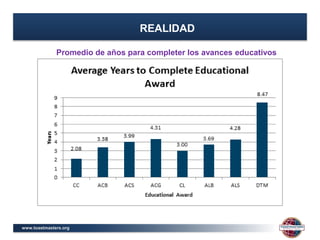
Promedio de años para completer los avances educativos
REALIDAD
www.toastmasters.org
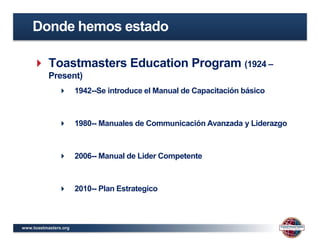
 Toastmasters Education Program (1924 –
Present)
 1942--Se introduce el Manual de Capacitación básico
 1980-- Manuales de Communicación Avanzada y Liderazgo
 2006-- Manual de Lider Competente
 2010-- Plan Estrategico
Donde hemos estado
www.toastmasters.org
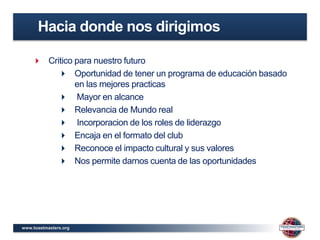
 Critico para nuestro futuro
 Oportunidad de tener un programa de educación basado
en las mejores practicas
 Mayor en alcance
 Relevancia de Mundo real
 Incorporacion de los roles de liderazgo
 Encaja en el formato del club
 Reconoce el impacto cultural y sus valores
 Nos permite darnos cuenta de las oportunidades
Hacia donde nos dirigimos
www.toastmasters.org
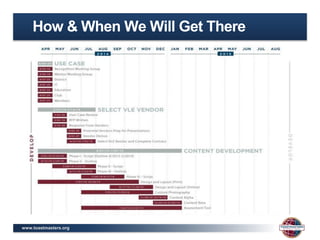
How & When We Will Get There
www.toastmasters.org
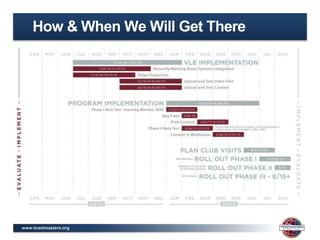
How & When We Will Get There
www.toastmasters.org
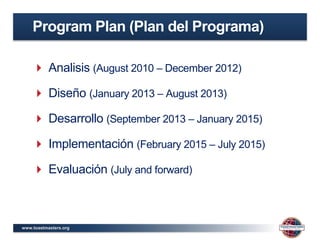
 Analisis (August 2010 – December 2012)
 Diseño (January 2013 – August 2013)
 Desarrollo (September 2013 – January 2015)
 Implementación (February 2015 – July 2015)
 Evaluación (July and forward)
Program Plan (Plan del Programa)
www.toastmasters.org
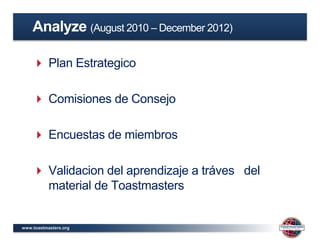
 Plan Estrategico
 Comisiones de Consejo
 Encuestas de miembros
 Validacion del aprendizaje a tráves del
material de Toastmasters
Analyze (August 2010 – December 2012)
www.toastmasters.org
 Competencias identificadas
Hablar en publico
 Comunicacion Interpersonal
 Liderazgo y Gestion
 Liderar Estratégicamente
 Contruyendo la Confianza
Diseño (January 2013 – August 2013)
www.toastmasters.org
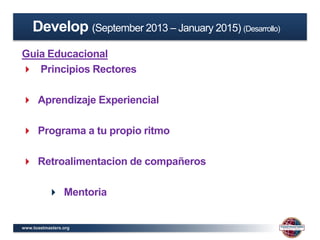
Guia Educacional
 Principios Rectores
 Aprendizaje Experiencial
 Programa a tu propio ritmo
 Retroalimentacion de compañeros
 Mentoria
Develop (September 2013 – January 2015) (Desarrollo)
www.toastmasters.org
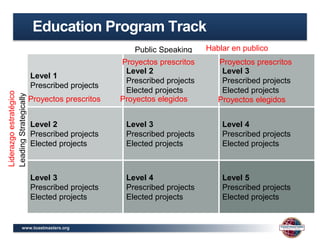
Education Program Track
Level 1
Prescribed projects
Level 2
Prescribed projects
Elected projects
Level 3
Prescribed projects
Elected projects
Level 2
Prescribed projects
Elected projects
Level 3
Prescribed projects
Elected projects
Level 4
Prescribed projects
Elected projects
Level 3
Prescribed projects
Elected projects
Level 4
Prescribed projects
Elected projects
Level 5
Prescribed projects
Elected projects
Public Speaking
LeadingStrategically
Level 1
Prescribed projects
Level 2
Prescribed projects
Elected projects
Level 3
Prescribed projects
Elected projects
Level 2
Prescribed projects
Elected projects
Level 3
Prescribed projects
Elected projects
Level 4
Prescribed projects
Elected projects
Level 3
Prescribed projects
Elected projects
Level 4
Prescribed projects
Elected projects
Level 5
Prescribed projects
Elected projects
Proyectos prescritos
Proyectos elegidos
Proyectos prescritos
Proyectos elegidos
Hablar en publico
Liderazgoestratégico
www.toastmasters.org
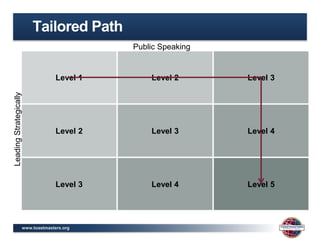
Tailored Path
Level 1 Level 2 Level 3
Level 2 Level 3 Level 4
Level 3 Level 4 Level 5
Public Speaking
LeadingStrategically
www.toastmasters.org
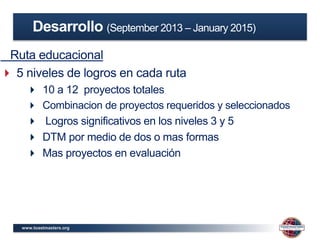
Ruta educacional
 5 niveles de logros en cada ruta
 10 a 12 proyectos totales
 Combinacion de proyectos requeridos y seleccionados
 Logros significativos en los niveles 3 y 5
 DTM por medio de dos o mas formas
 Mas proyectos en evaluación
Desarrollo (September 2013 – January 2015)
www.toastmasters.org
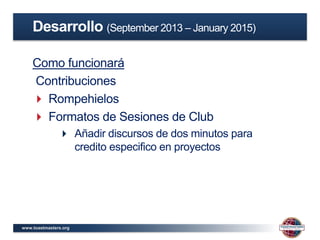
Como funcionará
Contribuciones
 Rompehielos
 Formatos de Sesiones de Club
 Añadir discursos de dos minutos para
credito especifico en proyectos
Desarrollo (September 2013 – January 2015)
www.toastmasters.org
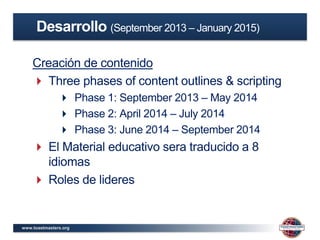
Creación de contenido
 Three phases of content outlines & scripting
 Phase 1: September 2013 – May 2014
 Phase 2: April 2014 – July 2014
 Phase 3: June 2014 – September 2014
 El Material educativo sera traducido a 8
idiomas
 Roles de lideres
Desarrollo (September 2013 – January 2015)
www.toastmasters.org
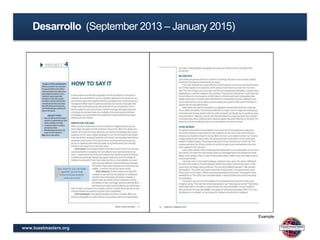
Example
Desarrollo (September 2013 – January 2015)
www.toastmasters.org
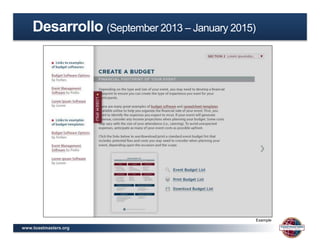
Example
Desarrollo (September 2013 – January 2015)
www.toastmasters.org
Example
Desarrollo (September 2013 – January 2015)
www.toastmasters.org
Example
Desarrollo (September 2013 – January 2015)
www.toastmasters.org
Example
Desarrollo (September 2013 – January 2015)
www.toastmasters.org
Example
Desarrollo (September 2013 – January 2015)
www.toastmasters.org
Formalizando a los Mentores
 Objetivo
 Proveer de un programa estandarizado donde la
experiencia de los mentores sirva de guia y
soporte para que su mentorizado crezca
 Requerimiento de elegibilidad para participación
 Virtual o en Persona
Desarrollo (September 2013 – January 2015)
www.toastmasters.org
Ambiente virtual de Aprendizaje
• Que es esto?
• Como sera usado?
•
• Por que es importante?
Desarrollo (September 2013 – January 2015)
www.toastmasters.org
Preparando nuestros miembros
 Cambio en la Dirección
 Influencia
 Maestros del aprendizaje
 Embajadores
 Consejero Regional
 Lideres del Distrito
Desarrollo (September 2013 – January 2015)
www.toastmasters.org
Reconcimiento
 Reconocimiento a Miembros en especifico
 Premios
 (Programa de club distinuido su impacto y
ajustes.
 (Programa de reconocimiento distinguido
impacto y ajustes)
Desarrollo (September 2013 – January 2015)
www.toastmasters.org
 Prueba beta (February – April 2015)
 Limpieza (April – May)
 Impresion de manuales y material de apoyo en Ingles
 2da prueba beta (May – June 2015)
 Lanzamiento (July/August 2015)
 Despliegue por tipo de usuario
 Nuevos miembros
 Miembros actuales
• Todos los miembros
• Programas paralelos
Implement (February 2015 – July 2015)
www.toastmasters.org
Una vez que se lanza el programa educativo
revitalizado, continuamente evaluaremos su
efectividad en todas sus formas, para
asegurarnos que esta cumpliendo con las
necesidades de sus miembros y es lo mejor
para el programa
Evaluación (July and forward)
www.toastmasters.org
• Producir un programa de clase mundial que
verdaderamente permita a sus miembros se
conviertan en comunicadores efectivos y lideres.
• Preservar la rica historia y cultura Toastmasters
• Comunicar a traves del proceso
Our Commitment
www.toastmasters.org
• Asistir a los webinars
• Presentarse a los eventos de distrito
• Asociarse con lideres de distrito
• Prueba beta
¿Cual es tu rol?
www.toastmasters.org
• Desarrollo
• Haciendo la diferencia
• Comunicación mejorada
Nuestra asociación con ustedes

Programa de revitalización para embajadores

Notas del editor

  • #3  Less than 10% of all members earn education awards. Additionally, the majority of Toastmasters members are getting bogged down in the current education program. On the average, it takes members more than 2 years to achieve the Competent Communicator Award It takes members 3 years to achieve the Competent Leader Award. And on the average, it takes members about 8 ½ years to earn their DTM When club presidents were asked what obstacles they faced, they told us that the education program is one of their biggest challenges—specifically, that it is difficult to understand and work in.
  • #4  In 1942, the Basic Training manual was introduced----that was the predecessor to today’s Competent Communication manual During the 1980s, the Advanced Communication and Leadership Program became integrated into the education system, and more manuals were developed. In 2006, the Competent Leader manual formally introduced recognition of leadership learning into the education program. In the 2010 Strategic Plan, the Board recognized the need to modernize the communication program and more completely support leadership learning as part of the member experience. Looking back, it’s clear that the education program was developed in building-block fashion---responses to member feedback and requests for more learning opportunities. There was never the benefit of a master plan. Which brings us to the need for a revitalized program.
  • #5  The revitalized education program is vital to our future. We must adapt to a changing world---and this is the best way to meet members’ needs in today’s global marketplace. To modernize our program and make it more relevant to the world today, we must use current best practices to help members grow, learn and meet their goals. This revitalized program is our opportunity to do that. If we do nothing to our education program, we will have low retention and moderate growth. This is the largest project the organization has ever undertaken and the deepest revision to the education program in our history. The program will enable members to develop communication and leadership skills that are relevant to their real-world goals and aspirations. The new program is being designed to help members succeed outside of Toastmasters in many ways. The importance of having projects with real-world application was reinforced by the feedback we received from Learning Masters. There will be a greater emphasis on leadership development and leadership roles in the program The program will continue to recognize and honor the cultural impacts and values of Toastmasters. This is a very exciting opportunity to take our program to the next level: to be a thought leader on communication and leadership to gain accreditations to provide greater benefit for members and potential members. The tangible benefits will replace anecdotal testimonies of the value of Toastmasters. This will also make the program more attractive to corporate clubs. This is in alignment with feedback from Learning Masters about more needing to be done to promote the benefits of Toastmasters. Early in the development stage of the project, it was realized that the scope of the project needed to be greater than originally anticipated to ensure the quality of the revitalized education program met what members expect of our organization. Increasing the scope of the project was based in part on the feedback Learning Masters provided, which helped us realize that more work needed to be done to improve the program.
  • #6  This timeline of the revitalization process is based on the “best-case scenario” --- in other words, this is the timeline if everything goes according to plan. If there are delays in any or all of these parts of the revitalization process, or if there are elements added to the process, these things will impact the timeline. Our commitment is to produce a program that is right and complete. The timeline is based on that. The program will launch when it’s ready.
  • #7  Same point: This is the timeline if everything goes according to plan; if there are delays, they will impact the timeline. Risks may include how long it takes for VLE implementation, beta testing and debugging.
  • #8  There is much more work to be done—the next few slides will define the program plan. This slide describes the ADDIE model, which is an acronym for : Analyze, Design, Develop, Implement and Evaluate. This is the model we are following throughout the revitalization process. The ADDIE model is one of the most important ones that is used by instructional designers and trainers. By using the five-process steps of ADDIE, we are able to determine the most effective and efficient way to develop a top-quality education program. The Analyze and Design phases of this process are completed, and the program is now in the Development phase.
  • #9  For the “Analyze” process (the “A” in ADDIE), we started with the Board’s 2010 Strategic Plan, which called for a modernized communication program and a renewed focus on leadership. Board committees focused on identifying the skills, competencies and attributes learned through the Toastmasters education program. Current and former members were surveyed so we could better understand what they’ve learned through the program. We evaluated all Toastmasters learning materials to validate where our materials fully support learning---and see where there are gaps
  • #10  In the Design phase (the first “D” in ADDIE), we narrowed down all the feedback we received from members to five core competencies that reflect the most valuable and fulfilling learning experience. These five competencies give members what they need to grow, learn and succeed in the world today. The five competencies, which the Learning Masters validated in a survey, are: Public Speaking (Public speaking builds members’ confidence in delivering both prepared and impromptu speeches in the Toastmasters club environment as well as their personal and professional lives. Through practice, peer evaluation and educational tools, members learn how to present their messages effectively, concisely and professionally. Interpersonal Communication (Interpersonal communication builds members’ confidence in communicating with others, whether verbally, non-verbally, in writing or via electronic methods. Members learn how to build relationships, resolve conflict and communicate well with others. ) Leading and Managing (There are different skill sets needed for both of these roles. Within the Toastmasters organization of clubs, areas, divisions and districts, managing deals mostly with planning, organizing and facilitating specific tasks (such as the club treasurer managing the club’s budget). Leading deals with people, whether they are individuals or groups.) Leading Strategically (This is the ability to see the big picture and have the ideas and vision to do things better, whether it’s build a more supportive club environment, lead a team, or attract and retain more members. The Toastmasters strategic leader has a vision that is both attainable and inspiring. He or she is able to bring about positive changes by inspiring others to get involved and help) Building Confidence (Through self-reflection and evaluation, members learn to acknowledge their flaws and embrace their capacity for self-improvement. By learning how to set goals and meet them, they gain confidence in their own knowledge, skills and abilities. ) Tailored learning paths for members were designed, and each path will have five levels of achievement.
  • #11  As we were building the foundation of the program, we considered our guiding principles to ensure that we weren’t altering what works in the club environment. This also ensures that our culture is preserved. These remain the four guiding principles of the Toastmasters education program: Experiential Learning Self-paced Program Peer Feedback Mentoring
  • #12 The tailored learning paths are the result of the emphasis on the five core competencies and four guiding principles of the education program. Learning paths will help members customize their learning to meet their personal and professional goals. This is an example of a learning path that incorporates “Leading Strategically” and “Public Speaking.”
  • #13 This is an example of one way a member could progress through the education program track.
  • #14  Each learning path will have five levels of achievement. The paths will progressively build in complexity, and at each level after level 1, members will use the skills learned at the previous level. Tailored learning paths are needed, because the education program can’t be a “one-size-fits-all” program---as the Learning Masters stressed in their input on the Toastmasters learning experience. Each member has his or her unique needs and interests, and this program will give them customized learning. Each path will feature 10 to 12 total projects. Each path will also have a mix of required and elective projects at every level, so that members will have variety. Level 3 and Level 5 will both require significant achievement. The highest level of achievement will still be called a DTM. To achieve this, members must successfully complete two or more learning paths. We are currently working on the specific names of recognition for members. This will go before the Board for approval. In the revitalized program, there will be more projects on evaluation---and members will receive more guidance on how to be an effective evaluator. This is a need that Learning Masters continually mentioned in their LinkedIn discussions.
  • #15  When members begin in the revitalized education program, they answer questions in a self-assessment to determine their educational goals and interests. Their answers determine their personally tailored learning path. The feedback that Learning Masters gave us will help inform the tone and structure of the assessment.  The Ice Breaker will be the first speech assignment on every tailored learning path, and then each path increases in complexity. The club experience, atmosphere and values will remain the same. Most  speeches will continue to be 5 to 7 minutes long. In the revitalized education program, two-minute speeches will be added for specific projects.
  • #16  First, the content development team develops outlines of the educational projects, then the team scripts the projects. The scripting of content refers to the exact wording and phrasing that will be used. There will be three phases to the scripting. Through this process, the design and purpose of the program comes through. Educational materials will be translated into eight languages Arabic Simplified Chinese Traditional Chinese French German Japanese Spanish Portuguese Leadership roles have been incorporated into the program to ensure significant increases in the complexity and measurement of this component of the program.
  • #17  You will see an exciting change in the approach to layout and design. This is an example of how densely worded our current manuals are. The next few examples will show the new interactive features of the digital portion of the revitalized education program.
  • #18  [Note to Dan: This is an example of a section of a project; “Create A Budget” is not its own project.] In the new program, the content will be visually appealing, concise, education-focused. There will be more than 100 interactive elements in the online portion of the revitalized program as well as 60-plus videos and other online resources. In the revitalized program, members will have online access to educational materials --- although they will also have the option of using print materials. This slide is an example of the interactive elements in the program. All of the examples we will look at here are from projects at Level 5. In the tab to the left of the page, there are links to tools that will help members learn more about how to create a budget.
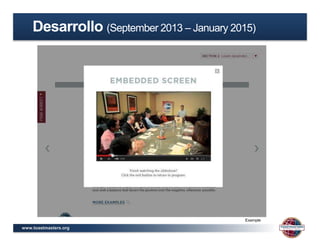
  • #19  The embedded screen will be some kind of interactive element that will pop up, such as a video.
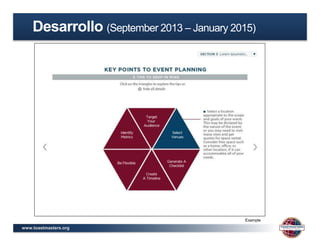
  • #20  For this element, you can click on a particular triangle and the text will pop up. Or you can show the text for all the triangles at once.
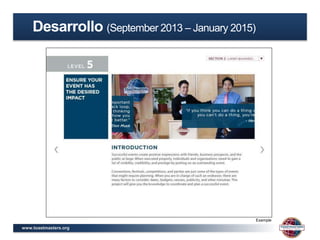
  • #21  In this example, quotes from prominent figures will continually rotate on the page. The different quotes keep sliding across the page, like a carousel The drop-down box at the upper right corner is used to navigate between sections in a project.
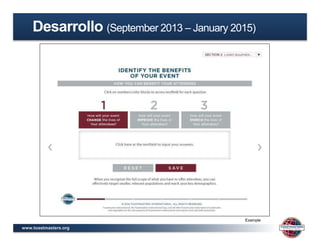
  • #22 In this example, the reader can click on each tab that has a question --- 1, 2 and 3 --- and write an answer in the space provided. Then later in the project, they can look at answers to those questions.
  • #23  The revitalized education program will include a formal mentoring program. The objective of this aspect is to provide a standardized program where experienced mentors encourage, guide, and support protégés to grow. The program is mutually beneficial to both members (mentor and member being mentored) by challenging them to achieve more than they thought they could. There will be eligibility requirements for being a mentor. Members will be able to work with a member “virtually” or in-person. The concept of a “virtual” mentor was shaped by feedback provided by Learning Masters.
  • #24  A virtual learning environment (VLE) is a set of teaching and learning tools designed to enhance the learning experience by including technology in the learning process. The VLE is where the members can work on their educational projects online. In the revitalized program, the VLE will allow members to interact with the educational content in many ways. For example, members can reinforce their learning by watching videos and taking quizzes. In addition, the VLE will automatically track members’ progress and achievement. The VLE will mirror the print content, but it will also enhance and deepen the experiencing of, and engagement with, that content. It adds a sense of immediate access for members. With this online component, members will be able to access all educational materials and related resources anywhere and anytime. The VLE make us modernized and current; having this tool means our competitors can’t get an edge on us by taking advantage of technology.
  • #25  Change Management Going forward, you will be provided with “sneak” previews of the design of the program and examples of the educational projects. You will continue to get updates on the revitalization project and learn about successes along the way. Because your input is highly valued, you and your team will have the opportunity to beta test the enhanced program. The Board and Region Advisors will be able to review the design of the revitalized program and to sample projects. They will be updated on the progress of the project, and will be beta testing the program. District leaders, we will also rely on your continued support going forward, such as your working smoothly with Chief Ambassadors. You, too , will be provided with “sneak” previews of the design of the program, and examples of the educational projects. Also, your Toastmasters knowledge and expertise will be relied on as we invite you to participate in beta testing of the program.
  • #26  All of these items will be brought before the Board for approval.
  • #27  Implement (February-July 1, 2015) Beta Test (February-April 2015) Learning Masters/BOD/RAs District Leaders/Chief Ambassadors/Ambassadors Debug (April-May) Print English manuals and supporting materials Soft launch (May-June 2015) Club leaders (VPEs, VPMs and Club Presidents, specifically) Influencers Launch – July/August 2015 (new members) Once the revitalized program is launched, the current and revitalized education programs will run concurrently for a minimum of 2 years.
  • #28  Once the revitalized education program launches, we will continually evaluate its effectiveness on all fronts, to make sure it is meeting members’ needs and is the best program possible.
  • #30  We’re going to give you updates about what to share as this information becomes available --- so we can’t give you specific timelines as of yet. A complete communication plan is being developed now and will be shared with you as soon as it’s finalized. This is going to require patience on your part, because all of the answers aren’t available today. In this webinar, we’re sharing everything we know, but there are many decisions, processes, and details that are evolving and will continue to evolve through beta testing. Over the next year, you’ll be asked to still attend webinars, lead your team of Ambassadors, present at district events, partner with your district leadership team, and participate in beta testing.
  • #31  Developing a project of this scale is a complex process. This is the first time members have been brought into the development of the program at this early of a stage and it has been a learning process for us. We know you care about this organization and about making an impact. Thank you again for your commitment.