y
._
Los seres vivos están
formados
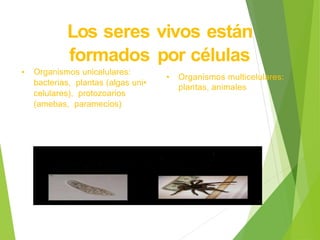
Organismos unicelulares:
bacterias, plantas (algas uni•
celulares), protozoarios
(amebas, paramecios)
por células
•
• Organismos multicelulares:
plantas, animales
Niveles de organización y propiedades emergentes
Qué es un ser vivo? Hay alguna definición?
Características?
-Diferencias con sistemas químicos:
-Capacidad de duplicarse
-Presencia
-Presencia
distinta del
de enzimas
de una membrana que
medio externo
le permite mantener una identidad química
Teoría celular
• Todos los organismos están compuestos por células: unicelulares, pluricelulares
•Toda célula proviene de una pre-existente
•las células contienen la información hereditaria de los organismos vivos y se
transmite
Virus y priones
Los virus y los priones no se
consideran seres vivos
Tipos
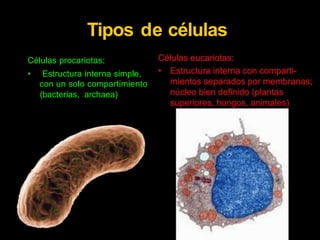
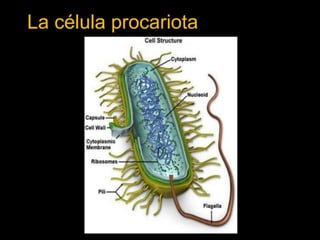
Células procariotas:
de células
• Estructura interna simple,
con un solo compartimiento
(bacterias, archaea)
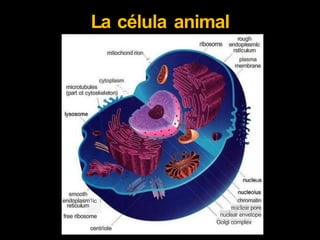
La célula animal
rough
endopresmlc
rstlcuíurn
plasma
membrane
ríbosoms
mitochond rion,
"-
cytoplasm
"-
microtubules
(part ot cytoskeleton) "'-

.,
smooth
endoplasm1ic / chromatin
nuclear pore
nuclear envetope
Golgl complex
reticuíum
free ribosome
centnole
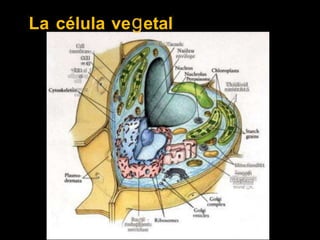
La célula
Cdl
1ncmhr.an~
e.cu
~tau"o
'ªf
ª
~dtoining
cdl
ve etal
'-==~1ai,.':acuolc
Nudcu
rnvdopr
Th)ukoid
n)tmbt:lM.5
A
Mmx:hondñi1
~mooth
ctldoplasmi~
micu(:¡¡n,
Rn,"h •
t'ndopb)mt:
ttti<'Ulunt
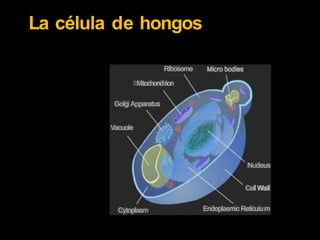
La célula de hongos
Ribosome
1Mitochondrion
GolgiApparatus
Vacuole
Nudeus
CellWall
Endoplasmic Reticulu m
Cytoplasm
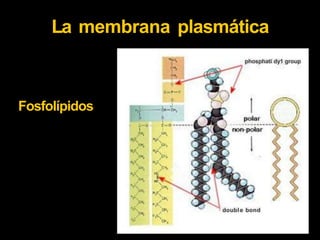
La membrana plasmática
phosphati dy1 group
Fosfolípidos
· double bond
Estructura de la membrana
plasmática
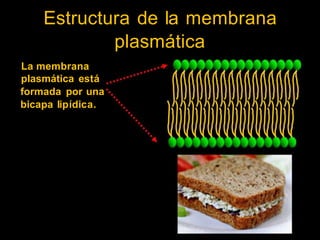
La membrana
plasmática está
formada por una
bicapa lipídica.
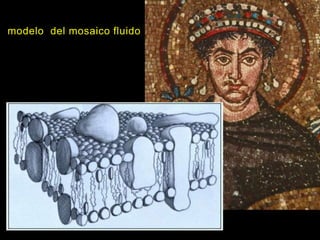
modelo del mosaico fluido
Estructura de la Membrana plasmática
-
-
~
·_
::,·_
::': ', ·
~~
--
-
~ ·.
- ~ ~ ~
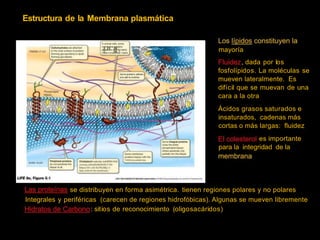
mayoría
, dada por los
fosfolípidos. La moléculas se
mueven lateralmente. Es
difícil que se muevan de una
cara a la otra
Ácidos grasos saturados e
insaturados, cadenas más
cortas o más largas: fluidez
es importante
para la integridad de la
OutSicleof cell
- .
• ; • • : , • • · ; ¡
• ; , ; .1 . ; . ;
1ntenorcy,oskele ton.
Cholesterol molecules intOf5P8<SO(f
¡wnong phospholpidtails in the
bilayer ín--.ce the fll.idty ol
lattyacidsín lile membrane .
lnslde olcell
se distribuyen en forma asimétrica. tienen regiones polares y no polares
Integrales y periféricas (carecen de regiones hidrofóbicas). Algunas se mueven libremente
: sitios de reconocimiento (oligosacáridos)
Funciones de la membrana
plasmática
• Barrera entre el
citoplasma
medio extracelular y el
• Soporte para receptores de hormonas y
neurotransmisores
• Soporte para transportadores de iones
y nutrientes
Transporte
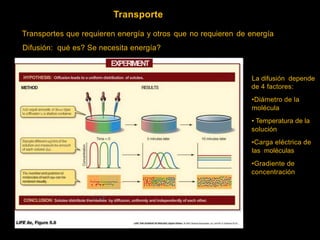
Transportes que requieren energía y otros
Difusión: qué es? Se necesita energía?
que no requieren de energía
EXPERIMENT
La difusión depende
de 4 factores:
•Diámetro de la
molécula
• Temperatura de la
solución
•Carga eléctrica de
las moléculas
•Gradiente de
concentración
HYPOTHESIS: Oiffusion leads to a uniform distribution of solutes.
METHOD RESULTS
Add equal amounts of three dyes
to s1
1
1
1water in a shallow container.
Sample different reg100Sof the
solubon and measure the amount
of each colored dye.
The numberandposnionol
moleculesofeachdye can be
renderedvisually. ·
.
·
·
.
·
·
.
·
.
·
·
·
·
·
.·
·
·
·
·
·
·
.
·
.
·
·
.
·
.
.
·
·
·
·
·
·
·
·
·
·
·
·
·
·
·
·
·
·
CONCLUSION: Solutes distribute themselves by diffusion, uniformly and independently of each other.
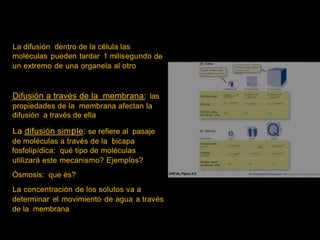
La difusión dentro de la célula las
moléculas pueden tardar 1 milisegundo
un extremo de una organela al otro
de
Smaller surface 1
1
rea
comparad to
volum,
6sides'x 12
~
2-mmcube
6 sides x 2>:
24mm2
2J
1-mmcube 4-mmcuba
2
Difusión a través de la membrana: las 6 sídes x 4
96mlT'2
Surface area 6mm2
¡3 - 1mm3
propiedades de la membrana afectan la
difusión a través de ella
64 mm3
4l
Bmm~
Volume
Surface area-
to-volume ratio
6:1 3:1 1.5:1
Q
"1
2
.
b
6
µ
m
La difusión sim le: se refiere al pasaje o
1 µm
(B) Spheres
de moléculas a través de la bicapa
fosfolipídica: qué tipo de moléculas
utilizará este mecanismo? Ejemplos?
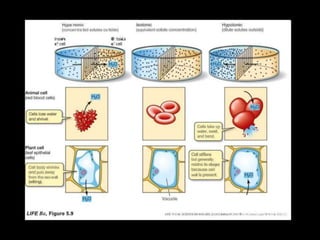
Ósmosis: que és?
La concentración de los solutos va a
determinar el movimiento de agua a través
de la membrana
0,ameter
Surface area
4 n r
2¡,m 3µrn
2 2
3.14 µm2 28.26 µm
Volume 14.18µm3
0.52 µm3 4.19¡un "
'
n
r
Suñace area-
to-volume ratio 6:1 3:1 2:1
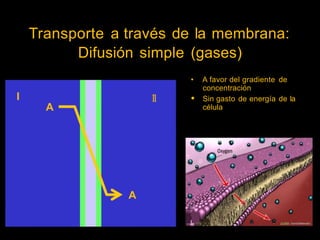
Transporte a través de la membrana:
Difusión simple (gases)
• A favor del gradiente
concentración
de
1
1 • Sin gasto
célula
de energía de la
,. .
~~- ,,
~r..,-.•,•n1~m)~,:I:,J; ~ • @2006 1-towStuttworks
.
lsotonic
(equivalenl solute conoentration)
Hypotonic
(dilute solutes outside}
Hype rtonic
.:
(concen tra ted solutes ou tside)
. .:
.
. .
Cells take up
water, swell,
and berst.
Cell stíffens
but generally
retalns its shape
because oell
wall Is present.
Cell body shrinks
and puls away
from the oeawall
(wilting).
Vacuole
LIFE Be, Figure 5.9 UFE: T > I E SCIENCE OF 8101.00Y, E,vN/1 Edllon O 2007 S - ~ l n c . a,w;! W H.~ & Co .
Difusión facilitada
Canales
A polar substance is more concentrated
on the outside tnan the inside of the cell.
de iones lo atraviesan
segundo
por
Outslde of cell
o
o o
o
o o
Stimulus
m o l e c u l e "
o
o
o o
o
El agua?
Iones hidratados
acuaporinas
..:
--i:-:)r:f·:rt: :ti-"1.4
o-rI:1-rYíl..-.il'r'
,u*ErfT1rr1tfrcT
i* rf ,w
o
o o
filatil J],
J'
. --••:. •-
. . .
lnside ot cell 3 • • - •• • -
m_ 11~ 11JJ1l1rt
,,....,.,.:!1-P.~
(: ll..HI
Difusión
Proteínas
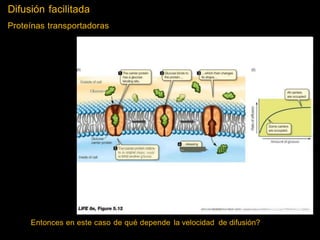
facilitada
transportadoras
(B)
Outside of cell
Gluoose
Amou nt of glueose
Toecamerproteh rettms
to its orighal shape, ready
to bind another glcose.
~ il!:
UF'e THE SCIEHCf!OF BlOI. OOY. EJpM/1 Edllon O 2007 5......,_..,lnc. """W H. r-......, & Co.
Entonces en este caso de qué depende la velocidad de difusión?
Difusión facilitada
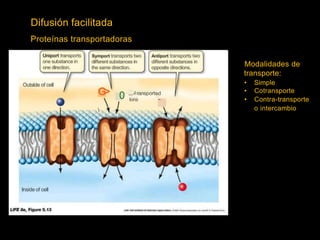
Proteínas transportadoras
Symport transports two
different substances in
the same direction.
Antiport transports two
different substances in
opposite directions.
Modalidades de
transporte:
one direction.
•
•
•
Simple
Cotransporte
Contra-transporte
Outside of cell
G
> 0 .....-!ransported

tons ~
o intercambio
lnside of cell
¿Qué pasa si vamos en contra de un gradiente de concentración
respecto de la energía?
Transporte activo
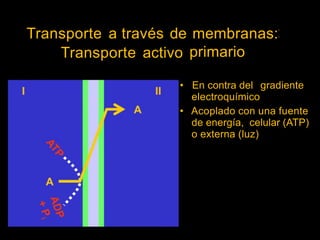
Transporte a través de membranas:
primario
Transporte activo
• En contra del
electroquímico
gradiente
• Acoplado con una fuente
de energía, celular (ATP)
o externa (luz)
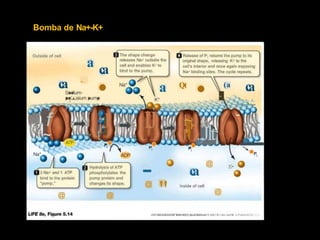
Bomba de Na+-K+
The shape change
releases Na+ outside the
cell and enables K• to
blnd to the pump.
., Ralease of P¡ returns the pump to its
original shape, releasing K+ to the
cell's interior and once again exposing
Na• binding sites. The cycle repeats.
Outside of cell
a
~
c
a
• •
c
a a c
a
'
-·
-
.
·
-
-
(a
Qt
.... . .
¡:J
- - 1 ~
~
- ' '
1
'
l'J
•
-
·
.
' '
""'"-"'-~.....-
,,,,f
.
.f~
l
~
¡
,
J
l'I
•
'K.
.,Jlt¡
t .
·
. 1 . . • . . . . . . . . .
1
•
.
@ K
•
c
a
lnside of cell
Hydrolysís of ATP
phosphorylates the
pump protein and
changas its shape.
3 Na+ and 1 ATP
bind to the protein
"pump."
"
@
@
@ @
UFE! THE SCIENCE OF BIOI.OOY, Elr,ltUt Edltlott O 2007 S.--lnc. ond W. H. F,wnin & Co.
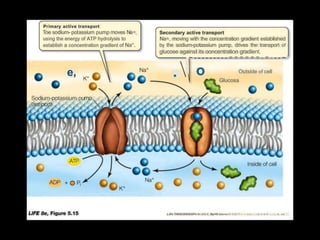
Primary active transport
Toe sodium- potassium pump moves Na+,
using the energy of ATP hydrolysis to
establish a concentration gradlent of Na".
Secondary active transport
Na+, moving with the concentration gradient established
by the sodium-potassium pump, drives the transport of
glucose against its ooncentration gradient.
~ - - - - - - - - - = = = = = = - = - - - ~
o
.
e, Outside of cell
Glucosa
Sodium-potassium pu
L.IFe THESCENCEOF8 / 0 l . O G Y, Bp/WI EdlCfon O 2 0 0 7 ~ ~ 1 n c . . - i d I'/, H- F. . . ,,., $ . ce,
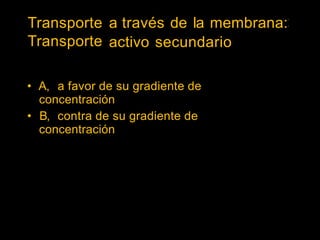
Transporte
Transporte
a través de la membrana:
activo secundario
• A, a favor de su gradiente de
concentración
• B, contra de su gradiente de
concentración

Célula, membrana celular curso dt.pptx

  • 1.
  • 2.
    Los seres vivosestán formados Organismos unicelulares: bacterias, plantas (algas uni• celulares), protozoarios (amebas, paramecios) por células • • Organismos multicelulares: plantas, animales
  • 3.
    Niveles de organizacióny propiedades emergentes Qué es un ser vivo? Hay alguna definición? Características? -Diferencias con sistemas químicos: -Capacidad de duplicarse -Presencia -Presencia distinta del de enzimas de una membrana que medio externo le permite mantener una identidad química Teoría celular • Todos los organismos están compuestos por células: unicelulares, pluricelulares •Toda célula proviene de una pre-existente •las células contienen la información hereditaria de los organismos vivos y se transmite
  • 4.
    Virus y priones Losvirus y los priones no se consideran seres vivos
  • 5.
    Tipos Células procariotas: de células •Estructura interna simple, con un solo compartimiento (bacterias, archaea)
  • 7.
    La célula animal rough endopresmlc rstlcuíurn plasma membrane ríbosoms mitochondrion, "- cytoplasm "- microtubules (part ot cytoskeleton) "'- ., smooth endoplasm1ic / chromatin nuclear pore nuclear envetope Golgl complex reticuíum free ribosome centnole
  • 8.
  • 9.
    La célula dehongos Ribosome 1Mitochondrion GolgiApparatus Vacuole Nudeus CellWall Endoplasmic Reticulu m Cytoplasm
  • 10.
    La membrana plasmática phosphatidy1 group Fosfolípidos · double bond
  • 11.
    Estructura de lamembrana plasmática La membrana plasmática está formada por una bicapa lipídica.
  • 12.
  • 13.
    Estructura de laMembrana plasmática - - ~ ·_ ::,·_ ::': ', · ~~ -- - ~ ·. - ~ ~ ~ mayoría , dada por los fosfolípidos. La moléculas se mueven lateralmente. Es difícil que se muevan de una cara a la otra Ácidos grasos saturados e insaturados, cadenas más cortas o más largas: fluidez es importante para la integridad de la OutSicleof cell - . • ; • • : , • • · ; ¡ • ; , ; .1 . ; . ; 1ntenorcy,oskele ton. Cholesterol molecules intOf5P8<SO(f ¡wnong phospholpidtails in the bilayer ín--.ce the fll.idty ol lattyacidsín lile membrane . lnslde olcell se distribuyen en forma asimétrica. tienen regiones polares y no polares Integrales y periféricas (carecen de regiones hidrofóbicas). Algunas se mueven libremente : sitios de reconocimiento (oligosacáridos)
  • 14.
    Funciones de lamembrana plasmática • Barrera entre el citoplasma medio extracelular y el • Soporte para receptores de hormonas y neurotransmisores • Soporte para transportadores de iones y nutrientes
  • 15.
    Transporte Transportes que requierenenergía y otros Difusión: qué es? Se necesita energía? que no requieren de energía EXPERIMENT La difusión depende de 4 factores: •Diámetro de la molécula • Temperatura de la solución •Carga eléctrica de las moléculas •Gradiente de concentración HYPOTHESIS: Oiffusion leads to a uniform distribution of solutes. METHOD RESULTS Add equal amounts of three dyes to s1 1 1 1water in a shallow container. Sample different reg100Sof the solubon and measure the amount of each colored dye. The numberandposnionol moleculesofeachdye can be renderedvisually. · . · · . · · . · . · · · · · .· · · · · · · . · . · · . · . . · · · · · · · · · · · · · · · · · · CONCLUSION: Solutes distribute themselves by diffusion, uniformly and independently of each other.
  • 16.
    La difusión dentrode la célula las moléculas pueden tardar 1 milisegundo un extremo de una organela al otro de Smaller surface 1 1 rea comparad to volum, 6sides'x 12 ~ 2-mmcube 6 sides x 2>: 24mm2 2J 1-mmcube 4-mmcuba 2 Difusión a través de la membrana: las 6 sídes x 4 96mlT'2 Surface area 6mm2 ¡3 - 1mm3 propiedades de la membrana afectan la difusión a través de ella 64 mm3 4l Bmm~ Volume Surface area- to-volume ratio 6:1 3:1 1.5:1 Q "1 2 . b 6 µ m La difusión sim le: se refiere al pasaje o 1 µm (B) Spheres de moléculas a través de la bicapa fosfolipídica: qué tipo de moléculas utilizará este mecanismo? Ejemplos? Ósmosis: que és? La concentración de los solutos va a determinar el movimiento de agua a través de la membrana 0,ameter Surface area 4 n r 2¡,m 3µrn 2 2 3.14 µm2 28.26 µm Volume 14.18µm3 0.52 µm3 4.19¡un " ' n r Suñace area- to-volume ratio 6:1 3:1 2:1
  • 17.
    Transporte a travésde la membrana: Difusión simple (gases) • A favor del gradiente concentración de 1 1 • Sin gasto célula de energía de la ,. . ~~- ,, ~r..,-.•,•n1~m)~,:I:,J; ~ • @2006 1-towStuttworks
  • 18.
    . lsotonic (equivalenl solute conoentration) Hypotonic (dilutesolutes outside} Hype rtonic .: (concen tra ted solutes ou tside) . .: . . . Cells take up water, swell, and berst. Cell stíffens but generally retalns its shape because oell wall Is present. Cell body shrinks and puls away from the oeawall (wilting). Vacuole LIFE Be, Figure 5.9 UFE: T > I E SCIENCE OF 8101.00Y, E,vN/1 Edllon O 2007 S - ~ l n c . a,w;! W H.~ & Co .
  • 19.
    Difusión facilitada Canales A polarsubstance is more concentrated on the outside tnan the inside of the cell. de iones lo atraviesan segundo por Outslde of cell o o o o o o Stimulus m o l e c u l e " o o o o o El agua? Iones hidratados acuaporinas ..: --i:-:)r:f·:rt: :ti-"1.4 o-rI:1-rYíl..-.il'r' ,u*ErfT1rr1tfrcT i* rf ,w o o o filatil J], J' . --••:. •- . . . lnside ot cell 3 • • - •• • - m_ 11~ 11JJ1l1rt ,,....,.,.:!1-P.~ (: ll..HI
  • 20.
    Difusión Proteínas facilitada transportadoras (B) Outside of cell Gluoose Amount of glueose Toecamerproteh rettms to its orighal shape, ready to bind another glcose. ~ il!: UF'e THE SCIEHCf!OF BlOI. OOY. EJpM/1 Edllon O 2007 5......,_..,lnc. """W H. r-......, & Co. Entonces en este caso de qué depende la velocidad de difusión?
  • 21.
    Difusión facilitada Proteínas transportadoras Symporttransports two different substances in the same direction. Antiport transports two different substances in opposite directions. Modalidades de transporte: one direction. • • • Simple Cotransporte Contra-transporte Outside of cell G > 0 .....-!ransported tons ~ o intercambio lnside of cell
  • 22.
    ¿Qué pasa sivamos en contra de un gradiente de concentración respecto de la energía? Transporte activo
  • 23.
    Transporte a travésde membranas: primario Transporte activo • En contra del electroquímico gradiente • Acoplado con una fuente de energía, celular (ATP) o externa (luz)
  • 24.
    Bomba de Na+-K+ Theshape change releases Na+ outside the cell and enables K• to blnd to the pump. ., Ralease of P¡ returns the pump to its original shape, releasing K+ to the cell's interior and once again exposing Na• binding sites. The cycle repeats. Outside of cell a ~ c a • • c a a c a ' -· - . · - - (a Qt .... . . ¡:J - - 1 ~ ~ - ' ' 1 ' l'J • - · . ' ' ""'"-"'-~.....- ,,,,f . .f~ l ~ ¡ , J l'I • 'K. .,Jlt¡ t . · . 1 . . • . . . . . . . . . 1 • . @ K • c a lnside of cell Hydrolysís of ATP phosphorylates the pump protein and changas its shape. 3 Na+ and 1 ATP bind to the protein "pump." " @ @ @ @ UFE! THE SCIENCE OF BIOI.OOY, Elr,ltUt Edltlott O 2007 S.--lnc. ond W. H. F,wnin & Co.
  • 25.
    Primary active transport Toesodium- potassium pump moves Na+, using the energy of ATP hydrolysis to establish a concentration gradlent of Na". Secondary active transport Na+, moving with the concentration gradient established by the sodium-potassium pump, drives the transport of glucose against its ooncentration gradient. ~ - - - - - - - - - = = = = = = - = - - - ~ o . e, Outside of cell Glucosa Sodium-potassium pu L.IFe THESCENCEOF8 / 0 l . O G Y, Bp/WI EdlCfon O 2 0 0 7 ~ ~ 1 n c . . - i d I'/, H- F. . . ,,., $ . ce,
  • 26.
    Transporte Transporte a través dela membrana: activo secundario • A, a favor de su gradiente de concentración • B, contra de su gradiente de concentración