Integrante: Daniel Rodríguez.
C.I.: V.- 26.007.031.
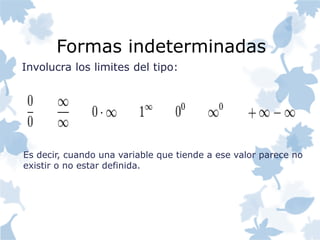
Formas indeterminadas
Es decir, cuando una variable que tiende a ese valor parece no
existir o no estar definida.
Involucra los limites del tipo:
Forma 0/0
Forma ∞/ ∞
FORMA 0*∞
Forma ∞-∞
Formas 1∞ ,∞0 , 00
Guillaume Françoise
Antoine Marqués De
L’Hopital
Regla de L’Hopital
Supongamos que existen 2 funciones f y g, las cuales están
definidas dentro de un intervalo (a,b) excepto tal ves en un
valor c dentro del mismo intervalo.
Si ambas funciones son derivables, entonces, si existe el limite
de la función en el valor c.
si es o
Entonces → =
DEFINICION
EJERCICIOS
Indeterminación tipo: o/01)
2 X3
lim ⎯⎯⎯⎯⎯⎯⎯⎯⎯⎯ =
x→0 x - SIN(x)
6 X2
lim ⎯⎯⎯⎯⎯⎯⎯⎯⎯ =
x→0 1 - COS(x)
12·x
Lim ⎯⎯⎯⎯⎯⎯ =
x→0 SIN(x)
12
Lim ⎯⎯⎯⎯⎯⎯ =
x→0 COS(x)
2)
LN(1 + 6·x)
lim ⎯⎯⎯⎯⎯⎯⎯⎯⎯⎯⎯ =
x→0 x
6
⎯⎯⎯⎯⎯⎯⎯
lim 1 + 6·x
=
x→0 ⎯⎯⎯⎯⎯⎯⎯⎯⎯
1
6
lim ⎯⎯⎯⎯⎯⎯⎯ =
x→0 1 + 6·x
12
6
Indeterminación tipo: ∞/∞
1)
LN(x)
lim ⎯⎯⎯⎯⎯⎯ =
x→ ∞ x2 + 2
1/x
lim ⎯⎯⎯ =
x→∞ 2·x
1
lim ⎯⎯⎯⎯ =
x→∞ 2x2
1
⎯⎯⎯ =
∞
0
2)
x
lim ⎯⎯⎯⎯⎯⎯⎯⎯⎯⎯
=
x→∞ LN(x) 3 - 2·x
1
lim ⎯⎯⎯⎯⎯⎯⎯⎯⎯⎯⎯⎯⎯⎯⎯
=
x→∞ 3·LN(x)·2 (1/x)+
2
1/
2
Indeterminación tipo: ∞-∞1)
⎛ 1 1 ⎞
lim ⎯ - ⎯⎯⎯⎯ =
x→0⎝ x SIN(x) ⎠
SIN(x) - x
lim ⎯⎯⎯⎯⎯⎯⎯⎯⎯ =
x→0 x·SIN(x)
COS(x) - 1
lim ⎯⎯⎯⎯⎯⎯⎯⎯⎯⎯⎯⎯⎯⎯⎯
x→0 SIN(x) + x·COS(x)
- SIN(x)
lim ⎯⎯⎯⎯⎯⎯⎯⎯⎯⎯⎯⎯⎯⎯⎯⎯⎯⎯⎯⎯⎯ =
x→0 COS(x) + COS(x) - x·SIN(x)
0
⎯⎯⎯ =
2
2)
lim [LN(x + 1) - LN(x)]
=
x→∞
lim LN [(x + 1)/x ] = lim LN [1 + 1/x ] = LN 1
=
x→∞ x→∞
0
0
Indeterminación tipo: ∞-∞3)
⎛ 1 1
⎞
lim ⎯⎯⎯⎯⎯⎯⎯⎯ - ⎯
=
x→0 ⎝ LN(1 + x) x ⎠
x - LN(1 +
x)
lim ⎯⎯⎯⎯⎯⎯⎯⎯⎯⎯⎯
=
x→0 x·LN(1 + x)
1
1 -
⎯⎯⎯⎯⎯
1 +
x
lim ⎯⎯⎯⎯⎯⎯⎯⎯⎯⎯⎯⎯⎯⎯
x→0
x
LN(1 + x) +
⎯⎯⎯⎯
1 + x
1 + x - 1
⎯⎯⎯⎯⎯⎯⎯⎯
1 + x
lim ⎯⎯⎯⎯⎯⎯⎯⎯⎯⎯⎯⎯⎯⎯⎯⎯⎯⎯⎯
=
x→0 (1 + x)·LN(1 + x)
+ x
⎯⎯⎯⎯⎯⎯⎯⎯⎯⎯⎯⎯⎯⎯⎯⎯⎯
1 + x
1
lim ⎯⎯⎯⎯⎯⎯⎯⎯⎯⎯⎯⎯⎯⎯⎯⎯⎯⎯⎯⎯⎯
=
x→0 LN(1 + x) + x·LN(1 +
x) + x
1
lim ⎯⎯⎯⎯⎯⎯⎯⎯⎯⎯⎯⎯⎯⎯⎯⎯⎯⎯⎯⎯⎯⎯⎯⎯⎯⎯⎯ =
x→0 1 x
⎯⎯⎯⎯⎯ + LN(1 + x) + ⎯⎯⎯⎯ + 1
1 + x 1 + x
1/
2
Indeterminación tipo: 0*∞
1)
lim x·LN(x) → g →
x→0 ⎯⎯⎯
1 /f
Se transforma la función en 0/0 o ∞ /∞ reescribiendo f*g
= f o
⎯⎯⎯
1/ g
g según convenga.
⎯⎯⎯
1 /f
LN(x)
lim ⎯⎯⎯⎯⎯ =
x→0 1 / x
1 /x
lim ⎯⎯⎯⎯⎯⎯ =
x→0 -1 /X2
lim -x =
x→0
0
2)
lim (TAN(x) -
1)(SEC(2)·x) =
x→ /4
TAN(x) - 1
0
lim ⎯⎯⎯⎯⎯⎯⎯⎯⎯⎯ =
⎯
x→ /4 COS(2)·x
0
1 + TAN2(x)
lim ⎯⎯⎯⎯⎯⎯⎯⎯⎯⎯⎯ =
x→ /4 - 2·SIN(2)·x
-
1
Indeterminación tipo: 1∞ ,∞0
, 00
1) Forma 1∞
1/COS(x)
lim (1 + 2·COS(x))
x→ /2
Suponemos que la solución del limite es A.
1/COS(x)
A= lim (1 + 2·COS(x))
x→ /2
Bajamos el exponente con LN.
LN A= lim 1 LN(1 +
2·COS(x))
x→ /2 ⎯⎯⎯⎯⎯
→
COS(x)
LN(1 + 2·COS(x)) 0
LN A= lim ⎯⎯⎯⎯⎯⎯⎯⎯⎯⎯⎯⎯⎯⎯⎯⎯ = ⎯⎯⎯
x→ /2 COS(x) 0
Aplicamos L`Hopital
- 2·SIN(x)
Lim ⎯⎯⎯⎯⎯⎯⎯⎯⎯⎯⎯
x→ /2 1 + 2·COS(x)
=
⎯⎯⎯⎯⎯⎯⎯⎯⎯⎯⎯⎯⎯⎯
- SIN(x)
2
lim ⎯⎯⎯⎯⎯⎯⎯⎯⎯⎯⎯⎯ =
2
x→ /2 1 + 2·COS(x)
LN A= 2 → e2 = A .∙.
Para resolverlas tomamos logaritmos naturales, consiguiendo bajar el
exponente. El logaritmo de una potencia es igual al exponente por el logaritmo
de la base:
LN ab = b LN a.
e2
Indeterminación tipo: 1∞ ,∞0
, 00
2) Forma ∞0
lim ⎛ 1 ⎞
TAN(x)
x→0 ⎯⎯
=
⎝ x2 ⎠
LN A = lim TAN(x) LN[ 1/
x2 ]
x→0
=
LN A = lim TAN(x) [LN1-
LN x2 ]
x→0
LN A = lim TAN(x)[-
2LN x ]
x→0
=
LN A = -2 lim TAN(x)[LN x ]
x→0 = 0* ∞
Convertimos a g
→
⎯⎯⎯
1 /f
LN(x)
-2 lim ⎯⎯⎯⎯⎯⎯⎯⎯ =
∞/∞
x→0 1/TAN(x)
Aplicamos
L`Hopital
1 / x
-2 lim ⎯⎯⎯⎯⎯⎯⎯⎯⎯⎯⎯
=
x→0 -1/ SIN2 (x)
SIN2 (x)
-2 lim ⎯⎯⎯⎯⎯⎯⎯
=
x→0 x
2·SIN(x)·COS(x)
lim ⎯⎯⎯⎯⎯⎯⎯⎯⎯⎯⎯⎯⎯ = 2*0 = 0
x→0 1
LN A= 0 → e0 = A .∙.1
Indeterminación tipo: 1∞ ,∞0
, 00
3) Forma 00
lim X x =
x→0
LN A= lim X LN X =
0* ∞
x→0
Convertimos a g →
⎯⎯⎯
1 /f
LN(x)
lim ⎯⎯⎯⎯⎯ =
∞/∞
x→0 1/ x
Aplicamos L`Hopital
1 /x
lim ⎯⎯⎯⎯⎯⎯ =
x→0 -1 /X2
lim -x = 0
x→0
1LN A= 0 → e0 = A .∙.
Indeterminación tipo: 1∞ ,∞0
, 00
3) Forma 00
1e0 =
lim X tanx
x→0 =
LN A= lim TAN(x) LN(x)
x→0 =
lim e tanxlnx
x→0 =
LN(x)
e lim e ⎯⎯⎯⎯⎯⎯
=
x→0 COT(x)
-1/ x
e^ lim [ ⎯⎯⎯⎯⎯⎯ ] =
x→0 CSC2 (x)
-SIN 2 (x)
e^ lim [ ⎯⎯⎯⎯⎯⎯ ]
x→0 x
e^ lim [-
2·SIN(x)·COS(x)] =
x→0

Formas indeterminadas. daniel

  • 1.
  • 2.
    Formas indeterminadas Es decir,cuando una variable que tiende a ese valor parece no existir o no estar definida. Involucra los limites del tipo:
  • 3.
  • 4.
  • 5.
  • 6.
  • 7.
  • 8.
  • 9.
    Regla de L’Hopital Supongamosque existen 2 funciones f y g, las cuales están definidas dentro de un intervalo (a,b) excepto tal ves en un valor c dentro del mismo intervalo. Si ambas funciones son derivables, entonces, si existe el limite de la función en el valor c.
  • 10.
    si es o Entonces→ = DEFINICION
  • 11.
  • 12.
    Indeterminación tipo: o/01) 2X3 lim ⎯⎯⎯⎯⎯⎯⎯⎯⎯⎯ = x→0 x - SIN(x) 6 X2 lim ⎯⎯⎯⎯⎯⎯⎯⎯⎯ = x→0 1 - COS(x) 12·x Lim ⎯⎯⎯⎯⎯⎯ = x→0 SIN(x) 12 Lim ⎯⎯⎯⎯⎯⎯ = x→0 COS(x) 2) LN(1 + 6·x) lim ⎯⎯⎯⎯⎯⎯⎯⎯⎯⎯⎯ = x→0 x 6 ⎯⎯⎯⎯⎯⎯⎯ lim 1 + 6·x = x→0 ⎯⎯⎯⎯⎯⎯⎯⎯⎯ 1 6 lim ⎯⎯⎯⎯⎯⎯⎯ = x→0 1 + 6·x 12 6
  • 13.
    Indeterminación tipo: ∞/∞ 1) LN(x) lim⎯⎯⎯⎯⎯⎯ = x→ ∞ x2 + 2 1/x lim ⎯⎯⎯ = x→∞ 2·x 1 lim ⎯⎯⎯⎯ = x→∞ 2x2 1 ⎯⎯⎯ = ∞ 0 2) x lim ⎯⎯⎯⎯⎯⎯⎯⎯⎯⎯ = x→∞ LN(x) 3 - 2·x 1 lim ⎯⎯⎯⎯⎯⎯⎯⎯⎯⎯⎯⎯⎯⎯⎯ = x→∞ 3·LN(x)·2 (1/x)+ 2 1/ 2
  • 14.
    Indeterminación tipo: ∞-∞1) ⎛1 1 ⎞ lim ⎯ - ⎯⎯⎯⎯ = x→0⎝ x SIN(x) ⎠ SIN(x) - x lim ⎯⎯⎯⎯⎯⎯⎯⎯⎯ = x→0 x·SIN(x) COS(x) - 1 lim ⎯⎯⎯⎯⎯⎯⎯⎯⎯⎯⎯⎯⎯⎯⎯ x→0 SIN(x) + x·COS(x) - SIN(x) lim ⎯⎯⎯⎯⎯⎯⎯⎯⎯⎯⎯⎯⎯⎯⎯⎯⎯⎯⎯⎯⎯ = x→0 COS(x) + COS(x) - x·SIN(x) 0 ⎯⎯⎯ = 2 2) lim [LN(x + 1) - LN(x)] = x→∞ lim LN [(x + 1)/x ] = lim LN [1 + 1/x ] = LN 1 = x→∞ x→∞ 0 0
  • 15.
    Indeterminación tipo: ∞-∞3) ⎛1 1 ⎞ lim ⎯⎯⎯⎯⎯⎯⎯⎯ - ⎯ = x→0 ⎝ LN(1 + x) x ⎠ x - LN(1 + x) lim ⎯⎯⎯⎯⎯⎯⎯⎯⎯⎯⎯ = x→0 x·LN(1 + x) 1 1 - ⎯⎯⎯⎯⎯ 1 + x lim ⎯⎯⎯⎯⎯⎯⎯⎯⎯⎯⎯⎯⎯⎯ x→0 x LN(1 + x) + ⎯⎯⎯⎯ 1 + x 1 + x - 1 ⎯⎯⎯⎯⎯⎯⎯⎯ 1 + x lim ⎯⎯⎯⎯⎯⎯⎯⎯⎯⎯⎯⎯⎯⎯⎯⎯⎯⎯⎯ = x→0 (1 + x)·LN(1 + x) + x ⎯⎯⎯⎯⎯⎯⎯⎯⎯⎯⎯⎯⎯⎯⎯⎯⎯ 1 + x 1 lim ⎯⎯⎯⎯⎯⎯⎯⎯⎯⎯⎯⎯⎯⎯⎯⎯⎯⎯⎯⎯⎯ = x→0 LN(1 + x) + x·LN(1 + x) + x 1 lim ⎯⎯⎯⎯⎯⎯⎯⎯⎯⎯⎯⎯⎯⎯⎯⎯⎯⎯⎯⎯⎯⎯⎯⎯⎯⎯⎯ = x→0 1 x ⎯⎯⎯⎯⎯ + LN(1 + x) + ⎯⎯⎯⎯ + 1 1 + x 1 + x 1/ 2
  • 16.
    Indeterminación tipo: 0*∞ 1) limx·LN(x) → g → x→0 ⎯⎯⎯ 1 /f Se transforma la función en 0/0 o ∞ /∞ reescribiendo f*g = f o ⎯⎯⎯ 1/ g g según convenga. ⎯⎯⎯ 1 /f LN(x) lim ⎯⎯⎯⎯⎯ = x→0 1 / x 1 /x lim ⎯⎯⎯⎯⎯⎯ = x→0 -1 /X2 lim -x = x→0 0 2) lim (TAN(x) - 1)(SEC(2)·x) = x→ /4 TAN(x) - 1 0 lim ⎯⎯⎯⎯⎯⎯⎯⎯⎯⎯ = ⎯ x→ /4 COS(2)·x 0 1 + TAN2(x) lim ⎯⎯⎯⎯⎯⎯⎯⎯⎯⎯⎯ = x→ /4 - 2·SIN(2)·x - 1
  • 17.
    Indeterminación tipo: 1∞,∞0 , 00 1) Forma 1∞ 1/COS(x) lim (1 + 2·COS(x)) x→ /2 Suponemos que la solución del limite es A. 1/COS(x) A= lim (1 + 2·COS(x)) x→ /2 Bajamos el exponente con LN. LN A= lim 1 LN(1 + 2·COS(x)) x→ /2 ⎯⎯⎯⎯⎯ → COS(x) LN(1 + 2·COS(x)) 0 LN A= lim ⎯⎯⎯⎯⎯⎯⎯⎯⎯⎯⎯⎯⎯⎯⎯⎯ = ⎯⎯⎯ x→ /2 COS(x) 0 Aplicamos L`Hopital - 2·SIN(x) Lim ⎯⎯⎯⎯⎯⎯⎯⎯⎯⎯⎯ x→ /2 1 + 2·COS(x) = ⎯⎯⎯⎯⎯⎯⎯⎯⎯⎯⎯⎯⎯⎯ - SIN(x) 2 lim ⎯⎯⎯⎯⎯⎯⎯⎯⎯⎯⎯⎯ = 2 x→ /2 1 + 2·COS(x) LN A= 2 → e2 = A .∙. Para resolverlas tomamos logaritmos naturales, consiguiendo bajar el exponente. El logaritmo de una potencia es igual al exponente por el logaritmo de la base: LN ab = b LN a. e2
  • 18.
    Indeterminación tipo: 1∞,∞0 , 00 2) Forma ∞0 lim ⎛ 1 ⎞ TAN(x) x→0 ⎯⎯ = ⎝ x2 ⎠ LN A = lim TAN(x) LN[ 1/ x2 ] x→0 = LN A = lim TAN(x) [LN1- LN x2 ] x→0 LN A = lim TAN(x)[- 2LN x ] x→0 = LN A = -2 lim TAN(x)[LN x ] x→0 = 0* ∞ Convertimos a g → ⎯⎯⎯ 1 /f LN(x) -2 lim ⎯⎯⎯⎯⎯⎯⎯⎯ = ∞/∞ x→0 1/TAN(x) Aplicamos L`Hopital 1 / x -2 lim ⎯⎯⎯⎯⎯⎯⎯⎯⎯⎯⎯ = x→0 -1/ SIN2 (x) SIN2 (x) -2 lim ⎯⎯⎯⎯⎯⎯⎯ = x→0 x 2·SIN(x)·COS(x) lim ⎯⎯⎯⎯⎯⎯⎯⎯⎯⎯⎯⎯⎯ = 2*0 = 0 x→0 1 LN A= 0 → e0 = A .∙.1
  • 19.
    Indeterminación tipo: 1∞,∞0 , 00 3) Forma 00 lim X x = x→0 LN A= lim X LN X = 0* ∞ x→0 Convertimos a g → ⎯⎯⎯ 1 /f LN(x) lim ⎯⎯⎯⎯⎯ = ∞/∞ x→0 1/ x Aplicamos L`Hopital 1 /x lim ⎯⎯⎯⎯⎯⎯ = x→0 -1 /X2 lim -x = 0 x→0 1LN A= 0 → e0 = A .∙.
  • 20.
    Indeterminación tipo: 1∞,∞0 , 00 3) Forma 00 1e0 = lim X tanx x→0 = LN A= lim TAN(x) LN(x) x→0 = lim e tanxlnx x→0 = LN(x) e lim e ⎯⎯⎯⎯⎯⎯ = x→0 COT(x) -1/ x e^ lim [ ⎯⎯⎯⎯⎯⎯ ] = x→0 CSC2 (x) -SIN 2 (x) e^ lim [ ⎯⎯⎯⎯⎯⎯ ] x→0 x e^ lim [- 2·SIN(x)·COS(x)] = x→0