Enseñanza de lenguas en la
  educación plurilingüe II

               Maribi Apraiz
              Marimar Pérez
            Donostia, 4 de septiembre de 2012
ESTRUCTURA DE LAS ACTIVIDADES
MODELO ANALÍTICO
• Saberes lingüísticos sueltos,
  fragmentados.
• Organizados según su propia lógica
  disciplinar.
• Fundamentalmente saberes de tipo
  conceptual.
• Compartimentos estancos.


     MODELO ANALÍTICO
MODELO SINTÉTICO
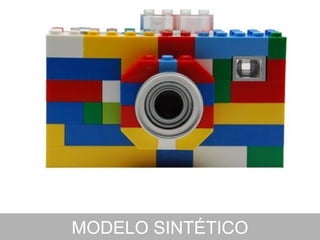
• Habilidades lingüístico
  comunicativas interrelacionadas.
• Organizadas en torno al uso.
• Integra:
   – lengua oral y lengua escrita
   – uso y reflexión
   – comprensión y producción


    MODELO SINTÉTICO
PROYECTOS DE
       COMUNICACIÓN


 SECUENCIA        TAREAS
  DIDÁTICA


MODELOS SINTÉTCOS
“Dime algo y lo olvidaré, enséñame
 algo y lo recordaré, pero hazme
partícipe de algo y lo aprenderé”
     “Dime algo y lo olvidaré, enséñame algo
        y lo recordaré, pero hazme partícipe de
                  algo y lo aprenderé”
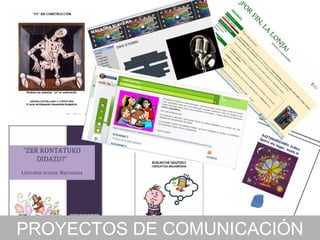
PROYECTOS DE COMUNICACIÓN


  Plan de trabajo
PROYECTOS DE COMUNICACIÓN
Basados en necesidades
PROYECTOS DE COMUNICACIÓN
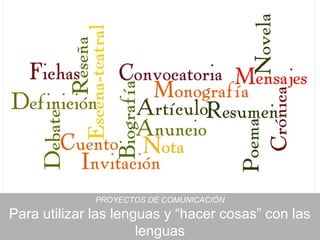
Para utilizar las lenguas y “hacer cosas” con las
                      lenguas
PROYECTOS DE COMUNICACIÓN
Para aprender sobre lo que se hace
PROYECTOS DE COMUNICACIÓN
Para realizar actividades diversas que desarrollan
      procedimientos, actitudes y conceptos
PROYECTOS DE COMUNICACIÓN
Que colocan al alumno en el centro de su aprendizaje
PROYECTOS DE COMUNICACIÓN
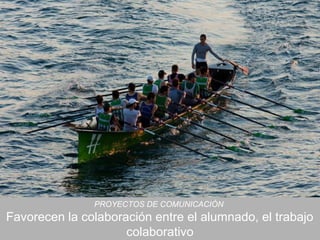
Favorecen la colaboración entre el alumnado, el trabajo
                     colaborativo
PROYECTOS DE COMUNICACIÓN
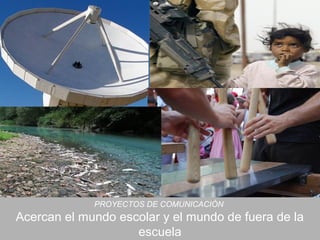
Acercan el mundo escolar y el mundo de fuera de la
                    escuela
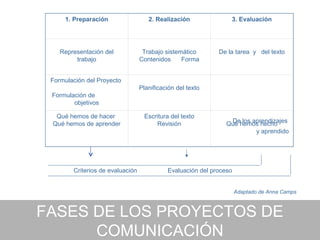
1. Preparación                  2. Realización              3. Evaluación


    Representación del             Trabajo sistemático       De la tarea y del texto
         trabajo                  Contenidos     Forma


 Formulación del Proyecto
                                  Planificación del texto
 Formulación de
        objetivos

  Qué hemos de hacer               Escritura del texto
 Qué hemos de aprender                 Revisión                  De los aprendizajes
                                                                Qué hemos hecho
                                                                         y aprendido


        Criterios de evaluación             Evaluación del proceso


                                                                     Adaptado de Anna Camps


FASES DE LOS PROYECTOS DE
      COMUNICACIÓN
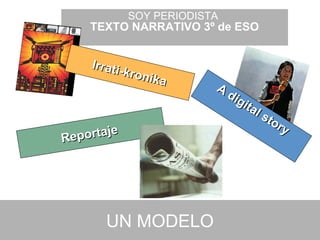
SOY PERIODISTA
    TEXTO NARRATIVO 3º de ESO


     Irrati
            -kron
                 ika
                          A
                            dig
                               i ta
                                    l   sto
                                            ry
Re portaje


       UN MODELO
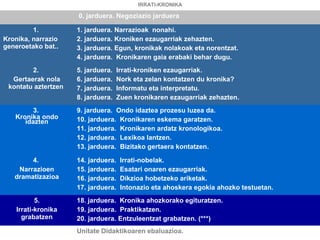
IRRATI-KRONIKA

                     0. jarduera. Negoziazio jarduera

         1.          1. jarduera. Narrazioak nonahi.
Kronika, narrazio    2. jarduera. Kroniken ezaugarriak zehazten.
generoetako bat..    3. jarduera. Egun, kronikak nolakoak eta norentzat.
                     4. jarduera. Kronikaren gaia erabaki behar dugu.
        2.           5. jarduera.   Irrati-kroniken ezaugarriak.
  Gertaerak nola     6. jarduera.   Nork eta zelan kontatzen du kronika?
 kontatu aztertzen   7. jarduera.   Informatu eta interpretatu.
                     8. jarduera.   Zuen kronikaren ezaugarriak zehazten.
         3.          9. jarduera. Ondo idaztea prozesu luzea da.
   Kronika ondo      10. jarduera. Kronikaren eskema garatzen.
      idazten
                     11. jarduera. Kronikaren ardatz kronologikoa.
                     12. jarduera. Lexikoa lantzen.
                     13. jarduera. Bizitako gertaera kontatzen.

        4.           14. jarduera.   Irrati-nobelak.
    Narrazioen       15. jarduera.   Esatari onaren ezaugarriak.
   dramatizazioa     16. jarduera.   Dikzioa hobetzeko ariketak.
                     17. jarduera.   Intonazio eta ahoskera egokia ahozko testuetan.
           5.        18. jarduera. Kronika ahozkorako egituratzen.
    Irrati-kronika   19. jarduera. Praktikatzen.
      grabatzen      20. jarduera. Entzuleentzat grabatzen. (***)
                     Unitate Didaktikoaren ebaluazioa.
REPORTAJE
                            Actividad de motivación
                            Actividad 1. Nuestro glosario sobre prensa.
             1.             Actividad 2. El acto comunicativo en la prensa.
    El tratamiento de la    Actividad 3. ¿Qué le interesa al público?
        información         Actividad 4. La noticia: rastreamos sus características.
                            Actividad 5. Las 6W.
                            Actividad 6. Hoy es noticia...

                            Actividad 7. Género periodístico es...
           2.               Actividad 8. Y ahora practicamos con los textos.
  Géneros periodísticos     Actividad 9. Revisamos el esquema sobre géneros.
                            Actividad 10. Colección de textos.
                            Actividad 11. Nos informamos sobre el reportaje.
             3.             Actividad 12. Buscamos lo específico del reportaje.
        El reportaje        Actividad 13. Cambiamos de estilo.
                            Actividad 14. Tomamos decisiones.
           4.               Actividad 15. Aprendemos a plasmar lo que dicen otros.
Aprendemos algunos trucos   Actividad 16. No toda la información sirve.
         útiles             Actividad 17. Empleamos los verbos en su justo tiempo.
                            Actividad 18. Recogemos la información.
          5.                Actividad 19. Ordenamos la información seleccionada.
 Redactamos el reportaje    Actividad 20. Redactamos el borrador.
                            Actividad 21. Corregimos nuestros reportajes.
                            Actividad 22. Elaboramos el reportaje definitivo.
                            Evaluación de la Unidad Didáctica.
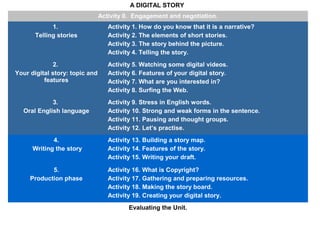
A DIGITAL STORY
                                Activity 0. Engagement and negotiation.
             1.                    Activity 1. How do you know that it is a narrative?
       Telling stories             Activity 2. The elements of short stories.
                                   Activity 3. The story behind the picture.
                                   Activity 4. Telling the story.
              2.                   Activity 5. Watching some digital videos.
Your digital story: topic and      Activity 6. Features of your digital story.
          features                 Activity 7. What are you interested in?
                                   Activity 8. Surfing the Web.
            3.                     Activity 9. Stress in English words.
  Oral English language            Activity 10. Strong and weak forms in the sentence.
                                   Activity 11. Pausing and thought groups.
                                   Activity 12. Let’s practise.
             4.                    Activity 13. Building a story map.
      Writing the story            Activity 14. Features of the story.
                                   Activity 15. Writing your draft.

            5.                     Activity 16. What is Copyright?
     Production phase              Activity 17. Gathering and preparing resources.
                                   Activity 18. Making the story board.
                                   Activity 19. Creating your digital story.
                                          Evaluating the Unit.
Contenidos que
 comparten las
 lenguas:

• Sobre el texto narrativo
  (eu) (eng)
• Sobre los textos
  periodísticos (es)
• 6 W (es) (eu) (eng)
• …


  REPARTO DE CONTENIDOS
Características
 específicas de cada
 lengua:
                            URTE
• Verbos (eu) (es)        BERRI ON
  (eng)
• Organizadores
  textuales y
  conectores (eu)
• Orden de los
  elementos de la frase
• …

  REPARTO DE CONTENIDOS
• Evaluación inicial
• Evaluación del
  proceso
• Evaluación
  individual o grupal
• Evaluación del
  producto final
• Evaluación del
  proceso de
  aprendizaje
EVALUACIÓN DEL PROCESO Y DEL
         RESULTADO
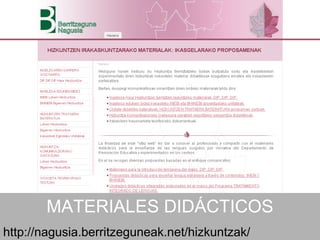
MATERIALES DIDÁCTICOS
http://nagusia.berritzeguneak.net/hizkuntzak/
MATERIALES DIDÁCTICOS
 https://sites.google.com/site/komunikazioproiektuak/

Enseñanza de lenguas II

  • 1.
    Enseñanza de lenguasen la educación plurilingüe II Maribi Apraiz Marimar Pérez Donostia, 4 de septiembre de 2012
  • 2.
    ESTRUCTURA DE LASACTIVIDADES
  • 3.
  • 4.
    • Saberes lingüísticossueltos, fragmentados. • Organizados según su propia lógica disciplinar. • Fundamentalmente saberes de tipo conceptual. • Compartimentos estancos. MODELO ANALÍTICO
  • 5.
  • 6.
    • Habilidades lingüístico comunicativas interrelacionadas. • Organizadas en torno al uso. • Integra: – lengua oral y lengua escrita – uso y reflexión – comprensión y producción MODELO SINTÉTICO
  • 7.
    PROYECTOS DE COMUNICACIÓN SECUENCIA TAREAS DIDÁTICA MODELOS SINTÉTCOS
  • 8.
    “Dime algo ylo olvidaré, enséñame algo y lo recordaré, pero hazme partícipe de algo y lo aprenderé” “Dime algo y lo olvidaré, enséñame algo y lo recordaré, pero hazme partícipe de algo y lo aprenderé”
  • 10.
  • 11.
  • 12.
  • 13.
    PROYECTOS DE COMUNICACIÓN Parautilizar las lenguas y “hacer cosas” con las lenguas
  • 14.
    PROYECTOS DE COMUNICACIÓN Paraaprender sobre lo que se hace
  • 15.
    PROYECTOS DE COMUNICACIÓN Pararealizar actividades diversas que desarrollan procedimientos, actitudes y conceptos
  • 16.
    PROYECTOS DE COMUNICACIÓN Quecolocan al alumno en el centro de su aprendizaje
  • 17.
    PROYECTOS DE COMUNICACIÓN Favorecenla colaboración entre el alumnado, el trabajo colaborativo
  • 18.
    PROYECTOS DE COMUNICACIÓN Acercanel mundo escolar y el mundo de fuera de la escuela
  • 19.
    1. Preparación 2. Realización 3. Evaluación Representación del Trabajo sistemático De la tarea y del texto trabajo Contenidos Forma Formulación del Proyecto Planificación del texto Formulación de objetivos Qué hemos de hacer Escritura del texto Qué hemos de aprender Revisión De los aprendizajes Qué hemos hecho y aprendido Criterios de evaluación Evaluación del proceso Adaptado de Anna Camps FASES DE LOS PROYECTOS DE COMUNICACIÓN
  • 20.
    SOY PERIODISTA TEXTO NARRATIVO 3º de ESO Irrati -kron ika A dig i ta l sto ry Re portaje UN MODELO
  • 21.
    IRRATI-KRONIKA 0. jarduera. Negoziazio jarduera 1. 1. jarduera. Narrazioak nonahi. Kronika, narrazio 2. jarduera. Kroniken ezaugarriak zehazten. generoetako bat.. 3. jarduera. Egun, kronikak nolakoak eta norentzat. 4. jarduera. Kronikaren gaia erabaki behar dugu. 2. 5. jarduera. Irrati-kroniken ezaugarriak. Gertaerak nola 6. jarduera. Nork eta zelan kontatzen du kronika? kontatu aztertzen 7. jarduera. Informatu eta interpretatu. 8. jarduera. Zuen kronikaren ezaugarriak zehazten. 3. 9. jarduera. Ondo idaztea prozesu luzea da. Kronika ondo 10. jarduera. Kronikaren eskema garatzen. idazten 11. jarduera. Kronikaren ardatz kronologikoa. 12. jarduera. Lexikoa lantzen. 13. jarduera. Bizitako gertaera kontatzen. 4. 14. jarduera. Irrati-nobelak. Narrazioen 15. jarduera. Esatari onaren ezaugarriak. dramatizazioa 16. jarduera. Dikzioa hobetzeko ariketak. 17. jarduera. Intonazio eta ahoskera egokia ahozko testuetan. 5. 18. jarduera. Kronika ahozkorako egituratzen. Irrati-kronika 19. jarduera. Praktikatzen. grabatzen 20. jarduera. Entzuleentzat grabatzen. (***) Unitate Didaktikoaren ebaluazioa.
  • 22.
    REPORTAJE Actividad de motivación Actividad 1. Nuestro glosario sobre prensa. 1. Actividad 2. El acto comunicativo en la prensa. El tratamiento de la Actividad 3. ¿Qué le interesa al público? información Actividad 4. La noticia: rastreamos sus características. Actividad 5. Las 6W. Actividad 6. Hoy es noticia... Actividad 7. Género periodístico es... 2. Actividad 8. Y ahora practicamos con los textos. Géneros periodísticos Actividad 9. Revisamos el esquema sobre géneros. Actividad 10. Colección de textos. Actividad 11. Nos informamos sobre el reportaje. 3. Actividad 12. Buscamos lo específico del reportaje. El reportaje Actividad 13. Cambiamos de estilo. Actividad 14. Tomamos decisiones. 4. Actividad 15. Aprendemos a plasmar lo que dicen otros. Aprendemos algunos trucos Actividad 16. No toda la información sirve. útiles Actividad 17. Empleamos los verbos en su justo tiempo. Actividad 18. Recogemos la información. 5. Actividad 19. Ordenamos la información seleccionada. Redactamos el reportaje Actividad 20. Redactamos el borrador. Actividad 21. Corregimos nuestros reportajes. Actividad 22. Elaboramos el reportaje definitivo. Evaluación de la Unidad Didáctica.
  • 23.
    A DIGITAL STORY Activity 0. Engagement and negotiation. 1. Activity 1. How do you know that it is a narrative? Telling stories Activity 2. The elements of short stories. Activity 3. The story behind the picture. Activity 4. Telling the story. 2. Activity 5. Watching some digital videos. Your digital story: topic and Activity 6. Features of your digital story. features Activity 7. What are you interested in? Activity 8. Surfing the Web. 3. Activity 9. Stress in English words. Oral English language Activity 10. Strong and weak forms in the sentence. Activity 11. Pausing and thought groups. Activity 12. Let’s practise. 4. Activity 13. Building a story map. Writing the story Activity 14. Features of the story. Activity 15. Writing your draft. 5. Activity 16. What is Copyright? Production phase Activity 17. Gathering and preparing resources. Activity 18. Making the story board. Activity 19. Creating your digital story. Evaluating the Unit.
  • 24.
    Contenidos que compartenlas lenguas: • Sobre el texto narrativo (eu) (eng) • Sobre los textos periodísticos (es) • 6 W (es) (eu) (eng) • … REPARTO DE CONTENIDOS
  • 25.
    Características específicas decada lengua: URTE • Verbos (eu) (es) BERRI ON (eng) • Organizadores textuales y conectores (eu) • Orden de los elementos de la frase • … REPARTO DE CONTENIDOS
  • 26.
    • Evaluación inicial •Evaluación del proceso • Evaluación individual o grupal • Evaluación del producto final • Evaluación del proceso de aprendizaje EVALUACIÓN DEL PROCESO Y DEL RESULTADO
  • 27.
  • 28.

Notas del editor

  • #9 Bertan jarduera guztiak helburu komunikatibo jakin bat lortzera bideratuta daude, sekuentzia egituratuz. IKASKUNTZA AKTIBOAri lotutako tradizio didaktikoaren ondorengoak dira. Ikasleen beharrizanekin eta gizarte inguruakekin lotzen dute ikaskuntza. Bat datoz gaitasunen garapenaren marko berriarekin Bertan jarduera guztiak helburu komunikatibo jakin bat lortzera bideratuta daude, sekuentzia egituratuz. IKASKUNTZA AKTIBOAri lotutako tradizio didaktikoaren ondorengoak dira. Ikasleen beharrizanekin eta gizarte inguruakekin lotzen dute ikaskuntza. Bat datoz gaitasunen garapenaren marko berriarekin Bertan jarduera guztiak helburu komunikatibo jakin bat lortzera bideratuta daude, sekuentzia egituratuz. IKASKUNTZA AKTIBOAri lotutako tradizio didaktikoaren ondorengoak dira. Ikasleen beharrizanekin eta gizarte inguruakekin lotzen dute ikaskuntza. Bat datoz gaitasunen garapenaren marko berriarekin Bertan jarduera guztiak helburu komunikatibo jakin bat lortzera bideratuta daude, sekuentzia egituratuz. IKASKUNTZA AKTIBOAri lotutako tradizio didaktikoaren ondorengoak dira. Ikasleen beharrizanekin eta gizarte inguruakekin lotzen dute ikaskuntza. Bat datoz gaitasunen garapenaren marko berriarekin Bertanjarduera guztiek helburu komunikatibo jakin bat lortzera bideratuta daude, sekuientzia egitaratuz. Ikaskuntza Akytiboa Marcoa
  • #25 Se explican en una unidad y se hacen puentes para las otras.