MATEMÁTICAS TIMONMATE
EJERCICIOS RESUELTOS DE POLINOMIOS
http://perso.wanadoo.es/timonmate/1/13
POLINOMIOS
A. Introducción Teoría
B. Ejercicios resueltos
B.1. Sumas y restas
B.2. Multiplicación
B.3. División
B.4. Sacar factor común
B.5. Simplificar fracciones algebraicas
B.6. Operaciones con fracciones algebraicas
B.7. Relación entre dividendo, divisor, resto y cociente
Notas teóricas
- Operaciones con polinomios:
a) Suma y resta
Se agrupan los monomios del mismo grado y se opera.
b) Multiplicación
Se multiplica cada uno de los términos del primer polinomio por
cada uno de los términos del segundo y luego se agrupan y se
operan los términos del mismo grado.
c) División
Suelen utilizarse dos métodos:
i. Método estándar: Se procede de forma análoga a la división
entre números.
ii. Método de Ruffini: Sólo se puede aplicar para dividir
polinomios de grado igual o mayor que dos entre un binomio
de grado uno
- Teorema del resto:
Se cumple que:
Dividendo divisor cociente resto  
dividendo divisor
resto cociente
Polinomios resueltos TIMONMATE
http://perso.wanadoo.es/timonmate/ 2/13
El resto de la división de un polinomio entre x a- coincide con el valor
del polinomio en a, es decir: ( )resto P a=
- Factorización de polinomios:
Los polinomios compuestos pueden descomponerse como producto de
dos o más polinomios de grado menor. A esta tarea se le llama factorizar
polinomios.
Ejercicios resueltos
B.1. Sumas y restas
1. 3x + 2x = 5x
2. 6x – 15x = –9x
3. 2 22
3x + 2x 3x 5xx 25 x- + = +
4. 2 2 2
x 3x 2x x 4x x- - - - -=
5. 3 2 3 3 2 22 3
x 5xx 3x 22x xx 4 4xx 3xx 5 x+ - +- - - -+ = -+ =
3 2
6x 2x 4x= + -
6. ( ) ( )2 2 2 2 2
3x 2x x 4x 2x 4x3x 2x x 4x - +- - - + = - - =- -
B.2. Multiplica
7. 1 2 32
x xx x+
⋅ = =
8. 33 2 52
xx xx +
= =⋅
9. 2 64 4 2
6 62x x3x x+
=⋅ =
10. ( )2 2 57 7
102x x x5 x 10+ --
=-- ⋅ -=
11. 6 · (3x + 2) = 18x+12
12. 9 · (6x – 5) = 54x–45
13. – 3 · (2x – 7) = –6x+21
TIMONMATE Polinomios resueltos
http://perso.wanadoo.es/timonmate/3/13
14. 5 · (x – 2) = 5x–10
15. –2 · (3x – 9) = –6x+18
16. 9 · (6x – 5) = 54x–45
17. x · (x – 2) = x2 –2x
18. –2x · (3x – 9) = 6x2 +18x
19. 9x2 · (6x – 5) = 54x3 –45x2
20. 5x · (x2+x – 2) = 5x3 +5x2 –10x
21. (3x2 – 7x – 1) · (–4) · x5 = –12x7 +28x6 +4x5
22. –2x2 · (3x3 – 9x2+7x+1) = –6x5 +18x4 –14x3 –2x2
23. 9x6(– 5x4 + 10x3 – 3x2 – x + 3) = –45x10 +90x9 –27x8 – 9x7 +27x6
24. (3x + 1)(5x + 2) = 3x· (5x + 2)+1· (5x + 2) =15x2+6x+5x + 2 = 15x2+11x+2
25. (2x + 7)(x + 1) =2x· (x + 1)+7· (x + 1) = 2x2+2x+7x + 7 = 2x2+9x+7
26. (x – 1)(5x + 6) = x· (5x + 6)–1· (5x + 6) = 5x2+6x–5x–6 = 5x2+x–6
27. (3x – 1)(–7x + 2) = 3x· (–7x + 2) –1· (–7x + 2) = –21x2+6x+7x – 2 =
= –21x2+13x–2
28. (3x + 7)(x2+x – 2)=
=(3x + 7)(x2+x – 2) = 3x ·(x2+x – 2) + 7· (x2+x – 2) =
= 3x3+3x2 –6x+ 7x2+7x –14 = 3x3+10x2 +x –14
29. (x2+x – 2)(x2+x – 2) =
= x2(x2+x–2)+x(x2+x–2)–2(x2+x–2) = x4+x3 –2x2 +x3+x2 –2x –2x2– 2x+4 =
= x4+2x3 –3x2 –4x+4
30. ( )
2
2
x 2 27x 27x 27 + ++ =
31. ( ) 2
2
3 31x 10 31x 251x 5 - +- =
32.
2
x x
3 3
33
x
3
3
æ öæ ö÷ ÷ç ç+ - =÷ ÷ç ç÷ ÷ç çè øè
-
ø
Polinomios resueltos TIMONMATE
http://perso.wanadoo.es/timonmate/ 4/13
33. ( ) ( )x 2 x 2 2- ⋅ + = ( ) ( )x x 2 2 2 x 2 2+ - + = 2
x 2 2x 2x 2+ - - =
2
x 2x 2+ -
34. ( )
2
2
3x 3- = ( ) ( )
22 2 4 2
3x 2 3x 3 3 9x 6 3x 3- ⋅ ⋅ + = - +
35. ( )
3
4
2x 5+ = ( ) ( ) ( ) ( ) ( )
2 33 24 4 4
2x 3 2x 5 3 2x 5 5+ ⋅ ⋅ + ⋅ ⋅ + =
( )
3
12 8 4
8x 12 5x 30x 5= + ⋅ + +
TEMA RELACIONADO:
Binomio de Newton
B.3. División
36. ( ) ( )2
x 4x 3 : x 1- + -
Solución:
a) Método de Ruffini
1 –4 3
1 1 –3
1 –3 0
b) Método general o estándar
x2 – 4x +3 x – 1
–x2 x x – 3
0 –3x +3
3x –3
0 0
Resto: 0
Cociente: x – 3
Cociente
Resto
TIMONMATE Polinomios resueltos
http://perso.wanadoo.es/timonmate/5/13
37. ( ) ( )2
3x x 5 : x 2+ - +
Solución:
a) Método de Ruffini
3 1 -5
-2 -6 10
3 -5 5
b) Método general
3x2 + x – 5 x + 2
–3x2 –6x 3x – 5
0 –5x –5
5x 10
0 5
38. ( ) ( )5 4
6x 3x 2x : x 1- + +
Solución:
Resto
Cociente: 3x – 5
Cociente
Resto
Polinomios resueltos TIMONMATE
http://perso.wanadoo.es/timonmate/ 6/13
a) Método estándar:
6x5 – 3x4 + 2x x + 1
–6x5–6x4 6x4–9x3 +9x2–9x+11
–9x4 +2x
9x4+9x3
9x3 +2x
–9x3–9x2
–9x2+2x Resto: –11
9x2+9x Cociente: 6x4–9x3 +9x2–9x+11
11x
–11x–11
–11
b) Método de Ruffini
39. ( ) ( )3 2 2
x x 2x 3 : x x 1- + - + -
Solución:
En este caso no podemos aplicar el método de Ruffini, ya que aparece un
divisor que no es de la forma ( )x a
- Método estándar:
6 –3 0 0 2 0
–1 –6 9 –9 9 –11
6 –9 9 –9 11 –11
Cociente:
6x4–9x3 +9x2–9x+11
Resto:
–11
TIMONMATE Polinomios resueltos
http://perso.wanadoo.es/timonmate/7/13
3 2
x x 2x 3- + - 2
x x 1+ -
3 2
x x x- - + x 2-
2
2x 3x 3- + -
2
2x 2x 2+ - Resto: 5x 5-
5x 5- Cociente: x 2-
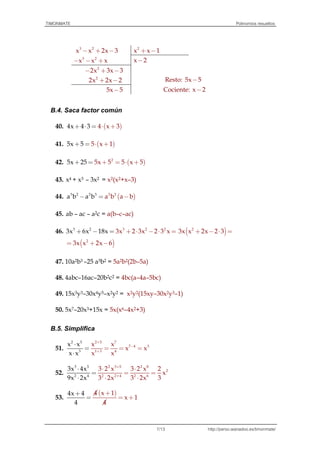
B.4. Saca factor común
40. ( )3x 44 x4 3+ ⋅ = ⋅ +
41. ( )55 15 xx+ = ⋅ +
42. ( )2
5x 5 5 x5 25 5x + = ⋅= ++
43. x4 + x3 – 3x2 = x2(x2+x–3)
44. ( )3 2 2 3 2 2
a ba b a b a b- = -
45. ab – ac – a2c = a(b–c–ac)
46. 33 2 2 2
3 3xx 6x 1 2 3 x8 2x 3x+ ⋅ - ⋅+ - = = ( )2
3x x 2x 2 3+ - ⋅ =
( )2
3x x 2x 6= + -
47. 10a2b3 –25 a3b2 = 5a2b2(2b–5a)
48. 4abc–16ac–20b2c2 = 4bc(a–4a–5bc)
49. 15x3y3–30x4y5–x2y2 = x2y2(15xy–30x2y3–1)
50. 5x7–20x3+15x = 5x(x6–4x2+3)
B.5. Simplifica
51.
2 5 7
7 4 3
1 3
2 5
3 4
x x
x
x x
x
x
x
x
x
+
-
+
⋅
=
⋅
= = =
52.
2 3 5 2 8
2
2 2
3 5
2 4 4 2 6
3x 4x
9
3 2 x 3 2 x 2
x
3 2x 3 2x 3x 2x
+
+
⋅
=
⋅ ⋅
= =
⋅ ⋅⋅
53.
( )4 x
4
4
4
1
4x 1
x
+
=
+
+=
Polinomios resueltos TIMONMATE
http://perso.wanadoo.es/timonmate/ 8/13
54.
4x 44
8
+
=
( )x 1
4
+ x 1
2 2
+
=
⋅
55.
8
4x
4
4
=
+
2
4
⋅
( )
2
x 1 x 1
=
+ +
56.
x 3
2x 3
x
2
3+
=
+ ⋅
+
( )2 x 3+
1
2
=
57.
x 2 x 2
2
x 2
2x 4 x 2 2
- -
=
- ⋅
-
=
- ( )2 x 2-
1
2
=
58.
22 2 2
2
12x 36 2 32 3x 3
x3x 9
2
3 3
⋅⋅ - ⋅
=
-
-
=
-
( )x 3-
3 ( )x 3-
4= .
También habría podido proceder del siguiente modo:
( )⋅ -- ⋅ - ⋅
= =
- -
4 3x 912x 36 4 3x 4 9
3x 9 3x 9 -3x 9
= 4
59.
3x 9 3x 9
4 3x
3x 9
12x 3 4 96
- -
=
⋅ ⋅
-
- -
=
( )4 3x 9⋅ -
1
4
=
60.
( ) ( )
24 24 2 12 12
2x 2 2 2
24
x 22x 2 x 24 x 2
=
-
⋅
= = =
- ⋅ - - -
61.
-
=
⋅ - ⋅
-
=
-
23 2
2
3 2
2
x15x 5x
2 15x 2
15x 5x
30x 1 5x0x
( )-15x 5
2 x ( )-15x 5
=
x
2
62.
3x 53x 5
6 3x
3x 5
18x 3 6 50
--
=
⋅ ⋅
-
- -
=
( ) 1
6 3x 5
⋅
⋅ -( )
1
6
=
63.
( )
2
2
3x 2x 2x
3x x
6x
3x x x 13 1
⋅
=
-- -
=
64.
( )
( )
5x 15 15x 15 1
5 5x 5
5
15 5 5x
x 15
25x 7 155 5
+ ⋅+
= =
⋅ + ⋅ ⋅ +
+
=
+
65.
2
2
x + 2x + 1
=
x - 1
( )
( )( )
2
x 1 x 1
=
x 1 x 1 x 1
+ +
+ - -
Puede que te estés preguntando por qué
el resultado no es
0
2
. La razón por la que
en el numerador queda un 1 es que x+3
se puede escribir también como: (x+3)·1.
Así que:
( )
( )
( )
+ ⋅+
= =
+ +
x 3 1x 3 1
2 x 3 2 x 3 2
TIMONMATE Polinomios resueltos
http://perso.wanadoo.es/timonmate/9/13
66.
2
2
x 4x 3
x 1
- +
=
-
( )x 1- ( )
( ) ( )
x 3
x 1 x 1
-
+ -
x 3
x 1
-
=
+
67.
2
3x y - xy
=
9xy - 3y
( )
( )
xy x 3 x
3y x 3 3
-
=
-
68.
( )
( )
2 2
3 2 2 23 22 2
ab a b ab 1a b ab
a b a b a b ab b ba a
-
= =
-
-
=
-
B.6. Opera con las siguientes fracciones polinómicas
69.
- +
+ =
- + -2
x 1 x 1
x 2x 1 x 1 ( )
2
x 1 x 1 1 x 1 x 2
x 1 x 1 x 1 x 1x 1
- + + +
+ = + =
- - - --
70. 2
1 x x x 1
x 2x 1 x 1 x 1
- -
+ - =
- + - + ( )
2
x 1 x x 1
x 1 x 1x 1
- -
- + - =
- +-
1 x x 1
x 1 x 1 x 1
-
=- + - =
- - +
x 1 x 1
x 1 x 1
- -
- =
- +
( )( )
( )( )
( )
( )( )
2
x 1 x 1 x 1
x 1 x 1 x 1 x 1
- + -
- =
- + - +
( )( )
2 2
x 1 x 2x 1
x 1 x 1
- - + -
= =
- +
( )
( )( )
2 x 1
x 1 x 1
-
=
- +
2
x 1+
71. 2
1 1
x 2x 1 x 1
+ =
- + - ( )
2
1 1
x 1x 1
+ =
-- ( ) ( )
2 2
1 x 1
x 1 x 1
-
+ =
- - ( )
2
x
x 1-
72. 2
1 x x
x 2x 1 x 1 x 1
+ - =
- + - + 2
1 x x
x 2x 1 x 1 x 1
+ - =
- + - +
( )
2
1 x x
x 1 x 1x 1
= + - =
- +-
( ) ( )
( )( )
( ) ( )
( )
( ) ( )
2
2 2 2
x x 1 x 1 x x 1x 1
x 1 x 1 x 1 x 1 x 1 x 1
- + -+
= + - =
- + - + - +
( )( ) ( )
( ) ( )
2
2
x 1 x x 1 x 1 x x 1
x 1 x 1
+ + - + - -
= =
- +
Polinomios resueltos TIMONMATE
http://perso.wanadoo.es/timonmate/ 10/13
( ) ( )
( ) ( )
2 2
2
x 1 x x 1 x x 2x 1
x 1 x 1
+ + - - - +
=
- + ( ) ( )
3 3 2
2
x 1 x x x 2x x
x 1 x 1
+ + - - + -
= =
- +
( ) ( )
2
2
2x x 1
x 1 x 1
- +
=
- +
73. 3 2 2 2
x 1 1 2 x 1 1 x
x 2x x 2 x 1 x x 2 x 1 x 1
æ ö æ ö- + -÷ ÷ç ç+ - ⋅ + =÷ ÷ç ç ÷÷ çç è øè ø- - + - - - - -
x 1-
=
( )x 1- ( )( ) ( )( ) ( )( )
1 2 x 1 x 1
x 1 x 1 x 1 x 2 x 1 x 1x 1 x 2
æ ö÷ + -ç ÷ç + - ⋅ -÷ç ÷ç ÷+ - + - - -+ - ÷çè ø
æ ö÷ç ÷=ç ÷ç ÷çè ø
( )( ) ( )( ) ( )( )
1 1 2 x 1
1
x 1 x 2 x 1 x 1 x 1 x 2 x 1
æ ö æ ö+÷ç ÷ç÷= + - ⋅ - =ç ÷ç÷ ÷ç ç÷ è øç + - + - + - -è ø
( )( ) ( )( )
1 1 x 1 x 1
x 1 x 2 x 1 x 1 x 1
æ ö æ ö- + - +÷ç ÷ç÷= + ⋅ =ç ÷ç÷ ÷ç ç÷ è øç + - + - -è ø
( )
( )( )( )
( )
( )( )( )
x 1 x 2 2
x 1 x 1 x 2 x 1 x 1 x 2 x 1
æ ö- - - æ ö÷ç ÷ç÷= + ⋅ =ç ÷ç÷ ÷ç ç÷ è øç + - - + - - -è ø
( )( )( ) ( )( )( )
2
x 1 x 2 2 2
x 1 x 1 x 2 x 1 x 1 x 2 x 1
æ ö æ ö- + + - -÷ç ÷ç÷= ⋅ =ç ÷ç÷ ÷ç ç÷ è øç + - - - + - -è ø
B.7. Relación entre dividendo, divisor, resto y cociente
74. Determina el valor de m para que el polinomio
( ) ( )3 2
P x x 2x mx m 5= - - + - al dividirlo por ( )x 5- tenga un resto de
-4
Solución:
Por el teorema del resto se tiene que cumplir que ( )=-P 5 10, es decir:
( ) ( )=-  - ⋅ - + - =-  =3 2
P 5 3 5 2 5 5m m 5 10 m 20
75. Calcula el valor de m para que el polinomio
( )= - - +3 2
p x 3mx 7x 7mx 4m sea divisible por ( )-x 2
Solución:
Para que el polinomio sea divisible por ( )-x 2 se tienen que cumplir la
condición ( )=P 2 0 , es decir:
( )= ⋅ - ⋅ - ⋅ + =  =3 2
P 2 3m 2 7 2 7m 2 4m 0 m 2
TIMONMATE Polinomios resueltos
http://perso.wanadoo.es/timonmate/11/13
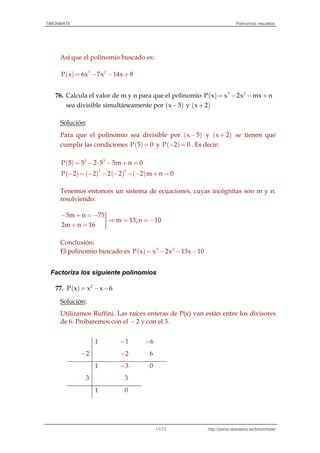
Así que el polinomio buscado es:
( )= - - +3 2
P x 6x 7x 14x 8
76. Calcula el valor de m y n para que el polinomio ( ) 3 2
P x x 2x mx n= - - +
sea divisible simultáneamente por ( )x 5- y ( )x 2+
Solución:
Para que el polinomio sea divisible por ( )x 5- y ( )x 2+ se tienen que
cumplir las condiciones ( )P 5 0= y ( )P 2 0- = . Es decir:
( ) 3 2
P 5 5 2 5 5m n 0= - ⋅ - + =
( ) ( ) ( ) ( )
3 2
P 2 2 2 2 2 m n 0- = - - - - - + =
Tenemos entonces un sistema de ecuaciones, cuyas incógnitas son m y n.
resolviendo:
5m n 75
m 13;n 10
2m n 16
ü- + =- ïï = =-
ï+ = ï
Conclusión:
El polinomio buscado es ( ) 3 2
P x x 2x 13x 10= - - -
Factoriza los siguiente polinomios
77. ( ) 2
P x x x 6= - -
Solución:
Utilizamos Ruffini. Las raíces enteras de P(x) van están entre los divisores
de 6. Probaremos con el -2 y con el 3.
1 1 6
2 2 6
1 3 0
3 3
1 0
Polinomios resueltos TIMONMATE
http://perso.wanadoo.es/timonmate/ 12/13
Conclusión:
( ) ( )( )P x x 2 x 3= + -
78. ( ) 2
P x x 9x 20= - +
Solución:
Utilizamos Ruffini. Las raíces enteras de P(x) van están entre los divisores
de 6. Probaremos con el 4 y con el 5.
1 9 20
4 4 20
1 5 0
5 5
1 0
Conclusión:
( ) ( )( )P x x 4 x 5= - -
79. ( ) 3 2
P x x 3x x 3= - - +
Solución:
Utilizamos Ruffini. Las raíces enteras de P(x) van están entre los divisores
de 3. Probaremos con el -1, 1 y con el 3.
1 3 1 3
1 1 4 3
1 4 3
1 1 3
1 3
3 3
1 0
Conclusión:
( ) ( )( )( )P x x 1 x 1 x 3= + - -
80. ( ) 4 3 2
P x x 5x 9x 7x 2= - + - +
TIMONMATE Polinomios resueltos
http://perso.wanadoo.es/timonmate/13/13
Solución:
Utilizamos Ruffini. Las raíces enteras de P(x) van están entre los siguientes
números, todos divisores de 2, es decir: 1 y 2 .
1 -5 9 -7 2
1 1 -4 5 -2
1 -4 5 -2 0
1 1 -3 2
1 -3 2 0
1 1 -2
1 -2 0
Conclusión:
( ) ( )( )( )( ) ( ) ( )
2
P x x 1 x 1 x 1 x 2 x 1 x 2= - - - - = - -
***

Polinomios resueltos

  • 1.
    MATEMÁTICAS TIMONMATE EJERCICIOS RESUELTOSDE POLINOMIOS http://perso.wanadoo.es/timonmate/1/13 POLINOMIOS A. Introducción Teoría B. Ejercicios resueltos B.1. Sumas y restas B.2. Multiplicación B.3. División B.4. Sacar factor común B.5. Simplificar fracciones algebraicas B.6. Operaciones con fracciones algebraicas B.7. Relación entre dividendo, divisor, resto y cociente Notas teóricas - Operaciones con polinomios: a) Suma y resta Se agrupan los monomios del mismo grado y se opera. b) Multiplicación Se multiplica cada uno de los términos del primer polinomio por cada uno de los términos del segundo y luego se agrupan y se operan los términos del mismo grado. c) División Suelen utilizarse dos métodos: i. Método estándar: Se procede de forma análoga a la división entre números. ii. Método de Ruffini: Sólo se puede aplicar para dividir polinomios de grado igual o mayor que dos entre un binomio de grado uno - Teorema del resto: Se cumple que: Dividendo divisor cociente resto   dividendo divisor resto cociente
  • 2.
    Polinomios resueltos TIMONMATE http://perso.wanadoo.es/timonmate/2/13 El resto de la división de un polinomio entre x a- coincide con el valor del polinomio en a, es decir: ( )resto P a= - Factorización de polinomios: Los polinomios compuestos pueden descomponerse como producto de dos o más polinomios de grado menor. A esta tarea se le llama factorizar polinomios. Ejercicios resueltos B.1. Sumas y restas 1. 3x + 2x = 5x 2. 6x – 15x = –9x 3. 2 22 3x + 2x 3x 5xx 25 x- + = + 4. 2 2 2 x 3x 2x x 4x x- - - - -= 5. 3 2 3 3 2 22 3 x 5xx 3x 22x xx 4 4xx 3xx 5 x+ - +- - - -+ = -+ = 3 2 6x 2x 4x= + - 6. ( ) ( )2 2 2 2 2 3x 2x x 4x 2x 4x3x 2x x 4x - +- - - + = - - =- - B.2. Multiplica 7. 1 2 32 x xx x+ ⋅ = = 8. 33 2 52 xx xx + = =⋅ 9. 2 64 4 2 6 62x x3x x+ =⋅ = 10. ( )2 2 57 7 102x x x5 x 10+ -- =-- ⋅ -= 11. 6 · (3x + 2) = 18x+12 12. 9 · (6x – 5) = 54x–45 13. – 3 · (2x – 7) = –6x+21
  • 3.
    TIMONMATE Polinomios resueltos http://perso.wanadoo.es/timonmate/3/13 14.5 · (x – 2) = 5x–10 15. –2 · (3x – 9) = –6x+18 16. 9 · (6x – 5) = 54x–45 17. x · (x – 2) = x2 –2x 18. –2x · (3x – 9) = 6x2 +18x 19. 9x2 · (6x – 5) = 54x3 –45x2 20. 5x · (x2+x – 2) = 5x3 +5x2 –10x 21. (3x2 – 7x – 1) · (–4) · x5 = –12x7 +28x6 +4x5 22. –2x2 · (3x3 – 9x2+7x+1) = –6x5 +18x4 –14x3 –2x2 23. 9x6(– 5x4 + 10x3 – 3x2 – x + 3) = –45x10 +90x9 –27x8 – 9x7 +27x6 24. (3x + 1)(5x + 2) = 3x· (5x + 2)+1· (5x + 2) =15x2+6x+5x + 2 = 15x2+11x+2 25. (2x + 7)(x + 1) =2x· (x + 1)+7· (x + 1) = 2x2+2x+7x + 7 = 2x2+9x+7 26. (x – 1)(5x + 6) = x· (5x + 6)–1· (5x + 6) = 5x2+6x–5x–6 = 5x2+x–6 27. (3x – 1)(–7x + 2) = 3x· (–7x + 2) –1· (–7x + 2) = –21x2+6x+7x – 2 = = –21x2+13x–2 28. (3x + 7)(x2+x – 2)= =(3x + 7)(x2+x – 2) = 3x ·(x2+x – 2) + 7· (x2+x – 2) = = 3x3+3x2 –6x+ 7x2+7x –14 = 3x3+10x2 +x –14 29. (x2+x – 2)(x2+x – 2) = = x2(x2+x–2)+x(x2+x–2)–2(x2+x–2) = x4+x3 –2x2 +x3+x2 –2x –2x2– 2x+4 = = x4+2x3 –3x2 –4x+4 30. ( ) 2 2 x 2 27x 27x 27 + ++ = 31. ( ) 2 2 3 31x 10 31x 251x 5 - +- = 32. 2 x x 3 3 33 x 3 3 æ öæ ö÷ ÷ç ç+ - =÷ ÷ç ç÷ ÷ç çè øè - ø
  • 4.
    Polinomios resueltos TIMONMATE http://perso.wanadoo.es/timonmate/4/13 33. ( ) ( )x 2 x 2 2- ⋅ + = ( ) ( )x x 2 2 2 x 2 2+ - + = 2 x 2 2x 2x 2+ - - = 2 x 2x 2+ - 34. ( ) 2 2 3x 3- = ( ) ( ) 22 2 4 2 3x 2 3x 3 3 9x 6 3x 3- ⋅ ⋅ + = - + 35. ( ) 3 4 2x 5+ = ( ) ( ) ( ) ( ) ( ) 2 33 24 4 4 2x 3 2x 5 3 2x 5 5+ ⋅ ⋅ + ⋅ ⋅ + = ( ) 3 12 8 4 8x 12 5x 30x 5= + ⋅ + + TEMA RELACIONADO: Binomio de Newton B.3. División 36. ( ) ( )2 x 4x 3 : x 1- + - Solución: a) Método de Ruffini 1 –4 3 1 1 –3 1 –3 0 b) Método general o estándar x2 – 4x +3 x – 1 –x2 x x – 3 0 –3x +3 3x –3 0 0 Resto: 0 Cociente: x – 3 Cociente Resto
  • 5.
    TIMONMATE Polinomios resueltos http://perso.wanadoo.es/timonmate/5/13 37.( ) ( )2 3x x 5 : x 2+ - + Solución: a) Método de Ruffini 3 1 -5 -2 -6 10 3 -5 5 b) Método general 3x2 + x – 5 x + 2 –3x2 –6x 3x – 5 0 –5x –5 5x 10 0 5 38. ( ) ( )5 4 6x 3x 2x : x 1- + + Solución: Resto Cociente: 3x – 5 Cociente Resto
  • 6.
    Polinomios resueltos TIMONMATE http://perso.wanadoo.es/timonmate/6/13 a) Método estándar: 6x5 – 3x4 + 2x x + 1 –6x5–6x4 6x4–9x3 +9x2–9x+11 –9x4 +2x 9x4+9x3 9x3 +2x –9x3–9x2 –9x2+2x Resto: –11 9x2+9x Cociente: 6x4–9x3 +9x2–9x+11 11x –11x–11 –11 b) Método de Ruffini 39. ( ) ( )3 2 2 x x 2x 3 : x x 1- + - + - Solución: En este caso no podemos aplicar el método de Ruffini, ya que aparece un divisor que no es de la forma ( )x a - Método estándar: 6 –3 0 0 2 0 –1 –6 9 –9 9 –11 6 –9 9 –9 11 –11 Cociente: 6x4–9x3 +9x2–9x+11 Resto: –11
  • 7.
    TIMONMATE Polinomios resueltos http://perso.wanadoo.es/timonmate/7/13 32 x x 2x 3- + - 2 x x 1+ - 3 2 x x x- - + x 2- 2 2x 3x 3- + - 2 2x 2x 2+ - Resto: 5x 5- 5x 5- Cociente: x 2- B.4. Saca factor común 40. ( )3x 44 x4 3+ ⋅ = ⋅ + 41. ( )55 15 xx+ = ⋅ + 42. ( )2 5x 5 5 x5 25 5x + = ⋅= ++ 43. x4 + x3 – 3x2 = x2(x2+x–3) 44. ( )3 2 2 3 2 2 a ba b a b a b- = - 45. ab – ac – a2c = a(b–c–ac) 46. 33 2 2 2 3 3xx 6x 1 2 3 x8 2x 3x+ ⋅ - ⋅+ - = = ( )2 3x x 2x 2 3+ - ⋅ = ( )2 3x x 2x 6= + - 47. 10a2b3 –25 a3b2 = 5a2b2(2b–5a) 48. 4abc–16ac–20b2c2 = 4bc(a–4a–5bc) 49. 15x3y3–30x4y5–x2y2 = x2y2(15xy–30x2y3–1) 50. 5x7–20x3+15x = 5x(x6–4x2+3) B.5. Simplifica 51. 2 5 7 7 4 3 1 3 2 5 3 4 x x x x x x x x x x + - + ⋅ = ⋅ = = = 52. 2 3 5 2 8 2 2 2 3 5 2 4 4 2 6 3x 4x 9 3 2 x 3 2 x 2 x 3 2x 3 2x 3x 2x + + ⋅ = ⋅ ⋅ = = ⋅ ⋅⋅ 53. ( )4 x 4 4 4 1 4x 1 x + = + +=
  • 8.
    Polinomios resueltos TIMONMATE http://perso.wanadoo.es/timonmate/8/13 54. 4x 44 8 + = ( )x 1 4 + x 1 2 2 + = ⋅ 55. 8 4x 4 4 = + 2 4 ⋅ ( ) 2 x 1 x 1 = + + 56. x 3 2x 3 x 2 3+ = + ⋅ + ( )2 x 3+ 1 2 = 57. x 2 x 2 2 x 2 2x 4 x 2 2 - - = - ⋅ - = - ( )2 x 2- 1 2 = 58. 22 2 2 2 12x 36 2 32 3x 3 x3x 9 2 3 3 ⋅⋅ - ⋅ = - - = - ( )x 3- 3 ( )x 3- 4= . También habría podido proceder del siguiente modo: ( )⋅ -- ⋅ - ⋅ = = - - 4 3x 912x 36 4 3x 4 9 3x 9 3x 9 -3x 9 = 4 59. 3x 9 3x 9 4 3x 3x 9 12x 3 4 96 - - = ⋅ ⋅ - - - = ( )4 3x 9⋅ - 1 4 = 60. ( ) ( ) 24 24 2 12 12 2x 2 2 2 24 x 22x 2 x 24 x 2 = - ⋅ = = = - ⋅ - - - 61. - = ⋅ - ⋅ - = - 23 2 2 3 2 2 x15x 5x 2 15x 2 15x 5x 30x 1 5x0x ( )-15x 5 2 x ( )-15x 5 = x 2 62. 3x 53x 5 6 3x 3x 5 18x 3 6 50 -- = ⋅ ⋅ - - - = ( ) 1 6 3x 5 ⋅ ⋅ -( ) 1 6 = 63. ( ) 2 2 3x 2x 2x 3x x 6x 3x x x 13 1 ⋅ = -- - = 64. ( ) ( ) 5x 15 15x 15 1 5 5x 5 5 15 5 5x x 15 25x 7 155 5 + ⋅+ = = ⋅ + ⋅ ⋅ + + = + 65. 2 2 x + 2x + 1 = x - 1 ( ) ( )( ) 2 x 1 x 1 = x 1 x 1 x 1 + + + - - Puede que te estés preguntando por qué el resultado no es 0 2 . La razón por la que en el numerador queda un 1 es que x+3 se puede escribir también como: (x+3)·1. Así que: ( ) ( ) ( ) + ⋅+ = = + + x 3 1x 3 1 2 x 3 2 x 3 2
  • 9.
    TIMONMATE Polinomios resueltos http://perso.wanadoo.es/timonmate/9/13 66. 2 2 x4x 3 x 1 - + = - ( )x 1- ( ) ( ) ( ) x 3 x 1 x 1 - + - x 3 x 1 - = + 67. 2 3x y - xy = 9xy - 3y ( ) ( ) xy x 3 x 3y x 3 3 - = - 68. ( ) ( ) 2 2 3 2 2 23 22 2 ab a b ab 1a b ab a b a b a b ab b ba a - = = - - = - B.6. Opera con las siguientes fracciones polinómicas 69. - + + = - + -2 x 1 x 1 x 2x 1 x 1 ( ) 2 x 1 x 1 1 x 1 x 2 x 1 x 1 x 1 x 1x 1 - + + + + = + = - - - -- 70. 2 1 x x x 1 x 2x 1 x 1 x 1 - - + - = - + - + ( ) 2 x 1 x x 1 x 1 x 1x 1 - - - + - = - +- 1 x x 1 x 1 x 1 x 1 - =- + - = - - + x 1 x 1 x 1 x 1 - - - = - + ( )( ) ( )( ) ( ) ( )( ) 2 x 1 x 1 x 1 x 1 x 1 x 1 x 1 - + - - = - + - + ( )( ) 2 2 x 1 x 2x 1 x 1 x 1 - - + - = = - + ( ) ( )( ) 2 x 1 x 1 x 1 - = - + 2 x 1+ 71. 2 1 1 x 2x 1 x 1 + = - + - ( ) 2 1 1 x 1x 1 + = -- ( ) ( ) 2 2 1 x 1 x 1 x 1 - + = - - ( ) 2 x x 1- 72. 2 1 x x x 2x 1 x 1 x 1 + - = - + - + 2 1 x x x 2x 1 x 1 x 1 + - = - + - + ( ) 2 1 x x x 1 x 1x 1 = + - = - +- ( ) ( ) ( )( ) ( ) ( ) ( ) ( ) ( ) 2 2 2 2 x x 1 x 1 x x 1x 1 x 1 x 1 x 1 x 1 x 1 x 1 - + -+ = + - = - + - + - + ( )( ) ( ) ( ) ( ) 2 2 x 1 x x 1 x 1 x x 1 x 1 x 1 + + - + - - = = - +
  • 10.
    Polinomios resueltos TIMONMATE http://perso.wanadoo.es/timonmate/10/13 ( ) ( ) ( ) ( ) 2 2 2 x 1 x x 1 x x 2x 1 x 1 x 1 + + - - - + = - + ( ) ( ) 3 3 2 2 x 1 x x x 2x x x 1 x 1 + + - - + - = = - + ( ) ( ) 2 2 2x x 1 x 1 x 1 - + = - + 73. 3 2 2 2 x 1 1 2 x 1 1 x x 2x x 2 x 1 x x 2 x 1 x 1 æ ö æ ö- + -÷ ÷ç ç+ - ⋅ + =÷ ÷ç ç ÷÷ çç è øè ø- - + - - - - - x 1- = ( )x 1- ( )( ) ( )( ) ( )( ) 1 2 x 1 x 1 x 1 x 1 x 1 x 2 x 1 x 1x 1 x 2 æ ö÷ + -ç ÷ç + - ⋅ -÷ç ÷ç ÷+ - + - - -+ - ÷çè ø æ ö÷ç ÷=ç ÷ç ÷çè ø ( )( ) ( )( ) ( )( ) 1 1 2 x 1 1 x 1 x 2 x 1 x 1 x 1 x 2 x 1 æ ö æ ö+÷ç ÷ç÷= + - ⋅ - =ç ÷ç÷ ÷ç ç÷ è øç + - + - + - -è ø ( )( ) ( )( ) 1 1 x 1 x 1 x 1 x 2 x 1 x 1 x 1 æ ö æ ö- + - +÷ç ÷ç÷= + ⋅ =ç ÷ç÷ ÷ç ç÷ è øç + - + - -è ø ( ) ( )( )( ) ( ) ( )( )( ) x 1 x 2 2 x 1 x 1 x 2 x 1 x 1 x 2 x 1 æ ö- - - æ ö÷ç ÷ç÷= + ⋅ =ç ÷ç÷ ÷ç ç÷ è øç + - - + - - -è ø ( )( )( ) ( )( )( ) 2 x 1 x 2 2 2 x 1 x 1 x 2 x 1 x 1 x 2 x 1 æ ö æ ö- + + - -÷ç ÷ç÷= ⋅ =ç ÷ç÷ ÷ç ç÷ è øç + - - - + - -è ø B.7. Relación entre dividendo, divisor, resto y cociente 74. Determina el valor de m para que el polinomio ( ) ( )3 2 P x x 2x mx m 5= - - + - al dividirlo por ( )x 5- tenga un resto de -4 Solución: Por el teorema del resto se tiene que cumplir que ( )=-P 5 10, es decir: ( ) ( )=-  - ⋅ - + - =-  =3 2 P 5 3 5 2 5 5m m 5 10 m 20 75. Calcula el valor de m para que el polinomio ( )= - - +3 2 p x 3mx 7x 7mx 4m sea divisible por ( )-x 2 Solución: Para que el polinomio sea divisible por ( )-x 2 se tienen que cumplir la condición ( )=P 2 0 , es decir: ( )= ⋅ - ⋅ - ⋅ + =  =3 2 P 2 3m 2 7 2 7m 2 4m 0 m 2
  • 11.
    TIMONMATE Polinomios resueltos http://perso.wanadoo.es/timonmate/11/13 Asíque el polinomio buscado es: ( )= - - +3 2 P x 6x 7x 14x 8 76. Calcula el valor de m y n para que el polinomio ( ) 3 2 P x x 2x mx n= - - + sea divisible simultáneamente por ( )x 5- y ( )x 2+ Solución: Para que el polinomio sea divisible por ( )x 5- y ( )x 2+ se tienen que cumplir las condiciones ( )P 5 0= y ( )P 2 0- = . Es decir: ( ) 3 2 P 5 5 2 5 5m n 0= - ⋅ - + = ( ) ( ) ( ) ( ) 3 2 P 2 2 2 2 2 m n 0- = - - - - - + = Tenemos entonces un sistema de ecuaciones, cuyas incógnitas son m y n. resolviendo: 5m n 75 m 13;n 10 2m n 16 ü- + =- ïï = =- ï+ = ï Conclusión: El polinomio buscado es ( ) 3 2 P x x 2x 13x 10= - - - Factoriza los siguiente polinomios 77. ( ) 2 P x x x 6= - - Solución: Utilizamos Ruffini. Las raíces enteras de P(x) van están entre los divisores de 6. Probaremos con el -2 y con el 3. 1 1 6 2 2 6 1 3 0 3 3 1 0
  • 12.
    Polinomios resueltos TIMONMATE http://perso.wanadoo.es/timonmate/12/13 Conclusión: ( ) ( )( )P x x 2 x 3= + - 78. ( ) 2 P x x 9x 20= - + Solución: Utilizamos Ruffini. Las raíces enteras de P(x) van están entre los divisores de 6. Probaremos con el 4 y con el 5. 1 9 20 4 4 20 1 5 0 5 5 1 0 Conclusión: ( ) ( )( )P x x 4 x 5= - - 79. ( ) 3 2 P x x 3x x 3= - - + Solución: Utilizamos Ruffini. Las raíces enteras de P(x) van están entre los divisores de 3. Probaremos con el -1, 1 y con el 3. 1 3 1 3 1 1 4 3 1 4 3 1 1 3 1 3 3 3 1 0 Conclusión: ( ) ( )( )( )P x x 1 x 1 x 3= + - - 80. ( ) 4 3 2 P x x 5x 9x 7x 2= - + - +
  • 13.
    TIMONMATE Polinomios resueltos http://perso.wanadoo.es/timonmate/13/13 Solución: UtilizamosRuffini. Las raíces enteras de P(x) van están entre los siguientes números, todos divisores de 2, es decir: 1 y 2 . 1 -5 9 -7 2 1 1 -4 5 -2 1 -4 5 -2 0 1 1 -3 2 1 -3 2 0 1 1 -2 1 -2 0 Conclusión: ( ) ( )( )( )( ) ( ) ( ) 2 P x x 1 x 1 x 1 x 2 x 1 x 2= - - - - = - - ***