PRACTICA 1
1.1 DEMOSTRAR LOS SIGUIENTES TEOREMAS DE LOS NUMEROS REALES
a) am
an
= am+n
b) (am
)n
= amn
c) ax = a x = 1
d) a(b - c) = ab – ac
e) a + x = b x = a – b
f) a2
+ b2
= (a + b) (a - b)
g) (-1)x = -x
h) -(-a) = a
1.2 Determinar el conjunto solución y graficar las siguientes Inecuaciones
a) 4x – 5 < 7
b) 2x + 1 ≥ 5
c) 5 – x < 2
d) 17 – 3x ≥ 2
e) 5x – 4 ≤ 3x + 4
f) 2x – 9 <6 – x
g) 1 < 2x – 9 < 5
h) 2 ≤ 3x – 7 ≤ 8
i) 1< 7 – 2x < 9
j) 3 < 23 – 4x < 15
k) 8 < 5x + 8 ≤ 18
l) 9 ≤ 7x – 5 < ∞
1.3 Determinar el conjunto solución y graficar las siguientes inecuaciones cuadráticas y de grado superior
a) x2
- 16<0 h) x2
- 10x + 25 < 0 o) x3
- 8x2
+ 17x - 10 > 0
b) 10 - x2
<1 i) x2
+ 4 < 0 p) x3
-3x2
- 18x + 40 < 0
c) x2
- 5x+ 4<0 J) x2
+ 4 < 0 q) x3
- 6x2
+ 12x - 8 < 0
d) x2
- 3x - 10<0 k) x4
+ x2
< 0 r) x4
- 4x3
- 7x2
+ 22x + 24 < 0
e) x2
3x-10<0 l) (x - 1)3
> 0 s) x4
- 13x2
+ 36 <0
f) (x2
+ 1)2
< (x2
-1)2
m) x4
– 1 < 0 t) x5
- 5x3
+ 4x >0
g) (x + 1)2
-(x-1)2
< 4 n) x3
– x < 0 u) x8
– 256 >0
1.4 Determinar la solución y graficar las siguientes inecuaciones algebraicas.
a) 2/x > 1
b) 8/x < 4
c) 5 / (x - 2) < 0
d) 2 / (x - 4) < 1
e) (x - 2)/(x - 4) < 0
f) (x - 1)/(x – 2) <1
g) (3x - 5)/(x - 3) > 1
h) (x - 3)/(x - 5) > 1
i) (3x - 1)/(x - 4) < 2
j) (x2
– 6x + 8)/(x2
– 4x + 2) > 0
k) (X2
– 7x + 12)/(x2
– 3x + 2) < 1
l) (X2
+1)/ (x2
+ 9) < 0
m) (x - 1)/(x - 4) < (x - 3)/(x - 2)
n) 1/(x - 2) – 2(x - 1) < 0
o) 12x/(x + 3) > x + 3
p) 3/x + 2/(x - 1) + 4/(x - 2) > 6

Practica 1 calculo

  • 1.
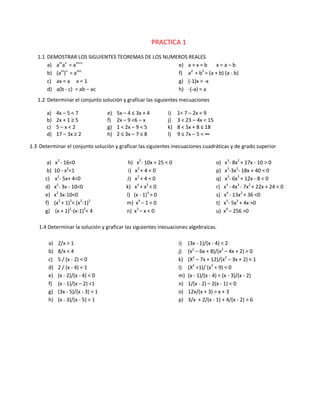
    PRACTICA 1 1.1 DEMOSTRARLOS SIGUIENTES TEOREMAS DE LOS NUMEROS REALES a) am an = am+n b) (am )n = amn c) ax = a x = 1 d) a(b - c) = ab – ac e) a + x = b x = a – b f) a2 + b2 = (a + b) (a - b) g) (-1)x = -x h) -(-a) = a 1.2 Determinar el conjunto solución y graficar las siguientes Inecuaciones a) 4x – 5 < 7 b) 2x + 1 ≥ 5 c) 5 – x < 2 d) 17 – 3x ≥ 2 e) 5x – 4 ≤ 3x + 4 f) 2x – 9 <6 – x g) 1 < 2x – 9 < 5 h) 2 ≤ 3x – 7 ≤ 8 i) 1< 7 – 2x < 9 j) 3 < 23 – 4x < 15 k) 8 < 5x + 8 ≤ 18 l) 9 ≤ 7x – 5 < ∞ 1.3 Determinar el conjunto solución y graficar las siguientes inecuaciones cuadráticas y de grado superior a) x2 - 16<0 h) x2 - 10x + 25 < 0 o) x3 - 8x2 + 17x - 10 > 0 b) 10 - x2 <1 i) x2 + 4 < 0 p) x3 -3x2 - 18x + 40 < 0 c) x2 - 5x+ 4<0 J) x2 + 4 < 0 q) x3 - 6x2 + 12x - 8 < 0 d) x2 - 3x - 10<0 k) x4 + x2 < 0 r) x4 - 4x3 - 7x2 + 22x + 24 < 0 e) x2 3x-10<0 l) (x - 1)3 > 0 s) x4 - 13x2 + 36 <0 f) (x2 + 1)2 < (x2 -1)2 m) x4 – 1 < 0 t) x5 - 5x3 + 4x >0 g) (x + 1)2 -(x-1)2 < 4 n) x3 – x < 0 u) x8 – 256 >0 1.4 Determinar la solución y graficar las siguientes inecuaciones algebraicas. a) 2/x > 1 b) 8/x < 4 c) 5 / (x - 2) < 0 d) 2 / (x - 4) < 1 e) (x - 2)/(x - 4) < 0 f) (x - 1)/(x – 2) <1 g) (3x - 5)/(x - 3) > 1 h) (x - 3)/(x - 5) > 1 i) (3x - 1)/(x - 4) < 2 j) (x2 – 6x + 8)/(x2 – 4x + 2) > 0 k) (X2 – 7x + 12)/(x2 – 3x + 2) < 1 l) (X2 +1)/ (x2 + 9) < 0 m) (x - 1)/(x - 4) < (x - 3)/(x - 2) n) 1/(x - 2) – 2(x - 1) < 0 o) 12x/(x + 3) > x + 3 p) 3/x + 2/(x - 1) + 4/(x - 2) > 6