SUBSECRETARIA TÈCNICO PEDAGÒGICO
UNIDAD DE EDUCACIÓN BASICA
GUÍA PARA LA PLANIFICACIÓN DOCENTE DE CONTENIDOS CURRICULARES EN BASE A LOS
ESTANDARES EDUCATIVOS NACIONALES PARA EL III CICLO DE LA EDUCACIÓN BÁSICA
CENTRO EDUCATIVO_________________________________________
AREA CURRICULAR:__________________________________________
GRADO: _________________________________________________
NOMBRE DEL DOCENTE: ______________________________________________
FECHA: _____________________________________________________
GUÍA PARA LA PLANIFICACIÓN DOCENTE DE CONTENIDOS CURRICULARES EN BASE A LOS ESTANDARES EDUCATIVOS NACIONALES PARA EL III CICLO DE
LA EDUCACIÓN BÁSICA
PRESENTACION
La Secretaríade Educación de laRepúblicade Honduras a través de la Unidad de Educación Básica,
con el apoyotécnicoy financierode lacooperaciónalemanaGIZ,realizalahomologación del tercer
ciclode EducaciónBásicaque consiste enunproceso de alineamientode losaspectoscurricularesy
administrativos, como una estrategia de trabajo que los centros educativos que tienen varias
modalidadesde entrega tales como: la modalidad de ciclo común presencial, ciclo básico técnico,
centrosde educación básica y modalidades alternativas (EDUCATODOS, SEMED, IHER,SAT BAYAN)
mejoren el accesoy ampliaciónde coberturadel tercer ciclo a través de una educación de calidad,
para que losestudiantes puedantenerlibre movilidadentreunamodalidadyotra,para asegurar el
ingresoal siguiente niveleducativoconlascompetenciasrequeridas, sin importar la modalidad en
la que cursan el tercer ciclo. En ese sentido se presenta a los docentes: La GUÍA PARA LA
PLANIFICACIÓN DOCENTE DE CONTENIDOS CURRICULARES EN BASE A LOS ESTANDARES
EDUCATIVOS NACIONALES.
El propósitode laguía esque el docente organice suplanificación anual y por cada parcial en base
al Diseño Curricular de Educación Básica a través de la estructura que incorpora los estándares
educativosnacionales,programacionesde cadaunade las áreascurriculares,bloquesde contenido,
los contenidos conceptuales y Actitudinales , los procesos y actividades sugeridas, acciones
didácticas creadaspor el docente que considere necesarioparacompletarel desarrollode laclase y
un apartado de observaciones.
GUÍA PARA LA PLANIFICACIÓN DOCENTEDECONTENIDOS CURRICULARES EN BASEA LOS ESTANDARES EDUCATIVOS NACIONALES
PARA EL III CICLODELA EDUCACIÓN BÁSICA
El Diseño Curricular Nacional de Educación Básica (DCNEB
¿Para que un Diseño Curricular para
la Educación Básica?
El DCNEB tiene un carácter
normativo,constituye elconjuntode
saberes,competencias,habilidadesy
destrezas básicas que deben formar
parte del proceso de enseñanza-
aprendizaje en todo el país
Esta estructurado por áreas
curriculares cada una comprende:
Definición y fundamentación del
área,Ejestransversales,Expectativas
de logro por ciclo y por grado y la
presentación y fundamentación de
los bloques de contenido,
orientaciones metodológicas y
orientaciones para la evaluación.
Área de Comunicación Alcance
Organiza, construye y desarrolla las
competencias comunicativas.
Parte de la lengua materna, aborda
los contenidos conceptuales,
procedimentales y actitudinales
desde unaperspectiva integradora y
articulada.
Habilita a los y las alumnas para
desenvolverse adecuadamente ensu
contexto social, local, nacional e
internacional.
Esta área comprende las siguientes
disciplinas: Lengua Materna,
Español,EducaciónArtística e Idioma
Extranjero.
El área de Comunicación garantiza
que las y los estudiantes puedan
utilizar adecuadamente todas las
formas de la comunicación en
diferentes situaciones, reflexionar
sobre ellaydesenvolverse con éxito
en la sociedad moderna.
Constituye un instrumento básico
para lograr aprendizajes en otros
campos educativos, dentro y fuera
de la escuela.
GUÍA PARA LA PLANIFICACIÓN DOCENTEDECONTENIDOS CURRICULARES EN BASEA LOS ESTANDARES EDUCATIVOS NACIONALES PARA EL III CICLODELA EDUCACIÓN BÁSICA
El DCNEB Unifica criterios en torno a:
¿Qué enseñar?
Contenidos
► Conceptuales► Saber ser
► Saber conocer ► Procedimentales (procesos y
actividades sugeridas).► Saber hacer
► Saber convivir ► Actitudinales
Contenidos y marco didáctico del DCNEB
Qué saber (Contenidos conceptuales)
 Saber científico, tecnológico y humanista que se quiere transferir al alumno a través de cada área.
¿Cómo y cuando
enseñar?
Aprendizajes
► Individualmente significativos
► Socialmente relevantes
► Culturalmente pertinentes
Metodología Enfoque
constructivista
¿Cómo y cuando
evaluar?
Evaluación
formativa
► Función diagnostica
► Función formativa
► Función sumativa
 Conjunto de conceptos, principios, explicaciones, datos y hechos.
Saber hacer (Contenidos procedimentales)
 Conjunto de acciones u operaciones ordenadas y dirigidas hacia la consecución de una meta, ej.: ejecución de procedimientos, estrategias, técnicas, métodos, habilidades, destrezas.
 Estrategias cognoscitivas generales utilizadas por el sujeto en la reconstrucción de conocimientos de distintos campos conceptuales.
GUÍA PARA LA PLANIFICACIÓN DOCENTEDECONTENIDOS CURRICULARES EN BASEA LOS ESTANDARES EDUCATIVOS NACIONALES PARA EL III CICLODELA EDUCACIÓN BÁSICA
Saber ser (Contendidos Actitudinales)
 Aspecto valorativo que todo conocimiento conlleva y que media nuestras acciones.
 Las actitudesfrente al conocimientoadquiridodeterminanel gradode compromisoque el educandoadquiere enlaaplicación del mismo para resolver problemas sociales, familiares, ej.: Sida, medio
ambiente, etc.
¿Cual es el marco didáctico del DCNRB?
 Concepción del aprendizaje:
- Proceso de construcción de saberes y significados a partir de la relación entre lo que el estudiante sabe (saberes previos) y puede hacer y los nuevos contenidos.
 Características del aprendizaje:
- Proceso pluridimensional dialectico y dinámico con avances desiguales y constantes y con múltiples reorganizaciones.
- Pone en juego aspectos cognoscitivos, afectivos, valores, intereses, actitudes.
- Se construye en interrelación con el entorno.
- Proceso de construcción conjunta con adultos y padres a partir de la confrontación de ideas, la búsqueda de acuerdos y consensos.
 Concepción de la enseñanza:
- Procesode interrelaciónactivaenlapropuestade situacionesproblematizadorasde aprendizaje parapromoverlainterrelacióny una síntesis significativa entre el nuevo conocimiento y el que ya
poseen los mismos.
- Debe partir de los esquemas conceptuales, las competencias y las habilidades, las valoraciones y actitudes de los alumnos desde las cuales estos contextualizaran cada nueva experiencia de
aprendizaje.
GUÍA PARA LA PLANIFICACIÓN DOCENTEDECONTENIS CURRICULARES EN BASEA LOS ESTANDARES EDUCATIVOS NACIONALES PARA EL III CICLODELA EDUCACIÓN BÁSICA
¿Cuales son las condiciones necesarias del aprendizaje?
1ra. Condición:Reconocerque losalumnospresentanalgunossaberespreviosrelacionadosconel
conocimientoque se vaa enseñar.
La experiencia previa incluye: conceptos, imágenes del mundo, representaciones, códigos lingüísticos.
Condiciona el aprendizaje
2a. Condición: El conocimientoenseñadodebe generarse apartirde un procesode comprensióny
de pensamientocrítico.
Saber ¿que es lo que realmente
queremos que el alumno comprenda?
¿Para que queremos que comprendan
este tema o concepto?
¿Cómo involucrar a los
alumnos enestos temasque
deseamoscomprenda?¿Como
comprobar docentesy
alumnos que se esta
construyendoesa
comprensión?
3a. Condición: Lo que se enseñasupone estrategiascognitivasde reflexiónsobre el propio
¿Cómo debe ser la relación docente-alumno?
¿Como se comprende la relación entre pares?
¿Cuáles son las características del contexto institucional?
En el año 2002,la Secretaría de Educación de Honduras dio a conocer un nuevo currículo que cubre desde Prebásica hasta el No veno grado, llamado Diseño Curricular Nacional Básico (DCNB). Para apoyar la implementación del
nuevo currículo en las aulas en todo el país, el Proyecto MIDEH/AIR, en colaboración con la Secretaría de Educación y docentes líderes de cada departamento d el país, desarrolló un sistema de evaluación nacional basado en
Estándares de Contenido para Español, Matemáticas, Ciencias Sociales y Ciencias Naturales.
Los materiales desarrollados por la Secretaría de Educación incluyen:
 Estándares Educativos Nacionales: definen los objetivos educativos que los docentes deben enseñar y lo que cada estudiante debe lograr en el proceso de aprendizaje, es decir, lo que deben saber y saber hacer.
 Programaciones: orientan la labor docente, mes a mes y por grado, sobre los estándares y contenidos a desarrollar.
 Pruebas Diagnósticas: identifican los estudiantes que tienen un nivel de desempeño aceptable en los estándares de Español y Matemáticas, así como los que requieren procesos de nivelación en estas áreas.
 Pruebas Formativas Mensuales: evalúan los estándares desarrollados durante cada mes, los resultados le sirven al docente para hacer ajustes a sus estrategias pedagógicas y a los estudiantes para hacer ajustes a sus estrategias de
aprendizaje.
 Instructivos: orientan al docente sobre el uso y aplicación de las Pruebas Mensuales y las Diagnósticas.
 Pruebas Fin de Grado: valoran los aprendizajes logrados al final del año escolar con el propósito de tomar decisiones administrativas. Están alineadas directamente con los Estándares Educativos Nacionales.
 Estándares de Desempeño: constituyen un marco de referencia para interpretar los resultados de las Pruebas de Fin de Grado y sirven para clasificar al estudiante en un nivel de desempeño determinado (Insatisfactorio, Debe
Mejorar, Satisfactorio y Avanzado).
Todos estos materiales están alineados al nuevo currículo y a los textos oficiales en las áreas de Comunicación (Español), Matemáticas, Ciencias Sociales y Ciencias Naturales.
Mayor Información visite la pág. http//:av.dcnbhonduras.org
aprendizaje.
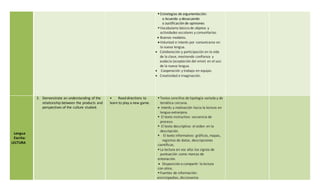
SEPTIMO GRADO – PROGRAMACIÓN DE INGLÉS 2013
Mes: Febrero Duración: XXXX horas/clase
Bloque Estándares
Indicador
Contenidos:
conceptuales y actitudinales
Procesos y
actividades sugeridas
(DCNEB)
Evaluación
diagnóstica,
formativa y
sumativa
Lengua oral:
Escucha
1. Engage in conversations, provide and
obtain information, express feelings
and emotions, and exchange opinions
(Interpersonal)
• Initiate and maintain
discussions where some
responses may be
unpredictable (e.g.,
scenarios).
• Provide an opinion on
topics of social and personal
interest (e.g., music,
literature, the arts, and the
sciences) and support with
details and examples.
• Engage in extended
conversations on a variety
of topics.
 Textos sencillos de tipología variada
contextualizados en la vida del aula o el
tema tratado.
 Estrategias de escucha: (previas,
durante, después de la escucha).
 Concentración y esfuerzo para escuchar
con atención.
 Participación activa en la reconstrucción
del mensaje escuchado.
 Fórmulas de cortesía y registros
formales e informales entre
compañeros y compañeras y con el
profesor o profesora.
 Órdenes complejas.
 Normas para organizar el espacio y la
vida cotidiana del aula.
 Instrucciones de actividades, procesos y
juegos.
 Vocabulario básico escolar.
 Elementos paralingüísticos (gestos, uso
de la voz...).
 Cortesía y buena educación.
 Concentración y esfuerzo para escuchar
con atención.
 Gozo y disfrute con la literatura;
creatividad e imaginación.
 Curiosidad e interés científico.
PREESCUCHA:
Participan en una
conversación previa a la
escucha del texto, guiada
por la maestra,
para expresar sus
conocimientos previos
sobre el tema, y efectuar
hipótesis iniciales.
Responden cortésmente ycon
el registro
adecuado a las diferentes
situaciones
sociales habituales en el aula
(saludos y
despedidas,peticiones y
solicitudes,excusas,
etc.).
Dialogo en parejas
 Respeto y valoración de las
intervenciones de los compañeros.
 Crítica constructiva hacia el trabajo de
los demás.
Los medios de comunicación y sus
funciones: entretenimiento.
 La TV: narraciones filmadas o en
dibujos.
 El diálogo.
 La narración.
 Pronunciación, lengua estándar.
Gozo y disfrute en el uso de la lengua
extranjera.
 El texto conversacional: registro
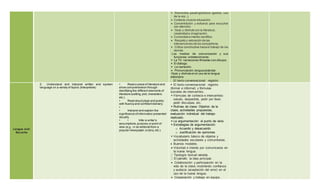
Lengua oral:
Escucha
2. Understand and interpret written and
spoken language on a variety of topics
(Interpretive)
• Read a piece of
literature and show
comprehension through
identifying the different
elements of literature
(setting, plot, characters,
etc.).
• Infer a writer’s
assumptions, purpose, or
point of view (e.g., in an
editorial from a popular
newspaper, a story, etc.).
• Analyze purpose,
social context and tone of
spoken and written
discourse (a coach pep talk,
a presidential candidate
speech, etc).
• Interpret and explain
the significance of
 El texto conversacional: registro
(formal e informal) y fórmulas
sociales de intercambio.
 Fórmulas de cortesía e intercambio:
saludo, despedida, pedir por favor, pedir
disculpas, etc.
 Rutinas de clase: Objetivo de la
clase, actividades propuestas,
evaluación individual del trabajo
realizado.
 La argumentación: el punto de vista
 Estrategias de argumentación:
o Acuerdo y desacuerdo
o Justificación de opiniones
 Vocabulario básico de objetos y
actividades escolares y comunitarias.
 Buenos modales.
 Voluntad e interés por comunicarse en
la nueva lengua.
� Tipología textual variada.
� El párrafo: la idea principal.
information presented
visually.
 Colaboración y participación en la vida
de la clase, mostrando confianza y
audacia (aceptación del error) en el uso
de la nueva lengua.
 Cooperación y trabajo en equipo.
 Responsabilidad individual y
 colectiva en el logro de metas
 comunes.
Creatividad e imaginación.
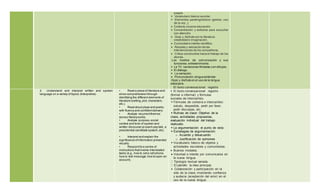
LENGUA
ORAL:
HABLA
3. Present information, concepts, and
ideas to an audience of listeners or
readers on a variety of topics
(Presentational)
• Represent information
visually.
• Design announcements.
• Write and present an
original story
 Tipología textual variada.
 El párrafo: la idea principal.
 Vocabulario básico.
 Colaboración y participación en la vida
de la clase, mostrando confianza y
audacia (aceptación del error) en el uso
de la nueva lengua.
Cooperación y trabajo en equipo.
Creatividad e imaginación.
 Pronunciación y entonación
Interés por expresarse y comunicarse a
través de situaciones simuladas.
LENGUA
ORAL :
HABLA
4. Demonstrate an understanding of the
relationship between the practices and
perspectives of the culture studied.
• Exchange opinions with
classmates on social issues
from the target culture
 El texto conversacional: registro (formal
e informal) y fórmulas sociales de
intercambio.
 Fórmulas de cortesía e intercambio:
saludo, despedida, pedir por favor, pedir
disculpas, etc.
 La argumentación: el punto de vista
 Estrategias de argumentación:
o Acuerdo y desacuerdo
o Justificación de opiniones
 Vocabulario básico de objetos y
actividades escolares y comunitarias.
 Buenos modales.
 Voluntad e interés por comunicarse en
la nueva lengua.
 Colaboración y participación en la vida
de la clase, mostrando confianza y
audacia (aceptación del error) en el uso
de la nueva lengua.
 Cooperación y trabajo en equipo.
 Creatividad e imaginación.
Lengua
Escrita:
LECTURA
5. Demonstrate an understanding of the
relationship between the products and
perspectives of the culture studied.
• Read directions to
learn to play a new game.
 Textos sencillos de tipología variada y de
temática cercana.
 Interés y motivación hacia la lectura en
lengua extranjera.
 El texto instructivo: secuencia de
proceso.
 El texto descriptivo: el orden en la
descripción.
 El texto informativo: gráficos, mapas,
registros de datos, descripciones
científicas.
 La lectura en voz alta: los signos de
puntuación como marcas de
entonación.
 Disposición a compartir la lectura
con otros.
 Fuentes de información:
enciclopedias, diccionarios
enciclopédicos, monográficos,
revistas científicas, etc.
 Nuevas tecnologías: internet,
CDROMs, etc.
Lengua
Escrita:
LECTURA
6. Use different media (written sources
and technology) to increase
understanding of the target culture.
 Read directions (e.g., to
learn to play a new
game).
 Expand knowledge and
use of idiomatic
expressions.
 Describe the use of
money in the target
culture.
 Use appropriate
Etiquette in public
places, at school, etc.
(role play).
 Identify music and
musicians in the target
culture.
 Textos sencillos de tipología variada y de
temática cercana.
 Interés y motivación hacia la lectura en
lengua extranjera.
 El texto instructivo: secuencia de
proceso.
 El texto descriptivo: el orden en la
descripción.
 El texto informativo: gráficos, mapas,
registros de datos, descripciones
científicas.
 La lectura en voz alta: los signos de
puntuación como marcas de
entonación.
 Disposición a compartir la lectura con
otros.
 Fuentes de información:
enciclopedias, diccionarios
enciclopédicos, monográficos,
revistas científicas, etc.
 Nuevas tecnologías: internet,
CDROMs, etc.
Lengua Oral:
HABLA
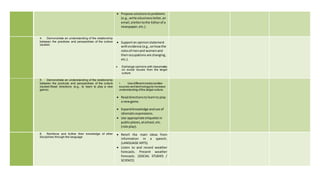
7. Reinforce and further their knowledge
of other disciplines through the
language
 Retell the main ideas from
information in a speech.
(LANGUAGE ARTS)
 Identify and independently
use personal space, general
space, and boundaries and
discuss why they are
important. (SOCIAL
STUDIES)
 Label and/or create several
types of maps of target
countries (e.g., political,
topographical, linguistic,
products, natural
resources, ethnic groups,
etc.). (SOCIAL STUDIES)
 El párrafo: la idea principal.
 Vocabulario básico.
 Colaboración y participación en la vida
de la clase, mostrando confianza y
audacia (aceptación del error) en el uso
de la nueva lengua.
 Cooperación y trabajo en equipo.
 Creatividad e imaginación.
 Pronunciación y entonación
 Interés por expresarse y comunicarse a
través de situaciones simuladas.
 Valoración del trabajo en equipo
 La obra teatral
Lengua
Escrita:
LECTURA
8. Acquire and use information from a
variety of sources only available in the
world language, using technology,
print, audiovisual, media, data and
human resources (Interdisciplinary)
• Use tools to find the
meaning of unknown words
(thesaurus) (e.g., students
create (vocabulary) displays
(showcases or bulletin
boards related to science,
 El texto instructivo: secuencia de
proceso.
 El texto descriptivo: el orden en la
descripción.
 El texto informativo: gráficos, mapas,
registros de datos, descripciones
health, art, math, etc.) of
pictures from magazines,
newspapers, and text from
computer technology,
library and/or realia from
home or teacher).
• Identify components
of food chains or life cycles
from diagrams or graphic
organizers
científicas.
 Tipos de lectura en función al objetivo
lector: lectura selectiva.
 Interés y motivación hacia la lectura
como fuente de información.
 Autonomía y exactitud en el trabajo.
 Gozo y disfrute con la literatura;
creatividad e imaginación.
 Curiosidad e interés científico.
 Respeto y valoración de las
intervenciones de los compañeros.
Reflexion
sobre la
Llengua.
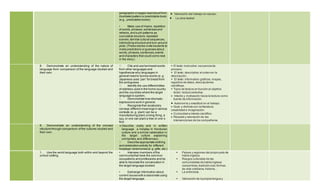
9. Demonstrate an understanding of the
nature of language from comparison of
the language studied and their own.
Cite and use borrowed
words from other languages
and hypothesize why
languages in general need
to borrow words (e. g.
Japanese uses ¨pan¨ for
bread from the portuguese.
Identify the use
different titles of address
used in the home country
and the countries where the
target language is spoken.
Demonstrate how
idiomatic expressions work
in general.
Recognize that
vocabulary conveys
different meanings in
various contexts (e. g. plant:
 Los medios de comunicación y sus
funciones
 La TV
 El lenguaje publicitario.
 Concentración y esfuerzo para
escucharcon atención
 Interés por la lengua extranjera
como medio de información
 La diversidad de lenguas en el
mundo: número de lenguas,
número de hablantes de las
distintas lenguas, familias de
lenguas, etc.
 Mapas lingüísticos del mundo.
 El bilingüismo y el multilingüismo
en
Honduras y el mundo: lenguas
mayoritarias y minoritarias,
derechos lingüísticos de las
can be a manufacturing
plant, a living thing, a spy,
or one can plant a tree or
one´s foot.
personas.
 El inglés como lengua de
comunicación internacional.
 Valoración de la riqueza lingüística
y cultural en el mundo.
 El texto instructivo: secuencia de
proceso.
 El texto informativo: gráficos,
mapas, registros de datos,
descripciones científicas.
Lengua
Oral:
HABLA
10. Use the world language both within
and beyond the school setting.
• Interview members of
the community that have
the common occupations
and professions and be able
to translate the
conversation in the target
language studied.
• Exchange information
about current issues with a
classmate using the target
language.
 Países y regiones del propio país de
habla inglesa.
 Rasgos culturales de las
comunidades de habla inglesa:
costumbres, tradición oral, formas
de vida cotidiana, historia...
 La entrevista.
 Valoración de la propia lengua y
cultura.
 Respeto e interés por otras lenguas
y culturas.
 Valoración del multilingüismo y
multiculturalismo como fuente de
riqueza colectiva y personal.
LENGUA
ORAL:
Escucha
11. Show evidence of becoming life-long
learners by using the language for
personal enjoyment and enrichment.
• Use the target
language to welcome native
speakers visiting their
communities.
• Enroll in a community
work program (e.g., a
 Situaciones cotidianas correspondientes
a la edad, simuladas con uso de habla
estándar: relaciones familiares, juego y
convivencia entre amigos, la compra, etc.
tutoring club for members
of their communities).
(PERSONAL ENRICHMENT)
• Use the country’s
currency on an imaginary
trip. (PERSONAL
ENRICHMENT)
SEPTIMO GRADO – PROGRAMACIÓN DE INGLÉS 2013
Mes: Marzo Duración: XXXX horas/clase
Bloque Estándares
Indicador
Contenidos:
conceptuales y actitudinales
Procesos y actividades
sugeridas (DCNEB)
Evaluación
diagnóstica,
formativa y
sumativa
1. Engage in conversations,provide and obtain
information, express feelings and emotions, and
exchange opinions (Interpersonal)
• Initiate and maintain
discussions where some
responses maybe unpredictable
(e.g., scenarios).
• Engage in extended
conversations on a variety of
topics.
 Textos sencillos de tipología variada
contextualizados en la vida del aula o el
tema tratado.
 Estrategias de escucha: (previas,
durante, después de la escucha).
 Concentración y esfuerzo para escuchar
con atención.
 Participación activa en la reconstrucción
del mensaje escuchado.
 Fórmulas de cortesía y registros
formales e informales entre compañeros
y compañeras y con el profesor o
profesora.
 Órdenes complejas.
 Normas para organizar el espacio y la
vida cotidiana del aula.
 Instrucciones de actividades, procesos
y juegos.
 Vocabulario básico escolar.
 Elementos paralingüísticos (gestos,uso
de la voz...).
 Cortesía y buena educación.
 Concentración y esfuerzo para escuchar
con atención.
 Gozo y disfrute con la literatura;
creatividad e imaginación.
 Curiosidad e interés científico.
 Respeto y valoración de las
intervenciones de los compañeros.
 Crítica constructiva hacia el trabajo de
los demás.
Los medios de comunicación y sus
funciones: entretenimiento.
 La TV: narraciones filmadas o en
dibujos.
 El diálogo.
 La narración.
 Pronunciación,lengua estándar.
Gozo y disfrute en el uso de la lengua
extranjera.
El texto conversacional: registro
2. Understand and interpret written and spoken
language on a variety of topics (Interpretive)
• Read a piece of literature
and show comprehension through
identifying the different elements
of literature (setting,plot,
characters,etc.).
• Infer a writer’s
assumptions,purpose,or point of
view (e.g., in an editorial from a
popular newspaper,a story, etc.).
• Analyze purpose,social
context and tone of spoken and
written discourse (a coach pep
talk, a presidential candidate
speech,etc).
• Interpret and explain the
significance ofinformation
presented visually.
 El texto conversacional: registro
(formal e informal) y fórmulas
sociales de intercambio.
 Fórmulas de cortesía e intercambio:
saludo, despedida, pedir por favor,
pedir disculpas, etc.
 Rutinas de clase: Objetivo de la
clase, actividades propuestas,
evaluación individual del trabajo
realizado.
 La argumentación: el punto de vista
 Estrategias de argumentación:
o Acuerdo y desacuerdo
o Justificación de opiniones
 Vocabulario básico de objetos y
actividades escolares y
comunitarias.
 Buenos modales.
 Voluntad e interés por comunicarse
en la nueva lengua.
� Tipología textual variada.
� El párrafo: la idea principal.
 Colaboración y participación en la
vida de la clase, mostrando
confianza y audacia (aceptación del
error) en el uso de la nueva lengua.
 Cooperación y trabajo en equipo.
 Responsabilidad individual y
 colectiva en el logro de metas
 comunes.
Creatividad e imaginación.
3. Present information, concepts, and ideas to
an audience of listeners or readers on a variety of
topics (Presentational)
• Write brief paraphrases and
summaries on teacher-given
topics.
• Narrate/give an oral report
in present,pastand future tenses.
• Representinformation
visually.
• Design announcements.
• Propose solutions to
problems (e.g.,write a business
letter, an email,a letter to the
Editor of a newspaper,etc.).
 Tipología textual variada.
 El párrafo: la idea principal.
 Vocabulario básico.
 Colaboración yparticipación en la vida
de la clase,mostrando confianza y
audacia (aceptación del error) en el uso
de la nueva lengua.
 Cooperación y trabajo en equipo.
Creatividad e imaginación.
 Pronunciación y entonación
Interés por expresarse y comunicarse a
través de situaciones simuladas.
4. Demonstrate an understanding of the
relationship between the practices and
perspectives of the culture studied.
• Supportan opinion
statementwith evidence (e.g., on
how the roles of men and women
and their occupations are
changing,etc.).
• Exchange opinions with
classmates on social issues from
the target culture.
 El texto conversacional: registro
(formal e informal) y fórmulas
sociales de intercambio.
 Fórmulas de cortesía e intercambio:
saludo, despedida, pedir por favor,
pedir disculpas, etc.
 La argumentación: el punto de vista
 Estrategias de argumentación:
o Acuerdo y desacuerdo
o Justificación de opiniones
 Vocabulario básico de objetos y
actividades escolares y
comunitarias.
 Buenos modales.
 Voluntad e interés por comunicarse
en la nueva lengua.
 Colaboración y participación en la
vida de la clase, mostrando
confianza y audacia (aceptación del
error) en el uso de la nueva lengua.
 Cooperación y trabajo en equipo.
 Creatividad e imaginación.
5. Demonstrate an understanding of the
relationship between the products and
perspectives of the culture studied.Read
directions (e.g., to learn to play a new game).
• Use differentmedia (written
sources and technology) to
increase understanding ofthe
target culture.
• Expand knowledge and use
of idiomatic expressions.
• Use appropriate etiquette in
public places,atschool,etc. (role
play).
 Textos sencillos de tipología variada y de
temática cercana.
 Interés y motivación hacia la lectura
en lengua extranjera.
 El texto instructivo:secuencia de
proceso.
 El texto descriptivo:el orden en la
descripción.
 El texto informativo:gráficos,mapas,
registros de datos,descripciones
científicas.
 La lectura en voz alta: los signos de
puntuación como marcas de
entonación.
 Disposición a compartir la lectura
con otros.
 Fuentes de información:
enciclopedias,diccionarios
enciclopédicos,monográficos,
revistas científicas,etc.
 Nuevas tecnologías:internet,
CDROMs, etc.
6. Reinforce and further their knowledge of
other disciplines through the language
• Solve story problems using
numbers up to 1 million.(MATH)
• Identify and independently
use personal space,general
space,and boundaries and
discuss whythey are important.
(SOCIAL STUDIES)
• Label and/or create several
types of maps oftarget countries
(e.g., political,topographical,
linguistic,products,natural
resources,ethnic groups,etc.).
(SOCIAL STUDIES)
 Textos sencillos de tipología variada y de
temática cercana.
 Interés y motivación hacia la lectura
en lengua extranjera.
 El texto instructivo:secuencia de
proceso.
 El texto descriptivo:el orden en la
descripción.
 El texto informativo:gráficos,mapas,
registros de datos,descripciones
científicas.
 La lectura en voz alta: los signos de
puntuación como marcas de
entonación.
 Disposición a compartir la lectura
con otros.
 Fuentes de información:
enciclopedias,diccionarios
enciclopédicos,monográficos,
revistas científicas,etc.
 Nuevas tecnologías:internet,
CDROMs, etc.
7. Acquire and use information from a variety of
sources only available in the world language,
using technology, print, audiovisual, media, data
and human resources (Interdisciplinary)
• Use tools to find the
meaning ofunknown words
(thesaurus) (e.g.,students create
(vocabulary) displays (showcases
or bulletin boards related to
science,health,art, math, etc.) of
pictures from magazines,
newspapers,and text from
computer technology,library
and/or realia from home or
teacher).
• Identify components offood
chains or life cycles from diagrams
or graphic organizers
• Explain the importance or
impactof the interative nature of
food chains or life cycles.
 El párrafo: la idea principal.
 Vocabulario básico.
 Colaboración y participación en la
vida de la clase, mostrando confianza
y audacia (aceptación del error) en el
uso de la nueva lengua.
 Cooperación y trabajo en equipo.
 Creatividad e imaginación.
 Pronunciación y entonación
 Interés por expresarse y comunicarse
a través de situaciones simuladas.
 Valoración del trabajo en equipo
 La obra teatral
8. Demonstrate an understanding of the nature
of language from comparison of the language
studied and their own.
Describe something orallyand in
written language (e.g. a holyday
in Honduran culture and a similar
celebration in the target culture
explaining similarities and
differences).
 El texto instructivo: secuencia de
proceso.
 El texto descriptivo:el orden en la
descripción.
 El texto informativo:gráficos,mapas,
registros de datos,descripciones
científicas.
 Tipos de lectura en función al objetivo
lector: lectura selectiva.
 Interés y motivación hacia la lectura
como fuente de información.
 Autonomía y exactitud en el trabajo.
 Gozo y disfrute con la literatura;
creatividad e imaginación.
 Curiosidad e interés científico.
 Respeto y valoración de las
intervenciones de los compañeros.
9. Use the world language both within and beyond
the school setting.
• Design a map placing food,
arts and crafts, clothing,etc.
(hamburgers,Hawaiian necklace,
winter coat, scarf,etc.) from target
culture.
• Research basic information
of the countries in the Americas
where the target language is
 Países y regiones del propio país
de habla inglesa.
 Rasgos culturales de las
comunidades de habla inglesa:
costumbres,tradición oral,formas
de vida cotidiana,historia...
 La entrevista.
spoken (Belize,Puerto Rico, USA,
Canada),make a presentation of
the main characteristics.
• Exchange information
aboutcurrent issues with a
classmate using the target
language.
 Valoración de la propia lengua y
cultura.
 Respeto e interés por otras
lenguas y culturas.
 Valoración del multilingüismo y
multiculturalismo como fuente de riqueza
colectiva y personal.
10. Show evidence of becoming life-long learners
by using the language for personal enjoymentand
enrichment.
• Use the target language to
write greeting cards,notes,letters
requesting specific information,
and e-mails.
• Identify the main points and
details in a radio or TV news
program.
 Situaciones cotidianas correspondientes
a la edad, simuladas con uso de habla
estándar: relaciones familiares, juego y
convivencia entre amigos, la
compra,etc.
SEPTIMO GRADO – PROGRAMACIÓN DE INGLÉS 2013
Mes: Abril Duración: XXXX horas/clase
Bloque Estándares
Indicador Contenidos:
conceptuales y actitudinales
Procesos y
actividades
sugeridas (DCNEB)
Evaluación
diagnóstica,
formativa y
sumativa
Lengua oral:
Escucha
1. Engage in conversations, provide and obtain
information, express feelings and emotions, and
exchange opinions (Interpersonal)
• Initiate and maintain
discussions where some responses
may be unpredictable (e.g.,
scenarios).
• Engage in extended
conversations on a variety of topics.
• Critique information presented
visually (through art, drama,etc.).
 Textos sencillos de tipología variada
contextualizados en la vida del aula o el
tema tratado.
 Estrategias de escucha: (previas, durante,
después de la escucha).
 Concentración y esfuerzo para escuchar
con atención.
 Participación activa en la reconstrucción
del mensaje escuchado.
 Fórmulas de cortesía y registros formales
e informales entre compañeros y
compañeras y con el profesor o profesora.
 Órdenes complejas.
 Normas para organizar el espacio y la vida
cotidiana del aula.
 Instrucciones de actividades, procesos y
juegos.
 Vocabulario básico escolar.
 Elementos paralingüísticos (gestos, uso
de la voz...).
 Cortesía y buena educación.
 Concentración y esfuerzo para escuchar
con atención.
 Gozo y disfrute con la literatura;
creatividad e imaginación.
 Curiosidad e interés científico.
 Respeto y valoración de las
intervenciones de los compañeros.
 Crítica constructiva hacia el trabajo de los
demás.
Los medios de comunicación y sus
funciones: entretenimiento.
 La TV: narraciones filmadas o en dibujos.
 El diálogo.
 La narración.
 Pronunciación,lengua estándar.
Gozo y disfrute en el uso de la lengua
extranjera.
El texto conversacional: registro
Lengua oral:
Escucha
2. Understand and interpret written and spoken
language on a variety of topics (Interpretive)
• Read a piece of literature and
show comprehension through
identifying the different elements of
literature (setting,plot, characters,
etc.).
• Read aloud plays and poetry
with fluency and confidentdelivery.
•
• Interpret and explain the
significance ofinformation presented
visually.
• • Infer a writer’s
assumptions,purpose,or point of
view (e.g., in an editorial from a
popular newspaper,a story, etc.).
 El texto conversacional: registro
(formal e informal) y fórmulas
sociales de intercambio.
 Fórmulas de cortesía e intercambio:
saludo, despedida, pedir por favor,
pedir disculpas, etc.
 Rutinas de clase: Objetivo de la
clase, actividades propuestas,
evaluación individual del trabajo
realizado.
 La argumentación: el punto de vista
 Estrategias de argumentación:
o Acuerdo y desacuerdo
o Justificación de opiniones
 Vocabulario básico de objetos y
actividades escolares y comunitarias.
 Buenos modales.
 Voluntad e interés por comunicarse en
la nueva lengua.
� Tipología textual variada.
� El párrafo: la idea principal.
 Colaboración y participación en la
vida de la clase, mostrando confianza
y audacia (aceptación del error) en el
uso de la nueva lengua.
 Cooperación y trabajo en equipo.
 Responsabilidad individual y
 colectiva en el logro de metas
 comunes.
Creatividad e imaginación.
LENGUA
ORAL:
HABLA
3. Present information, concepts, and ideas to an
audience of listeners or readers on a variety of topics
(Presentational)
• Write brief paraphrases and
summaries on teacher-given topics.
• Narrate/give an oral reportin
present,pastand future tenses.
• Representinformation visually.
• Write and presentan original
story.
 Tipología textual variada.
 El párrafo: la idea principal.
 Vocabulario básico.
 Colaboración yparticipación en la vida de
la clase,mostrando confianza y audacia
(aceptación del error) en el uso de la
nueva lengua.
 Cooperación y trabajo en equipo.
Creatividad e imaginación.
 Pronunciación y entonación
Interés por expresarse y comunicarse a
través de situaciones simuladas.
LENGUA
ORAL :
HABLA
4. Demonstrate an understanding of the relationship
between the practices and perspectives of the culture
studied.
• Supportan opinion statement
with evidence (e.g., on how the roles
of men and women and their
occupations are changing,etc.).
Describe cultural activities and
traditions.
• Exchange opinions with
classmates on social issues from the
target culture.
 El texto conversacional: registro
(formal e informal) y fórmulas sociales
de intercambio.
 Fórmulas de cortesía e intercambio:
saludo, despedida, pedir por favor,
pedir disculpas, etc.
 La argumentación: el punto de vista
 Estrategias de argumentación:
o Acuerdo y desacuerdo
o Justificación de opiniones
 Vocabulario básico de objetos y
actividades escolares y comunitarias.
 Buenos modales.
 Voluntad e interés por comunicarse en
la nueva lengua.
 Colaboración y participación en la vida
de la clase, mostrando confianza y
audacia (aceptación del error) en el
uso de la nueva lengua.
 Cooperación y trabajo en equipo.
 Creatividad e imaginación.
Lengua
Escrita:
LECTURA
5. Demonstrate an understanding of the relationship
between the products and perspectives of the culture
studied.Read directions (e.g., to learn to play a new
game).
• Use differentmedia (written
sources and technology) to increase
understanding ofthe target culture.
• Expand knowledge and use of
idiomatic expressions.
 Textos sencillos de tipología variada y de
temática cercana.
 Interés y motivación hacia la lectura
en lengua extranjera.
 El texto instructivo:secuencia de proceso.
 El texto descriptivo:el orden en la
• Use appropriate etiquette in
public places,atschool,etc. (role
play).
descripción.
 El texto informativo:gráficos,mapas,
registros de datos,descripciones
científicas.
 La lectura en voz alta: los signos de
puntuación como marcas de
entonación.
 Disposición a compartir la lectura
con otros.
 Fuentes de información:
enciclopedias,diccionarios
enciclopédicos,monográficos,
revistas científicas,etc.
 Nuevas tecnologías:internet,
CDROMs, etc.
Lengua Oral:
HABLA
6. Reinforce and further their knowledge of other
disciplines through the language
Identify and independentlyuse
personal space,general space,and
boundaries and discuss whythey are
important.(SOCIAL STUDIES)
Label and/or create several types of
maps oftarget countries (e.g.,
political,topographical,linguistic,
products,natural resources,ethnic
groups,etc.). (SOCIAL STUDIES)
 Textos sencillos de tipología variada y de
temática cercana.
 Interés y motivación hacia la lectura
en lengua extranjera.
 El texto instructivo:secuencia de
proceso.
 El texto descriptivo:el orden en la
descripción.
 El texto informativo:gráficos,mapas,
registros de datos,descripciones
científicas.
 La lectura en voz alta: los signos de
puntuación como marcas de
entonación.
 Disposición a compartir la lectura
con otros.
 Fuentes de información:
enciclopedias,diccionarios
enciclopédicos,monográficos,
revistas científicas,etc.
 Nuevas tecnologías:internet,
CDROMs, etc.
Lengua
Escrita:
LECTURA
7. Acquire and use information from a variety of
sources only available in the world language, using
technology, print, audiovisual, media, data and human
resources (Interdisciplinary)
• Use tools to find the meaning
of unknown words (thesaurus) (e.g.,
students create (vocabulary) displays
(showcases or bulletin boards related
to science,health,art, math,etc.) of
pictures from magazines,
newspapers,and text from computer
technology, library and/or realia from
home or teacher).
Interpret visual connection between
characters,places,or objectos in
paragraphs or pages read aloud from
 El párrafo: la idea principal.
 Vocabulario básico.
 Colaboración y participación en la
vida de la clase,mostrando confianza
y audacia (aceptación del error) en el
uso de la nueva lengua.
 Cooperación y trabajo en equipo.
 Creatividad e imaginación.
 Pronunciación y entonación
 Interés por expresarse y comunicarse a
través de situaciones simuladas.
illustrated pattern or predictable book
(e.g., predictable books)
 Valoración del trabajo en equipo
 La obra teatral
8. Demonstrate an understanding of the nature of
language from comparison of the language studied and
their own.
Cite and use borrowed words
from other languages and
hypothesize why languages in
general need to borrow words (e. g.
Japanese uses ¨pan¨ for bread from
the portuguese.
Identify the use differenttitles
of address used in the home country
and the countries where the target
language is spoken.
Demonstrate how idiomatic
expressions work in general.
Recognize that vocabulary
conveys different meanings in various
contexts (e. g. plant:can be a
manufacturing plant,a living thing, a
spy, or one can plant a tree or one´s
foot.
 El texto instructivo: secuencia de
proceso.
 El texto descriptivo:el orden en la
descripción.
 El texto informativo:gráficos,mapas,
registros de datos,descripciones
científicas.
 Tipos de lectura en función al objetivo
lector: lectura selectiva.
 Interés y motivación hacia la lectura como
fuente de información.
 Autonomía y exactitud en el trabajo.
 Gozo y disfrute con la literatura;
creatividad e imaginación.
 Curiosidad e interés científico.
 Respeto y valoración de las
intervenciones de los compañeros.
Lengua
Oral:
HABLA
9. Use the world language both within and beyond the
school setting.
• Interview members ofthe
communitythat have the common
occupations and professions and be
able to translate the conversation in
the target language studied.
• Design a map placing food,
arts and crafts, clothing,etc.
(hamburgers,Hawaiian necklace,
winter coat, scarf,etc.) from target
culture.
• Exchange information about
current issues with a classmate using
the target language.
• Research basic information of
the countries in the Americas where
the target language is spoken (Belize,
Puerto Rico,USA, Canada),make a
presentation ofthe main
characteristics.
 Países y regiones del propio país de
habla inglesa.
 Rasgos culturales de las
comunidades de habla inglesa:
costumbres,tradición oral,formas
de vida cotidiana,historia...
 La entrevista.
 Valoración de la propia lengua y
cultura.
 Respeto e interés por otras lenguas
y culturas.
 Valoración del multilingüismo y
multiculturalismo como fuente de riqueza
colectiva y personal.
LENGUA
ORAL:
Escucha
10. Show evidence of becoming life-long learners by
using the language for personal enjoyment and
enrichment.
• Participate in a leguage
immersion experience.(e.g.,
interviewing a person to get general
information.
Use the target language to welcome
native speakers visiting their
 Situaciones cotidianas correspondientes a
la edad, simuladas con uso de habla
estándar: relaciones familiares, juego y
convivencia entre amigos, la
compra,etc.
communities.
• Use the country’s currency on
an imaginarytrip.(PERSONAL
ENRICHMENT)
SEPTIMO GRADO – PROGRAMACIÓN DE INGLÉS 2013
Mes: Mayo Duración: XXXX horas/clase
Bloque Estándares
Indicador Contenidos:
conceptuales y actitudinales
Procesos y
actividades
sugeridas (DCNEB)
Evaluación
diagnóstica,
formativa y
sumativa
1. Engage in conversations, provide and obtain
information, express feelings and emotions, and
exchange opinions (Interpersonal)
• Initiate and maintain
discussions where some responses
may be unpredictable (e.g.,
scenarios).
• Provide an opinion on topics of
social and personal interest(e.g.,
music,literature,the arts, and the
sciences) and supportwith details
and examples.
• Engage in extended
conversations on a variety of topics.
• Critique information presented
visually (through art, drama,etc.).
 Textos sencillos de tipología variada
contextualizados en la vida del aula o el
tema tratado.
 Estrategias de escucha: (previas, durante,
después de la escucha).
 Concentración y esfuerzo para escuchar
con atención.
 Participación activa en la reconstrucción
del mensaje escuchado.
 Fórmulas de cortesía y registros formales
e informales entre compañeros y
compañeras y con el profesor o profesora.
 Órdenes complejas.
 Normas para organizar el espacio y la vida
cotidiana del aula.
 Instrucciones de actividades, procesos y
juegos.
 Vocabulario básico escolar.
 Elementos paralingüísticos (gestos, uso
de la voz...).
 Cortesía y buena educación.
 Concentración y esfuerzo para escuchar
con atención.
 Gozo y disfrute con la literatura;
creatividad e imaginación.
 Curiosidad e interés científico.
 Respeto y valoración de las
intervenciones de los compañeros.
 Crítica constructiva hacia el trabajo de los
demás.
Los medios de comunicación y sus
funciones: entretenimiento.
 La TV: narraciones filmadas o en dibujos.
 El diálogo.
 La narración.
 Pronunciación,lengua estándar.
Gozo y disfrute en el uso de la lengua
extranjera.
El texto conversacional: registro
2. Understand and interpret written and spoken
language on a variety of topics (Interpretive)
• Read a piece of literature and
show comprehension through
identifying the different elements of
literature (setting,plot, characters,
etc.).
• Read aloud plays and poetry
with fluency and confidentdelivery.
• Analyze recurrentthemes
across literaryworks.
• Analyze purpose,social
context and tone of spoken and
written discourse (a coach pep talk, a
presidential candidate speech,etc).
• Interpret and explain the
significance ofinformation presented
visually.
• Respond to a series of
instructions thatinvolve interrelated
tasks (e.g., how to seta cell phone,
how to text message,how to open an
account).
 El texto conversacional: registro
(formal e informal) y fórmulas
sociales de intercambio.
 Fórmulas de cortesía e intercambio:
saludo, despedida, pedir por favor,
pedir disculpas, etc.
 Rutinas de clase: Objetivo de la
clase, actividades propuestas,
evaluación individual del trabajo
realizado.
 La argumentación: el punto de vista
 Estrategias de argumentación:
o Acuerdo y desacuerdo
o Justificación de opiniones
 Vocabulario básico de objetos y
actividades escolares y comunitarias.
 Buenos modales.
 Voluntad e interés por comunicarse en
la nueva lengua.
� Tipología textual variada.
� El párrafo: la idea principal.
 Colaboración y participación en la
vida de la clase, mostrando confianza
y audacia (aceptación del error) en el
uso de la nueva lengua.
 Cooperación y trabajo en equipo.
 Responsabilidad individual y
 colectiva en el logro de metas
 comunes.
Creatividad e imaginación.
3. Present information, concepts, and ideas to an
audience of listeners or readers on a variety of topics
(Presentational)
• Fill in authentic forms (e.g.,
magazine subscriptions,invitations,
Internet forms where available).
• Write brief paraphrases and
summaries on teacher-given topics.
• Narrate/give an oral reportin
present,pastand future tenses.
• Representinformation visually.
• Write and presentan original
story.
 Tipología textual variada.
 El párrafo: la idea principal.
 Vocabulario básico.
 Colaboración yparticipación en la vida de
la clase,mostrando confianza y audacia
(aceptación del error) en el uso de la
nueva lengua.
 Cooperación y trabajo en equipo.
Creatividad e imaginación.
 Pronunciación y entonación
Interés por expresarse y comunicarse a
través de situaciones simuladas.
4. Demonstrate an understanding of the relationship
between the practices and perspectives of the culture
studied.
• Describe cultural activities and
traditions.
• Describe attitudes toward
moneyin the target culture.
• Exchange opinions with
classmates on social issues from the
target culture.
 El texto conversacional: registro
(formal e informal) y fórmulas sociales
de intercambio.
 Fórmulas de cortesía e intercambio:
saludo, despedida, pedir por favor,
pedir disculpas, etc.
 La argumentación: el punto de vista
 Estrategias de argumentación:
o Acuerdo y desacuerdo
o Justificación de opiniones
 Vocabulario básico de objetos y
actividades escolares y comunitarias.
 Buenos modales.
 Voluntad e interés por comunicarse en
la nueva lengua.
 Colaboración y participación en la vida
de la clase, mostrando confianza y
audacia (aceptación del error) en el
uso de la nueva lengua.
 Cooperación y trabajo en equipo.
 Creatividad e imaginación.
5. Demonstrate an understanding of the relationship
between the products and perspectives of the culture
studied.Read directions (e.g., to learn to play a new
game).
• Use differentmedia (written
sources and technology) to increase
understanding ofthe target culture.
• Expand knowledge and use of
idiomatic expressions.
 Textos sencillos de tipología variada y de
temática cercana.
 Interés y motivación hacia la lectura
en lengua extranjera.
 El texto instructivo:secuencia de proceso.
 El texto descriptivo:el orden en la
• Use appropriate etiquette in
public places,at school,etc. (role
play).
•• Describe the use of moneyin
the target culture.
descripción.
 El texto informativo:gráficos,mapas,
registros de datos,descripciones
científicas.
 La lectura en voz alta: los signos de
puntuación como marcas de
entonación.
 Disposición a compartir la lectura
con otros.
 Fuentes de información:
enciclopedias,diccionarios
enciclopédicos,monográficos,
revistas científicas,etc.
 Nuevas tecnologías:internet,
CDROMs, etc.
6. Reinforce and further their knowledge of other
disciplines through the language
Write responses to selected literature
that exhibit understanding ofthe tex,
using detailed sentences and
transitions.(LANGUAGE ARTS)
Identify and independentlyuse
personal space,general space,and
boundaries and discuss whythey are
important.(SOCIAL STUDIES)
Label and/or create several types of
maps oftarget countries (e.g.,
political,topographical,linguistic,
products,natural resources,ethnic
groups,etc.). (SOCIAL STUDIES)
 Textos sencillos de tipología variada y de
temática cercana.
 Interés y motivación hacia la lectura
en lengua extranjera.
 El texto instructivo:secuencia de
proceso.
 El texto descriptivo:el orden en la
descripción.
 El texto informativo:gráficos,mapas,
registros de datos,descripciones
científicas.
 La lectura en voz alta: los signos de
puntuación como marcas de
entonación.
 Disposición a compartir la lectura
con otros.
 Fuentes de información:
enciclopedias,diccionarios
enciclopédicos,monográficos,
revistas científicas,etc.
 Nuevas tecnologías:internet,
CDROMs, etc.
7. Acquire and use information from a variety of
sources only available in the world language, using
technology, print, audiovisual, media, data and human
resources (Interdisciplinary)
• Use tools to find the meaning
of unknown words (thesaurus) (e.g.,
students create (vocabulary) displays
(showcases or bulletin boards related
to science,health,art, math,etc.) of
pictures from magazines,
newspapers,and text from computer
technology, library and/or realia from
home or teacher).
Interpret visual connection between
characters,places,or objectos in
 El párrafo: la idea principal.
 Vocabulario básico.
 Colaboración y participación en la
vida de la clase,mostrando confianza
y audacia (aceptación del error) en el
uso de la nueva lengua.
 Cooperación y trabajo en equipo.
 Creatividad e imaginación.
 Pronunciación y entonación
 Interés por expresarse y comunicarse a
través de situaciones simuladas.
paragraphs or pages read aloud from
illustrated pattern or predictable book
(e.g., predictable books)
• Make use of rhyme, repetition
of words,phrases,sentences and
refrains,and such patterns as
cumulative structure,repeated
scenes,familiar cultural sequences,
interlocking structure and turn-around
plots.(These stories invite students to
make predictions or guesses about
words,phrases,sentences,events
and characters that could come next
in the story.)
 Valoración del trabajo en equipo
 La obra teatral
8. Demonstrate an understanding of the nature of
language from comparison of the language studied and
their own.
Cite and use borrowed words
from other languages and
hypothesize why languages in
general need to borrow words (e. g.
Japanese uses ¨pan¨ for bread from
the portuguese.
Identify the use differenttitles
of address used in the home country
and the countries where the target
language is spoken.
Demonstrate how idiomatic
expressions work in general.
Recognize that vocabulary
conveys different meanings in various
contexts (e. g. plant:can be a
manufacturing plant,a living thing, a
spy, or one can plant a tree or one´s
foot.
 El texto instructivo: secuencia de
proceso.
 El texto descriptivo:el orden en la
descripción.
 El texto informativo:gráficos,mapas,
registros de datos,descripciones
científicas.
 Tipos de lectura en función al objetivo
lector: lectura selectiva.
 Interés y motivación hacia la lectura como
fuente de información.
 Autonomía y exactitud en el trabajo.
 Gozo y disfrute con la literatura;
creatividad e imaginación.
 Curiosidad e interés científico.
 Respeto y valoración de las
intervenciones de los compañeros.
8. Demonstrate an understanding of the concept
ofculture through comparison of the cultures studied and
their own.
 Describe orally and in written
language a holyday in Honduran
culture and a similar celebration in
the target culture explaining
similarities and differences).
Describe appropriate clothing
and celebration activity for different
holydays/ ceremonies (e. g. gifts, etc.)
1. Use the world language both within and beyond the
school setting.
• Interview members ofthe
communitythat have the common
occupations and professions and be
able to translate the conversation in
the target language studied.
• Exchange information about
current issues with a classmate using
the target language.
 Países y regiones del propio país de
habla inglesa.
 Rasgos culturales de las
comunidades de habla inglesa:
costumbres,tradición oral,formas
de vida cotidiana,historia...
 La entrevista.
 Valoración de la propia lengua y
cultura.
 Respeto e interés por otras lenguas
y culturas.
 Valoración del multilingüismo y
multiculturalismo como fuente de riqueza
colectiva y personal.
2. Show evidence of becoming life-long learners by
using the language for personal enjoyment and
enrichment.
• Use the target language to
write greeting cards,notes,letters
requesting specific information,and e
–mails.
 Situaciones cotidianas correspondientes a
la edad, simuladas con uso de habla
estándar: relaciones familiares, juego y
convivencia entre amigos, la
compra,etc.
SEPTIMO GRADO – PROGRAMACIÓN DE INGLÉS 2013
Mes: Junio Duración: XXXX horas/clase
Bloque Estándares
Indicador Contenidos:
conceptuales y actitudinales
Procesos y
actividades
sugeridas (DCNEB)
Evaluación
diagnóstica,
formativa y
sumativa
1. Engage in conversations, provide and obtain
information, express feelings and emotions, and
exchange opinions (Interpersonal)
• Initiate and maintain
discussions where some responses
may be unpredictable (e.g.,
scenarios).
• Provide an opinion on topics of
social and personal interest(e.g.,
music,literature,the arts, and the
sciences) and supportwith details
and examples.
• Engage in extended
conversations on a variety of topics.
• Critique information presented
visually (through art, drama,etc.).
2. Understand and interpret written and spoken
language on a variety of topics (Interpretive)
• Read a piece of literature and
show comprehension through
identifying the different elements of
literature (setting,plot, characters,
etc.).
• Read aloud plays and poetry
with fluency and confidentdelivery.
• Infer a writer’s assumptions,
purpose,or pointof view (e.g., in an
editorial from a popular newspaper,a
story, etc.).
 Analyze recurrent themes
across literary works.
• Analyze purpose,social
context and tone of spoken and
written discourse (a coach pep talk, a
presidential candidate speech,etc).
• Interpret and explain the
significance ofinformation presented
visually.
3. Present information, concepts, and ideas to an
audience of listeners or readers on a variety of topics
(Presentational)
• Write brief paraphrases and
summaries on teacher-given topics.
• Narrate/give an oral reportin
present,pastand future tenses.
• Representinformation visually.
4. Demonstrate an understanding of the relationship
between the practices and perspectives of the culture
studied.
• Describe cultural activities and
traditions.
• Exchange opinions with
classmates on social issues from the
target culture.
5. Demonstrate an understanding of the relationship
between the products and perspectives of the culture
studied.Read directions (e.g., to learn to play a new
game).
• Use differentmedia (written
sources and technology) to increase
understanding ofthe target culture.
• Expand knowledge and use of
idiomatic expressions.
• Use appropriate etiquette in
public places,atschool,etc. (role
play).
• Identify music and musicians in
the target culture.
6. Reinforce and further their knowledge of other
disciplines through the language
• Compare works ofart from
different cultures.(ART)
• Explain how music reflects the
target culture. (MUSIC)
• Recognize contemporary
music in the target language (e.g.
Selena,Celine Dion,etc). (MUSIC)
7. Acquire and use information from a variety of
sources only available in the world language, using
technology, print, audiovisual, media, data and human
resources (Interdisciplinary)
• Use tools to find the meaning
of unknown words (thesaurus) (e.g.,
students create (vocabulary) displays
(showcases or bulletin boards related
to science,health,art, math,etc.) of
pictures from magazines,
newspapers,and text from computer
technology, library and/or realia from
home or teacher).
Interpret visual connection between
characters,places,or objectos in
paragraphs or pages read aloud from
illustrated pattern or predictable book
(e.g., predictable books)
• Make use of rhyme, repetition
of words,phrases,sentences and
refrains,and such patterns as
cumulative structure,repeated
scenes,familiar cultural sequences,
interlocking structure and turn-around
plots.(These stories invite students to
make predictions or guesses about
words,phrases,sentences,events
and characters that could come next
in the story.)
8. Demonstrate an understanding of the nature of
language from comparison of the language studied and
their own.
Cite and use borrowed words
from other languages and
hypothesize why languages in
general need to borrow words (e. g.
Japanese uses ¨pan¨ for bread from
the portuguese.
 Demonstrate how idiomatic
expressions work in general.
Recognize that vocabulary
conveys different meanings in various
contexts (e. g. plant:can be a
manufacturing plant,a living thing, a
spy, or one can plant a tree or one´s
foot.
8. Demonstrate an understanding of the concept
ofculture through comparison of the cultures studied and
their own.
 Describe a leisure activity in
both native and target
culture.
 Describe something orally
Compare and contrast
literature, art, music, etc. in
different cultures.
1. Use the world language both within and beyond the
school setting.
• Interview members ofthe
communitythat have the common
occupations and professions and be
able to translate the conversation in
the target language studied.
• Exchange information about
current issues with a classmate using
the target language.
• Research basic information of
the countries in the Americas where
the target language is spoken (Belize,
Puerto Rico,USA, Canada),make a
presentation ofthe main
characteristics.
2. Show evidence of becoming life-long learners by
using the language for personal enjoyment and
enrichment.
Participate in a leguage immersion
experience.(e.g., interviewing a
person to get general information.
Use the target language to welcome
native speakers visiting their
communities.
Identify the main points and details in
a radio or TV news program.
• Enroll in a communitywork
program (e.g., a tutoring club for
members oftheir communities).
(PERSONAL ENRICHMENT)
SEPTIMO GRADO – PROGRAMACIÓN DE INGLÉS 2013
Mes: Julio Duración: XXXX horas/clase
Bloque Estándares
Indicador Contenidos:
conceptuales y actitudinales
Procesos y
actividades
sugeridas (DCNEB)
Evaluación
diagnóstica,
formativa y
sumativa
1. Engage in conversations, provide and obtain
information, express feelings and emotions, and
exchange opinions (Interpersonal)
• Initiate and maintain
discussions where some responses
may be unpredictable (e.g.,
scenarios).
• Provide an opinion on topics of
social and personal interest(e.g.,
music,literature,the arts, and the
sciences) and supportwith details
and examples.
• Engage in extended
conversations on a variety of topics.
• Critique information presented
visually (through art, drama,etc.).
• Develop a logical argumenton
the advantages and disadvantages of
a proposed course ofaction (e.g., the
year-round school,lowing the age for
getting a driver’s license to 15).
2. Understand and interpret written and spoken
language on a variety of topics (Interpretive)
• Analyze purpose,social
context and tone of spoken and
written discourse (a coach pep talk, a
presidential candidate speech,etc).
• Interpret and explain the
significance ofinformation presented
visually.
3. Present information, concepts, and ideas to an
audience of listeners or readers on a variety of topics
(Presentational)
• Write and act out a commercial
with a group.
• Representinformation visually.
• Design announcements.
• Propose solutions to problems
(e.g., write a business letter,an email,
a letter to the Editor of a newspaper,
etc.).
4. Demonstrate an understanding of the relationship
between the practices and perspectives of the culture
studied.
• Supportan opinion statement
with evidence (e.g., on how the roles
of men and women and their
occupations are changing,etc.).
Identify the economic situation ofthe
Honduran culture and its position in
the global economyin relation to the
target culture.
 Identify practices and beliefs with
regard to body hygiene.•
 Exchange opinions with classmates
on social issues from the target
culture.
5. Demonstrate an understanding of the relationship
between the products and perspectives of the culture
studied.Read directions (e.g., to learn to play a new
game).
• Use differentmedia (written
sources and technology) to increase
understanding ofthe target culture.
• Expand knowledge and use of
idiomatic expressions.
• Use appropriate etiquette in
public places,atschool,etc. (role
play).
6. Reinforce and further their knowledge of other
disciplines through the language
• Retell the main ideas from
information in a speech.(LANGUAGE
ARTS)
7. Acquire and use information from a variety of
sources only available in the world language, using
technology, print, audiovisual, media, data and human
resources (Interdisciplinary)
• Use tools to find the meaning
of unknown words (thesaurus) (e.g.,
students create (vocabulary) displays
(showcases or bulletin boards related
to science,health,art, math,etc.) of
pictures from magazines,
newspapers,and text from computer
technology, library and/or realia from
home or teacher).
Interpret visual connection between
characters,places,or objectos in
paragraphs or pages read aloud from
illustrated pattern or predictable book
(e.g., predictable books)
• Make use of rhyme, repetition
of words,phrases,sentences and
refrains,and such patterns as
cumulative structure,repeated
scenes,familiar cultural sequences,
interlocking structure and turn-around
plots.(These stories invite students to
make predictions or guesses about
words,phrases, sentences,events
and characters that could come next
in the story.)
8. Demonstrate an understanding of the nature of
language from comparison of the language studied and
their own.
Cite and use borrowed words
from other languages and
hypothesize why languages in
general need to borrow words (e. g.
Japanese uses ¨pan¨ for bread from
the portuguese.
Identify the use differenttitles
of address used in the home country
and the countries where the target
language is spoken.
 Demonstrate how idiomatic
expressions work in general.
Recognize that vocabulary
conveys different meanings in various
contexts (e. g. plant:can be a
manufacturing plant,a living thing, a
spy, or one can plant a tree or one´s
foot.
8. Demonstrate an understanding of the concept
ofculture through comparison of the cultures studied and
their own.
 Choose a profession and tell
about the career in both
cultures.
1. Use the world language both within and beyond the
school setting.
• Interview members ofthe
communitythat have the common
occupations and professions and be
able to translate the conversation in
the target language studied.
• Exchange information about
current issues with a classmate using
the target language.
• Research basic information of
the countries in the Americas where
the target language is spoken (Belize,
Puerto Rico,USA, Canada),make a
presentation ofthe main
characteristics.
2. Students use the world language both world
language both within and beyond the school setting. Exchange information about current
with a classmate using the target
language.
Students show evidence of becoming
life-long learners byusing the
language for personal enjoymentand
enrichment.
Participate in a language immersion
experience.(e.g., interviewing a
person to get general informacion )
Demonstrate an understanding of
printed or recorded advice and
suggestions.
Use the target language to write
greeting cards,notes,letters
requesting specific information,and
e-mails
Identify the main points and details in
a radio or TV news program.
SEPTIMO GRADO – PROGRAMACIÓN DE INGLÉS 2013
Mes: Agosto Duración: XXXX horas/clase
Bloque Estándares
Indicador Contenidos:
conceptuales y actitudinales
Procesos y
actividades
sugeridas (DCNEB)
Evaluación
diagnóstica,
formativa y
sumativa
1. Engage in conversations, provide and obtain
information, express feelings and emotions, and
exchange opinions (Interpersonal)
• Initiate and maintain
discussions where some responses
may be unpredictable (e.g.,
scenarios).
• Provide an opinion on topics of
social and personal interest(e.g.,
music,literature,the arts, and the
sciences) and supportwith details
and examples.
• Engage in extended
conversations on a variety of topics.
2. Understand and interpret written and spoken
language on a variety of topics (Interpretive)
 Read a piece of literature and
show comprehension through
identifying the different elements
of literature (setting, plot,
characters, etc.).
• Read aloud plays and poetry
with fluency and confidentdelivery.
• Infer a writer’s assumptions,
purpose,or pointof view (e.g., in an
editorial from a popular newspaper,a
story, etc.).
• Analyze recurrentthemes
across literaryworks.
• Analyze purpose,social
context and tone of spoken and
written discourse (a coach pep talk, a
presidential candidate speech,etc).
• Interpret and explain the
significance ofinformation presented
visually.
3. Present information, concepts, and ideas to an
audience of listeners or readers on a variety of topics
(Presentational)
• Write brief paraphrases and
summaries on teacher-given topics.
• Narrate/give an oral reportin
present,pastand future tenses.
• Representinformation visually.
• Write and presentan original
story.
4. Demonstrate an understanding of the relationship
between the practices and perspectives of the culture
studied.
• Supportan opinion statement
with evidence (e.g., on how the roles
of men and women and their
occupations are changing,etc.).
Identify the economic situation ofthe
Honduran culture and its position in
the global economyin relation to the
target culture.
 Identify practices and beliefs with
regard to body hygiene.•
 Exchange opinions with classmates
on social issues from the target
culture.
5. Demonstrate an understanding of the relationship
between the products and perspectives of the culture
studied.Read directions (e.g., to learn to play a new
game).
• Use differentmedia (written
sources and technology) to increase
understanding ofthe target culture.
• Expand knowledge and use of
idiomatic expressions.
• Use appropriate etiquette in
public places,at school,etc. (role
play).
 Identify music and musiciansin the
target culture.
6. Reinforce and further their knowledge of other
disciplines through the language
 Retell the main ideas from
information in a speech.
(LANGUAGE ARTS)
 Explainhowmusicreflectsthe
target culture. (MUSIC)
 Make a list of how literature
reflects the target culture.
(LANGUAGE ARTS)
 Recognize contemporary music
in the target language (e.g.
Selena, Celine Dion, etc).
(MUSIC)
 Write responses to selected
literature that exhibit
understandingof the text,using
detailed sentences and
transitions. (LANGUAGE ARTS).
 Identifyand independently use
personal space, general space,
and boundariesanddiscusswhy
they are important. (SOCIAL
STUDIES)
 Label and/or create several
types of maps of target
countries (e.g., political,
topographical, linguistic,
products, natural resources,
ethnic groups, etc.). (SOCIAL
STUDIES)
7. Acquire and use information from a variety of
sources only available in the world language, using
technology, print, audiovisual, media, data and human
resources (Interdisciplinary)
• Use tools to find the meaning
of unknown words (thesaurus) (e.g.,
students create (vocabulary) displays
(showcases or bulletin boards related
to science,health,art, math,etc.) of
pictures from magazines,
newspapers,and text from computer
technology, library and/or realia from
home or teacher).
Interpret visual connection between
characters,places,or objectos in
paragraphs or pages read aloud from
illustrated pattern or predictable book
(e.g., predictable books)
• Make use of rhyme, repetition
of words,phrases,sentences and
refrains,and such patterns as
cumulative structure,repeated
scenes,familiar cultural sequences,
interlocking structure and turn-around
plots.(These stories invite students to
make predictions or guesses about
words,phrases,sentences,events
and characters that could come next
in the story.)
 List the sequence of events
related to characters and
settings in illustrated folktales
using graphic organizers.
8. Demonstrate an understanding of the nature of
language from comparison of the language studied and
their own.
Cite and use borrowed words
from other languages and
hypothesize why languages in
general need to borrow words (e. g.
Japanese uses ¨pan¨ for bread from
the portuguese.
Identify the use differenttitles
of address used in the home country
and the countries where the target
language is spoken.
 Demonstrate how idiomatic
expressions work in general.
Recognize that vocabulary
conveys different meanings in various
contexts (e. g. plant:can be a
manufacturing plant,a living thing, a
spy, or one can plant a tree or one´s
foot.
8. Demonstrate an understanding of the concept
ofculture through comparison of the cultures studied and
their own.
 Describe something orally
and in written language (e.
g. a holyday in Honduran
culture and a similar
celebration in the target
culture explaining
similaritiesanddifferences).
 Describe appropriate
clothing and celebration
activity for different
holydays/ ceremonies(e.g.
gifts, etc.)
 Compare and contrast
literature, art, music, etc. in
different cultures.
1. Use the world language both within and beyond the
school setting.
 Design a map placing food, arts
and crafts, clothing, etc.
(hamburgers, Hawaiian
necklace, winter coat, scarf,
etc.) from target culture.
• Exchange information about
current issues with a classmate using
the target language.
• Research basic information of
the countries in the Americas where
the target language is spoken (Belize,
Puerto Rico,USA, Canada),make a
presentation ofthe main
characteristics.
2. Show evidence of becoming life-long learners by
using the language for personal enjoyment and
enrichment.
Participate in a leguage immersion
experience.(e.g., interviewing a
person to get general information.
Use the target language to welcome
native speakers visiting their
communities.
Identify the main points and details in
a radio or TV news program.
• Enroll in a communitywork
program (e.g., a tutoring club for
members oftheir communities).
(PERSONAL ENRICHMENT)
SEPTIMO GRADO – PROGRAMACIÓN DE INGLES 2013
Mes: Septiembre Duración: XXXX horas/clase
Bloque Estándares
Indicador Contenidos:
conceptuales y actitudinales
Procesos y
actividades
sugeridas (DCNEB)
Evaluación
diagnóstica,
formativa y
sumativa
1. Engage in conversations, provide and obtain
information, express feelings and emotions, and
exchange opinions (Interpersonal)
• Initiate and maintain
discussions where some responses
may be unpredictable (e.g.,
scenarios).
• Provide an opinion on topics of
social and personal interest(e.g.,
music,literature,the arts, and the
sciences) and supportwith details
and examples.
• Engage in extended
conversations on a variety of topics.
• Develop a logical argumenton
the advantages and disadvantages of
a proposed course ofaction (e.g., the
year-round school,lowing the age for
getting a driver’s license to 15).
2. Understand and interpret written and spoken
language on a variety of topics (Interpretive) • Infer a writer’s assumptions,
purpose,or pointof view (e.g., in an
editorial from a popular newspaper,a
story, etc.).
• Analyze recurrentthemes
across literaryworks.
• Analyze purpose,social
context and tone of spoken and
written discourse (a coach pep talk, a
presidential candidate speech,etc).
• Interpret and explain the
significance ofinformation presented
visually.
3. Present information, concepts, and ideas to an
audience of listeners or readers on a variety of topics
(Presentational)
• Write brief paraphrases and
summaries on teacher-given topics.
• Narrate/give an oral reportin
present,pastand future tenses.
• Propose solutions to problems
(e.g., write a business letter,an email,
a letter to the Editor of a newspaper,
etc.).
4. Demonstrate an understanding of the relationship
between the practices and perspectives of the culture
studied.
• Supportan opinion statement
with evidence (e.g., on how the roles
of men and women and their
occupations are changing,etc.).
Identify the economic situation ofthe
Honduran culture and its position in
the global economyin relation to the
target culture.
 Describe attitudestoward
moneyinthe target culture.
 Identify practices and beliefs with
regard to body hygiene.•
 Exchange opinions with classmates
on social issues from the target
culture.
5. Demonstrate an understanding of the relationship
between the products and perspectives of the culture
studied.Read directions (e.g., to learn to play a new
game).
• Use differentmedia (written
sources and technology) to increase
understanding ofthe target culture.
• Expand knowledge and use of
idiomatic expressions.
• Describe the use of moneyin the
target culture.
6. Reinforce and further their knowledge of other
disciplines through the language
 Solve story problems using
numbers up to 1 million.
(MATH)
 Retell the main ideas from
information in a speech.
(LANGUAGE ARTS)
 Label and/or create several
types of maps of target
countries (e.g., political,
topographical, linguistic,
products, natural resources,
ethnic groups, etc.). (SOCIAL
STUDIES)
7. Acquire and use information from a variety of
sources only available in the world language, using
technology, print, audiovisual, media, data and human
resources (Interdisciplinary)
• Use tools to find the meaning
of unknown words (thesaurus) (e.g.,
students create (vocabulary) displays
(showcases or bulletin boards related
to science,health,art, math,etc.) of
pictures from magazines,
newspapers,and text from computer
technology, library and/or realia from
home or teacher).
 Interpret visual connection between
characters, places, or objectos in
paragraphs or pages read aloud
from illustrated pattern or
predictable book (e.g., predictable
books)
 List technological resources of
communities or regions of the
target language.
8. Demonstrate an understanding of the nature of
language from comparison of the language studied and
their own.
Cite and use borrowed words
from other languages and
hypothesize why languages in
general need to borrow words (e. g.
Japanese uses ¨pan¨ for bread from
the portuguese.
Identify the use differenttitles
of address used in the home country
and the countries where the target
language is spoken.
 Demonstrate how idiomatic
expressions work in general.
Recognize that vocabulary
conveys different meanings in various
contexts (e. g. plant:can be a
manufacturing plant,a living thing, a
spy, or one can plant a tree or one´s
foot.
8. Demonstrate an understanding of the concept of
culture through comparison of the cultures studied and
their own.
 Choose a professionandtell
about the career in both
cultures.
1. Use the world language both within and beyond the
school setting.
 Interview members of the
community that have the
common occupations and
professions and be able to
translate the conversation in
the target language studied.
 Design a map placing food, arts
and crafts, clothing, etc.
(hamburgers, Hawaiian
necklace, winter coat, scarf,
etc.) from target culture.
 Exchange information about
current issues with a classmate
using the target language.
 Research basic information of
the countries in the Americas
where the target language is
spoken (Belize, Puerto Rico,
USA, Canada), make a
presentation of the main
characteristics.
2. Show evidence of becoming life-long learners by
using the language for personal enjoyment and
enrichment.
Participate in a leguage immersion
experience.(e.g., interviewing a
person to get general information.
 Use the target language to
welcome native speakers
visiting their communities.
Demonstrate an understanding
of printed or recorded advice
and suggestions.
Use the target language to welcome
native speakers visiting their
communities.
Identify the main points and details in
a radio or TV news program.
• Enroll in a communitywork
program (e.g., a tutoring club for
members oftheir communities).
(PERSONAL ENRICHMENT)
SEPTIMO GRADO – PROGRAMACIÓN DE INGLES 2013
Mes: Octubre Duración: XXXX horas/clase
Bloque Estándares
Indicador Contenidos:
conceptuales y actitudinales
Procesos y
actividades
sugeridas (DCNEB)
Evaluación
diagnóstica,
formativa y
sumativa
1. Engage in conversations, provide and obtain
information, express feelings and emotions, and
exchange opinions (Interpersonal)
• Initiate and maintain
discussions where some responses
may be unpredictable (e.g.,
scenarios).
• Provide an opinion on topics of
social and personal interest(e.g.,
music,literature,the arts, and the
sciences) and supportwith details
and examples.
• Engage in extended
conversations on a variety of topics.
2. Understand and interpret written and spoken
language on a variety of topics (Interpretive)  Reada piece of literature and
showcomprehensionthrough
identifyingthe different
elementsof literature (setting,
plot,characters,etc.).
 Readaloudplaysand poetry
withfluencyandconfident
delivery.
Infer a writer’s assumptions,purpose,
or pointof view (e.g., in an editorial
from a popular newspaper,a story,
etc.).
• Analyze recurrentthemes
across literaryworks.
• Analyze purpose,social
context and tone of spoken and
written discourse (a coach pep talk, a
presidential candidate speech,etc).
3. Present information, concepts, and ideas to an
audience of listeners or readers on a variety of topics
(Presentational)
• Write brief paraphrases and
summaries on teacher-given topics.
• Narrate/give an oral reportin
present,pastand future tenses.
 Write and presentanoriginal
story.
4. Demonstrate an understanding of the relationship
between the practices and perspectives of the culture
studied.
 Exchange opinions with classmates
on social issues from the target
culture.
5. Demonstrate an understanding of the relationship
between the products and perspectives of the culture
studied.Read directions (e.g., to learn to play a new
game).
• Use differentmedia (written
sources and technology) to increase
understanding ofthe target culture.
 Expandknowledge anduse of
idiomaticexpressions.
 Use appropriate etiquette in
publicplaces,atschool,etc.
(role play).
6. Reinforce and further their knowledge of other
disciplines through the language
 Retell the main ideas from
information in a speech.
(LANGUAGE ARTS)
 Make a list of how literature
reflects the target culture.
(LANGUAGE ARTS)
 Recognize contemporary music
in the target language (e.g.
Selena, Celine Dion, etc).
(MUSIC)
Write responses to selected
literature that exhibit
understandingof the text,using
detailed sentences and
transitions. (LANGUAGE ARTS).
7. Acquire and use information from a variety of
sources only available in the world language, using
technology, print, audiovisual, media, data and human
resources (Interdisciplinary)
• Use tools to find the meaning
of unknown words (thesaurus) (e.g.,
students create (vocabulary) displays
(showcases or bulletin boards related
to science,health,art, math,etc.) of
pictures from magazines,
newspapers,and text from computer
technology, library and/or realia from
home or teacher).
 Interpret visual connection between
characters, places, or objectos in
paragraphs or pages read aloud
from illustrated pattern or
predictable book (e.g., predictable
books)
 Make use of rhyme, repetition
of words, phrases, sentences
and refrains, and such patterns
as cumulative structure,
repeated scenes, familiar
cultural sequences,interlocking
structure and turn-around
plots. (These stories invite
studentstomake predictionsor
guesses about words, phrases,
sentences, events and
characters that could come
next in the story.)
 List technological resources of
communities or regions of the
target language.
 List the sequence of events
related to characters and
settings in illustrated folktales
using graphic organizers.
8. Demonstrate an understanding of the nature of
language from comparison of the language studied and
their own.
Cite and use borrowed words
from other languages and
hypothesize why languages in
general need to borrow words (e. g.
Japanese uses ¨pan¨ for bread from
the portuguese.
Identify the use differenttitles
of address used in the home country
and the countries where the target
language is spoken.
 Demonstrate how idiomatic
expressions work in general.
Recognize that vocabulary
conveys different meanings in various
contexts (e. g. plant:can be a
manufacturing plant,a living thing, a
spy, or one can plant a tree or one´s
foot.
8. Demonstrate an understanding of the concept of
culture through comparison of the cultures studied and
their own.
 Describe something orally
and in written language (e.
g. a holyday in Honduran
culture and a similar
celebration in the target
culture explaining
similarities and
differences).
 Describe appropriate
clothing and celebration
activity for different
holydays/ceremonies(e.g.
gifts, etc.)
 Compare and contrast
literature, art, music, etc. in
different cultures.
1. Use the world language both within and beyond the
school setting.
 Interview members of the
community that have the
common occupations and
professions and be able to
translate the conversation in
the target language studied.
 Design a map placing food, arts
and crafts, clothing, etc.
(hamburgers, Hawaiian
necklace, winter coat, scarf,
etc.) from target culture.
 Exchange information about
current issues with a classmate
using the target language.
 Research basic information of
the countries in the Americas
where the target language is
spoken (Belize, Puerto Rico,
USA, Canada), make a
presentation of the main
characteristics.
2. Show evidence of becoming life-long learners by
using the language for personal enjoyment and
enrichment.
Participate in a leguage immersion
experience.(e.g., interviewing a
person to get general information.
 Use the target language to
welcome native speakers
visiting their communities.
• Enroll in a communitywork program
(e.g., a tutoring club for members of
their communities).(PERSONAL
ENRICHMENT)
SEPTIMO GRADO – PROGRAMACIÓN DE INGLES 2013
Mes: Noviembre Duración: XXXX horas/clase
Bloque Estándares
Indicador Contenidos:
conceptuales y actitudinales
Procesos y
actividades
sugeridas (DCNEB)
Evaluación
diagnóstica,
formativa y
sumativa
1. Engage in conversations, provide and obtain
information, express feelings and emotions, and
exchange opinions (Interpersonal)
• Initiate and maintain
discussions where some responses
may be unpredictable (e.g.,
scenarios).
• Provide an opinion on topics of
social and personal interest(e.g.,
music,literature,the arts, and the
sciences) and supportwith details
and examples.
• Engage in extended
conversations on a variety of topics.
• Develop a logical argumenton
the advantages and disadvantages of
a proposed course ofaction (e.g., the
year-round school,lowing the age for
getting a driver’s license to 15).
2. Understand and interpret written and spoken
language on a variety of topics (Interpretive) Infer a writer’s assumptions,purpose,
or pointof view (e.g., in an editorial
from a popular newspaper,a story,
etc.).
• Analyze purpose,social
context and tone of spoken and
written discourse (a coach pep talk, a
presidential candidate speech,etc).
 Respondtoa seriesof
instructionsthatinvolve
interrelatedtasks(e.g.,howto
seta cell phone,howtotext
message,how toopenan
account).
3. Present information, concepts, and ideas to an
audience of listeners or readers on a variety of topics
(Presentational)
 Fill inauthenticforms(e.g.,
magazine subscriptions,
invitations,Internetforms
where available).
Write brief paraphrases and
summaries on teacher-given topics.
• Narrate/give an oral reportin
present,pastand future tenses.
 Representinformationvisually.
 Propose solutionstoproblems
(e.g.,write abusinessletter,an
email,alettertothe Editorof a
newspaper,etc.).
4. Demonstrate an understanding of the relationship
between the practices and perspectives of the culture
studied.
 Supportan opinionstatement
withevidence (e.g.,onhowthe
rolesof menand womenand
theiroccupations are changing,
etc.).
 Exchange opinions with classmates
on social issues from the target
culture.
5. Demonstrate an understanding of the relationship
between the products and perspectives of the culture
studied.Read directions (e.g., to learn to play a new
game).
• Use differentmedia (written
sources and technology) to increase
understanding ofthe target culture.
 Readdirectionstolearnto play
a newgame.
 Expandknowledge anduse of
idiomaticexpressions.
 Use appropriate etiquette in
publicplaces,atschool,etc.
(role play).
6. Reinforce and further their knowledge of other
disciplines through the language
 Retell the main ideas from
information in a speech.
(LANGUAGE ARTS)
 Listen to and record weather
forecasts. Present weather
forecasts. (SOCIAL STUDIES /
SCIENCE)
7. Acquire and use information from a variety of
sources only available in the world language, using
technology, print, audiovisual, media, data and human
resources (Interdisciplinary)
• Use tools to find the meaning
of unknown words (thesaurus) (e.g.,
students create (vocabulary) displays
(showcases or bulletin boards related
to science,health,art, math,etc.) of
pictures from magazines,
newspapers,and text from computer
technology, library and/or realia from
home or teacher).
 Interpret visual connection between
characters, places, or objectos in
paragraphs or pages read aloud
from illustrated pattern or
predictable book (e.g., predictable
books)
8. Demonstrate an understanding of the nature of
language from comparison of the language studied and
their own.
Cite and use borrowed words
from other languages and
hypothesize why languages in
general need to borrow words (e. g.
Japanese uses ¨pan¨ for bread from
the portuguese.
Identify the use differenttitles
of address used in the home country
and the countries where the target
language is spoken.
 Demonstrate how idiomatic
expressions work in general.
Recognize that vocabulary
conveys different meanings in various
contexts (e. g. plant:can be a
manufacturing plant,a living thing, a
spy, or one can plant a tree or one´s
foot.
8. Demonstrate an understanding of the concept of
culture through comparison of the cultures studied and
their own.
 Choose a profession and tell
about the career in both
cultures.
 Describe aleisure activity in
both native and target
culture.
1. Use the world language both within and beyond the
school setting.
 Interview members of the
community that have the
common occupations and
professions and be able to
translate the conversation in
the target language studied.
 Exchange information about
current issues with a classmate
using the target language.
 Research basic information of
the countries in the Americas
where the target language is
spoken (Belize, Puerto Rico,
USA, Canada), make a
presentation of the main
characteristics.
2. Show evidence of becoming life-long learners by
using the language for personal enjoyment and
enrichment.
 Participate in a leguage immersion
experience. (e.g., interviewing a
person to get general information.
 Use the target language to
welcome native speakers
visiting their communities.
 Demonstrate an understanding
of printed or recorded advice
and suggestions.
 Identify the main points and
details in a radio or TV news
program.
 Enroll in a community work
program (e.g., a tutoring club for
members of their communities).
(PERSONAL ENRICHMENT)
Planificador inglés 2013

Planificador inglés 2013

  • 1.
    SUBSECRETARIA TÈCNICO PEDAGÒGICO UNIDADDE EDUCACIÓN BASICA GUÍA PARA LA PLANIFICACIÓN DOCENTE DE CONTENIDOS CURRICULARES EN BASE A LOS ESTANDARES EDUCATIVOS NACIONALES PARA EL III CICLO DE LA EDUCACIÓN BÁSICA CENTRO EDUCATIVO_________________________________________ AREA CURRICULAR:__________________________________________ GRADO: _________________________________________________ NOMBRE DEL DOCENTE: ______________________________________________ FECHA: _____________________________________________________
  • 2.
    GUÍA PARA LAPLANIFICACIÓN DOCENTE DE CONTENIDOS CURRICULARES EN BASE A LOS ESTANDARES EDUCATIVOS NACIONALES PARA EL III CICLO DE LA EDUCACIÓN BÁSICA PRESENTACION La Secretaríade Educación de laRepúblicade Honduras a través de la Unidad de Educación Básica, con el apoyotécnicoy financierode lacooperaciónalemanaGIZ,realizalahomologación del tercer ciclode EducaciónBásicaque consiste enunproceso de alineamientode losaspectoscurricularesy administrativos, como una estrategia de trabajo que los centros educativos que tienen varias modalidadesde entrega tales como: la modalidad de ciclo común presencial, ciclo básico técnico, centrosde educación básica y modalidades alternativas (EDUCATODOS, SEMED, IHER,SAT BAYAN) mejoren el accesoy ampliaciónde coberturadel tercer ciclo a través de una educación de calidad, para que losestudiantes puedantenerlibre movilidadentreunamodalidadyotra,para asegurar el ingresoal siguiente niveleducativoconlascompetenciasrequeridas, sin importar la modalidad en la que cursan el tercer ciclo. En ese sentido se presenta a los docentes: La GUÍA PARA LA PLANIFICACIÓN DOCENTE DE CONTENIDOS CURRICULARES EN BASE A LOS ESTANDARES EDUCATIVOS NACIONALES. El propósitode laguía esque el docente organice suplanificación anual y por cada parcial en base al Diseño Curricular de Educación Básica a través de la estructura que incorpora los estándares educativosnacionales,programacionesde cadaunade las áreascurriculares,bloquesde contenido, los contenidos conceptuales y Actitudinales , los procesos y actividades sugeridas, acciones didácticas creadaspor el docente que considere necesarioparacompletarel desarrollode laclase y un apartado de observaciones. GUÍA PARA LA PLANIFICACIÓN DOCENTEDECONTENIDOS CURRICULARES EN BASEA LOS ESTANDARES EDUCATIVOS NACIONALES PARA EL III CICLODELA EDUCACIÓN BÁSICA
  • 3.
    El Diseño CurricularNacional de Educación Básica (DCNEB ¿Para que un Diseño Curricular para la Educación Básica? El DCNEB tiene un carácter normativo,constituye elconjuntode saberes,competencias,habilidadesy destrezas básicas que deben formar parte del proceso de enseñanza- aprendizaje en todo el país Esta estructurado por áreas curriculares cada una comprende: Definición y fundamentación del área,Ejestransversales,Expectativas de logro por ciclo y por grado y la presentación y fundamentación de los bloques de contenido, orientaciones metodológicas y orientaciones para la evaluación. Área de Comunicación Alcance Organiza, construye y desarrolla las competencias comunicativas. Parte de la lengua materna, aborda los contenidos conceptuales, procedimentales y actitudinales desde unaperspectiva integradora y articulada. Habilita a los y las alumnas para desenvolverse adecuadamente ensu contexto social, local, nacional e internacional. Esta área comprende las siguientes disciplinas: Lengua Materna, Español,EducaciónArtística e Idioma Extranjero. El área de Comunicación garantiza que las y los estudiantes puedan utilizar adecuadamente todas las formas de la comunicación en diferentes situaciones, reflexionar sobre ellaydesenvolverse con éxito en la sociedad moderna. Constituye un instrumento básico para lograr aprendizajes en otros campos educativos, dentro y fuera de la escuela.
  • 4.
    GUÍA PARA LAPLANIFICACIÓN DOCENTEDECONTENIDOS CURRICULARES EN BASEA LOS ESTANDARES EDUCATIVOS NACIONALES PARA EL III CICLODELA EDUCACIÓN BÁSICA El DCNEB Unifica criterios en torno a: ¿Qué enseñar? Contenidos ► Conceptuales► Saber ser ► Saber conocer ► Procedimentales (procesos y actividades sugeridas).► Saber hacer ► Saber convivir ► Actitudinales Contenidos y marco didáctico del DCNEB Qué saber (Contenidos conceptuales)  Saber científico, tecnológico y humanista que se quiere transferir al alumno a través de cada área. ¿Cómo y cuando enseñar? Aprendizajes ► Individualmente significativos ► Socialmente relevantes ► Culturalmente pertinentes Metodología Enfoque constructivista ¿Cómo y cuando evaluar? Evaluación formativa ► Función diagnostica ► Función formativa ► Función sumativa
  • 5.
     Conjunto deconceptos, principios, explicaciones, datos y hechos. Saber hacer (Contenidos procedimentales)  Conjunto de acciones u operaciones ordenadas y dirigidas hacia la consecución de una meta, ej.: ejecución de procedimientos, estrategias, técnicas, métodos, habilidades, destrezas.  Estrategias cognoscitivas generales utilizadas por el sujeto en la reconstrucción de conocimientos de distintos campos conceptuales. GUÍA PARA LA PLANIFICACIÓN DOCENTEDECONTENIDOS CURRICULARES EN BASEA LOS ESTANDARES EDUCATIVOS NACIONALES PARA EL III CICLODELA EDUCACIÓN BÁSICA Saber ser (Contendidos Actitudinales)  Aspecto valorativo que todo conocimiento conlleva y que media nuestras acciones.  Las actitudesfrente al conocimientoadquiridodeterminanel gradode compromisoque el educandoadquiere enlaaplicación del mismo para resolver problemas sociales, familiares, ej.: Sida, medio ambiente, etc. ¿Cual es el marco didáctico del DCNRB?  Concepción del aprendizaje:
  • 6.
    - Proceso deconstrucción de saberes y significados a partir de la relación entre lo que el estudiante sabe (saberes previos) y puede hacer y los nuevos contenidos.  Características del aprendizaje: - Proceso pluridimensional dialectico y dinámico con avances desiguales y constantes y con múltiples reorganizaciones. - Pone en juego aspectos cognoscitivos, afectivos, valores, intereses, actitudes. - Se construye en interrelación con el entorno. - Proceso de construcción conjunta con adultos y padres a partir de la confrontación de ideas, la búsqueda de acuerdos y consensos.  Concepción de la enseñanza: - Procesode interrelaciónactivaenlapropuestade situacionesproblematizadorasde aprendizaje parapromoverlainterrelacióny una síntesis significativa entre el nuevo conocimiento y el que ya poseen los mismos. - Debe partir de los esquemas conceptuales, las competencias y las habilidades, las valoraciones y actitudes de los alumnos desde las cuales estos contextualizaran cada nueva experiencia de aprendizaje.
  • 7.
    GUÍA PARA LAPLANIFICACIÓN DOCENTEDECONTENIS CURRICULARES EN BASEA LOS ESTANDARES EDUCATIVOS NACIONALES PARA EL III CICLODELA EDUCACIÓN BÁSICA ¿Cuales son las condiciones necesarias del aprendizaje? 1ra. Condición:Reconocerque losalumnospresentanalgunossaberespreviosrelacionadosconel conocimientoque se vaa enseñar. La experiencia previa incluye: conceptos, imágenes del mundo, representaciones, códigos lingüísticos. Condiciona el aprendizaje 2a. Condición: El conocimientoenseñadodebe generarse apartirde un procesode comprensióny de pensamientocrítico. Saber ¿que es lo que realmente queremos que el alumno comprenda? ¿Para que queremos que comprendan este tema o concepto? ¿Cómo involucrar a los alumnos enestos temasque deseamoscomprenda?¿Como comprobar docentesy alumnos que se esta construyendoesa comprensión? 3a. Condición: Lo que se enseñasupone estrategiascognitivasde reflexiónsobre el propio
  • 8.
    ¿Cómo debe serla relación docente-alumno? ¿Como se comprende la relación entre pares? ¿Cuáles son las características del contexto institucional? En el año 2002,la Secretaría de Educación de Honduras dio a conocer un nuevo currículo que cubre desde Prebásica hasta el No veno grado, llamado Diseño Curricular Nacional Básico (DCNB). Para apoyar la implementación del nuevo currículo en las aulas en todo el país, el Proyecto MIDEH/AIR, en colaboración con la Secretaría de Educación y docentes líderes de cada departamento d el país, desarrolló un sistema de evaluación nacional basado en Estándares de Contenido para Español, Matemáticas, Ciencias Sociales y Ciencias Naturales. Los materiales desarrollados por la Secretaría de Educación incluyen:  Estándares Educativos Nacionales: definen los objetivos educativos que los docentes deben enseñar y lo que cada estudiante debe lograr en el proceso de aprendizaje, es decir, lo que deben saber y saber hacer.  Programaciones: orientan la labor docente, mes a mes y por grado, sobre los estándares y contenidos a desarrollar.  Pruebas Diagnósticas: identifican los estudiantes que tienen un nivel de desempeño aceptable en los estándares de Español y Matemáticas, así como los que requieren procesos de nivelación en estas áreas.  Pruebas Formativas Mensuales: evalúan los estándares desarrollados durante cada mes, los resultados le sirven al docente para hacer ajustes a sus estrategias pedagógicas y a los estudiantes para hacer ajustes a sus estrategias de aprendizaje.  Instructivos: orientan al docente sobre el uso y aplicación de las Pruebas Mensuales y las Diagnósticas.  Pruebas Fin de Grado: valoran los aprendizajes logrados al final del año escolar con el propósito de tomar decisiones administrativas. Están alineadas directamente con los Estándares Educativos Nacionales.  Estándares de Desempeño: constituyen un marco de referencia para interpretar los resultados de las Pruebas de Fin de Grado y sirven para clasificar al estudiante en un nivel de desempeño determinado (Insatisfactorio, Debe Mejorar, Satisfactorio y Avanzado). Todos estos materiales están alineados al nuevo currículo y a los textos oficiales en las áreas de Comunicación (Español), Matemáticas, Ciencias Sociales y Ciencias Naturales. Mayor Información visite la pág. http//:av.dcnbhonduras.org aprendizaje.
  • 9.
    SEPTIMO GRADO –PROGRAMACIÓN DE INGLÉS 2013 Mes: Febrero Duración: XXXX horas/clase Bloque Estándares Indicador Contenidos: conceptuales y actitudinales Procesos y actividades sugeridas (DCNEB) Evaluación diagnóstica, formativa y sumativa Lengua oral: Escucha 1. Engage in conversations, provide and obtain information, express feelings and emotions, and exchange opinions (Interpersonal) • Initiate and maintain discussions where some responses may be unpredictable (e.g., scenarios). • Provide an opinion on topics of social and personal interest (e.g., music, literature, the arts, and the sciences) and support with details and examples. • Engage in extended conversations on a variety of topics.  Textos sencillos de tipología variada contextualizados en la vida del aula o el tema tratado.  Estrategias de escucha: (previas, durante, después de la escucha).  Concentración y esfuerzo para escuchar con atención.  Participación activa en la reconstrucción del mensaje escuchado.  Fórmulas de cortesía y registros formales e informales entre compañeros y compañeras y con el profesor o profesora.  Órdenes complejas.  Normas para organizar el espacio y la vida cotidiana del aula.  Instrucciones de actividades, procesos y juegos.  Vocabulario básico escolar.  Elementos paralingüísticos (gestos, uso de la voz...).  Cortesía y buena educación.  Concentración y esfuerzo para escuchar con atención.  Gozo y disfrute con la literatura; creatividad e imaginación.  Curiosidad e interés científico. PREESCUCHA: Participan en una conversación previa a la escucha del texto, guiada por la maestra, para expresar sus conocimientos previos sobre el tema, y efectuar hipótesis iniciales. Responden cortésmente ycon el registro adecuado a las diferentes situaciones sociales habituales en el aula (saludos y despedidas,peticiones y solicitudes,excusas, etc.). Dialogo en parejas
  • 10.
     Respeto yvaloración de las intervenciones de los compañeros.  Crítica constructiva hacia el trabajo de los demás. Los medios de comunicación y sus funciones: entretenimiento.  La TV: narraciones filmadas o en dibujos.  El diálogo.  La narración.  Pronunciación, lengua estándar. Gozo y disfrute en el uso de la lengua extranjera.  El texto conversacional: registro Lengua oral: Escucha 2. Understand and interpret written and spoken language on a variety of topics (Interpretive) • Read a piece of literature and show comprehension through identifying the different elements of literature (setting, plot, characters, etc.). • Infer a writer’s assumptions, purpose, or point of view (e.g., in an editorial from a popular newspaper, a story, etc.). • Analyze purpose, social context and tone of spoken and written discourse (a coach pep talk, a presidential candidate speech, etc). • Interpret and explain the significance of  El texto conversacional: registro (formal e informal) y fórmulas sociales de intercambio.  Fórmulas de cortesía e intercambio: saludo, despedida, pedir por favor, pedir disculpas, etc.  Rutinas de clase: Objetivo de la clase, actividades propuestas, evaluación individual del trabajo realizado.  La argumentación: el punto de vista  Estrategias de argumentación: o Acuerdo y desacuerdo o Justificación de opiniones  Vocabulario básico de objetos y actividades escolares y comunitarias.  Buenos modales.  Voluntad e interés por comunicarse en la nueva lengua. � Tipología textual variada. � El párrafo: la idea principal.
  • 11.
    information presented visually.  Colaboracióny participación en la vida de la clase, mostrando confianza y audacia (aceptación del error) en el uso de la nueva lengua.  Cooperación y trabajo en equipo.  Responsabilidad individual y  colectiva en el logro de metas  comunes. Creatividad e imaginación. LENGUA ORAL: HABLA 3. Present information, concepts, and ideas to an audience of listeners or readers on a variety of topics (Presentational) • Represent information visually. • Design announcements. • Write and present an original story  Tipología textual variada.  El párrafo: la idea principal.  Vocabulario básico.  Colaboración y participación en la vida de la clase, mostrando confianza y audacia (aceptación del error) en el uso de la nueva lengua. Cooperación y trabajo en equipo. Creatividad e imaginación.  Pronunciación y entonación Interés por expresarse y comunicarse a través de situaciones simuladas. LENGUA ORAL : HABLA 4. Demonstrate an understanding of the relationship between the practices and perspectives of the culture studied. • Exchange opinions with classmates on social issues from the target culture  El texto conversacional: registro (formal e informal) y fórmulas sociales de intercambio.  Fórmulas de cortesía e intercambio: saludo, despedida, pedir por favor, pedir disculpas, etc.  La argumentación: el punto de vista
  • 12.
     Estrategias deargumentación: o Acuerdo y desacuerdo o Justificación de opiniones  Vocabulario básico de objetos y actividades escolares y comunitarias.  Buenos modales.  Voluntad e interés por comunicarse en la nueva lengua.  Colaboración y participación en la vida de la clase, mostrando confianza y audacia (aceptación del error) en el uso de la nueva lengua.  Cooperación y trabajo en equipo.  Creatividad e imaginación. Lengua Escrita: LECTURA 5. Demonstrate an understanding of the relationship between the products and perspectives of the culture studied. • Read directions to learn to play a new game.  Textos sencillos de tipología variada y de temática cercana.  Interés y motivación hacia la lectura en lengua extranjera.  El texto instructivo: secuencia de proceso.  El texto descriptivo: el orden en la descripción.  El texto informativo: gráficos, mapas, registros de datos, descripciones científicas.  La lectura en voz alta: los signos de puntuación como marcas de entonación.  Disposición a compartir la lectura con otros.  Fuentes de información: enciclopedias, diccionarios
  • 13.
    enciclopédicos, monográficos, revistas científicas,etc.  Nuevas tecnologías: internet, CDROMs, etc. Lengua Escrita: LECTURA 6. Use different media (written sources and technology) to increase understanding of the target culture.  Read directions (e.g., to learn to play a new game).  Expand knowledge and use of idiomatic expressions.  Describe the use of money in the target culture.  Use appropriate Etiquette in public places, at school, etc. (role play).  Identify music and musicians in the target culture.  Textos sencillos de tipología variada y de temática cercana.  Interés y motivación hacia la lectura en lengua extranjera.  El texto instructivo: secuencia de proceso.  El texto descriptivo: el orden en la descripción.  El texto informativo: gráficos, mapas, registros de datos, descripciones científicas.  La lectura en voz alta: los signos de puntuación como marcas de entonación.  Disposición a compartir la lectura con otros.  Fuentes de información: enciclopedias, diccionarios enciclopédicos, monográficos, revistas científicas, etc.  Nuevas tecnologías: internet, CDROMs, etc.
  • 14.
    Lengua Oral: HABLA 7. Reinforceand further their knowledge of other disciplines through the language  Retell the main ideas from information in a speech. (LANGUAGE ARTS)  Identify and independently use personal space, general space, and boundaries and discuss why they are important. (SOCIAL STUDIES)  Label and/or create several types of maps of target countries (e.g., political, topographical, linguistic, products, natural resources, ethnic groups, etc.). (SOCIAL STUDIES)  El párrafo: la idea principal.  Vocabulario básico.  Colaboración y participación en la vida de la clase, mostrando confianza y audacia (aceptación del error) en el uso de la nueva lengua.  Cooperación y trabajo en equipo.  Creatividad e imaginación.  Pronunciación y entonación  Interés por expresarse y comunicarse a través de situaciones simuladas.  Valoración del trabajo en equipo  La obra teatral Lengua Escrita: LECTURA 8. Acquire and use information from a variety of sources only available in the world language, using technology, print, audiovisual, media, data and human resources (Interdisciplinary) • Use tools to find the meaning of unknown words (thesaurus) (e.g., students create (vocabulary) displays (showcases or bulletin boards related to science,  El texto instructivo: secuencia de proceso.  El texto descriptivo: el orden en la descripción.  El texto informativo: gráficos, mapas, registros de datos, descripciones
  • 15.
    health, art, math,etc.) of pictures from magazines, newspapers, and text from computer technology, library and/or realia from home or teacher). • Identify components of food chains or life cycles from diagrams or graphic organizers científicas.  Tipos de lectura en función al objetivo lector: lectura selectiva.  Interés y motivación hacia la lectura como fuente de información.  Autonomía y exactitud en el trabajo.  Gozo y disfrute con la literatura; creatividad e imaginación.  Curiosidad e interés científico.  Respeto y valoración de las intervenciones de los compañeros. Reflexion sobre la Llengua. 9. Demonstrate an understanding of the nature of language from comparison of the language studied and their own. Cite and use borrowed words from other languages and hypothesize why languages in general need to borrow words (e. g. Japanese uses ¨pan¨ for bread from the portuguese. Identify the use different titles of address used in the home country and the countries where the target language is spoken. Demonstrate how idiomatic expressions work in general. Recognize that vocabulary conveys different meanings in various contexts (e. g. plant:  Los medios de comunicación y sus funciones  La TV  El lenguaje publicitario.  Concentración y esfuerzo para escucharcon atención  Interés por la lengua extranjera como medio de información  La diversidad de lenguas en el mundo: número de lenguas, número de hablantes de las distintas lenguas, familias de lenguas, etc.  Mapas lingüísticos del mundo.  El bilingüismo y el multilingüismo en Honduras y el mundo: lenguas mayoritarias y minoritarias, derechos lingüísticos de las
  • 16.
    can be amanufacturing plant, a living thing, a spy, or one can plant a tree or one´s foot. personas.  El inglés como lengua de comunicación internacional.  Valoración de la riqueza lingüística y cultural en el mundo.  El texto instructivo: secuencia de proceso.  El texto informativo: gráficos, mapas, registros de datos, descripciones científicas. Lengua Oral: HABLA 10. Use the world language both within and beyond the school setting. • Interview members of the community that have the common occupations and professions and be able to translate the conversation in the target language studied. • Exchange information about current issues with a classmate using the target language.  Países y regiones del propio país de habla inglesa.  Rasgos culturales de las comunidades de habla inglesa: costumbres, tradición oral, formas de vida cotidiana, historia...  La entrevista.  Valoración de la propia lengua y cultura.  Respeto e interés por otras lenguas y culturas.  Valoración del multilingüismo y multiculturalismo como fuente de riqueza colectiva y personal. LENGUA ORAL: Escucha 11. Show evidence of becoming life-long learners by using the language for personal enjoyment and enrichment. • Use the target language to welcome native speakers visiting their communities. • Enroll in a community work program (e.g., a  Situaciones cotidianas correspondientes a la edad, simuladas con uso de habla estándar: relaciones familiares, juego y convivencia entre amigos, la compra, etc.
  • 17.
    tutoring club formembers of their communities). (PERSONAL ENRICHMENT) • Use the country’s currency on an imaginary trip. (PERSONAL ENRICHMENT) SEPTIMO GRADO – PROGRAMACIÓN DE INGLÉS 2013 Mes: Marzo Duración: XXXX horas/clase Bloque Estándares Indicador Contenidos: conceptuales y actitudinales Procesos y actividades sugeridas (DCNEB) Evaluación diagnóstica, formativa y sumativa 1. Engage in conversations,provide and obtain information, express feelings and emotions, and exchange opinions (Interpersonal) • Initiate and maintain discussions where some responses maybe unpredictable (e.g., scenarios). • Engage in extended conversations on a variety of topics.  Textos sencillos de tipología variada contextualizados en la vida del aula o el tema tratado.  Estrategias de escucha: (previas, durante, después de la escucha).  Concentración y esfuerzo para escuchar con atención.  Participación activa en la reconstrucción del mensaje escuchado.  Fórmulas de cortesía y registros
  • 18.
    formales e informalesentre compañeros y compañeras y con el profesor o profesora.  Órdenes complejas.  Normas para organizar el espacio y la vida cotidiana del aula.  Instrucciones de actividades, procesos y juegos.  Vocabulario básico escolar.  Elementos paralingüísticos (gestos,uso de la voz...).  Cortesía y buena educación.  Concentración y esfuerzo para escuchar con atención.  Gozo y disfrute con la literatura; creatividad e imaginación.  Curiosidad e interés científico.  Respeto y valoración de las intervenciones de los compañeros.  Crítica constructiva hacia el trabajo de los demás. Los medios de comunicación y sus funciones: entretenimiento.  La TV: narraciones filmadas o en dibujos.  El diálogo.  La narración.  Pronunciación,lengua estándar. Gozo y disfrute en el uso de la lengua extranjera. El texto conversacional: registro 2. Understand and interpret written and spoken language on a variety of topics (Interpretive) • Read a piece of literature and show comprehension through identifying the different elements of literature (setting,plot, characters,etc.). • Infer a writer’s assumptions,purpose,or point of view (e.g., in an editorial from a popular newspaper,a story, etc.). • Analyze purpose,social context and tone of spoken and written discourse (a coach pep talk, a presidential candidate speech,etc). • Interpret and explain the significance ofinformation presented visually.  El texto conversacional: registro (formal e informal) y fórmulas sociales de intercambio.  Fórmulas de cortesía e intercambio: saludo, despedida, pedir por favor, pedir disculpas, etc.  Rutinas de clase: Objetivo de la clase, actividades propuestas, evaluación individual del trabajo realizado.  La argumentación: el punto de vista  Estrategias de argumentación: o Acuerdo y desacuerdo o Justificación de opiniones  Vocabulario básico de objetos y actividades escolares y comunitarias.  Buenos modales.
  • 19.
     Voluntad einterés por comunicarse en la nueva lengua. � Tipología textual variada. � El párrafo: la idea principal.  Colaboración y participación en la vida de la clase, mostrando confianza y audacia (aceptación del error) en el uso de la nueva lengua.  Cooperación y trabajo en equipo.  Responsabilidad individual y  colectiva en el logro de metas  comunes. Creatividad e imaginación. 3. Present information, concepts, and ideas to an audience of listeners or readers on a variety of topics (Presentational) • Write brief paraphrases and summaries on teacher-given topics. • Narrate/give an oral report in present,pastand future tenses. • Representinformation visually. • Design announcements. • Propose solutions to problems (e.g.,write a business letter, an email,a letter to the Editor of a newspaper,etc.).  Tipología textual variada.  El párrafo: la idea principal.  Vocabulario básico.  Colaboración yparticipación en la vida de la clase,mostrando confianza y audacia (aceptación del error) en el uso de la nueva lengua.  Cooperación y trabajo en equipo. Creatividad e imaginación.  Pronunciación y entonación Interés por expresarse y comunicarse a través de situaciones simuladas. 4. Demonstrate an understanding of the relationship between the practices and perspectives of the culture studied. • Supportan opinion statementwith evidence (e.g., on how the roles of men and women and their occupations are changing,etc.). • Exchange opinions with classmates on social issues from the target culture.  El texto conversacional: registro (formal e informal) y fórmulas sociales de intercambio.  Fórmulas de cortesía e intercambio: saludo, despedida, pedir por favor, pedir disculpas, etc.  La argumentación: el punto de vista  Estrategias de argumentación: o Acuerdo y desacuerdo o Justificación de opiniones  Vocabulario básico de objetos y actividades escolares y comunitarias.  Buenos modales.  Voluntad e interés por comunicarse en la nueva lengua.  Colaboración y participación en la vida de la clase, mostrando confianza y audacia (aceptación del error) en el uso de la nueva lengua.
  • 20.
     Cooperación ytrabajo en equipo.  Creatividad e imaginación. 5. Demonstrate an understanding of the relationship between the products and perspectives of the culture studied.Read directions (e.g., to learn to play a new game). • Use differentmedia (written sources and technology) to increase understanding ofthe target culture. • Expand knowledge and use of idiomatic expressions. • Use appropriate etiquette in public places,atschool,etc. (role play).  Textos sencillos de tipología variada y de temática cercana.  Interés y motivación hacia la lectura en lengua extranjera.  El texto instructivo:secuencia de proceso.  El texto descriptivo:el orden en la descripción.  El texto informativo:gráficos,mapas, registros de datos,descripciones científicas.  La lectura en voz alta: los signos de puntuación como marcas de entonación.  Disposición a compartir la lectura con otros.  Fuentes de información: enciclopedias,diccionarios enciclopédicos,monográficos, revistas científicas,etc.  Nuevas tecnologías:internet, CDROMs, etc. 6. Reinforce and further their knowledge of other disciplines through the language • Solve story problems using numbers up to 1 million.(MATH) • Identify and independently use personal space,general space,and boundaries and discuss whythey are important. (SOCIAL STUDIES) • Label and/or create several types of maps oftarget countries (e.g., political,topographical, linguistic,products,natural resources,ethnic groups,etc.). (SOCIAL STUDIES)  Textos sencillos de tipología variada y de temática cercana.  Interés y motivación hacia la lectura en lengua extranjera.  El texto instructivo:secuencia de proceso.  El texto descriptivo:el orden en la descripción.  El texto informativo:gráficos,mapas, registros de datos,descripciones científicas.  La lectura en voz alta: los signos de puntuación como marcas de entonación.  Disposición a compartir la lectura con otros.  Fuentes de información: enciclopedias,diccionarios enciclopédicos,monográficos, revistas científicas,etc.
  • 21.
     Nuevas tecnologías:internet, CDROMs,etc. 7. Acquire and use information from a variety of sources only available in the world language, using technology, print, audiovisual, media, data and human resources (Interdisciplinary) • Use tools to find the meaning ofunknown words (thesaurus) (e.g.,students create (vocabulary) displays (showcases or bulletin boards related to science,health,art, math, etc.) of pictures from magazines, newspapers,and text from computer technology,library and/or realia from home or teacher). • Identify components offood chains or life cycles from diagrams or graphic organizers • Explain the importance or impactof the interative nature of food chains or life cycles.  El párrafo: la idea principal.  Vocabulario básico.  Colaboración y participación en la vida de la clase, mostrando confianza y audacia (aceptación del error) en el uso de la nueva lengua.  Cooperación y trabajo en equipo.  Creatividad e imaginación.  Pronunciación y entonación  Interés por expresarse y comunicarse a través de situaciones simuladas.  Valoración del trabajo en equipo  La obra teatral 8. Demonstrate an understanding of the nature of language from comparison of the language studied and their own. Describe something orallyand in written language (e.g. a holyday in Honduran culture and a similar celebration in the target culture explaining similarities and differences).  El texto instructivo: secuencia de proceso.  El texto descriptivo:el orden en la descripción.  El texto informativo:gráficos,mapas, registros de datos,descripciones científicas.  Tipos de lectura en función al objetivo lector: lectura selectiva.  Interés y motivación hacia la lectura como fuente de información.  Autonomía y exactitud en el trabajo.  Gozo y disfrute con la literatura; creatividad e imaginación.  Curiosidad e interés científico.  Respeto y valoración de las intervenciones de los compañeros. 9. Use the world language both within and beyond the school setting. • Design a map placing food, arts and crafts, clothing,etc. (hamburgers,Hawaiian necklace, winter coat, scarf,etc.) from target culture. • Research basic information of the countries in the Americas where the target language is  Países y regiones del propio país de habla inglesa.  Rasgos culturales de las comunidades de habla inglesa: costumbres,tradición oral,formas de vida cotidiana,historia...  La entrevista.
  • 22.
    spoken (Belize,Puerto Rico,USA, Canada),make a presentation of the main characteristics. • Exchange information aboutcurrent issues with a classmate using the target language.  Valoración de la propia lengua y cultura.  Respeto e interés por otras lenguas y culturas.  Valoración del multilingüismo y multiculturalismo como fuente de riqueza colectiva y personal. 10. Show evidence of becoming life-long learners by using the language for personal enjoymentand enrichment. • Use the target language to write greeting cards,notes,letters requesting specific information, and e-mails. • Identify the main points and details in a radio or TV news program.  Situaciones cotidianas correspondientes a la edad, simuladas con uso de habla estándar: relaciones familiares, juego y convivencia entre amigos, la compra,etc. SEPTIMO GRADO – PROGRAMACIÓN DE INGLÉS 2013 Mes: Abril Duración: XXXX horas/clase Bloque Estándares Indicador Contenidos: conceptuales y actitudinales Procesos y actividades sugeridas (DCNEB) Evaluación diagnóstica, formativa y sumativa Lengua oral: Escucha 1. Engage in conversations, provide and obtain information, express feelings and emotions, and exchange opinions (Interpersonal) • Initiate and maintain discussions where some responses may be unpredictable (e.g., scenarios). • Engage in extended conversations on a variety of topics. • Critique information presented visually (through art, drama,etc.).  Textos sencillos de tipología variada contextualizados en la vida del aula o el tema tratado.  Estrategias de escucha: (previas, durante, después de la escucha).  Concentración y esfuerzo para escuchar con atención.  Participación activa en la reconstrucción del mensaje escuchado.  Fórmulas de cortesía y registros formales e informales entre compañeros y compañeras y con el profesor o profesora.  Órdenes complejas.  Normas para organizar el espacio y la vida cotidiana del aula.  Instrucciones de actividades, procesos y juegos.  Vocabulario básico escolar.
  • 23.
     Elementos paralingüísticos(gestos, uso de la voz...).  Cortesía y buena educación.  Concentración y esfuerzo para escuchar con atención.  Gozo y disfrute con la literatura; creatividad e imaginación.  Curiosidad e interés científico.  Respeto y valoración de las intervenciones de los compañeros.  Crítica constructiva hacia el trabajo de los demás. Los medios de comunicación y sus funciones: entretenimiento.  La TV: narraciones filmadas o en dibujos.  El diálogo.  La narración.  Pronunciación,lengua estándar. Gozo y disfrute en el uso de la lengua extranjera. El texto conversacional: registro Lengua oral: Escucha 2. Understand and interpret written and spoken language on a variety of topics (Interpretive) • Read a piece of literature and show comprehension through identifying the different elements of literature (setting,plot, characters, etc.). • Read aloud plays and poetry with fluency and confidentdelivery. • • Interpret and explain the significance ofinformation presented visually. • • Infer a writer’s assumptions,purpose,or point of view (e.g., in an editorial from a popular newspaper,a story, etc.).  El texto conversacional: registro (formal e informal) y fórmulas sociales de intercambio.  Fórmulas de cortesía e intercambio: saludo, despedida, pedir por favor, pedir disculpas, etc.  Rutinas de clase: Objetivo de la clase, actividades propuestas, evaluación individual del trabajo realizado.  La argumentación: el punto de vista  Estrategias de argumentación: o Acuerdo y desacuerdo o Justificación de opiniones  Vocabulario básico de objetos y actividades escolares y comunitarias.  Buenos modales.  Voluntad e interés por comunicarse en la nueva lengua. � Tipología textual variada. � El párrafo: la idea principal.  Colaboración y participación en la vida de la clase, mostrando confianza y audacia (aceptación del error) en el uso de la nueva lengua.  Cooperación y trabajo en equipo.
  • 24.
     Responsabilidad individualy  colectiva en el logro de metas  comunes. Creatividad e imaginación. LENGUA ORAL: HABLA 3. Present information, concepts, and ideas to an audience of listeners or readers on a variety of topics (Presentational) • Write brief paraphrases and summaries on teacher-given topics. • Narrate/give an oral reportin present,pastand future tenses. • Representinformation visually. • Write and presentan original story.  Tipología textual variada.  El párrafo: la idea principal.  Vocabulario básico.  Colaboración yparticipación en la vida de la clase,mostrando confianza y audacia (aceptación del error) en el uso de la nueva lengua.  Cooperación y trabajo en equipo. Creatividad e imaginación.  Pronunciación y entonación Interés por expresarse y comunicarse a través de situaciones simuladas. LENGUA ORAL : HABLA 4. Demonstrate an understanding of the relationship between the practices and perspectives of the culture studied. • Supportan opinion statement with evidence (e.g., on how the roles of men and women and their occupations are changing,etc.). Describe cultural activities and traditions. • Exchange opinions with classmates on social issues from the target culture.  El texto conversacional: registro (formal e informal) y fórmulas sociales de intercambio.  Fórmulas de cortesía e intercambio: saludo, despedida, pedir por favor, pedir disculpas, etc.  La argumentación: el punto de vista  Estrategias de argumentación: o Acuerdo y desacuerdo o Justificación de opiniones  Vocabulario básico de objetos y actividades escolares y comunitarias.  Buenos modales.  Voluntad e interés por comunicarse en la nueva lengua.  Colaboración y participación en la vida de la clase, mostrando confianza y audacia (aceptación del error) en el uso de la nueva lengua.  Cooperación y trabajo en equipo.  Creatividad e imaginación. Lengua Escrita: LECTURA 5. Demonstrate an understanding of the relationship between the products and perspectives of the culture studied.Read directions (e.g., to learn to play a new game). • Use differentmedia (written sources and technology) to increase understanding ofthe target culture. • Expand knowledge and use of idiomatic expressions.  Textos sencillos de tipología variada y de temática cercana.  Interés y motivación hacia la lectura en lengua extranjera.  El texto instructivo:secuencia de proceso.  El texto descriptivo:el orden en la
  • 25.
    • Use appropriateetiquette in public places,atschool,etc. (role play). descripción.  El texto informativo:gráficos,mapas, registros de datos,descripciones científicas.  La lectura en voz alta: los signos de puntuación como marcas de entonación.  Disposición a compartir la lectura con otros.  Fuentes de información: enciclopedias,diccionarios enciclopédicos,monográficos, revistas científicas,etc.  Nuevas tecnologías:internet, CDROMs, etc. Lengua Oral: HABLA 6. Reinforce and further their knowledge of other disciplines through the language Identify and independentlyuse personal space,general space,and boundaries and discuss whythey are important.(SOCIAL STUDIES) Label and/or create several types of maps oftarget countries (e.g., political,topographical,linguistic, products,natural resources,ethnic groups,etc.). (SOCIAL STUDIES)  Textos sencillos de tipología variada y de temática cercana.  Interés y motivación hacia la lectura en lengua extranjera.  El texto instructivo:secuencia de proceso.  El texto descriptivo:el orden en la descripción.  El texto informativo:gráficos,mapas, registros de datos,descripciones científicas.  La lectura en voz alta: los signos de puntuación como marcas de entonación.  Disposición a compartir la lectura con otros.  Fuentes de información: enciclopedias,diccionarios enciclopédicos,monográficos, revistas científicas,etc.  Nuevas tecnologías:internet, CDROMs, etc. Lengua Escrita: LECTURA 7. Acquire and use information from a variety of sources only available in the world language, using technology, print, audiovisual, media, data and human resources (Interdisciplinary) • Use tools to find the meaning of unknown words (thesaurus) (e.g., students create (vocabulary) displays (showcases or bulletin boards related to science,health,art, math,etc.) of pictures from magazines, newspapers,and text from computer technology, library and/or realia from home or teacher). Interpret visual connection between characters,places,or objectos in paragraphs or pages read aloud from  El párrafo: la idea principal.  Vocabulario básico.  Colaboración y participación en la vida de la clase,mostrando confianza y audacia (aceptación del error) en el uso de la nueva lengua.  Cooperación y trabajo en equipo.  Creatividad e imaginación.  Pronunciación y entonación  Interés por expresarse y comunicarse a través de situaciones simuladas.
  • 26.
    illustrated pattern orpredictable book (e.g., predictable books)  Valoración del trabajo en equipo  La obra teatral 8. Demonstrate an understanding of the nature of language from comparison of the language studied and their own. Cite and use borrowed words from other languages and hypothesize why languages in general need to borrow words (e. g. Japanese uses ¨pan¨ for bread from the portuguese. Identify the use differenttitles of address used in the home country and the countries where the target language is spoken. Demonstrate how idiomatic expressions work in general. Recognize that vocabulary conveys different meanings in various contexts (e. g. plant:can be a manufacturing plant,a living thing, a spy, or one can plant a tree or one´s foot.  El texto instructivo: secuencia de proceso.  El texto descriptivo:el orden en la descripción.  El texto informativo:gráficos,mapas, registros de datos,descripciones científicas.  Tipos de lectura en función al objetivo lector: lectura selectiva.  Interés y motivación hacia la lectura como fuente de información.  Autonomía y exactitud en el trabajo.  Gozo y disfrute con la literatura; creatividad e imaginación.  Curiosidad e interés científico.  Respeto y valoración de las intervenciones de los compañeros. Lengua Oral: HABLA 9. Use the world language both within and beyond the school setting. • Interview members ofthe communitythat have the common occupations and professions and be able to translate the conversation in the target language studied. • Design a map placing food, arts and crafts, clothing,etc. (hamburgers,Hawaiian necklace, winter coat, scarf,etc.) from target culture. • Exchange information about current issues with a classmate using the target language. • Research basic information of the countries in the Americas where the target language is spoken (Belize, Puerto Rico,USA, Canada),make a presentation ofthe main characteristics.  Países y regiones del propio país de habla inglesa.  Rasgos culturales de las comunidades de habla inglesa: costumbres,tradición oral,formas de vida cotidiana,historia...  La entrevista.  Valoración de la propia lengua y cultura.  Respeto e interés por otras lenguas y culturas.  Valoración del multilingüismo y multiculturalismo como fuente de riqueza colectiva y personal. LENGUA ORAL: Escucha 10. Show evidence of becoming life-long learners by using the language for personal enjoyment and enrichment. • Participate in a leguage immersion experience.(e.g., interviewing a person to get general information. Use the target language to welcome native speakers visiting their  Situaciones cotidianas correspondientes a la edad, simuladas con uso de habla estándar: relaciones familiares, juego y convivencia entre amigos, la compra,etc.
  • 27.
    communities. • Use thecountry’s currency on an imaginarytrip.(PERSONAL ENRICHMENT) SEPTIMO GRADO – PROGRAMACIÓN DE INGLÉS 2013 Mes: Mayo Duración: XXXX horas/clase Bloque Estándares Indicador Contenidos: conceptuales y actitudinales Procesos y actividades sugeridas (DCNEB) Evaluación diagnóstica, formativa y sumativa 1. Engage in conversations, provide and obtain information, express feelings and emotions, and exchange opinions (Interpersonal) • Initiate and maintain discussions where some responses may be unpredictable (e.g., scenarios). • Provide an opinion on topics of social and personal interest(e.g., music,literature,the arts, and the sciences) and supportwith details and examples. • Engage in extended conversations on a variety of topics. • Critique information presented visually (through art, drama,etc.).  Textos sencillos de tipología variada contextualizados en la vida del aula o el tema tratado.  Estrategias de escucha: (previas, durante, después de la escucha).  Concentración y esfuerzo para escuchar con atención.  Participación activa en la reconstrucción del mensaje escuchado.  Fórmulas de cortesía y registros formales e informales entre compañeros y compañeras y con el profesor o profesora.  Órdenes complejas.  Normas para organizar el espacio y la vida cotidiana del aula.  Instrucciones de actividades, procesos y
  • 28.
    juegos.  Vocabulario básicoescolar.  Elementos paralingüísticos (gestos, uso de la voz...).  Cortesía y buena educación.  Concentración y esfuerzo para escuchar con atención.  Gozo y disfrute con la literatura; creatividad e imaginación.  Curiosidad e interés científico.  Respeto y valoración de las intervenciones de los compañeros.  Crítica constructiva hacia el trabajo de los demás. Los medios de comunicación y sus funciones: entretenimiento.  La TV: narraciones filmadas o en dibujos.  El diálogo.  La narración.  Pronunciación,lengua estándar. Gozo y disfrute en el uso de la lengua extranjera. El texto conversacional: registro 2. Understand and interpret written and spoken language on a variety of topics (Interpretive) • Read a piece of literature and show comprehension through identifying the different elements of literature (setting,plot, characters, etc.). • Read aloud plays and poetry with fluency and confidentdelivery. • Analyze recurrentthemes across literaryworks. • Analyze purpose,social context and tone of spoken and written discourse (a coach pep talk, a presidential candidate speech,etc). • Interpret and explain the significance ofinformation presented visually. • Respond to a series of instructions thatinvolve interrelated tasks (e.g., how to seta cell phone, how to text message,how to open an account).  El texto conversacional: registro (formal e informal) y fórmulas sociales de intercambio.  Fórmulas de cortesía e intercambio: saludo, despedida, pedir por favor, pedir disculpas, etc.  Rutinas de clase: Objetivo de la clase, actividades propuestas, evaluación individual del trabajo realizado.  La argumentación: el punto de vista  Estrategias de argumentación: o Acuerdo y desacuerdo o Justificación de opiniones  Vocabulario básico de objetos y actividades escolares y comunitarias.  Buenos modales.  Voluntad e interés por comunicarse en la nueva lengua. � Tipología textual variada. � El párrafo: la idea principal.  Colaboración y participación en la vida de la clase, mostrando confianza y audacia (aceptación del error) en el uso de la nueva lengua.
  • 29.
     Cooperación ytrabajo en equipo.  Responsabilidad individual y  colectiva en el logro de metas  comunes. Creatividad e imaginación. 3. Present information, concepts, and ideas to an audience of listeners or readers on a variety of topics (Presentational) • Fill in authentic forms (e.g., magazine subscriptions,invitations, Internet forms where available). • Write brief paraphrases and summaries on teacher-given topics. • Narrate/give an oral reportin present,pastand future tenses. • Representinformation visually. • Write and presentan original story.  Tipología textual variada.  El párrafo: la idea principal.  Vocabulario básico.  Colaboración yparticipación en la vida de la clase,mostrando confianza y audacia (aceptación del error) en el uso de la nueva lengua.  Cooperación y trabajo en equipo. Creatividad e imaginación.  Pronunciación y entonación Interés por expresarse y comunicarse a través de situaciones simuladas. 4. Demonstrate an understanding of the relationship between the practices and perspectives of the culture studied. • Describe cultural activities and traditions. • Describe attitudes toward moneyin the target culture. • Exchange opinions with classmates on social issues from the target culture.  El texto conversacional: registro (formal e informal) y fórmulas sociales de intercambio.  Fórmulas de cortesía e intercambio: saludo, despedida, pedir por favor, pedir disculpas, etc.  La argumentación: el punto de vista  Estrategias de argumentación: o Acuerdo y desacuerdo o Justificación de opiniones  Vocabulario básico de objetos y actividades escolares y comunitarias.  Buenos modales.  Voluntad e interés por comunicarse en la nueva lengua.  Colaboración y participación en la vida de la clase, mostrando confianza y audacia (aceptación del error) en el uso de la nueva lengua.  Cooperación y trabajo en equipo.  Creatividad e imaginación. 5. Demonstrate an understanding of the relationship between the products and perspectives of the culture studied.Read directions (e.g., to learn to play a new game). • Use differentmedia (written sources and technology) to increase understanding ofthe target culture. • Expand knowledge and use of idiomatic expressions.  Textos sencillos de tipología variada y de temática cercana.  Interés y motivación hacia la lectura en lengua extranjera.  El texto instructivo:secuencia de proceso.  El texto descriptivo:el orden en la
  • 30.
    • Use appropriateetiquette in public places,at school,etc. (role play). •• Describe the use of moneyin the target culture. descripción.  El texto informativo:gráficos,mapas, registros de datos,descripciones científicas.  La lectura en voz alta: los signos de puntuación como marcas de entonación.  Disposición a compartir la lectura con otros.  Fuentes de información: enciclopedias,diccionarios enciclopédicos,monográficos, revistas científicas,etc.  Nuevas tecnologías:internet, CDROMs, etc. 6. Reinforce and further their knowledge of other disciplines through the language Write responses to selected literature that exhibit understanding ofthe tex, using detailed sentences and transitions.(LANGUAGE ARTS) Identify and independentlyuse personal space,general space,and boundaries and discuss whythey are important.(SOCIAL STUDIES) Label and/or create several types of maps oftarget countries (e.g., political,topographical,linguistic, products,natural resources,ethnic groups,etc.). (SOCIAL STUDIES)  Textos sencillos de tipología variada y de temática cercana.  Interés y motivación hacia la lectura en lengua extranjera.  El texto instructivo:secuencia de proceso.  El texto descriptivo:el orden en la descripción.  El texto informativo:gráficos,mapas, registros de datos,descripciones científicas.  La lectura en voz alta: los signos de puntuación como marcas de entonación.  Disposición a compartir la lectura con otros.  Fuentes de información: enciclopedias,diccionarios enciclopédicos,monográficos, revistas científicas,etc.  Nuevas tecnologías:internet, CDROMs, etc. 7. Acquire and use information from a variety of sources only available in the world language, using technology, print, audiovisual, media, data and human resources (Interdisciplinary) • Use tools to find the meaning of unknown words (thesaurus) (e.g., students create (vocabulary) displays (showcases or bulletin boards related to science,health,art, math,etc.) of pictures from magazines, newspapers,and text from computer technology, library and/or realia from home or teacher). Interpret visual connection between characters,places,or objectos in  El párrafo: la idea principal.  Vocabulario básico.  Colaboración y participación en la vida de la clase,mostrando confianza y audacia (aceptación del error) en el uso de la nueva lengua.  Cooperación y trabajo en equipo.  Creatividad e imaginación.  Pronunciación y entonación  Interés por expresarse y comunicarse a través de situaciones simuladas.
  • 31.
    paragraphs or pagesread aloud from illustrated pattern or predictable book (e.g., predictable books) • Make use of rhyme, repetition of words,phrases,sentences and refrains,and such patterns as cumulative structure,repeated scenes,familiar cultural sequences, interlocking structure and turn-around plots.(These stories invite students to make predictions or guesses about words,phrases,sentences,events and characters that could come next in the story.)  Valoración del trabajo en equipo  La obra teatral 8. Demonstrate an understanding of the nature of language from comparison of the language studied and their own. Cite and use borrowed words from other languages and hypothesize why languages in general need to borrow words (e. g. Japanese uses ¨pan¨ for bread from the portuguese. Identify the use differenttitles of address used in the home country and the countries where the target language is spoken. Demonstrate how idiomatic expressions work in general. Recognize that vocabulary conveys different meanings in various contexts (e. g. plant:can be a manufacturing plant,a living thing, a spy, or one can plant a tree or one´s foot.  El texto instructivo: secuencia de proceso.  El texto descriptivo:el orden en la descripción.  El texto informativo:gráficos,mapas, registros de datos,descripciones científicas.  Tipos de lectura en función al objetivo lector: lectura selectiva.  Interés y motivación hacia la lectura como fuente de información.  Autonomía y exactitud en el trabajo.  Gozo y disfrute con la literatura; creatividad e imaginación.  Curiosidad e interés científico.  Respeto y valoración de las intervenciones de los compañeros. 8. Demonstrate an understanding of the concept ofculture through comparison of the cultures studied and their own.  Describe orally and in written language a holyday in Honduran culture and a similar celebration in the target culture explaining similarities and differences). Describe appropriate clothing and celebration activity for different holydays/ ceremonies (e. g. gifts, etc.) 1. Use the world language both within and beyond the school setting. • Interview members ofthe communitythat have the common occupations and professions and be able to translate the conversation in the target language studied. • Exchange information about current issues with a classmate using the target language.  Países y regiones del propio país de habla inglesa.  Rasgos culturales de las comunidades de habla inglesa: costumbres,tradición oral,formas de vida cotidiana,historia...  La entrevista.  Valoración de la propia lengua y
  • 32.
    cultura.  Respeto einterés por otras lenguas y culturas.  Valoración del multilingüismo y multiculturalismo como fuente de riqueza colectiva y personal. 2. Show evidence of becoming life-long learners by using the language for personal enjoyment and enrichment. • Use the target language to write greeting cards,notes,letters requesting specific information,and e –mails.  Situaciones cotidianas correspondientes a la edad, simuladas con uso de habla estándar: relaciones familiares, juego y convivencia entre amigos, la compra,etc. SEPTIMO GRADO – PROGRAMACIÓN DE INGLÉS 2013 Mes: Junio Duración: XXXX horas/clase Bloque Estándares Indicador Contenidos: conceptuales y actitudinales Procesos y actividades sugeridas (DCNEB) Evaluación diagnóstica, formativa y sumativa 1. Engage in conversations, provide and obtain information, express feelings and emotions, and exchange opinions (Interpersonal) • Initiate and maintain discussions where some responses may be unpredictable (e.g., scenarios). • Provide an opinion on topics of social and personal interest(e.g., music,literature,the arts, and the
  • 33.
    sciences) and supportwithdetails and examples. • Engage in extended conversations on a variety of topics. • Critique information presented visually (through art, drama,etc.). 2. Understand and interpret written and spoken language on a variety of topics (Interpretive) • Read a piece of literature and show comprehension through identifying the different elements of literature (setting,plot, characters, etc.). • Read aloud plays and poetry with fluency and confidentdelivery. • Infer a writer’s assumptions, purpose,or pointof view (e.g., in an editorial from a popular newspaper,a story, etc.).  Analyze recurrent themes across literary works. • Analyze purpose,social context and tone of spoken and written discourse (a coach pep talk, a presidential candidate speech,etc). • Interpret and explain the significance ofinformation presented visually. 3. Present information, concepts, and ideas to an audience of listeners or readers on a variety of topics (Presentational) • Write brief paraphrases and summaries on teacher-given topics. • Narrate/give an oral reportin present,pastand future tenses. • Representinformation visually. 4. Demonstrate an understanding of the relationship between the practices and perspectives of the culture studied. • Describe cultural activities and traditions. • Exchange opinions with classmates on social issues from the target culture. 5. Demonstrate an understanding of the relationship between the products and perspectives of the culture studied.Read directions (e.g., to learn to play a new game). • Use differentmedia (written sources and technology) to increase understanding ofthe target culture. • Expand knowledge and use of idiomatic expressions. • Use appropriate etiquette in
  • 34.
    public places,atschool,etc. (role play). •Identify music and musicians in the target culture. 6. Reinforce and further their knowledge of other disciplines through the language • Compare works ofart from different cultures.(ART) • Explain how music reflects the target culture. (MUSIC) • Recognize contemporary music in the target language (e.g. Selena,Celine Dion,etc). (MUSIC) 7. Acquire and use information from a variety of sources only available in the world language, using technology, print, audiovisual, media, data and human resources (Interdisciplinary) • Use tools to find the meaning of unknown words (thesaurus) (e.g., students create (vocabulary) displays (showcases or bulletin boards related to science,health,art, math,etc.) of pictures from magazines, newspapers,and text from computer technology, library and/or realia from home or teacher). Interpret visual connection between characters,places,or objectos in paragraphs or pages read aloud from illustrated pattern or predictable book (e.g., predictable books) • Make use of rhyme, repetition of words,phrases,sentences and refrains,and such patterns as cumulative structure,repeated scenes,familiar cultural sequences, interlocking structure and turn-around plots.(These stories invite students to make predictions or guesses about words,phrases,sentences,events and characters that could come next in the story.) 8. Demonstrate an understanding of the nature of language from comparison of the language studied and their own. Cite and use borrowed words from other languages and hypothesize why languages in general need to borrow words (e. g. Japanese uses ¨pan¨ for bread from the portuguese.  Demonstrate how idiomatic expressions work in general.
  • 35.
    Recognize that vocabulary conveysdifferent meanings in various contexts (e. g. plant:can be a manufacturing plant,a living thing, a spy, or one can plant a tree or one´s foot. 8. Demonstrate an understanding of the concept ofculture through comparison of the cultures studied and their own.  Describe a leisure activity in both native and target culture.  Describe something orally Compare and contrast literature, art, music, etc. in different cultures. 1. Use the world language both within and beyond the school setting. • Interview members ofthe communitythat have the common occupations and professions and be able to translate the conversation in the target language studied. • Exchange information about current issues with a classmate using the target language. • Research basic information of the countries in the Americas where the target language is spoken (Belize, Puerto Rico,USA, Canada),make a presentation ofthe main characteristics. 2. Show evidence of becoming life-long learners by using the language for personal enjoyment and enrichment. Participate in a leguage immersion experience.(e.g., interviewing a person to get general information. Use the target language to welcome native speakers visiting their communities. Identify the main points and details in a radio or TV news program. • Enroll in a communitywork program (e.g., a tutoring club for members oftheir communities). (PERSONAL ENRICHMENT)
  • 36.
    SEPTIMO GRADO –PROGRAMACIÓN DE INGLÉS 2013 Mes: Julio Duración: XXXX horas/clase Bloque Estándares Indicador Contenidos: conceptuales y actitudinales Procesos y actividades sugeridas (DCNEB) Evaluación diagnóstica, formativa y sumativa 1. Engage in conversations, provide and obtain information, express feelings and emotions, and exchange opinions (Interpersonal) • Initiate and maintain discussions where some responses may be unpredictable (e.g., scenarios). • Provide an opinion on topics of social and personal interest(e.g., music,literature,the arts, and the sciences) and supportwith details and examples. • Engage in extended conversations on a variety of topics.
  • 37.
    • Critique informationpresented visually (through art, drama,etc.). • Develop a logical argumenton the advantages and disadvantages of a proposed course ofaction (e.g., the year-round school,lowing the age for getting a driver’s license to 15). 2. Understand and interpret written and spoken language on a variety of topics (Interpretive) • Analyze purpose,social context and tone of spoken and written discourse (a coach pep talk, a presidential candidate speech,etc). • Interpret and explain the significance ofinformation presented visually. 3. Present information, concepts, and ideas to an audience of listeners or readers on a variety of topics (Presentational) • Write and act out a commercial with a group. • Representinformation visually. • Design announcements. • Propose solutions to problems (e.g., write a business letter,an email, a letter to the Editor of a newspaper, etc.). 4. Demonstrate an understanding of the relationship between the practices and perspectives of the culture studied. • Supportan opinion statement with evidence (e.g., on how the roles of men and women and their occupations are changing,etc.). Identify the economic situation ofthe Honduran culture and its position in the global economyin relation to the target culture.  Identify practices and beliefs with regard to body hygiene.•  Exchange opinions with classmates on social issues from the target culture.
  • 38.
    5. Demonstrate anunderstanding of the relationship between the products and perspectives of the culture studied.Read directions (e.g., to learn to play a new game). • Use differentmedia (written sources and technology) to increase understanding ofthe target culture. • Expand knowledge and use of idiomatic expressions. • Use appropriate etiquette in public places,atschool,etc. (role play). 6. Reinforce and further their knowledge of other disciplines through the language • Retell the main ideas from information in a speech.(LANGUAGE ARTS) 7. Acquire and use information from a variety of sources only available in the world language, using technology, print, audiovisual, media, data and human resources (Interdisciplinary) • Use tools to find the meaning of unknown words (thesaurus) (e.g., students create (vocabulary) displays (showcases or bulletin boards related to science,health,art, math,etc.) of pictures from magazines, newspapers,and text from computer technology, library and/or realia from home or teacher). Interpret visual connection between characters,places,or objectos in paragraphs or pages read aloud from illustrated pattern or predictable book (e.g., predictable books) • Make use of rhyme, repetition of words,phrases,sentences and refrains,and such patterns as cumulative structure,repeated scenes,familiar cultural sequences, interlocking structure and turn-around plots.(These stories invite students to make predictions or guesses about words,phrases, sentences,events and characters that could come next in the story.) 8. Demonstrate an understanding of the nature of language from comparison of the language studied and their own. Cite and use borrowed words from other languages and hypothesize why languages in general need to borrow words (e. g. Japanese uses ¨pan¨ for bread from the portuguese. Identify the use differenttitles
  • 39.
    of address usedin the home country and the countries where the target language is spoken.  Demonstrate how idiomatic expressions work in general. Recognize that vocabulary conveys different meanings in various contexts (e. g. plant:can be a manufacturing plant,a living thing, a spy, or one can plant a tree or one´s foot. 8. Demonstrate an understanding of the concept ofculture through comparison of the cultures studied and their own.  Choose a profession and tell about the career in both cultures. 1. Use the world language both within and beyond the school setting. • Interview members ofthe communitythat have the common occupations and professions and be able to translate the conversation in the target language studied. • Exchange information about current issues with a classmate using the target language. • Research basic information of the countries in the Americas where the target language is spoken (Belize, Puerto Rico,USA, Canada),make a presentation ofthe main characteristics. 2. Students use the world language both world language both within and beyond the school setting. Exchange information about current with a classmate using the target language. Students show evidence of becoming life-long learners byusing the language for personal enjoymentand enrichment. Participate in a language immersion experience.(e.g., interviewing a person to get general informacion ) Demonstrate an understanding of printed or recorded advice and suggestions.
  • 40.
    Use the targetlanguage to write greeting cards,notes,letters requesting specific information,and e-mails Identify the main points and details in a radio or TV news program. SEPTIMO GRADO – PROGRAMACIÓN DE INGLÉS 2013 Mes: Agosto Duración: XXXX horas/clase Bloque Estándares Indicador Contenidos: conceptuales y actitudinales Procesos y actividades sugeridas (DCNEB) Evaluación diagnóstica, formativa y sumativa 1. Engage in conversations, provide and obtain information, express feelings and emotions, and exchange opinions (Interpersonal) • Initiate and maintain discussions where some responses may be unpredictable (e.g., scenarios). • Provide an opinion on topics of social and personal interest(e.g., music,literature,the arts, and the sciences) and supportwith details and examples. • Engage in extended
  • 41.
    conversations on avariety of topics. 2. Understand and interpret written and spoken language on a variety of topics (Interpretive)  Read a piece of literature and show comprehension through identifying the different elements of literature (setting, plot, characters, etc.). • Read aloud plays and poetry with fluency and confidentdelivery. • Infer a writer’s assumptions, purpose,or pointof view (e.g., in an editorial from a popular newspaper,a story, etc.). • Analyze recurrentthemes across literaryworks. • Analyze purpose,social context and tone of spoken and written discourse (a coach pep talk, a presidential candidate speech,etc). • Interpret and explain the significance ofinformation presented visually. 3. Present information, concepts, and ideas to an audience of listeners or readers on a variety of topics (Presentational) • Write brief paraphrases and summaries on teacher-given topics. • Narrate/give an oral reportin present,pastand future tenses. • Representinformation visually. • Write and presentan original story. 4. Demonstrate an understanding of the relationship between the practices and perspectives of the culture studied. • Supportan opinion statement with evidence (e.g., on how the roles of men and women and their occupations are changing,etc.). Identify the economic situation ofthe Honduran culture and its position in the global economyin relation to the target culture.  Identify practices and beliefs with regard to body hygiene.•
  • 42.
     Exchange opinionswith classmates on social issues from the target culture. 5. Demonstrate an understanding of the relationship between the products and perspectives of the culture studied.Read directions (e.g., to learn to play a new game). • Use differentmedia (written sources and technology) to increase understanding ofthe target culture. • Expand knowledge and use of idiomatic expressions. • Use appropriate etiquette in public places,at school,etc. (role play).  Identify music and musiciansin the target culture. 6. Reinforce and further their knowledge of other disciplines through the language  Retell the main ideas from information in a speech. (LANGUAGE ARTS)  Explainhowmusicreflectsthe target culture. (MUSIC)  Make a list of how literature reflects the target culture. (LANGUAGE ARTS)  Recognize contemporary music in the target language (e.g. Selena, Celine Dion, etc). (MUSIC)  Write responses to selected literature that exhibit understandingof the text,using detailed sentences and transitions. (LANGUAGE ARTS).  Identifyand independently use personal space, general space, and boundariesanddiscusswhy they are important. (SOCIAL STUDIES)  Label and/or create several
  • 43.
    types of mapsof target countries (e.g., political, topographical, linguistic, products, natural resources, ethnic groups, etc.). (SOCIAL STUDIES) 7. Acquire and use information from a variety of sources only available in the world language, using technology, print, audiovisual, media, data and human resources (Interdisciplinary) • Use tools to find the meaning of unknown words (thesaurus) (e.g., students create (vocabulary) displays (showcases or bulletin boards related to science,health,art, math,etc.) of pictures from magazines, newspapers,and text from computer technology, library and/or realia from home or teacher). Interpret visual connection between characters,places,or objectos in paragraphs or pages read aloud from illustrated pattern or predictable book (e.g., predictable books) • Make use of rhyme, repetition of words,phrases,sentences and refrains,and such patterns as cumulative structure,repeated scenes,familiar cultural sequences, interlocking structure and turn-around plots.(These stories invite students to make predictions or guesses about words,phrases,sentences,events and characters that could come next in the story.)  List the sequence of events related to characters and settings in illustrated folktales using graphic organizers. 8. Demonstrate an understanding of the nature of language from comparison of the language studied and their own. Cite and use borrowed words from other languages and hypothesize why languages in general need to borrow words (e. g. Japanese uses ¨pan¨ for bread from the portuguese. Identify the use differenttitles of address used in the home country
  • 44.
    and the countrieswhere the target language is spoken.  Demonstrate how idiomatic expressions work in general. Recognize that vocabulary conveys different meanings in various contexts (e. g. plant:can be a manufacturing plant,a living thing, a spy, or one can plant a tree or one´s foot. 8. Demonstrate an understanding of the concept ofculture through comparison of the cultures studied and their own.  Describe something orally and in written language (e. g. a holyday in Honduran culture and a similar celebration in the target culture explaining similaritiesanddifferences).  Describe appropriate clothing and celebration activity for different holydays/ ceremonies(e.g. gifts, etc.)  Compare and contrast literature, art, music, etc. in different cultures. 1. Use the world language both within and beyond the school setting.  Design a map placing food, arts and crafts, clothing, etc. (hamburgers, Hawaiian necklace, winter coat, scarf, etc.) from target culture. • Exchange information about current issues with a classmate using the target language. • Research basic information of the countries in the Americas where the target language is spoken (Belize, Puerto Rico,USA, Canada),make a presentation ofthe main characteristics.
  • 45.
    2. Show evidenceof becoming life-long learners by using the language for personal enjoyment and enrichment. Participate in a leguage immersion experience.(e.g., interviewing a person to get general information. Use the target language to welcome native speakers visiting their communities. Identify the main points and details in a radio or TV news program. • Enroll in a communitywork program (e.g., a tutoring club for members oftheir communities). (PERSONAL ENRICHMENT) SEPTIMO GRADO – PROGRAMACIÓN DE INGLES 2013 Mes: Septiembre Duración: XXXX horas/clase Bloque Estándares Indicador Contenidos: conceptuales y actitudinales Procesos y actividades sugeridas (DCNEB) Evaluación diagnóstica, formativa y sumativa 1. Engage in conversations, provide and obtain information, express feelings and emotions, and exchange opinions (Interpersonal) • Initiate and maintain discussions where some responses may be unpredictable (e.g., scenarios). • Provide an opinion on topics of social and personal interest(e.g., music,literature,the arts, and the sciences) and supportwith details
  • 46.
    and examples. • Engagein extended conversations on a variety of topics. • Develop a logical argumenton the advantages and disadvantages of a proposed course ofaction (e.g., the year-round school,lowing the age for getting a driver’s license to 15). 2. Understand and interpret written and spoken language on a variety of topics (Interpretive) • Infer a writer’s assumptions, purpose,or pointof view (e.g., in an editorial from a popular newspaper,a story, etc.). • Analyze recurrentthemes across literaryworks. • Analyze purpose,social context and tone of spoken and written discourse (a coach pep talk, a presidential candidate speech,etc). • Interpret and explain the significance ofinformation presented visually. 3. Present information, concepts, and ideas to an audience of listeners or readers on a variety of topics (Presentational) • Write brief paraphrases and summaries on teacher-given topics. • Narrate/give an oral reportin present,pastand future tenses. • Propose solutions to problems (e.g., write a business letter,an email, a letter to the Editor of a newspaper, etc.). 4. Demonstrate an understanding of the relationship between the practices and perspectives of the culture studied. • Supportan opinion statement with evidence (e.g., on how the roles of men and women and their occupations are changing,etc.). Identify the economic situation ofthe Honduran culture and its position in the global economyin relation to the target culture.  Describe attitudestoward moneyinthe target culture.  Identify practices and beliefs with regard to body hygiene.•
  • 47.
     Exchange opinionswith classmates on social issues from the target culture. 5. Demonstrate an understanding of the relationship between the products and perspectives of the culture studied.Read directions (e.g., to learn to play a new game). • Use differentmedia (written sources and technology) to increase understanding ofthe target culture. • Expand knowledge and use of idiomatic expressions. • Describe the use of moneyin the target culture. 6. Reinforce and further their knowledge of other disciplines through the language  Solve story problems using numbers up to 1 million. (MATH)  Retell the main ideas from information in a speech. (LANGUAGE ARTS)  Label and/or create several types of maps of target countries (e.g., political, topographical, linguistic, products, natural resources, ethnic groups, etc.). (SOCIAL STUDIES) 7. Acquire and use information from a variety of sources only available in the world language, using technology, print, audiovisual, media, data and human resources (Interdisciplinary) • Use tools to find the meaning of unknown words (thesaurus) (e.g., students create (vocabulary) displays (showcases or bulletin boards related to science,health,art, math,etc.) of pictures from magazines, newspapers,and text from computer technology, library and/or realia from home or teacher).  Interpret visual connection between characters, places, or objectos in paragraphs or pages read aloud from illustrated pattern or predictable book (e.g., predictable books)
  • 48.
     List technologicalresources of communities or regions of the target language. 8. Demonstrate an understanding of the nature of language from comparison of the language studied and their own. Cite and use borrowed words from other languages and hypothesize why languages in general need to borrow words (e. g. Japanese uses ¨pan¨ for bread from the portuguese. Identify the use differenttitles of address used in the home country and the countries where the target language is spoken.  Demonstrate how idiomatic expressions work in general. Recognize that vocabulary conveys different meanings in various contexts (e. g. plant:can be a manufacturing plant,a living thing, a spy, or one can plant a tree or one´s foot. 8. Demonstrate an understanding of the concept of culture through comparison of the cultures studied and their own.  Choose a professionandtell about the career in both cultures. 1. Use the world language both within and beyond the school setting.  Interview members of the community that have the common occupations and professions and be able to translate the conversation in the target language studied.  Design a map placing food, arts and crafts, clothing, etc. (hamburgers, Hawaiian necklace, winter coat, scarf, etc.) from target culture.  Exchange information about current issues with a classmate
  • 49.
    using the targetlanguage.  Research basic information of the countries in the Americas where the target language is spoken (Belize, Puerto Rico, USA, Canada), make a presentation of the main characteristics. 2. Show evidence of becoming life-long learners by using the language for personal enjoyment and enrichment. Participate in a leguage immersion experience.(e.g., interviewing a person to get general information.  Use the target language to welcome native speakers visiting their communities. Demonstrate an understanding of printed or recorded advice and suggestions. Use the target language to welcome native speakers visiting their communities. Identify the main points and details in a radio or TV news program. • Enroll in a communitywork program (e.g., a tutoring club for members oftheir communities). (PERSONAL ENRICHMENT)
  • 50.
    SEPTIMO GRADO –PROGRAMACIÓN DE INGLES 2013 Mes: Octubre Duración: XXXX horas/clase Bloque Estándares Indicador Contenidos: conceptuales y actitudinales Procesos y actividades sugeridas (DCNEB) Evaluación diagnóstica, formativa y sumativa 1. Engage in conversations, provide and obtain information, express feelings and emotions, and exchange opinions (Interpersonal) • Initiate and maintain discussions where some responses may be unpredictable (e.g., scenarios). • Provide an opinion on topics of social and personal interest(e.g., music,literature,the arts, and the sciences) and supportwith details and examples. • Engage in extended conversations on a variety of topics.
  • 51.
    2. Understand andinterpret written and spoken language on a variety of topics (Interpretive)  Reada piece of literature and showcomprehensionthrough identifyingthe different elementsof literature (setting, plot,characters,etc.).  Readaloudplaysand poetry withfluencyandconfident delivery. Infer a writer’s assumptions,purpose, or pointof view (e.g., in an editorial from a popular newspaper,a story, etc.). • Analyze recurrentthemes across literaryworks. • Analyze purpose,social context and tone of spoken and written discourse (a coach pep talk, a presidential candidate speech,etc). 3. Present information, concepts, and ideas to an audience of listeners or readers on a variety of topics (Presentational) • Write brief paraphrases and summaries on teacher-given topics. • Narrate/give an oral reportin present,pastand future tenses.  Write and presentanoriginal story. 4. Demonstrate an understanding of the relationship between the practices and perspectives of the culture studied.  Exchange opinions with classmates on social issues from the target culture. 5. Demonstrate an understanding of the relationship between the products and perspectives of the culture studied.Read directions (e.g., to learn to play a new game). • Use differentmedia (written sources and technology) to increase understanding ofthe target culture.  Expandknowledge anduse of idiomaticexpressions.  Use appropriate etiquette in publicplaces,atschool,etc. (role play).
  • 52.
    6. Reinforce andfurther their knowledge of other disciplines through the language  Retell the main ideas from information in a speech. (LANGUAGE ARTS)  Make a list of how literature reflects the target culture. (LANGUAGE ARTS)  Recognize contemporary music in the target language (e.g. Selena, Celine Dion, etc). (MUSIC) Write responses to selected literature that exhibit understandingof the text,using detailed sentences and transitions. (LANGUAGE ARTS). 7. Acquire and use information from a variety of sources only available in the world language, using technology, print, audiovisual, media, data and human resources (Interdisciplinary) • Use tools to find the meaning of unknown words (thesaurus) (e.g., students create (vocabulary) displays (showcases or bulletin boards related to science,health,art, math,etc.) of pictures from magazines, newspapers,and text from computer technology, library and/or realia from home or teacher).  Interpret visual connection between characters, places, or objectos in paragraphs or pages read aloud from illustrated pattern or predictable book (e.g., predictable books)  Make use of rhyme, repetition of words, phrases, sentences and refrains, and such patterns as cumulative structure,
  • 53.
    repeated scenes, familiar culturalsequences,interlocking structure and turn-around plots. (These stories invite studentstomake predictionsor guesses about words, phrases, sentences, events and characters that could come next in the story.)  List technological resources of communities or regions of the target language.  List the sequence of events related to characters and settings in illustrated folktales using graphic organizers. 8. Demonstrate an understanding of the nature of language from comparison of the language studied and their own. Cite and use borrowed words from other languages and hypothesize why languages in general need to borrow words (e. g. Japanese uses ¨pan¨ for bread from the portuguese. Identify the use differenttitles of address used in the home country and the countries where the target language is spoken.  Demonstrate how idiomatic expressions work in general. Recognize that vocabulary conveys different meanings in various contexts (e. g. plant:can be a manufacturing plant,a living thing, a spy, or one can plant a tree or one´s foot.
  • 54.
    8. Demonstrate anunderstanding of the concept of culture through comparison of the cultures studied and their own.  Describe something orally and in written language (e. g. a holyday in Honduran culture and a similar celebration in the target culture explaining similarities and differences).  Describe appropriate clothing and celebration activity for different holydays/ceremonies(e.g. gifts, etc.)  Compare and contrast literature, art, music, etc. in different cultures. 1. Use the world language both within and beyond the school setting.  Interview members of the community that have the common occupations and professions and be able to translate the conversation in the target language studied.  Design a map placing food, arts and crafts, clothing, etc. (hamburgers, Hawaiian necklace, winter coat, scarf, etc.) from target culture.  Exchange information about current issues with a classmate using the target language.  Research basic information of the countries in the Americas where the target language is spoken (Belize, Puerto Rico, USA, Canada), make a presentation of the main characteristics.
  • 55.
    2. Show evidenceof becoming life-long learners by using the language for personal enjoyment and enrichment. Participate in a leguage immersion experience.(e.g., interviewing a person to get general information.  Use the target language to welcome native speakers visiting their communities. • Enroll in a communitywork program (e.g., a tutoring club for members of their communities).(PERSONAL ENRICHMENT) SEPTIMO GRADO – PROGRAMACIÓN DE INGLES 2013 Mes: Noviembre Duración: XXXX horas/clase Bloque Estándares Indicador Contenidos: conceptuales y actitudinales Procesos y actividades sugeridas (DCNEB) Evaluación diagnóstica, formativa y sumativa
  • 56.
    1. Engage inconversations, provide and obtain information, express feelings and emotions, and exchange opinions (Interpersonal) • Initiate and maintain discussions where some responses may be unpredictable (e.g., scenarios). • Provide an opinion on topics of social and personal interest(e.g., music,literature,the arts, and the sciences) and supportwith details and examples. • Engage in extended conversations on a variety of topics. • Develop a logical argumenton the advantages and disadvantages of a proposed course ofaction (e.g., the year-round school,lowing the age for getting a driver’s license to 15). 2. Understand and interpret written and spoken language on a variety of topics (Interpretive) Infer a writer’s assumptions,purpose, or pointof view (e.g., in an editorial from a popular newspaper,a story, etc.). • Analyze purpose,social context and tone of spoken and written discourse (a coach pep talk, a presidential candidate speech,etc).  Respondtoa seriesof instructionsthatinvolve interrelatedtasks(e.g.,howto seta cell phone,howtotext message,how toopenan account). 3. Present information, concepts, and ideas to an audience of listeners or readers on a variety of topics (Presentational)  Fill inauthenticforms(e.g., magazine subscriptions, invitations,Internetforms where available). Write brief paraphrases and summaries on teacher-given topics. • Narrate/give an oral reportin present,pastand future tenses.  Representinformationvisually.
  • 57.
     Propose solutionstoproblems (e.g.,writeabusinessletter,an email,alettertothe Editorof a newspaper,etc.). 4. Demonstrate an understanding of the relationship between the practices and perspectives of the culture studied.  Supportan opinionstatement withevidence (e.g.,onhowthe rolesof menand womenand theiroccupations are changing, etc.).  Exchange opinions with classmates on social issues from the target culture. 5. Demonstrate an understanding of the relationship between the products and perspectives of the culture studied.Read directions (e.g., to learn to play a new game). • Use differentmedia (written sources and technology) to increase understanding ofthe target culture.  Readdirectionstolearnto play a newgame.  Expandknowledge anduse of idiomaticexpressions.  Use appropriate etiquette in publicplaces,atschool,etc. (role play). 6. Reinforce and further their knowledge of other disciplines through the language  Retell the main ideas from information in a speech. (LANGUAGE ARTS)  Listen to and record weather forecasts. Present weather forecasts. (SOCIAL STUDIES / SCIENCE)
  • 58.
    7. Acquire anduse information from a variety of sources only available in the world language, using technology, print, audiovisual, media, data and human resources (Interdisciplinary) • Use tools to find the meaning of unknown words (thesaurus) (e.g., students create (vocabulary) displays (showcases or bulletin boards related to science,health,art, math,etc.) of pictures from magazines, newspapers,and text from computer technology, library and/or realia from home or teacher).  Interpret visual connection between characters, places, or objectos in paragraphs or pages read aloud from illustrated pattern or predictable book (e.g., predictable books) 8. Demonstrate an understanding of the nature of language from comparison of the language studied and their own. Cite and use borrowed words from other languages and hypothesize why languages in general need to borrow words (e. g. Japanese uses ¨pan¨ for bread from the portuguese. Identify the use differenttitles of address used in the home country and the countries where the target language is spoken.  Demonstrate how idiomatic expressions work in general. Recognize that vocabulary conveys different meanings in various contexts (e. g. plant:can be a manufacturing plant,a living thing, a spy, or one can plant a tree or one´s foot. 8. Demonstrate an understanding of the concept of culture through comparison of the cultures studied and their own.  Choose a profession and tell about the career in both cultures.  Describe aleisure activity in both native and target culture.
  • 59.
    1. Use theworld language both within and beyond the school setting.  Interview members of the community that have the common occupations and professions and be able to translate the conversation in the target language studied.  Exchange information about current issues with a classmate using the target language.  Research basic information of the countries in the Americas where the target language is spoken (Belize, Puerto Rico, USA, Canada), make a presentation of the main characteristics. 2. Show evidence of becoming life-long learners by using the language for personal enjoyment and enrichment.  Participate in a leguage immersion experience. (e.g., interviewing a person to get general information.  Use the target language to welcome native speakers visiting their communities.  Demonstrate an understanding of printed or recorded advice and suggestions.  Identify the main points and details in a radio or TV news program.  Enroll in a community work program (e.g., a tutoring club for members of their communities). (PERSONAL ENRICHMENT)