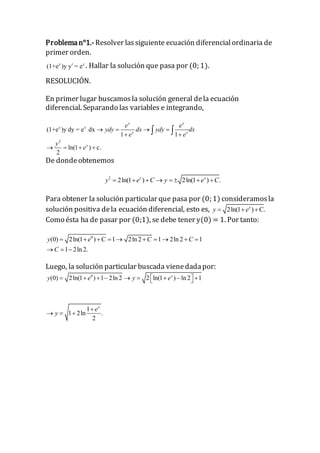
Problema n°1.- Resolver las siguiente ecuación diferencial ordinaria de 
primer orden. 
(1+e )y y = e x x  . Hallar la solución que pasa por (0; 1). 
RESOLUCIÓN. 
En primer lugar buscamos la solución general de la ecuación 
diferencial. Separando las variables e integrando, 
(1+e )y dy = e dx 
2 
1 1 
ln(1 ) c. 
2 
x x 
x x 
x x 
x 
e e 
ydy dx ydy dx 
e e 
y 
e 
    
  
    
  
De donde obtenemos 
2 y  2ln(1ex ) Cy   2ln(1ex ) C. 
Para obtener la solución particular que pasa por (0; 1) consideramos la 
solución positiva de la ecuación diferencial, esto es, 2ln(1 ) C. x y  e  
Como ésta ha de pasar por (0;1), se debe tener y(0) = 1. Por tanto: 
0 (0) 2ln(1 ) C 1 2ln 2 1 2ln 2 1 
y e C C 
1 2ln 2. 
C 
          
   
Luego, la solución particular buscada viene dada por: 
0 (0) 2ln(1 ) 1 2ln 2 2 ln(1 ) ln 2 1 x y   e    y    e    
1 
x e 
1 2ln . 
2 
y 
 
  
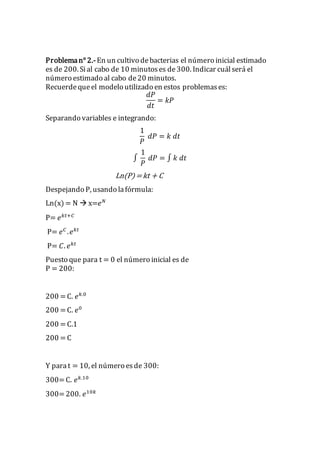
Problema n° 2.- En un cultivo de bacterias el número inicial estimado 
es de 200. Si al cabo de 10 minutos es de 300. Indicar cuál será el 
número estimado al cabo de 20 minutos. 
Recuerde que el modelo utilizado en estos problemas es: 
푑푃 
푑푡 
= 푘푃 
Separando variables e integrando: 
1 
푃 
푑푃 = 푘 푑푡 
∫ 
1 
푃 
푑푃 = ∫ 푘 푑푡 
Ln(P) = kt + C 
Despejando P, usando la fórmula: 
Ln(x) = N  x=푒푁 
P= 푒푘푡+퐶 
P= 푒퐶 . 푒푘푡 
P= 퐶. 푒푘푡 
Puesto que para t = 0 el número inicial es de 
P = 200: 
200 = C. 푒푘.0 
200 = C. 푒0 
200 = C.1 
200 = C 
Y para t = 10, el número es de 300: 
300= C. 푒푘.10 
300= 200. 푒10푘
3 
2 
= 푒10푘 
Usando la fórmula: 
푒푁 = 푥  N= Ln(x) 
 10.k = Ln(3 
2 
)  k= 0.04054 
Por tanto, para t=20 tendremos: 
P(t=20) = 200. 푒푘 .20 
P(t=20) = 200. 푒0,04054.20 
P(t=20) = 450 
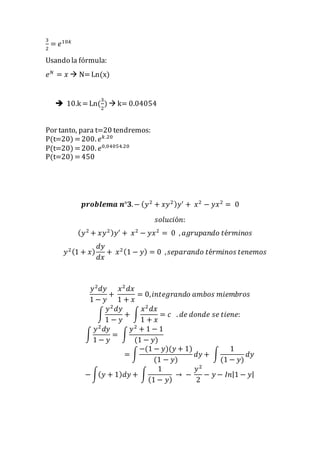
풑풓풐풃풍풆풎풂 풏°ퟑ. − (푦2 + 푥푦2 )푦′ + 푥2 − 푦푥2 = 0 
푠표푙푢푐푖ó푛: 
(푦2 + 푥푦2 )푦′ + 푥2 − 푦푥2 = 0 , 푎푔푟푢푝푎푛푑표 푡é푟푚푖푛표푠 
푦2 (1 + 푥) 
푑푦 
푑푥 
+ 푥2 (1 − 푦) = 0 , 푠푒푝푎푟푎푛푑표 푡é푟푚푖푛표푠 푡푒푛푒푚표푠 
푦2푑푦 
1 − 푦 
+ 
푥2 푑푥 
1 + 푥 
= 0, 푖푛푡푒푔푟푎푛푑표 푎푚푏표푠 푚푖푒푚푏푟표푠 
∫ 
푦2 푑푦 
1 − 푦 
+ ∫ 
푥2 푑푥 
1 + 푥 
= 푐 . 푑푒 푑표푛푑푒 푠푒 푡푖푒푛푒: 
∫ 
푦2 푑푦 
1 − 푦 
푦2 + 1 − 1 
(1 − 푦) 
= ∫ 
= ∫ 
−(1 − 푦)(푦 + 1) 
(1 − 푦) 
푑푦 + ∫ 
1 
(1 − 푦) 
푑푦 
− ∫(푦 + 1)푑푦 + ∫ 
1 
(1 − 푦) 
→ − 
푦2 
2 
− 푦 − 퐼푛|1 − 푦|
∫ 
푥2 푑푦 
1 + 푥 
= ∫ 
푥2 + 1 − 1 
(1 + 푥) 
= ∫ 
(푥 + 1)(푥 − 1) 
(1 + 푥) 
푑푦 + ∫ 
1 
(1 + 푥) 
푑푦 
→ ∫(푥 + 1)푑푦 + ∫ 
1 
(1 + 푥) 
푑푦 → 
푥2 
2 
+ 푥 − 퐼푛|1 + 푥| 
푝표푟 푙표 푡푎푛푡표: 
− 푦2 
2 
− 푦 − 퐼푛|1 − 푦| + 푥2 
2 
− 푥 + 퐼푛|1 + 푥| = 푐 
푠푖 푚푢푙푡푖푝푙푖푐푎푚표푠 푝표푟 2 푎 푡표푑푎 푙푎 푒푥푝푟푒푠푖ó푛 푡푒푛푒푚표푠 
−푦2 − 2푦 − 2퐼푛|1 − 푦| + 푥2 − 2푥 + 2퐼푛|1 + 푥| = 푐 ó 
1 + 푥 
1 − 푥 
(푥 + 푦)(푥 − 푦 − 2) + 2퐼푛 | 
| = 푐 
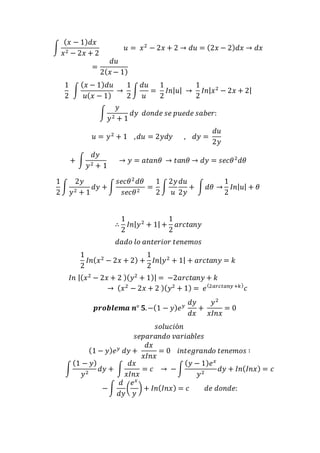
퐩퐫퐨퐛퐥퐞퐦퐚 퐧°ퟒ. −(푥푦2 − 푦2 + 푥 − 1)푑푥 + (푥2 푦) − 2푥푦 + 푥2 
+ 2푦 − 2푥 + 2)푑푦 = 0 
푠표푙푢푐푖ó푛: 
푎푔푟푢푝푎푛푑표 푡é푟푚푖푛표푠 푡푒푛푒푚표푠: 
[푦2 (푥 − 1) + (푥 − 1)]푑푥 + [푦(푥2 − 2푥 + 2)]푑푦 = 0 
푓푎푐푡표푟푖푧푎푛푑표 푡푒푛푒푚표푠: 
(푦2 + 1)(푥 − 1)푑푥 + (푦 + 1)(푥2 − 2푥) + 2푑푦 = 0 
푠푒푝푎푟푎푛푑표 푙푎푠 푣푎푟푖푎푏푙푒푠 
(푥 + 1)푑푥 
푥2 − 2푥 + 2 
+ 
푦 + 1 
푦2 + 1 
푑푦 = 0 푖푛푡푒푔푟푎푛푑표 
∫ 
(푥 + 1)푑푥 
푥2 − 2푥 + 2 
+ ∫ 
푦 + 1 
푦2 + 1 
푑푦 = 푘 푑푒 푑표푛푑푒
∫ 
(푥 − 1)푑푥 
푥2 − 2푥 + 2 
푢 = 푥2 − 2푥 + 2 → 푑푢 = (2푥 − 2)푑푥 → 푑푥 
= 
푑푢 
2(푥 − 1) 
1 
2 
∫ 
(푥 − 1)푑푢 
푢(푥 − 1) 
→ 
1 
2 
∫ 
푑푢 
푢 
= 
1 
2 
퐼푛|푢| → 
1 
2 
퐼푛|푥2 − 2푥 + 2| 
∫ 
푦 
푦2 + 1 
푑푦 푑표푛푑푒 푠푒 푝푢푒푑푒 푠푎푏푒푟: 
푢 = 푦2 + 1 , 푑푢 = 2푦푑푦 , 푑푦 = 
푑푢 
2푦 
+ ∫ 
푑푦 
푦2 + 1 
→ 푦 = 푎푡푎푛휃 → 푡푎푛휃 → 푑푦 = 푠푒푐휃2푑휃 
1 
2 
∫ 
2푦 
푦2 + 1 
푑푦 + ∫ 
푠푒푐휃2 푑휃 
푠푒푐휃2 = 
1 
2 
∫ 
2푦 
푢 
푑푢 
2푦 
+ ∫ 푑휃 → 
1 
2 
퐼푛|푢| + 휃 
∴ 
1 
2 
퐼푛|푦2 + 1| + 
1 
2 
푎푟푐푡푎푛푦 
푑푎푑표 푙표 푎푛푡푒푟푖표푟 푡푒푛푒푚표푠 
1 
2 
퐼푛(푥2 − 2푥 + 2) + 
1 
2 
퐼푛|푦2 + 1| + 푎푟푐푡푎푛푦 = 푘 
퐼푛 |(푥2 − 2푥 + 2 )(푦2 + 1)| = −2푎푟푐푡푎푛푦 + 푘 
→ (푥2 − 2푥 + 2 )(푦2 + 1) = 푒 (2푎푟푐푡푎푛푦 +푘 )푐 
풑풓풐풃풍풆풎풂 풏° ퟓ. −(1 − 푦)푒푦 푑푦 
푑푥 
+ 
푦2 
푥퐼푛푥 
= 0 
푠표푙푢푐푖ó푛 
푠푒푝푎푟푎푛푑표 푣푎푟푖푎푏푙푒푠 
(1 − 푦)푒푦 푑푦 + 
푑푥 
푥퐼푛푥 
= 0 푖푛푡푒푔푟푎푛푑표 푡푒푛푒푚표푠 ∶ 
∫ 
(1 − 푦) 
푦2 푑푦 + ∫ 
푑푥 
푥퐼푛푥 
= 푐 → − ∫ 
(푦 − 1)푒푥 
푦2 푑푦 + 퐼푛(퐼푛푥) = 푐 
− ∫ 
푑 
푑푦 
( 
푒푥 
푦 
) + 퐼푛(퐼푛푥) = 푐 푑푒 푑표푛푑푒:
− 
푒푥 
푦 
+ 퐼푛(퐼푛푥) = 푐 ∴ 퐼푛(퐼푛푥) = 
푒푥 
푦 
+ 푐 
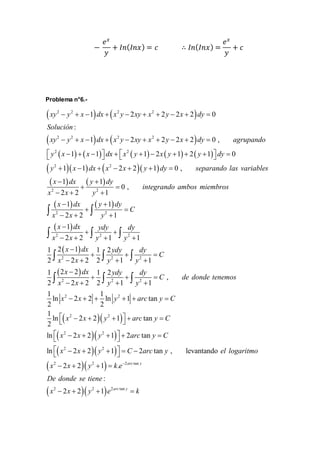
Problema n°6.- 
 2 2   2 2 
 
xy  y  x  1 dx  x y  2 xy  x  2 y  2 x  2 dy 
 
0 
Solución 
: 
xy y x dx x y xy x y x dy agrupando 
 2 2   2 2 
 
          
1 2 2 2 2 0 , 
2 2 
          
 y x   x   dx   x y   x y   y   dy 
 
1 1 1 2 1 2 1 0 
      
  
2 2 
y x dx x x y dy separando las variables 
x 
       
   
1 1 2 2 1 0 , 
1 
dx y 1 
dy 
  
0 , 
 
2 2 
integrando ambos miembros 
x x y 
   
  
2 2 1 
1 1 
2 2 1 
1 
2 2 1 1 
    
x dx y dy 
C 
  
  
2 2 
x  x  y 
 
 x  
 
dx ydy dy 
x x y y 
  
   
2 2 2 
    
  
x dx ydy dy 
1 2  
1 1 2 
2 2 2 2 1 1 
1 2 2 1 2 
   
   
2 2 2 
    
 
  
   
   
2 2 2 
, 
2 2 2 2 1 1 
C 
x x y y 
x dx ydy dy 
C 
x x y y 
    
1 1 
ln 2 2 ln 1 tan 
2 2 
1 
ln 2 2 1 tan 
2 
ln 2 2 1 2 tan 
2 2 
      
   
   
   
   
2 2 
       
  
 2   2 
    
  
 2   2 
    
  
    
ln 2 2 1 2 tan , levantando 
2 2 2 tan 
2 2 1 . 
arc y 
de donde tenemos 
x x y arc y C 
x x y arc y C 
x x y arc y C 
x x y C arc y el logaritmo 
x x y k e 
De dond 
 
: 
e se tiene 
   2 2 2 tan 
2 2 1 arc y 
x  x  y  e  k
Problemas de Ecuaciones Diferenciales

Problemas de Ecuaciones Diferenciales

  • 1.
    Problema n°1.- Resolverlas siguiente ecuación diferencial ordinaria de primer orden. (1+e )y y = e x x  . Hallar la solución que pasa por (0; 1). RESOLUCIÓN. En primer lugar buscamos la solución general de la ecuación diferencial. Separando las variables e integrando, (1+e )y dy = e dx 2 1 1 ln(1 ) c. 2 x x x x x x x e e ydy dx ydy dx e e y e             De donde obtenemos 2 y  2ln(1ex ) Cy   2ln(1ex ) C. Para obtener la solución particular que pasa por (0; 1) consideramos la solución positiva de la ecuación diferencial, esto es, 2ln(1 ) C. x y  e  Como ésta ha de pasar por (0;1), se debe tener y(0) = 1. Por tanto: 0 (0) 2ln(1 ) C 1 2ln 2 1 2ln 2 1 y e C C 1 2ln 2. C              Luego, la solución particular buscada viene dada por: 0 (0) 2ln(1 ) 1 2ln 2 2 ln(1 ) ln 2 1 x y   e    y    e    1 x e 1 2ln . 2 y    
  • 2.
    Problema n° 2.-En un cultivo de bacterias el número inicial estimado es de 200. Si al cabo de 10 minutos es de 300. Indicar cuál será el número estimado al cabo de 20 minutos. Recuerde que el modelo utilizado en estos problemas es: 푑푃 푑푡 = 푘푃 Separando variables e integrando: 1 푃 푑푃 = 푘 푑푡 ∫ 1 푃 푑푃 = ∫ 푘 푑푡 Ln(P) = kt + C Despejando P, usando la fórmula: Ln(x) = N  x=푒푁 P= 푒푘푡+퐶 P= 푒퐶 . 푒푘푡 P= 퐶. 푒푘푡 Puesto que para t = 0 el número inicial es de P = 200: 200 = C. 푒푘.0 200 = C. 푒0 200 = C.1 200 = C Y para t = 10, el número es de 300: 300= C. 푒푘.10 300= 200. 푒10푘
  • 3.
    3 2 =푒10푘 Usando la fórmula: 푒푁 = 푥  N= Ln(x)  10.k = Ln(3 2 )  k= 0.04054 Por tanto, para t=20 tendremos: P(t=20) = 200. 푒푘 .20 P(t=20) = 200. 푒0,04054.20 P(t=20) = 450 풑풓풐풃풍풆풎풂 풏°ퟑ. − (푦2 + 푥푦2 )푦′ + 푥2 − 푦푥2 = 0 푠표푙푢푐푖ó푛: (푦2 + 푥푦2 )푦′ + 푥2 − 푦푥2 = 0 , 푎푔푟푢푝푎푛푑표 푡é푟푚푖푛표푠 푦2 (1 + 푥) 푑푦 푑푥 + 푥2 (1 − 푦) = 0 , 푠푒푝푎푟푎푛푑표 푡é푟푚푖푛표푠 푡푒푛푒푚표푠 푦2푑푦 1 − 푦 + 푥2 푑푥 1 + 푥 = 0, 푖푛푡푒푔푟푎푛푑표 푎푚푏표푠 푚푖푒푚푏푟표푠 ∫ 푦2 푑푦 1 − 푦 + ∫ 푥2 푑푥 1 + 푥 = 푐 . 푑푒 푑표푛푑푒 푠푒 푡푖푒푛푒: ∫ 푦2 푑푦 1 − 푦 푦2 + 1 − 1 (1 − 푦) = ∫ = ∫ −(1 − 푦)(푦 + 1) (1 − 푦) 푑푦 + ∫ 1 (1 − 푦) 푑푦 − ∫(푦 + 1)푑푦 + ∫ 1 (1 − 푦) → − 푦2 2 − 푦 − 퐼푛|1 − 푦|
  • 4.
    ∫ 푥2 푑푦 1 + 푥 = ∫ 푥2 + 1 − 1 (1 + 푥) = ∫ (푥 + 1)(푥 − 1) (1 + 푥) 푑푦 + ∫ 1 (1 + 푥) 푑푦 → ∫(푥 + 1)푑푦 + ∫ 1 (1 + 푥) 푑푦 → 푥2 2 + 푥 − 퐼푛|1 + 푥| 푝표푟 푙표 푡푎푛푡표: − 푦2 2 − 푦 − 퐼푛|1 − 푦| + 푥2 2 − 푥 + 퐼푛|1 + 푥| = 푐 푠푖 푚푢푙푡푖푝푙푖푐푎푚표푠 푝표푟 2 푎 푡표푑푎 푙푎 푒푥푝푟푒푠푖ó푛 푡푒푛푒푚표푠 −푦2 − 2푦 − 2퐼푛|1 − 푦| + 푥2 − 2푥 + 2퐼푛|1 + 푥| = 푐 ó 1 + 푥 1 − 푥 (푥 + 푦)(푥 − 푦 − 2) + 2퐼푛 | | = 푐 퐩퐫퐨퐛퐥퐞퐦퐚 퐧°ퟒ. −(푥푦2 − 푦2 + 푥 − 1)푑푥 + (푥2 푦) − 2푥푦 + 푥2 + 2푦 − 2푥 + 2)푑푦 = 0 푠표푙푢푐푖ó푛: 푎푔푟푢푝푎푛푑표 푡é푟푚푖푛표푠 푡푒푛푒푚표푠: [푦2 (푥 − 1) + (푥 − 1)]푑푥 + [푦(푥2 − 2푥 + 2)]푑푦 = 0 푓푎푐푡표푟푖푧푎푛푑표 푡푒푛푒푚표푠: (푦2 + 1)(푥 − 1)푑푥 + (푦 + 1)(푥2 − 2푥) + 2푑푦 = 0 푠푒푝푎푟푎푛푑표 푙푎푠 푣푎푟푖푎푏푙푒푠 (푥 + 1)푑푥 푥2 − 2푥 + 2 + 푦 + 1 푦2 + 1 푑푦 = 0 푖푛푡푒푔푟푎푛푑표 ∫ (푥 + 1)푑푥 푥2 − 2푥 + 2 + ∫ 푦 + 1 푦2 + 1 푑푦 = 푘 푑푒 푑표푛푑푒
  • 5.
    ∫ (푥 −1)푑푥 푥2 − 2푥 + 2 푢 = 푥2 − 2푥 + 2 → 푑푢 = (2푥 − 2)푑푥 → 푑푥 = 푑푢 2(푥 − 1) 1 2 ∫ (푥 − 1)푑푢 푢(푥 − 1) → 1 2 ∫ 푑푢 푢 = 1 2 퐼푛|푢| → 1 2 퐼푛|푥2 − 2푥 + 2| ∫ 푦 푦2 + 1 푑푦 푑표푛푑푒 푠푒 푝푢푒푑푒 푠푎푏푒푟: 푢 = 푦2 + 1 , 푑푢 = 2푦푑푦 , 푑푦 = 푑푢 2푦 + ∫ 푑푦 푦2 + 1 → 푦 = 푎푡푎푛휃 → 푡푎푛휃 → 푑푦 = 푠푒푐휃2푑휃 1 2 ∫ 2푦 푦2 + 1 푑푦 + ∫ 푠푒푐휃2 푑휃 푠푒푐휃2 = 1 2 ∫ 2푦 푢 푑푢 2푦 + ∫ 푑휃 → 1 2 퐼푛|푢| + 휃 ∴ 1 2 퐼푛|푦2 + 1| + 1 2 푎푟푐푡푎푛푦 푑푎푑표 푙표 푎푛푡푒푟푖표푟 푡푒푛푒푚표푠 1 2 퐼푛(푥2 − 2푥 + 2) + 1 2 퐼푛|푦2 + 1| + 푎푟푐푡푎푛푦 = 푘 퐼푛 |(푥2 − 2푥 + 2 )(푦2 + 1)| = −2푎푟푐푡푎푛푦 + 푘 → (푥2 − 2푥 + 2 )(푦2 + 1) = 푒 (2푎푟푐푡푎푛푦 +푘 )푐 풑풓풐풃풍풆풎풂 풏° ퟓ. −(1 − 푦)푒푦 푑푦 푑푥 + 푦2 푥퐼푛푥 = 0 푠표푙푢푐푖ó푛 푠푒푝푎푟푎푛푑표 푣푎푟푖푎푏푙푒푠 (1 − 푦)푒푦 푑푦 + 푑푥 푥퐼푛푥 = 0 푖푛푡푒푔푟푎푛푑표 푡푒푛푒푚표푠 ∶ ∫ (1 − 푦) 푦2 푑푦 + ∫ 푑푥 푥퐼푛푥 = 푐 → − ∫ (푦 − 1)푒푥 푦2 푑푦 + 퐼푛(퐼푛푥) = 푐 − ∫ 푑 푑푦 ( 푒푥 푦 ) + 퐼푛(퐼푛푥) = 푐 푑푒 푑표푛푑푒:
  • 6.
    − 푒푥 푦 + 퐼푛(퐼푛푥) = 푐 ∴ 퐼푛(퐼푛푥) = 푒푥 푦 + 푐 Problema n°6.-  2 2   2 2  xy  y  x  1 dx  x y  2 xy  x  2 y  2 x  2 dy  0 Solución : xy y x dx x y xy x y x dy agrupando  2 2   2 2            1 2 2 2 2 0 , 2 2            y x   x   dx   x y   x y   y   dy  1 1 1 2 1 2 1 0         2 2 y x dx x x y dy separando las variables x           1 1 2 2 1 0 , 1 dx y 1 dy   0 ,  2 2 integrando ambos miembros x x y      2 2 1 1 1 2 2 1 1 2 2 1 1     x dx y dy C     2 2 x  x  y   x   dx ydy dy x x y y      2 2 2       x dx ydy dy 1 2  1 1 2 2 2 2 2 1 1 1 2 2 1 2       2 2 2              2 2 2 , 2 2 2 2 1 1 C x x y y x dx ydy dy C x x y y     1 1 ln 2 2 ln 1 tan 2 2 1 ln 2 2 1 tan 2 ln 2 2 1 2 tan 2 2                   2 2           2   2        2   2           ln 2 2 1 2 tan , levantando 2 2 2 tan 2 2 1 . arc y de donde tenemos x x y arc y C x x y arc y C x x y arc y C x x y C arc y el logaritmo x x y k e De dond  : e se tiene    2 2 2 tan 2 2 1 arc y x  x  y  e  k