Hospital Universitario Fundación Jiménez Díaz.
Madrid
Dr. Germán Peces-Barba
[ATS] Step-up randomized controlled trial of
segmental vapor ablation in patients with severe
emphysema: 6 month results
Strange CB, Herth FJF, Valipour A, Shah PL, Eberhardt R, Grah C, et al.
Mesa 4
Justificación
Reducción de volumen pulmonar en el enfisema
STEP-UP: Sequential Segmental Treatment of Emphysema with Upper Lobe Predominance Trial.
• La ablación por vapor puede utilizarse en la reducción de volumen pulmonar por
vía endoscópica en el enfisema grave.
• Aplicación segmentaria secuencial.
Métodos
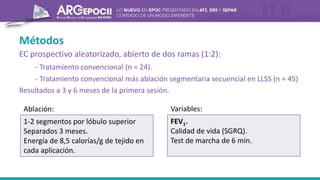
EC prospectivo aleatorizado, abierto de dos ramas (1:2):
- Tratamiento convencional (n = 24).
- Tratamiento convencional más ablación segmentaria secuencial en LLSS (n = 45)
Resultados a 3 y 6 meses de la primera sesión.
1-2 segmentos por lóbulo superior
Separados 3 meses.
Energía de 8,5 calorías/g de tejido en
cada aplicación.
Ablación:
FEV1.
Calidad de vida (SGRQ).
Test de marcha de 6 min.
Variables:
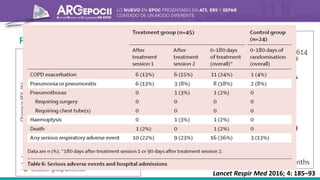
Resultados
Lancet Respir Med 2016; 4: 185–93
Conclusión
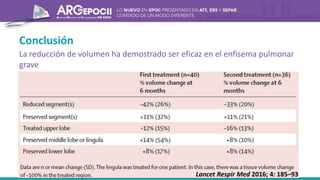
La reducción de volumen ha demostrado ser eficaz en el enfisema pulmonar
grave
- Mejoría en la función pulmonar, calidad de vida y capacidad de ejercicio
- La ablación por vapor ofrece unos resultados positivos
- Esta técnica abre nuevas posibilidades en la terapia de reducción de volumen
pulmonar.
Lancet Respir Med 2016; 4: 185–93
Comentarios
Reducción de volumen en el enfisema pulmonar
[ERS] Mepolizumab in COPD with eosinophilic
bronchitis: A randomized clinical trial
Dasgupta A, Kjarsgaard M, Capaldi D, Radford K, Aleman F, Parraga G, et al.
Mesa 4
Justificación
EPOC con eosinofilia
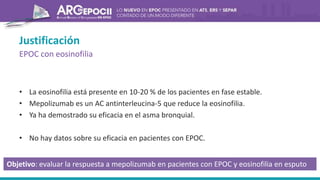
• La eosinofilia está presente en 10-20 % de los pacientes en fase estable.
• Mepolizumab es un AC antinterleucina-5 que reduce la eosinofilia.
• Ya ha demostrado su eficacia en el asma bronquial.
• No hay datos sobre su eficacia en pacientes con EPOC.
Objetivo: evaluar la respuesta a mepolizumab en pacientes con EPOC y eosinofilia en esputo
Métodos
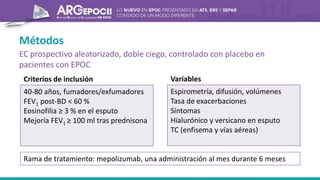
EC prospectivo aleatorizado, doble ciego, controlado con placebo en
pacientes con EPOC
40-80 años, fumadores/exfumadores
FEV1 post-BD < 60 %
Eosinofilia ≥ 3 % en el esputo
Mejoría FEV1 ≥ 100 ml tras prednisona
Criterios de inclusión
Espirometría, difusión, volúmenes
Tasa de exacerbaciones
Síntomas
Hialurónico y versicano en esputo
TC (enfisema y vías aéreas)
Variables
Rama de tratamiento: mepolizumab, una administración al mes durante 6 meses
Resultados
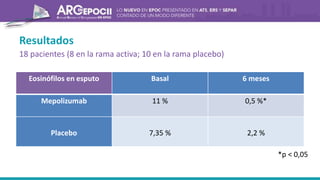
18 pacientes (8 en la rama activa; 10 en la rama placebo)
Eosinófilos en esputo Basal 6 meses
Mepolizumab 11 % 0,5 %*
Placebo 7,35 % 2,2 %
*p < 0,05
Eosinófilos en sangre Basal 6 meses
Mepolizumab 0,69 % 0,03 %*
Placebo 0,33 % 0,26 %
*p < 0,05
Sin diferencias en las variables secundarias
Función pulmonar
Exacerbaciones
Síntomas
Marcadores en el esputo
TC
Conclusión
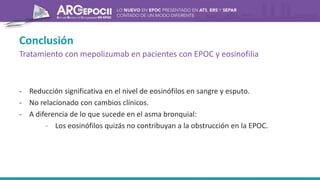
Tratamiento con mepolizumab en pacientes con EPOC y eosinofilia
- Reducción significativa en el nivel de eosinófilos en sangre y esputo.
- No relacionado con cambios clínicos.
- A diferencia de lo que sucede en el asma bronquial:
- Los eosinófilos quizás no contribuyan a la obstrucción en la EPOC.
Comentarios
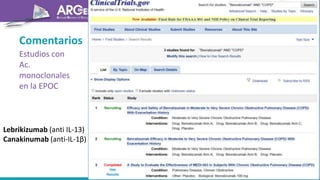
Estudios con
Ac.
monoclonales
en la EPOC
Lebrikizumab (anti IL-13)
Canakinumab (anti-IL-1β)
Mesa 4.3 Dr Germán Peces-Barba

Mesa 4.3 Dr Germán Peces-Barba

  • 1.
    Hospital Universitario FundaciónJiménez Díaz. Madrid Dr. Germán Peces-Barba
  • 2.
    [ATS] Step-up randomizedcontrolled trial of segmental vapor ablation in patients with severe emphysema: 6 month results Strange CB, Herth FJF, Valipour A, Shah PL, Eberhardt R, Grah C, et al. Mesa 4
  • 3.
    Justificación Reducción de volumenpulmonar en el enfisema STEP-UP: Sequential Segmental Treatment of Emphysema with Upper Lobe Predominance Trial. • La ablación por vapor puede utilizarse en la reducción de volumen pulmonar por vía endoscópica en el enfisema grave. • Aplicación segmentaria secuencial.
  • 4.
    Métodos EC prospectivo aleatorizado,abierto de dos ramas (1:2): - Tratamiento convencional (n = 24). - Tratamiento convencional más ablación segmentaria secuencial en LLSS (n = 45) Resultados a 3 y 6 meses de la primera sesión. 1-2 segmentos por lóbulo superior Separados 3 meses. Energía de 8,5 calorías/g de tejido en cada aplicación. Ablación: FEV1. Calidad de vida (SGRQ). Test de marcha de 6 min. Variables:
  • 5.
  • 6.
    Conclusión La reducción devolumen ha demostrado ser eficaz en el enfisema pulmonar grave - Mejoría en la función pulmonar, calidad de vida y capacidad de ejercicio - La ablación por vapor ofrece unos resultados positivos - Esta técnica abre nuevas posibilidades en la terapia de reducción de volumen pulmonar. Lancet Respir Med 2016; 4: 185–93
  • 7.
    Comentarios Reducción de volumenen el enfisema pulmonar
  • 8.
    [ERS] Mepolizumab inCOPD with eosinophilic bronchitis: A randomized clinical trial Dasgupta A, Kjarsgaard M, Capaldi D, Radford K, Aleman F, Parraga G, et al. Mesa 4
  • 9.
    Justificación EPOC con eosinofilia •La eosinofilia está presente en 10-20 % de los pacientes en fase estable. • Mepolizumab es un AC antinterleucina-5 que reduce la eosinofilia. • Ya ha demostrado su eficacia en el asma bronquial. • No hay datos sobre su eficacia en pacientes con EPOC. Objetivo: evaluar la respuesta a mepolizumab en pacientes con EPOC y eosinofilia en esputo
  • 10.
    Métodos EC prospectivo aleatorizado,doble ciego, controlado con placebo en pacientes con EPOC 40-80 años, fumadores/exfumadores FEV1 post-BD < 60 % Eosinofilia ≥ 3 % en el esputo Mejoría FEV1 ≥ 100 ml tras prednisona Criterios de inclusión Espirometría, difusión, volúmenes Tasa de exacerbaciones Síntomas Hialurónico y versicano en esputo TC (enfisema y vías aéreas) Variables Rama de tratamiento: mepolizumab, una administración al mes durante 6 meses
  • 11.
    Resultados 18 pacientes (8en la rama activa; 10 en la rama placebo) Eosinófilos en esputo Basal 6 meses Mepolizumab 11 % 0,5 %* Placebo 7,35 % 2,2 % *p < 0,05
  • 12.
    Eosinófilos en sangreBasal 6 meses Mepolizumab 0,69 % 0,03 %* Placebo 0,33 % 0,26 % *p < 0,05 Sin diferencias en las variables secundarias Función pulmonar Exacerbaciones Síntomas Marcadores en el esputo TC
  • 13.
    Conclusión Tratamiento con mepolizumaben pacientes con EPOC y eosinofilia - Reducción significativa en el nivel de eosinófilos en sangre y esputo. - No relacionado con cambios clínicos. - A diferencia de lo que sucede en el asma bronquial: - Los eosinófilos quizás no contribuyan a la obstrucción en la EPOC.
  • 14.
    Comentarios Estudios con Ac. monoclonales en laEPOC Lebrikizumab (anti IL-13) Canakinumab (anti-IL-1β)

Notas del editor

  • #5 Criterios de inclusión: - Age 45–75 years, - Evidence of upper lobe-predominant heterogeneous emphysema (>15% difference in lung density between targeted upper lobe segment and its respective lower lobe, - FEV1 between 20% and 45% predicted - Total lung capacity at least 100% predicted, - Substantial hyperinflation - Post-rehabilitation 6-min walk test (6MWT) greater than 140 m, and - Non-smoking for at least 6 months before study enrolment
  • #8 Research in context Evidence before this study We searched PubMed from Jan 1, 1999, up to Oct 1, 2015, using diff erent terms associated with the treatment of emphysema, including: “lung volume reduction surgery”, “bronchoscopic lung volume reduction”, “severe emphysema”, “collateral ventilation”, and “intralobar heterogeneity”. We included only studies published in English: Non-surgical bronchoscopic lung volumen reduction has gained clinical traction because the interventions are minimally invasive with reduced mortality and morbidity. At present, the two most investigated forms of bronchoscopic lung volume reduction are valve implantation and coil implantation. They need the implants to be placed on a lobar basis to achieve lobar volume reduction and clinical benefit. If one or more segments are quite healthy, complete lobar treatment from implants results in superfluous reduction. Valve implants do not achieve adequate volume reduction in the presence of collateral ventilation from incomplete fi ssures.7,8 Vapour ablation induces lung volume reduction by delivering water vapour to targeted emphysematous segments of the lungs, irrespective of the presence of collateral ventilation. The ablation and subsequent reduction of only the more diseased segments, while preserving healthier segments, was assessed in the Sequential Staged Treatment of Emphysema with Upper Lobe Predominance (STEP-UP) trial Successful lung volume reduction and minimal clinically important difference in lung function from vapour ablation have been previously reported in an early-phase feasibility study, the VAPOR trial, investigating a unilateral lobar approach. The early-phase experience with vapour ablation suggested that the occurrence and severity of serious adverse events typically increased with the volume of lung treated per session. Furthermore, our search emphasised the limitations of collateral ventilation and the need to target the whole lobe with endobronchial valve therapy. This finding established the need for a bronchoscopic therapy for emphysema using a segmental approach that targets only the more diseased segments for reduction and reduces the volume treated per session. Thermal ablation in particular was found to reduce individual segments without the need for complete lobar treatment. These criteria were incorporated into the design of the STEP-UP trial to find an optimum balance between vapour ablation’s efficacy and safety profiles. Added value of this study Quantitative high-resolution CT has ushered in the era of more precisely defi ning emphysematous regions of the lung and has led to the discovery that most patients with upper lobe-predominant severe emphysema have intralobar heterogeneity. This study is the fi rst randomised controlled trial investigating thermal vapour ablation and has shown that reduction of the more diseased segments while preserving the less diseased segments leads to clinically meaningful improvement in pulmonary function, quality of life, and exercise capacity. Implications of all the available evidence The staged treatments show a better safety profi le than the initial clinical trials with vapour ablation. Furthermore, the two-stage strategy demonstrates additional benefit. The next study to do will be to expand the concept of treating the most diseased segments from the upper lobes to all lobes.
  • #12 Mepolizumab reduced sputum eosinophils (baseline 11% to 0.5% at 6 months in active arm vs 7.35% to 2.2% in placebo arm, p<0.05) and blood eosinophils (0.69 at baseline to 0.03 at 6 months in active-arm vs 0.33 to 0.26 in placebo-arm, p<0.05). There were no significant changes with treatment in the secondary outcomes: lung function (FEV1, FVC, SVC, FEV1/SVC, FEV1/FVC, TLC, RV, RV/TLC and DLCO), exacerbation rates, patient-related outcomes, sputum markers (hyaluron and versican) and CT assessments of remodelling (airway-wall,lumen area,parametric response maps or relative areas of the CT density-histograms).
  • #13 Mepolizumab reduced sputum eosinophils (baseline 11% to 0.5% at 6 months in active arm vs 7.35% to 2.2% in placebo arm, p<0.05) and blood eosinophils (0.69 at baseline to 0.03 at 6 months in active-arm vs 0.33 to 0.26 in placebo-arm, p<0.05). There were no significant changes with treatment in the secondary outcomes: lung function (FEV1, FVC, SVC, FEV1/SVC, FEV1/FVC, TLC, RV, RV/TLC and DLCO), exacerbation rates, patient-related outcomes, sputum markers (hyaluron and versican) and CT assessments of remodelling (airway-wall,lumen area,parametric response maps or relative areas of the CT density-histograms).
  • #14 Mepolizumab did not improve lung function and exacerbation rates in COPD with eosinophilia. This suggests that although eosinophils are a predictor of response to treatment with corticosteroids, unlike in asthma, they may not directly contribute to luminal obstruction in COPD.