SARCOMAS DE PARTES BLANDAS
Dr. Romeo Técualt Gómez
Dra. Adriana Atencio Chan
Dr. Romeo Tecualt Gómez
INTRODUCCIÓN
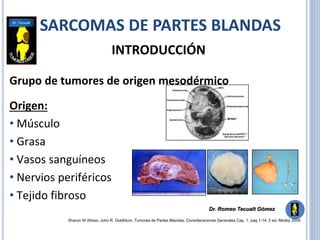
Grupo de tumores de origen mesodérmico
Origen:
• Músculo
• Grasa
• Vasos sanguíneos
• Nervios periféricos
• Tejido fibroso
Sharon W Weiss, John R. Goldblum. Tumores de Partes Blandas. Consideraciones Generales Cap. 1. pag 1-14, 5 ed. Mosby 2009
SARCOMAS DE PARTES BLANDAS
Dr. Romeo Tecualt Gómez
SARCOMAS DE PARTES BLANDAS
TIPOS MAS FRECUENTES
LITERATURA H.O.V.F.N.
Liposarcoma Sarcoma sinovial
Histiocitoma fibroso maligno Liposarcoma
Fibrosarcoma Sarcoma Neurogénico
Sarcoma sinovial Rabdomiosarcoma
Sarcoma neurogenico Hemangiosarcoma
Hemangiosarcoma Fibrosarcoma
Rabdomioarcoma Histiocitoma fibroso maligno
Leiomiosarcoma Leiomiosarcoma
Desmoide
Sarcoma Epitelioide
Sarcoma de células claras
Dr. Romeo Tecualt Gómez
SARCOMAS DE PARTES BLANDAS
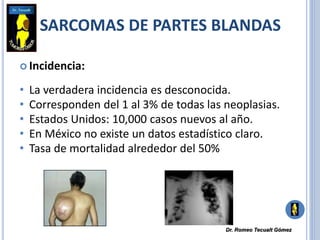
 Incidencia:
• La verdadera incidencia es desconocida.
• Corresponden del 1 al 3% de todas las neoplasias.
• Estados Unidos: 10,000 casos nuevos al año.
• En México no existe un datos estadístico claro.
• Tasa de mortalidad alrededor del 50%
Dr. Romeo Tecualt Gómez
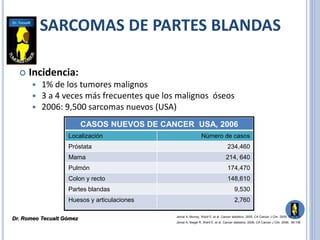
 Incidencia:
 1% de los tumores malignos
 3 a 4 veces más frecuentes que los malignos óseos
 2006: 9,500 sarcomas nuevos (USA)
Jemal A, Murray, Ward E, et al. Cancer statistics. 2005. CA Cancer J Clin. 2005; 55:16-30
Jemal A, Siegel R, Ward E, et al. Cancer statistics, 2006; CA Cancer J Clin. 2006; 56:106
SARCOMAS DE PARTES BLANDAS
CASOS NUEVOS DE CANCER USA, 2006
Localización Número de casos
Próstata 234,460
Mama 214, 640
Pulmón 174,470
Colon y recto 148,610
Partes blandas 9,530
Huesos y articulaciones 2,760
Dr. Romeo Tecualt Gómez
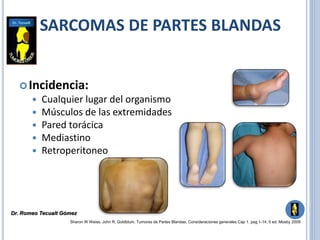
Incidencia:
 Cualquier lugar del organismo
 Músculos de las extremidades
 Pared torácica
 Mediastino
 Retroperitoneo
Sharon W Weiss, John R. Goldblum. Tumores de Partes Blandas. Consideraciones generales Cap 1. pag 1-14, 5 ed. Mosby 2009
SARCOMAS DE PARTES BLANDAS
Dr. Romeo Tecualt Gómez
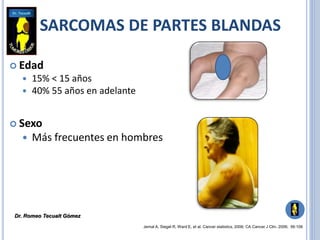
 Edad
 15% < 15 años
 40% 55 años en adelante
 Sexo
 Más frecuentes en hombres
Jemal A, Siegel R, Ward E, et al. Cancer statistics, 2006; CA Cancer J Clin. 2006; 56:106
SARCOMAS DE PARTES BLANDAS
Dr. Romeo Tecualt Gómez
SARCOMAS DE PARTES BLANDAS
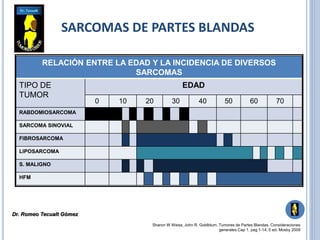
RELACIÓN ENTRE LA EDAD Y LA INCIDENCIA DE DIVERSOS
SARCOMAS
TIPO DE
TUMOR
EDAD
0 10 20 30 40 50 60 70
RABDOMIOSARCOMA
SARCOMA SINOVIAL
FIBROSARCOMA
LIPOSARCOMA
S. MALIGNO
HFM
Sharon W Weiss, John R. Goldblum. Tumores de Partes Blandas. Consideraciones
generales Cap 1. pag 1-14, 5 ed. Mosby 2009
Dr. Romeo Tecualt Gómez
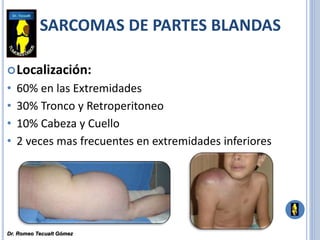
Localización:
• 60% en las Extremidades
• 30% Tronco y Retroperitoneo
• 10% Cabeza y Cuello
• 2 veces mas frecuentes en extremidades inferiores
SARCOMAS DE PARTES BLANDAS
Dr. Romeo Tecualt Gómez
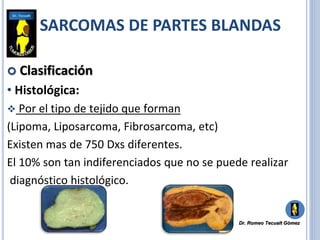
 Clasificación
• Histológica:
 Por el tipo de tejido que forman
(Lipoma, Liposarcoma, Fibrosarcoma, etc)
Existen mas de 750 Dxs diferentes.
El 10% son tan indiferenciados que no se puede realizar
diagnóstico histológico.
SARCOMAS DE PARTES BLANDAS
Dr. Romeo Tecualt Gómez
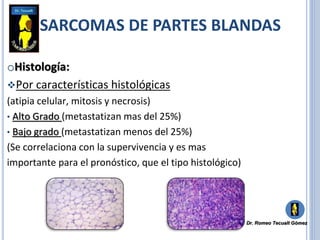
oHistología:
Por características histológicas
(atipia celular, mitosis y necrosis)
• Alto Grado (metastatizan mas del 25%)
• Bajo grado (metastatizan menos del 25%)
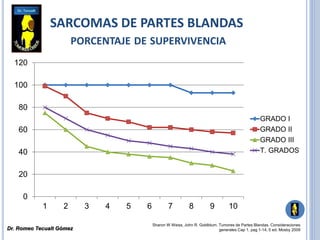
(Se correlaciona con la supervivencia y es mas
importante para el pronóstico, que el tipo histológico)
SARCOMAS DE PARTES BLANDAS
Dr. Romeo Tecualt Gómez
SARCOMAS DE PARTES BLANDAS
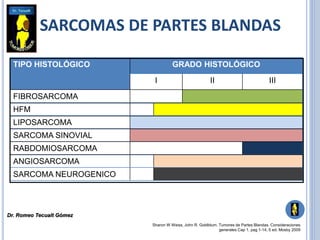
TIPO HISTOLÓGICO GRADO HISTOLÓGICO
I II III
FIBROSARCOMA
HFM
LIPOSARCOMA
SARCOMA SINOVIAL
RABDOMIOSARCOMA
ANGIOSARCOMA
SARCOMA NEUROGENICO
Sharon W Weiss, John R. Goldblum. Tumores de Partes Blandas. Consideraciones
generales Cap 1. pag 1-14, 5 ed. Mosby 2009
Dr. Romeo Tecualt Gómez
SARCOMAS DE PARTES BLANDAS
PORCENTAJE DE SUPERVIVENCIA
0
20
40
60
80
100
120
1 2 3 4 5 6 7 8 9 10
GRADO I
GRADO II
GRADO III
T. GRADOS
Sharon W Weiss, John R. Goldblum. Tumores de Partes Blandas. Consideraciones
generales Cap 1. pag 1-14, 5 ed. Mosby 2009Dr. Romeo Tecualt Gómez
SARCOMAS DE PARTES BLANDAS
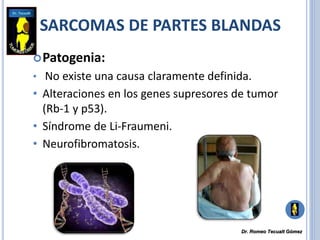
Patogenia:
• No existe una causa claramente definida.
• Alteraciones en los genes supresores de tumor
(Rb-1 y p53).
• Síndrome de Li-Fraumeni.
• Neurofibromatosis.
Dr. Romeo Tecualt Gómez
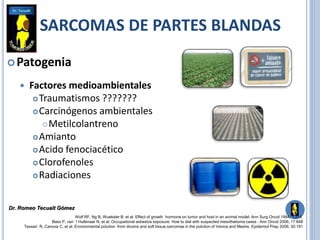
Patogenia
 Factores medioambientales
Traumatismos ???????
Carcinógenos ambientales
Metilcolantreno
Amianto
Acido fenociacético
Clorofenoles
Radiaciones
Wolf RF, Ng B, Wueksler B, et al. Effect of growth hormone on tumor and host in an animal model. Ann Surg Oncol 1994; 1:314.
Bass P, van ´t Hullenaar N, et al. Occupational asbestos exposure: How to dial with suspected mesothelioma cases . Ann Oncol 2006; 17:848
Tessari R, Canova C, et al. Environmental polution from dioxins and soft tissue sarcomas in the polution of Venice and Mestre. Epidemiol Prep 2006; 30:191
SARCOMAS DE PARTES BLANDAS
Dr. Romeo Tecualt Gómez
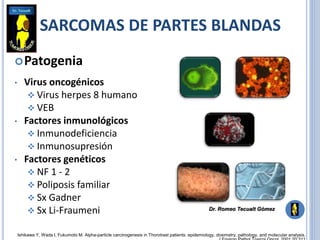
Patogenia
• Virus oncogénicos
 Virus herpes 8 humano
 VEB
• Factores inmunológicos
 Inmunodeficiencia
 Inmunosupresión
• Factores genéticos
 NF 1 - 2
 Poliposis familiar
 Sx Gadner
 Sx Li-Fraumeni
Ishikawa Y, Wada I, Fukumoto M. Alpha-particle carcinogenesis in Thorotrast patients: epidemiology, dosimetry, pathology, and molecular analysis.
SARCOMAS DE PARTES BLANDAS
Dr. Romeo Tecualt Gómez
SARCOMAS DE PARTES BLANDAS
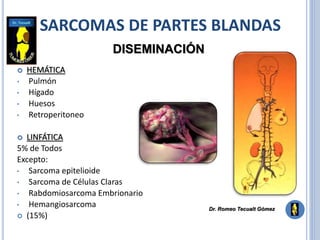
 HEMÁTICA
• Pulmón
• Hígado
• Huesos
• Retroperitoneo
 LINFÁTICA
5% de Todos
Excepto:
• Sarcoma epitelioide
• Sarcoma de Células Claras
• Rabdomiosarcoma Embrionario
• Hemangiosarcoma
 (15%)
DISEMINACIÓN
Dr. Romeo Tecualt Gómez
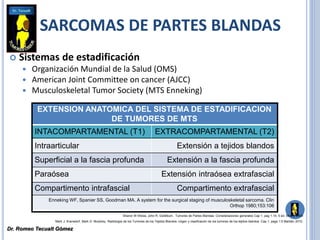
 Sistemas de estadificación
 Organización Mundial de la Salud (OMS)
 American Joint Committee on cancer (AJCC)
 Musculoskeletal Tumor Society (MTS Enneking)
Sharon W Weiss, John R. Goldblum. Tumores de Partes Blandas. Consideraciones generales Cap 1. pag 1-14, 5 ed. Mosby 2009
Mark J. Kransdorf, Mark D. Murphey. Radiología de los Tumores de los Tejidos Blandos. origen y clasificación de los tumores de los tejidos blandos .Cap 1. pags 1:5 Marbán 2010.
SARCOMAS DE PARTES BLANDAS
EXTENSION ANATOMICA DEL SISTEMA DE ESTADIFICACION
DE TUMORES DE MTS
INTACOMPARTAMENTAL (T1) EXTRACOMPARTAMENTAL (T2)
Intraarticular Extensión a tejidos blandos
Superficial a la fascia profunda Extensión a la fascia profunda
Paraósea Extensión intraósea extrafascial
Compartimento intrafascial Compartimento extrafascial
Enneking WF, Spanier SS, Goodman MA. A system for the surgical staging of musculoskeletal sarcoma. Clin
Orthop 1980;153:106
Dr. Romeo Tecualt Gómez
SARCOMAS DE PARTES BLANDAS
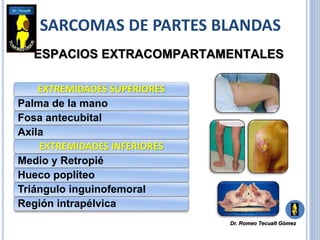
EXTREMIDADES SUPERIORES
Palma de la mano
Fosa antecubital
Axila
EXTREMIDADES INFERIORES
Medio y Retropié
Hueco poplíteo
Triángulo inguinofemoral
Región intrapélvica
ESPACIOS EXTRACOMPARTAMENTALES
Dr. Romeo Tecualt Gómez
SARCOMAS DE PARTES BLANDAS
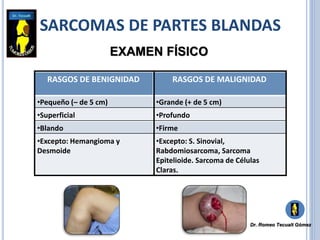
EXAMEN FÍSICO
RASGOS DE BENIGNIDAD RASGOS DE MALIGNIDAD
•Pequeño (– de 5 cm) •Grande (+ de 5 cm)
•Superficial •Profundo
•Blando •Firme
•Excepto: Hemangioma y
Desmoide
•Excepto: S. Sinovial,
Rabdomiosarcoma, Sarcoma
Epitelioide. Sarcoma de Células
Claras.
Dr. Romeo Tecualt Gómez
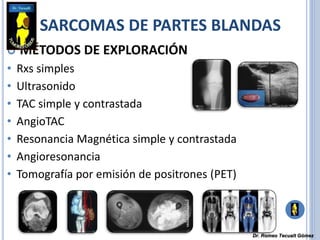
 MÉTODOS DE EXPLORACIÓN
• Rxs simples
• Ultrasonido
• TAC simple y contrastada
• AngioTAC
• Resonancia Magnética simple y contrastada
• Angioresonancia
• Tomografía por emisión de positrones (PET)
SARCOMAS DE PARTES BLANDAS
Dr. Romeo Tecualt Gómez
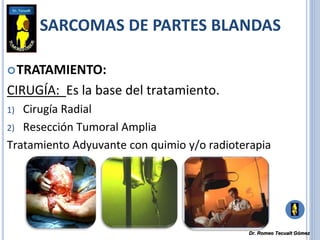
TRATAMIENTO:
CIRUGÍA: Es la base del tratamiento.
1) Cirugía Radial
2) Resección Tumoral Amplia
Tratamiento Adyuvante con quimio y/o radioterapia
SARCOMAS DE PARTES BLANDAS
Dr. Romeo Tecualt Gómez
SARCOMAS DE PARTES BLANDAS
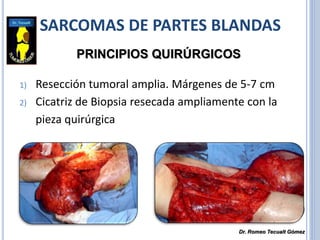
1) Resección tumoral amplia. Márgenes de 5-7 cm
2) Cicatriz de Biopsia resecada ampliamente con la
pieza quirúrgica
PRINCIPIOS QUIRÚRGICOS
Dr. Romeo Tecualt Gómez
SARCOMAS DE PARTES BLANDAS
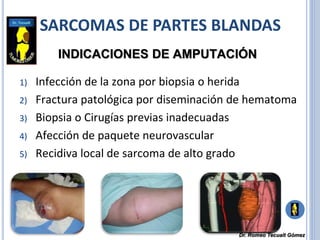
INDICACIONES DE AMPUTACIÓN
1) Infección de la zona por biopsia o herida
2) Fractura patológica por diseminación de hematoma
3) Biopsia o Cirugías previas inadecuadas
4) Afección de paquete neurovascular
5) Recidiva local de sarcoma de alto grado
Dr. Romeo Tecualt Gómez
SARCOMAS DE PARTES BLANDAS
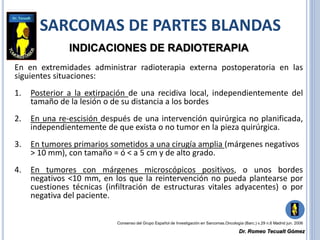
INDICACIONES DE RADIOTERAPIA
En en extremidades administrar radioterapia externa postoperatoria en las
siguientes situaciones:
1. Posterior a la extirpación de una recidiva local, independientemente del
tamaño de la lesión o de su distancia a los bordes
2. En una re-escisión después de una intervención quirúrgica no planificada,
independientemente de que exista o no tumor en la pieza quirúrgica.
3. En tumores primarios sometidos a una cirugía amplia (márgenes negativos
> 10 mm), con tamaño = ó < a 5 cm y de alto grado.
4. En tumores con márgenes microscópicos positivos, o unos bordes
negativos <10 mm, en los que la reintervención no pueda plantearse por
cuestiones técnicas (infiltración de estructuras vitales adyacentes) o por
negativa del paciente.
Consenso del Grupo Español de Investigación en Sarcomas.Oncología (Barc.) v.29 n.6 Madrid jun. 2006
Dr. Romeo Tecualt Gómez
SARCOMAS DE PARTES BLANDAS
PRESENTACIÓN
DE CASOS
Dr. Romeo Tecualt Gómez
SARCOMAS DE PARTES BLANDAS
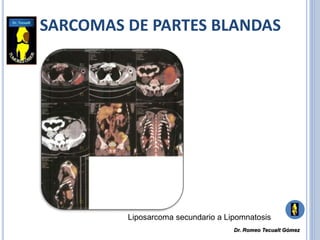
Liposarcoma secundario a Lipomnatosis
Dr. Romeo Tecualt Gómez
SARCOMAS DE PARTES BLANDAS
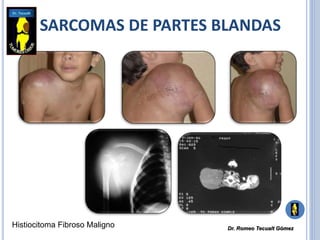
Histiocitoma Fibroso Maligno Dr. Romeo Tecualt Gómez
SARCOMAS DE PARTES BLANDAS
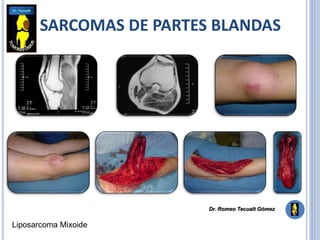
Liposarcoma Mixoide
Dr. Romeo Tecualt Gómez
SARCOMAS DE PARTES BLANDAS
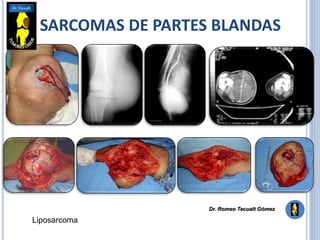
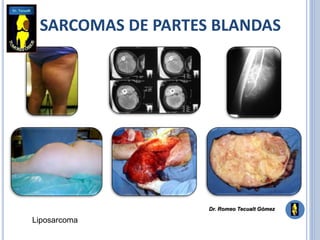
Liposarcoma
Dr. Romeo Tecualt Gómez
SARCOMAS DE PARTES BLANDAS
Liposarcoma
Dr. Romeo Tecualt Gómez
SARCOMAS DE PARTES BLANDAS
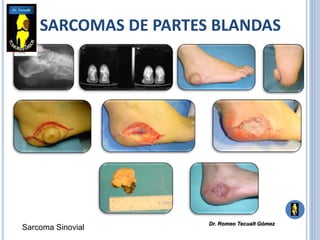
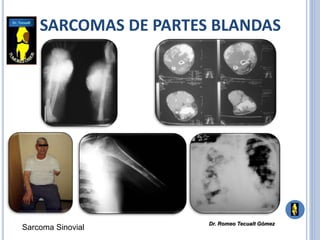
Sarcoma Sinovial
Dr. Romeo Tecualt Gómez
SARCOMAS DE PARTES BLANDAS
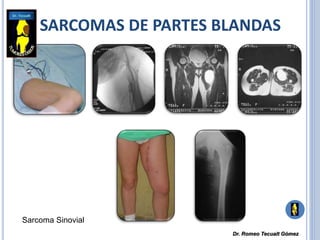
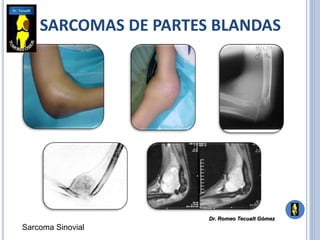
Sarcoma Sinovial
Dr. Romeo Tecualt Gómez
SARCOMAS DE PARTES BLANDAS
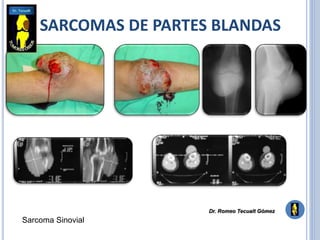
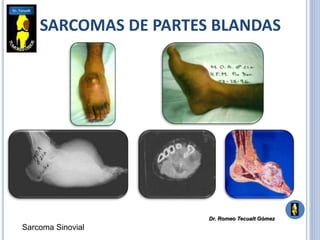
Sarcoma Sinovial
Dr. Romeo Tecualt Gómez
SARCOMAS DE PARTES BLANDAS
Sarcoma Sinovial
Dr. Romeo Tecualt Gómez
SARCOMAS DE PARTES BLANDAS
Sarcoma Sinovial
Dr. Romeo Tecualt Gómez
SARCOMAS DE PARTES BLANDAS
Sarcoma Sinovial
Dr. Romeo Tecualt Gómez
SARCOMAS DE PARTES BLANDAS
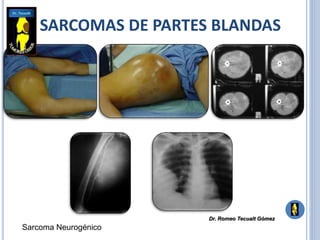
Sarcoma Neurogénico
Dr. Romeo Tecualt Gómez
SARCOMAS DE PARTES BLANDAS
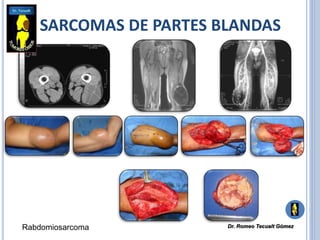
Rabdomiosarcoma Dr. Romeo Tecualt Gómez
Gracias
Por su
Atención
Dr. Romeo Tecualt Gómez

Sarcomas de partes blandas dr. tecualt

  • 1.
    SARCOMAS DE PARTESBLANDAS Dr. Romeo Técualt Gómez Dra. Adriana Atencio Chan Dr. Romeo Tecualt Gómez
  • 2.
    INTRODUCCIÓN Grupo de tumoresde origen mesodérmico Origen: • Músculo • Grasa • Vasos sanguíneos • Nervios periféricos • Tejido fibroso Sharon W Weiss, John R. Goldblum. Tumores de Partes Blandas. Consideraciones Generales Cap. 1. pag 1-14, 5 ed. Mosby 2009 SARCOMAS DE PARTES BLANDAS Dr. Romeo Tecualt Gómez
  • 3.
    SARCOMAS DE PARTESBLANDAS TIPOS MAS FRECUENTES LITERATURA H.O.V.F.N. Liposarcoma Sarcoma sinovial Histiocitoma fibroso maligno Liposarcoma Fibrosarcoma Sarcoma Neurogénico Sarcoma sinovial Rabdomiosarcoma Sarcoma neurogenico Hemangiosarcoma Hemangiosarcoma Fibrosarcoma Rabdomioarcoma Histiocitoma fibroso maligno Leiomiosarcoma Leiomiosarcoma Desmoide Sarcoma Epitelioide Sarcoma de células claras Dr. Romeo Tecualt Gómez
  • 4.
    SARCOMAS DE PARTESBLANDAS  Incidencia: • La verdadera incidencia es desconocida. • Corresponden del 1 al 3% de todas las neoplasias. • Estados Unidos: 10,000 casos nuevos al año. • En México no existe un datos estadístico claro. • Tasa de mortalidad alrededor del 50% Dr. Romeo Tecualt Gómez
  • 5.
     Incidencia:  1%de los tumores malignos  3 a 4 veces más frecuentes que los malignos óseos  2006: 9,500 sarcomas nuevos (USA) Jemal A, Murray, Ward E, et al. Cancer statistics. 2005. CA Cancer J Clin. 2005; 55:16-30 Jemal A, Siegel R, Ward E, et al. Cancer statistics, 2006; CA Cancer J Clin. 2006; 56:106 SARCOMAS DE PARTES BLANDAS CASOS NUEVOS DE CANCER USA, 2006 Localización Número de casos Próstata 234,460 Mama 214, 640 Pulmón 174,470 Colon y recto 148,610 Partes blandas 9,530 Huesos y articulaciones 2,760 Dr. Romeo Tecualt Gómez
  • 6.
    Incidencia:  Cualquier lugardel organismo  Músculos de las extremidades  Pared torácica  Mediastino  Retroperitoneo Sharon W Weiss, John R. Goldblum. Tumores de Partes Blandas. Consideraciones generales Cap 1. pag 1-14, 5 ed. Mosby 2009 SARCOMAS DE PARTES BLANDAS Dr. Romeo Tecualt Gómez
  • 7.
     Edad  15%< 15 años  40% 55 años en adelante  Sexo  Más frecuentes en hombres Jemal A, Siegel R, Ward E, et al. Cancer statistics, 2006; CA Cancer J Clin. 2006; 56:106 SARCOMAS DE PARTES BLANDAS Dr. Romeo Tecualt Gómez
  • 8.
    SARCOMAS DE PARTESBLANDAS RELACIÓN ENTRE LA EDAD Y LA INCIDENCIA DE DIVERSOS SARCOMAS TIPO DE TUMOR EDAD 0 10 20 30 40 50 60 70 RABDOMIOSARCOMA SARCOMA SINOVIAL FIBROSARCOMA LIPOSARCOMA S. MALIGNO HFM Sharon W Weiss, John R. Goldblum. Tumores de Partes Blandas. Consideraciones generales Cap 1. pag 1-14, 5 ed. Mosby 2009 Dr. Romeo Tecualt Gómez
  • 9.
    Localización: • 60% enlas Extremidades • 30% Tronco y Retroperitoneo • 10% Cabeza y Cuello • 2 veces mas frecuentes en extremidades inferiores SARCOMAS DE PARTES BLANDAS Dr. Romeo Tecualt Gómez
  • 10.
     Clasificación • Histológica: Por el tipo de tejido que forman (Lipoma, Liposarcoma, Fibrosarcoma, etc) Existen mas de 750 Dxs diferentes. El 10% son tan indiferenciados que no se puede realizar diagnóstico histológico. SARCOMAS DE PARTES BLANDAS Dr. Romeo Tecualt Gómez
  • 11.
    oHistología: Por características histológicas (atipiacelular, mitosis y necrosis) • Alto Grado (metastatizan mas del 25%) • Bajo grado (metastatizan menos del 25%) (Se correlaciona con la supervivencia y es mas importante para el pronóstico, que el tipo histológico) SARCOMAS DE PARTES BLANDAS Dr. Romeo Tecualt Gómez
  • 12.
    SARCOMAS DE PARTESBLANDAS TIPO HISTOLÓGICO GRADO HISTOLÓGICO I II III FIBROSARCOMA HFM LIPOSARCOMA SARCOMA SINOVIAL RABDOMIOSARCOMA ANGIOSARCOMA SARCOMA NEUROGENICO Sharon W Weiss, John R. Goldblum. Tumores de Partes Blandas. Consideraciones generales Cap 1. pag 1-14, 5 ed. Mosby 2009 Dr. Romeo Tecualt Gómez
  • 13.
    SARCOMAS DE PARTESBLANDAS PORCENTAJE DE SUPERVIVENCIA 0 20 40 60 80 100 120 1 2 3 4 5 6 7 8 9 10 GRADO I GRADO II GRADO III T. GRADOS Sharon W Weiss, John R. Goldblum. Tumores de Partes Blandas. Consideraciones generales Cap 1. pag 1-14, 5 ed. Mosby 2009Dr. Romeo Tecualt Gómez
  • 14.
    SARCOMAS DE PARTESBLANDAS Patogenia: • No existe una causa claramente definida. • Alteraciones en los genes supresores de tumor (Rb-1 y p53). • Síndrome de Li-Fraumeni. • Neurofibromatosis. Dr. Romeo Tecualt Gómez
  • 15.
    Patogenia  Factores medioambientales Traumatismos??????? Carcinógenos ambientales Metilcolantreno Amianto Acido fenociacético Clorofenoles Radiaciones Wolf RF, Ng B, Wueksler B, et al. Effect of growth hormone on tumor and host in an animal model. Ann Surg Oncol 1994; 1:314. Bass P, van ´t Hullenaar N, et al. Occupational asbestos exposure: How to dial with suspected mesothelioma cases . Ann Oncol 2006; 17:848 Tessari R, Canova C, et al. Environmental polution from dioxins and soft tissue sarcomas in the polution of Venice and Mestre. Epidemiol Prep 2006; 30:191 SARCOMAS DE PARTES BLANDAS Dr. Romeo Tecualt Gómez
  • 16.
    Patogenia • Virus oncogénicos Virus herpes 8 humano  VEB • Factores inmunológicos  Inmunodeficiencia  Inmunosupresión • Factores genéticos  NF 1 - 2  Poliposis familiar  Sx Gadner  Sx Li-Fraumeni Ishikawa Y, Wada I, Fukumoto M. Alpha-particle carcinogenesis in Thorotrast patients: epidemiology, dosimetry, pathology, and molecular analysis. SARCOMAS DE PARTES BLANDAS Dr. Romeo Tecualt Gómez
  • 17.
    SARCOMAS DE PARTESBLANDAS  HEMÁTICA • Pulmón • Hígado • Huesos • Retroperitoneo  LINFÁTICA 5% de Todos Excepto: • Sarcoma epitelioide • Sarcoma de Células Claras • Rabdomiosarcoma Embrionario • Hemangiosarcoma  (15%) DISEMINACIÓN Dr. Romeo Tecualt Gómez
  • 18.
     Sistemas deestadificación  Organización Mundial de la Salud (OMS)  American Joint Committee on cancer (AJCC)  Musculoskeletal Tumor Society (MTS Enneking) Sharon W Weiss, John R. Goldblum. Tumores de Partes Blandas. Consideraciones generales Cap 1. pag 1-14, 5 ed. Mosby 2009 Mark J. Kransdorf, Mark D. Murphey. Radiología de los Tumores de los Tejidos Blandos. origen y clasificación de los tumores de los tejidos blandos .Cap 1. pags 1:5 Marbán 2010. SARCOMAS DE PARTES BLANDAS EXTENSION ANATOMICA DEL SISTEMA DE ESTADIFICACION DE TUMORES DE MTS INTACOMPARTAMENTAL (T1) EXTRACOMPARTAMENTAL (T2) Intraarticular Extensión a tejidos blandos Superficial a la fascia profunda Extensión a la fascia profunda Paraósea Extensión intraósea extrafascial Compartimento intrafascial Compartimento extrafascial Enneking WF, Spanier SS, Goodman MA. A system for the surgical staging of musculoskeletal sarcoma. Clin Orthop 1980;153:106 Dr. Romeo Tecualt Gómez
  • 19.
    SARCOMAS DE PARTESBLANDAS EXTREMIDADES SUPERIORES Palma de la mano Fosa antecubital Axila EXTREMIDADES INFERIORES Medio y Retropié Hueco poplíteo Triángulo inguinofemoral Región intrapélvica ESPACIOS EXTRACOMPARTAMENTALES Dr. Romeo Tecualt Gómez
  • 20.
    SARCOMAS DE PARTESBLANDAS EXAMEN FÍSICO RASGOS DE BENIGNIDAD RASGOS DE MALIGNIDAD •Pequeño (– de 5 cm) •Grande (+ de 5 cm) •Superficial •Profundo •Blando •Firme •Excepto: Hemangioma y Desmoide •Excepto: S. Sinovial, Rabdomiosarcoma, Sarcoma Epitelioide. Sarcoma de Células Claras. Dr. Romeo Tecualt Gómez
  • 21.
     MÉTODOS DEEXPLORACIÓN • Rxs simples • Ultrasonido • TAC simple y contrastada • AngioTAC • Resonancia Magnética simple y contrastada • Angioresonancia • Tomografía por emisión de positrones (PET) SARCOMAS DE PARTES BLANDAS Dr. Romeo Tecualt Gómez
  • 22.
    TRATAMIENTO: CIRUGÍA: Es labase del tratamiento. 1) Cirugía Radial 2) Resección Tumoral Amplia Tratamiento Adyuvante con quimio y/o radioterapia SARCOMAS DE PARTES BLANDAS Dr. Romeo Tecualt Gómez
  • 23.
    SARCOMAS DE PARTESBLANDAS 1) Resección tumoral amplia. Márgenes de 5-7 cm 2) Cicatriz de Biopsia resecada ampliamente con la pieza quirúrgica PRINCIPIOS QUIRÚRGICOS Dr. Romeo Tecualt Gómez
  • 24.
    SARCOMAS DE PARTESBLANDAS INDICACIONES DE AMPUTACIÓN 1) Infección de la zona por biopsia o herida 2) Fractura patológica por diseminación de hematoma 3) Biopsia o Cirugías previas inadecuadas 4) Afección de paquete neurovascular 5) Recidiva local de sarcoma de alto grado Dr. Romeo Tecualt Gómez
  • 25.
    SARCOMAS DE PARTESBLANDAS INDICACIONES DE RADIOTERAPIA En en extremidades administrar radioterapia externa postoperatoria en las siguientes situaciones: 1. Posterior a la extirpación de una recidiva local, independientemente del tamaño de la lesión o de su distancia a los bordes 2. En una re-escisión después de una intervención quirúrgica no planificada, independientemente de que exista o no tumor en la pieza quirúrgica. 3. En tumores primarios sometidos a una cirugía amplia (márgenes negativos > 10 mm), con tamaño = ó < a 5 cm y de alto grado. 4. En tumores con márgenes microscópicos positivos, o unos bordes negativos <10 mm, en los que la reintervención no pueda plantearse por cuestiones técnicas (infiltración de estructuras vitales adyacentes) o por negativa del paciente. Consenso del Grupo Español de Investigación en Sarcomas.Oncología (Barc.) v.29 n.6 Madrid jun. 2006 Dr. Romeo Tecualt Gómez
  • 26.
    SARCOMAS DE PARTESBLANDAS PRESENTACIÓN DE CASOS Dr. Romeo Tecualt Gómez
  • 27.
    SARCOMAS DE PARTESBLANDAS Liposarcoma secundario a Lipomnatosis Dr. Romeo Tecualt Gómez
  • 28.
    SARCOMAS DE PARTESBLANDAS Histiocitoma Fibroso Maligno Dr. Romeo Tecualt Gómez
  • 29.
    SARCOMAS DE PARTESBLANDAS Liposarcoma Mixoide Dr. Romeo Tecualt Gómez
  • 30.
    SARCOMAS DE PARTESBLANDAS Liposarcoma Dr. Romeo Tecualt Gómez
  • 31.
    SARCOMAS DE PARTESBLANDAS Liposarcoma Dr. Romeo Tecualt Gómez
  • 32.
    SARCOMAS DE PARTESBLANDAS Sarcoma Sinovial Dr. Romeo Tecualt Gómez
  • 33.
    SARCOMAS DE PARTESBLANDAS Sarcoma Sinovial Dr. Romeo Tecualt Gómez
  • 34.
    SARCOMAS DE PARTESBLANDAS Sarcoma Sinovial Dr. Romeo Tecualt Gómez
  • 35.
    SARCOMAS DE PARTESBLANDAS Sarcoma Sinovial Dr. Romeo Tecualt Gómez
  • 36.
    SARCOMAS DE PARTESBLANDAS Sarcoma Sinovial Dr. Romeo Tecualt Gómez
  • 37.
    SARCOMAS DE PARTESBLANDAS Sarcoma Sinovial Dr. Romeo Tecualt Gómez
  • 38.
    SARCOMAS DE PARTESBLANDAS Sarcoma Neurogénico Dr. Romeo Tecualt Gómez
  • 39.
    SARCOMAS DE PARTESBLANDAS Rabdomiosarcoma Dr. Romeo Tecualt Gómez
  • 40.