Cálculo Diferencial
Derivada de Funciones
Trigonométricas G.IV.
En esta guía veremos Identidades, Tablas para Derivadas y Ejercicios
resueltos de las Funciones Trigonométricas.

Innovación y Futuro
Jair Ospino Ardila
Propiedades – Identidades Trigonométricas
𝑠𝑒𝑛2 𝑥 + cos2 𝑥 = 1

Tabla de Derivadas
Nombre Funciones
Seno
Coseno
Tangente
Cotangente
Secante
Cosecante
ArcoSeno
ArcoCoseno
ArcoTangente

Nomenclatura
𝑆𝑒𝑛 𝑢
𝐶𝑜𝑠 𝑢

Derivadas
𝐶𝑜𝑠 𝑢 ∗ 𝑢′
−𝑆𝑒𝑛 𝑢 ∗ 𝑢′

𝑇𝑎𝑛 𝑢

𝑆𝑒𝑐 2 𝑢 ∗ 𝑢′ o también

𝐶𝑜𝑡 𝑢

( −𝐶𝑠𝑐 2 𝑢 ∗ 𝑢′ ) o también

𝑆𝑒𝑐 𝑢
𝐶𝑠𝑐 𝑢

𝑢′

𝑆𝑒𝑐 𝑢 ∗ 𝑇𝑎𝑛 𝑢 ∗ 𝑢′
−𝐶𝑠𝑐 𝑢 ∗ 𝐶𝑜𝑡 𝑢 ∗ 𝑢′
𝑢′

𝐴𝑟𝑐𝑠𝑒𝑛 𝑢
𝐴𝑟𝑐𝑐𝑜𝑠 𝑢
𝐴𝑟𝑐𝑡𝑎𝑛 𝑢

http://innovacionyfuturo.wordpress.com

𝐶𝑜𝑠2 (𝑢)
−𝑢′
𝑆𝑒𝑛2 (𝑢)

1 − 𝑢2
−𝑢′
1 − 𝑢2
𝑢′
2+1
𝑢

jairospino@ingenieros.com
Resolver 𝑓 𝑥 = 𝑠𝑒𝑛 3𝑥

𝑓 𝑥 = 𝑠𝑒𝑛 3𝑥

Como
𝑓 ′ (𝑠𝑒𝑛 𝑢) = 𝐶𝑜𝑠 𝑢 ∗ 𝑢′
Entonces

𝑓′ 𝑥 = 𝐶𝑜𝑠 3𝑥 ∗ (3)
𝑓′ 𝑥 = 3𝐶𝑜𝑠 3𝑥

𝑓′ 𝑥 = 3𝐶𝑜𝑠 3𝑥

𝑈𝑛𝑖𝑑𝑎𝑠

http://innovacionyfuturo.wordpress.com

jairospino@ingenieros.com
Resolver 𝑓 𝑥 = 𝐶𝑜𝑠 𝑥 3

𝑓 𝑥 = 𝐶𝑜𝑠 𝑥 3

Como
𝑓 ′ 𝑐𝑜𝑠 𝑢 = −𝑆𝑒𝑛 𝑢 ∗ 𝑢′

Entonces

𝑓 ′ 𝑥 = −𝑆𝑒𝑛 𝑥 3 ∗ 3𝑥 2
𝑓 ′ (𝑥) = −3𝑥 2 𝑆𝑒𝑛 𝑥 3

Ambas

http://innovacionyfuturo.wordpress.com

jairospino@ingenieros.com
Resolver 𝑓 𝑥 = 𝐶𝑜𝑠 3 𝑥

𝑓 𝑥 = 𝐶𝑜𝑠 3 𝑥

Podemos reescribir esta función de
la siguiente manera

𝑓 𝑥 = 𝐶𝑜𝑠 𝑥

3

Como



𝑑𝑦



𝑓 ′ 𝑐𝑜𝑠 𝑢 = −𝑆𝑒𝑛 𝑢 ∗ 𝑢′

𝑑𝑥

𝑥 𝑛 = 𝑛𝑥 𝑛−1 ∗ 𝑥 ′

𝑓 ′ 𝑥 = −3𝑆𝑒𝑛

Entonces

𝑓′ 𝑥 =

3 𝐶𝑜𝑠 𝑥

𝑓 ′ 𝑥 = −3𝑆𝑒𝑛

2

𝑥 ∗ 𝐶𝑜𝑠2 𝑥

∗ (−𝑆𝑒𝑛 𝑥 )

𝑥 ∗ 𝐶𝑜𝑠2 𝑥

Ambas

http://innovacionyfuturo.wordpress.com

jairospino@ingenieros.com
1

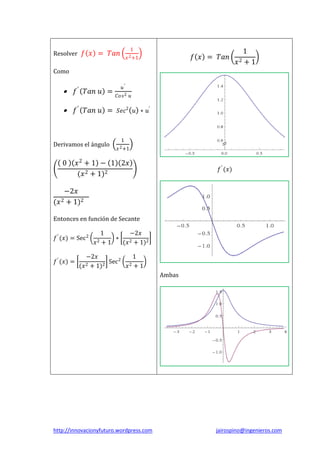
Resolver 𝑓 𝑥 = 𝑇𝑎𝑛

𝑓 𝑥 = 𝑇𝑎𝑛

𝑥 2 +1

1
𝑥2 + 1

Como
𝑢′



𝑓 ′ 𝑇𝑎𝑛 𝑢 =



𝑓 ′ 𝑇𝑎𝑛 𝑢 = 𝑆𝑒𝑐2 𝑢 ∗ 𝑢′

Derivamos el ángulo

0

𝐶𝑜𝑠 2 𝑢

1
𝑥 2 +1

𝑥 2 + 1 − 1 2𝑥
(𝑥 2 + 1)2

𝑓 ′ (𝑥)

−2𝑥
(𝑥 2 + 1)2
Entonces en función de Secante
𝑓 ′ (𝑥) = Sec 2
𝑓 ′ (𝑥) =

𝑥2

1
−2𝑥
∗
2 + 1)2
+1
(𝑥

−2𝑥
1
Sec 2 2
2
+ 1)
𝑥 +1

(𝑥 2

Ambas

http://innovacionyfuturo.wordpress.com

jairospino@ingenieros.com
Resolver 𝑓 𝑥 = 𝑒 −𝑥 ∗ 𝑆𝑒𝑛 2𝑥

𝑓 𝑥 = 𝑒 −𝑥 ∗ 𝑆𝑒𝑛 2𝑥

Como la derivada de un producto es:


𝑓 𝑥 = 𝑚∗ 𝑢
𝑓 ′ 𝑥 = 𝑚′ ∗ 𝑢 + 𝑚 ∗ 𝑢′



𝑓 ′ (𝑠𝑒𝑛 𝑢) = 𝐶𝑜𝑠 𝑢 ∗ 𝑢′

Entonces
𝑓′ 𝑥

𝑓′ 𝑥 = −1 𝑒 −𝑥 ∗ 𝑆𝑒𝑛 2𝑥 + 𝑒 −𝑥 𝐶𝑜𝑠 2𝑥 ∗ (2)

𝑓 ′ (𝑥) = −𝑒 −𝑥 𝑆𝑒𝑛 2𝑥 + 2𝑒 −𝑥 𝐶𝑜𝑠 2𝑥

Tomamos factor común 𝑒 −𝑥
𝑓 ′ 𝑥 = 𝑒 −𝑥 2𝐶𝑜𝑠 2𝑥 − 𝑆𝑒𝑛 2𝑥

Ambas

http://innovacionyfuturo.wordpress.com

jairospino@ingenieros.com
Resolver 𝑓 𝑥 = 𝑇𝑎𝑛3 25𝑥

4

Podemos reescribir esta función de la siguiente manera

𝑓 𝑥 = 𝑇𝑎𝑛 25𝑥

4

3

Como la derivada de una Potencia es:



𝑑𝑦
𝑑𝑥

𝑥 𝑛 = 𝑛𝑥 𝑛−1 ∗ 𝑥 ′

Entonces

𝑓 ′ (𝑥) = 3 𝑇𝑎𝑛 25𝑥

4

2

∗

𝑑𝑦
𝑑𝑥

𝑇𝑎𝑛 25𝑥

4

(A)

En el paso anterior hemos dejado la derivada interna de la función indicada para
resolverla en el siguiente paso con más calma
Como la derivada de la Tangente es:



𝑓 ′ 𝑇𝑎𝑛 𝑢 = 𝑆𝑒𝑐2 𝑢 ∗ 𝑢′

Entonces
𝑑𝑦
4
𝑇𝑎𝑛 25𝑥
𝑑𝑥

= 𝑆𝑒𝑐 2 25𝑥

4

∗

𝑑𝑦 5𝑥 4
2
𝑑𝑥

Reemplazamos en (A)

𝑓 ′ (𝑥) = 3 𝑇𝑎𝑛 25𝑥

4

2

∗ 𝑆𝑒𝑐 2 25𝑥

4

∗

𝑑𝑦
𝑑𝑥

25𝑥

4

(B)

En el paso anterior hemos vuelto a dejar la derivada interna de la función indicada
para resolverla en el siguiente paso con más calma
Como la derivada de una función exponencial es:

𝑓 𝑥 = 𝑎𝑥

𝑓 ′ 𝑥 = 𝑎 𝑥 ∗ ln(𝑎) * x’



Entonces
𝑑𝑦
𝑑𝑥

25𝑥

4

4

= 25𝑥 ln 2 ∗

𝑑𝑦
𝑑𝑥

5𝑥 4

Reemplazamos en (B)

𝑓 ′ (𝑥) = 3 𝑇𝑎𝑛 25𝑥

4

2

∗ 𝑆𝑒𝑐 2 25𝑥

http://innovacionyfuturo.wordpress.com

4

4

∗ 25𝑥 ln 2 ∗

𝑑𝑦
5𝑥 4
𝑑𝑥
jairospino@ingenieros.com
Finalmente podemos apreciar que la última derivada indicada ya es muy sencilla.

𝑓 ′ (𝑥) = 3 𝑇𝑎𝑛 25𝑥

2

4

∗ 𝑆𝑒𝑐 2 25𝑥

4

4

∗ 25𝑥 ln 2 ∗ 20𝑥 3

Si ordenamos para mejor visibilidad

𝑓 ′ 𝑥 = 3 ∗ 20 𝑥 3 ∗ 𝑇𝑎𝑛2 25𝑥
4

4

∗ 𝑆𝑒𝑐 2 25𝑥

𝑓 ′ 𝑥 = 60𝑥 3 ∗ 25𝑥 ∗ ln 2 ∗ 𝑇𝑎𝑛2 25𝑥

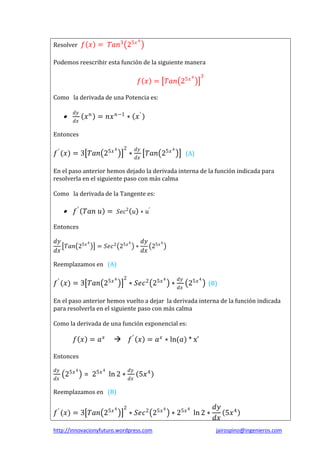
𝑓 𝑥 = 𝑇𝑎𝑛3 25𝑥

4

4

4

∗ 25𝑥 ∗ ln 2

∗ 𝑆𝑒𝑐 2 25𝑥

4

4

𝑓′ 𝑥

Ambos

http://innovacionyfuturo.wordpress.com

jairospino@ingenieros.com
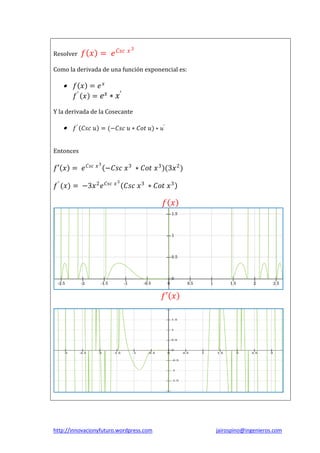
Resolver

𝑓 𝑥 = 𝑒 𝐶𝑠𝑐

𝑥3

Como la derivada de una función exponencial es:



𝑓 𝑥 = 𝑒𝑥
𝑓 ′ 𝑥 = 𝑒 𝑥 ∗ 𝑥′

Y la derivada de la Cosecante



𝑓 ′ 𝐶𝑠𝑐 𝑢 = (−𝐶𝑠𝑐 𝑢 ∗ 𝐶𝑜𝑡 𝑢) ∗ 𝑢′

Entonces

𝑓′ 𝑥 = 𝑒 𝐶𝑠𝑐

𝑥3

−𝐶𝑠𝑐 𝑥 3 ∗ 𝐶𝑜𝑡 𝑥 3 (3𝑥 2 )

𝑓 ′ (𝑥) = −3𝑥 2 𝑒 𝐶𝑠𝑐

𝑥3

𝐶𝑠𝑐 𝑥 3 ∗ 𝐶𝑜𝑡 𝑥 3

𝑓 𝑥

𝑓′ 𝑥

http://innovacionyfuturo.wordpress.com

jairospino@ingenieros.com
𝑓 𝑥 =

Resolver

𝑥 2 +1
𝑥 𝑠𝑒𝑛 𝑥

Podemos reescribir esta función de la siguiente manera
𝑓 𝑥 =

𝑥2 + 1
1
∗
𝑥
𝑠𝑒𝑛 𝑥

Por identidad 𝐶𝑠𝑐 𝑥 =

1
𝑠𝑒𝑛 𝑥

Entonces

𝑓 𝑥 =

𝑥2 + 1
∗ 𝐶𝑠𝑐 𝑥
𝑥

𝑓 𝑥 =

𝑥 2 ∗ 𝐶𝑠𝑐 𝑥 + 𝐶𝑠𝑐 𝑥
𝑥

Derivamos como un cociente
como



𝑓 𝑥 =
𝑓′ 𝑥 =

𝑢
𝑧

𝑢′ ∗ 𝑧 − 𝑢 ∗ 𝑧′
𝑧2

Derivada del Producto

Como
 𝑓 𝑥 = 𝑚∗ 𝑢

𝑥 2 ∗ 𝐶𝑠𝑐 𝑥

𝑓 ′ 𝑥 = 𝑚′ ∗ 𝑢 + 𝑚 ∗ 𝑢′
Procedemos a Derivar
-

𝑓′ 𝑥 =

𝑓′ 𝑥 =

Como en el numerador tenemos un producto que depende de la misma
variable, tendremos que derivar como un producto primero antes de hacerlo
como un cociente.
2𝑥 𝐶𝑠𝑐 𝑥 + 𝑥 2 −𝐶𝑠𝑐 𝑥 ∙ 𝐶𝑜𝑡 𝑥 + −𝐶𝑠𝑐 𝑥 ∙ 𝐶𝑜𝑡 𝑥
𝑥2

∗ 𝑥− 1

𝑥 2 𝐶𝑠𝑐 𝑥 + 𝐶𝑠𝑐 𝑥

2𝑥 2 𝐶𝑠𝑐 𝑥 − 𝑥 3 𝐶𝑠𝑐 𝑥 ∙ 𝐶𝑜𝑡 𝑥 − 𝑥 𝐶𝑠𝑐 𝑥 ∙ 𝐶𝑜𝑡 𝑥 − 𝑥 2 𝐶𝑠𝑐 𝑥 − 𝐶𝑠𝑐 𝑥
𝑥2

Reducimos términos semejantes y eliminamos el corchete para apreciar mejor
𝑓′ 𝑥 =

𝑥 2 𝐶𝑠𝑐 𝑥 − 𝑥 3 𝐶𝑠𝑐 𝑥 ∙ 𝐶𝑜𝑡 𝑥 − 𝑥 𝐶𝑠𝑐 𝑥 ∙ 𝐶𝑜𝑡 𝑥 − 𝐶𝑠𝑐 𝑥
𝑥2

http://innovacionyfuturo.wordpress.com

jairospino@ingenieros.com
Tomamos factor común Csc x
𝑓′ 𝑥 =

𝐶𝑠𝑐 𝑥 𝑥 2 − 𝑥 3 𝐶𝑜𝑡 𝑥 − 𝑥 𝐶𝑜𝑡 𝑥 − 1
𝑥2

Dentro del corchete tomamos factor común x Cot x
𝑓′ 𝑥 =

𝐶𝑠𝑐 𝑥 𝑥 2 − 𝑥 𝐶𝑜𝑡 𝑥 𝑥 2 + 1 − 1
𝑥2

Ordenamos para apreciar mejor
𝐶𝑠𝑐 𝑥 −𝑥 𝑥 2 + 1 ∙ 𝐶𝑜𝑡 𝑥 + 𝑥 2 − 1
𝑓′ 𝑥 =
𝑥2
𝑓′ 𝑥 =

𝐶𝑠𝑐 𝑥 − 𝑥 3 + 𝑥 ∙ 𝐶𝑜𝑡 𝑥 + 𝑥 2 − 1
𝑥2

Sacamos el signo menos del corchete
𝑓′ 𝑥 =

− 𝐶𝑠𝑐 𝑥

𝑥 3 + 𝑥 ∙ 𝐶𝑜𝑡 𝑥 − 𝑥 2 + 1
𝑥2

𝑓 𝑥

Unidas
𝑓′ 𝑥

http://innovacionyfuturo.wordpress.com

jairospino@ingenieros.com
𝑓 𝑥 = ln

Resolver

𝑥 2 𝐶𝑜𝑠 𝑥
2𝑥+1 3

Para resolver este ejercicio debemos utilizar una de las propiedades de los
logaritmos.
Dónde: ln

𝑗
𝑚

= ln 𝑗 – ln 𝑚

Si reemplazamos seria:

𝑓 𝑥 = ln 𝑥 2 𝐶𝑜𝑠 𝑥 − ln 2𝑥 + 1

3

Derivamos
Como derivada de

ln 𝑢 =

𝑢′
𝑢

2𝑥 𝐶𝑜𝑠 𝑥 + 𝑥 2 (−𝑠𝑒𝑛 𝑥)
3 2𝑥 + 1 2 ∗ (2)
𝑓′ 𝑥 =
−
𝑥 2 𝐶𝑜𝑠 𝑥
2𝑥 + 1 3
2𝑥 𝐶𝑜𝑠 𝑥 − 𝑥 2 𝑠𝑒𝑛 𝑥
6 2𝑥 + 1 2
𝑓′ 𝑥 =
−
𝑥 2 𝐶𝑜𝑠 𝑥
2𝑥 + 1 3
2𝑥 𝐶𝑜𝑠 𝑥
𝑥 2 𝑠𝑒𝑛 𝑥
6
𝑓′ 𝑥 = 2
− 2
−
𝑥 𝐶𝑜𝑠 𝑥
𝑥 𝐶𝑜𝑠 𝑥
2𝑥 + 1
𝑓′ 𝑥 =
𝑓′ 𝑥 =
𝑓′ 𝑥 =

2
6
− tan 𝑥 −
𝑥
2𝑥 + 1
2 − 𝑥 tan 𝑥
𝑥

−

6
2𝑥 + 1

Identidad

tan 𝑥 =

𝑠𝑒𝑛 𝑥
cos 𝑥

2 − 𝑥 tan 𝑥 2𝑥 + 1 − 6𝑥
𝑥 2𝑥 + 1

𝑓′ 𝑥 =

2 2𝑥 + 1 − 𝑥 tan 𝑥 2𝑥 + 1 − 6𝑥
𝑥 2𝑥 + 1

𝑓′ 𝑥 =

4𝑥 + 2 − 𝑥 tan 𝑥 2𝑥 + 1 − 6𝑥
𝑥 2𝑥 + 1

http://innovacionyfuturo.wordpress.com

jairospino@ingenieros.com
𝑓′ 𝑥 =

2 − 𝑥 tan 𝑥 2𝑥 + 1 − 2𝑥
𝑥 2𝑥 + 1

𝑓 𝑥

𝑓′ 𝑥

Unidas

http://innovacionyfuturo.wordpress.com

jairospino@ingenieros.com
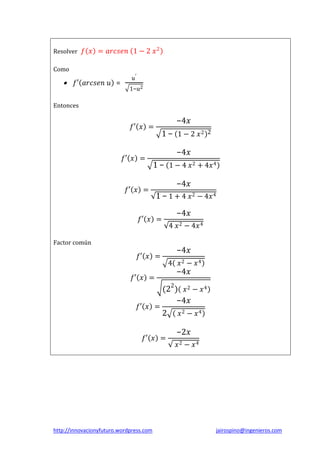
Resolver 𝑓 𝑥 = 𝑎𝑟𝑐𝑠𝑒𝑛 1 − 2 𝑥 2
Como



𝑓′ 𝑎𝑟𝑐𝑠𝑒𝑛 𝑢 =

𝑢′
1−𝑢2

Entonces

−4𝑥

𝑓′ 𝑥 =

𝑓′ 𝑥 =

1 − 1 − 2 𝑥2

2

−4𝑥
1 − 1 − 4 𝑥 2 + 4𝑥 4

𝑓′ 𝑥 =

−4𝑥
1 − 1 + 4 𝑥 2 − 4𝑥 4

𝑓′ 𝑥 =

−4𝑥
4 𝑥 2 − 4𝑥 4

Factor común

𝑓′ 𝑥 =
𝑓′ 𝑥 =

−4𝑥
4 𝑥2 − 𝑥4

−4𝑥

(22 ) 𝑥 2 − 𝑥 4
−4𝑥
𝑓′ 𝑥 =
2 𝑥2 − 𝑥4
𝑓′ 𝑥 =

http://innovacionyfuturo.wordpress.com

−2𝑥
𝑥2 − 𝑥4

jairospino@ingenieros.com

Derivada de funciones trigonometricas

  • 1.
    Cálculo Diferencial Derivada deFunciones Trigonométricas G.IV. En esta guía veremos Identidades, Tablas para Derivadas y Ejercicios resueltos de las Funciones Trigonométricas. Innovación y Futuro Jair Ospino Ardila
  • 2.
    Propiedades – IdentidadesTrigonométricas 𝑠𝑒𝑛2 𝑥 + cos2 𝑥 = 1 Tabla de Derivadas Nombre Funciones Seno Coseno Tangente Cotangente Secante Cosecante ArcoSeno ArcoCoseno ArcoTangente Nomenclatura 𝑆𝑒𝑛 𝑢 𝐶𝑜𝑠 𝑢 Derivadas 𝐶𝑜𝑠 𝑢 ∗ 𝑢′ −𝑆𝑒𝑛 𝑢 ∗ 𝑢′ 𝑇𝑎𝑛 𝑢 𝑆𝑒𝑐 2 𝑢 ∗ 𝑢′ o también 𝐶𝑜𝑡 𝑢 ( −𝐶𝑠𝑐 2 𝑢 ∗ 𝑢′ ) o también 𝑆𝑒𝑐 𝑢 𝐶𝑠𝑐 𝑢 𝑢′ 𝑆𝑒𝑐 𝑢 ∗ 𝑇𝑎𝑛 𝑢 ∗ 𝑢′ −𝐶𝑠𝑐 𝑢 ∗ 𝐶𝑜𝑡 𝑢 ∗ 𝑢′ 𝑢′ 𝐴𝑟𝑐𝑠𝑒𝑛 𝑢 𝐴𝑟𝑐𝑐𝑜𝑠 𝑢 𝐴𝑟𝑐𝑡𝑎𝑛 𝑢 http://innovacionyfuturo.wordpress.com 𝐶𝑜𝑠2 (𝑢) −𝑢′ 𝑆𝑒𝑛2 (𝑢) 1 − 𝑢2 −𝑢′ 1 − 𝑢2 𝑢′ 2+1 𝑢 jairospino@ingenieros.com
  • 3.
    Resolver 𝑓 𝑥= 𝑠𝑒𝑛 3𝑥 𝑓 𝑥 = 𝑠𝑒𝑛 3𝑥 Como 𝑓 ′ (𝑠𝑒𝑛 𝑢) = 𝐶𝑜𝑠 𝑢 ∗ 𝑢′ Entonces 𝑓′ 𝑥 = 𝐶𝑜𝑠 3𝑥 ∗ (3) 𝑓′ 𝑥 = 3𝐶𝑜𝑠 3𝑥 𝑓′ 𝑥 = 3𝐶𝑜𝑠 3𝑥 𝑈𝑛𝑖𝑑𝑎𝑠 http://innovacionyfuturo.wordpress.com jairospino@ingenieros.com
  • 4.
    Resolver 𝑓 𝑥= 𝐶𝑜𝑠 𝑥 3 𝑓 𝑥 = 𝐶𝑜𝑠 𝑥 3 Como 𝑓 ′ 𝑐𝑜𝑠 𝑢 = −𝑆𝑒𝑛 𝑢 ∗ 𝑢′ Entonces 𝑓 ′ 𝑥 = −𝑆𝑒𝑛 𝑥 3 ∗ 3𝑥 2 𝑓 ′ (𝑥) = −3𝑥 2 𝑆𝑒𝑛 𝑥 3 𝑓 ′ (𝑥) = −3𝑥 2 𝑆𝑒𝑛 𝑥 3 Ambas http://innovacionyfuturo.wordpress.com jairospino@ingenieros.com
  • 5.
    Resolver 𝑓 𝑥= 𝐶𝑜𝑠 3 𝑥 𝑓 𝑥 = 𝐶𝑜𝑠 3 𝑥 Podemos reescribir esta función de la siguiente manera 𝑓 𝑥 = 𝐶𝑜𝑠 𝑥 3 Como  𝑑𝑦  𝑓 ′ 𝑐𝑜𝑠 𝑢 = −𝑆𝑒𝑛 𝑢 ∗ 𝑢′ 𝑑𝑥 𝑥 𝑛 = 𝑛𝑥 𝑛−1 ∗ 𝑥 ′ 𝑓 ′ 𝑥 = −3𝑆𝑒𝑛 Entonces 𝑓′ 𝑥 = 3 𝐶𝑜𝑠 𝑥 𝑓 ′ 𝑥 = −3𝑆𝑒𝑛 2 𝑥 ∗ 𝐶𝑜𝑠2 𝑥 ∗ (−𝑆𝑒𝑛 𝑥 ) 𝑥 ∗ 𝐶𝑜𝑠2 𝑥 Ambas http://innovacionyfuturo.wordpress.com jairospino@ingenieros.com
  • 6.
    1 Resolver 𝑓 𝑥= 𝑇𝑎𝑛 𝑓 𝑥 = 𝑇𝑎𝑛 𝑥 2 +1 1 𝑥2 + 1 Como 𝑢′  𝑓 ′ 𝑇𝑎𝑛 𝑢 =  𝑓 ′ 𝑇𝑎𝑛 𝑢 = 𝑆𝑒𝑐2 𝑢 ∗ 𝑢′ Derivamos el ángulo 0 𝐶𝑜𝑠 2 𝑢 1 𝑥 2 +1 𝑥 2 + 1 − 1 2𝑥 (𝑥 2 + 1)2 𝑓 ′ (𝑥) −2𝑥 (𝑥 2 + 1)2 Entonces en función de Secante 𝑓 ′ (𝑥) = Sec 2 𝑓 ′ (𝑥) = 𝑥2 1 −2𝑥 ∗ 2 + 1)2 +1 (𝑥 −2𝑥 1 Sec 2 2 2 + 1) 𝑥 +1 (𝑥 2 Ambas http://innovacionyfuturo.wordpress.com jairospino@ingenieros.com
  • 7.
    Resolver 𝑓 𝑥= 𝑒 −𝑥 ∗ 𝑆𝑒𝑛 2𝑥 𝑓 𝑥 = 𝑒 −𝑥 ∗ 𝑆𝑒𝑛 2𝑥 Como la derivada de un producto es:  𝑓 𝑥 = 𝑚∗ 𝑢 𝑓 ′ 𝑥 = 𝑚′ ∗ 𝑢 + 𝑚 ∗ 𝑢′  𝑓 ′ (𝑠𝑒𝑛 𝑢) = 𝐶𝑜𝑠 𝑢 ∗ 𝑢′ Entonces 𝑓′ 𝑥 𝑓′ 𝑥 = −1 𝑒 −𝑥 ∗ 𝑆𝑒𝑛 2𝑥 + 𝑒 −𝑥 𝐶𝑜𝑠 2𝑥 ∗ (2) 𝑓 ′ (𝑥) = −𝑒 −𝑥 𝑆𝑒𝑛 2𝑥 + 2𝑒 −𝑥 𝐶𝑜𝑠 2𝑥 Tomamos factor común 𝑒 −𝑥 𝑓 ′ 𝑥 = 𝑒 −𝑥 2𝐶𝑜𝑠 2𝑥 − 𝑆𝑒𝑛 2𝑥 Ambas http://innovacionyfuturo.wordpress.com jairospino@ingenieros.com
  • 8.
    Resolver 𝑓 𝑥= 𝑇𝑎𝑛3 25𝑥 4 Podemos reescribir esta función de la siguiente manera 𝑓 𝑥 = 𝑇𝑎𝑛 25𝑥 4 3 Como la derivada de una Potencia es:  𝑑𝑦 𝑑𝑥 𝑥 𝑛 = 𝑛𝑥 𝑛−1 ∗ 𝑥 ′ Entonces 𝑓 ′ (𝑥) = 3 𝑇𝑎𝑛 25𝑥 4 2 ∗ 𝑑𝑦 𝑑𝑥 𝑇𝑎𝑛 25𝑥 4 (A) En el paso anterior hemos dejado la derivada interna de la función indicada para resolverla en el siguiente paso con más calma Como la derivada de la Tangente es:  𝑓 ′ 𝑇𝑎𝑛 𝑢 = 𝑆𝑒𝑐2 𝑢 ∗ 𝑢′ Entonces 𝑑𝑦 4 𝑇𝑎𝑛 25𝑥 𝑑𝑥 = 𝑆𝑒𝑐 2 25𝑥 4 ∗ 𝑑𝑦 5𝑥 4 2 𝑑𝑥 Reemplazamos en (A) 𝑓 ′ (𝑥) = 3 𝑇𝑎𝑛 25𝑥 4 2 ∗ 𝑆𝑒𝑐 2 25𝑥 4 ∗ 𝑑𝑦 𝑑𝑥 25𝑥 4 (B) En el paso anterior hemos vuelto a dejar la derivada interna de la función indicada para resolverla en el siguiente paso con más calma Como la derivada de una función exponencial es: 𝑓 𝑥 = 𝑎𝑥 𝑓 ′ 𝑥 = 𝑎 𝑥 ∗ ln(𝑎) * x’  Entonces 𝑑𝑦 𝑑𝑥 25𝑥 4 4 = 25𝑥 ln 2 ∗ 𝑑𝑦 𝑑𝑥 5𝑥 4 Reemplazamos en (B) 𝑓 ′ (𝑥) = 3 𝑇𝑎𝑛 25𝑥 4 2 ∗ 𝑆𝑒𝑐 2 25𝑥 http://innovacionyfuturo.wordpress.com 4 4 ∗ 25𝑥 ln 2 ∗ 𝑑𝑦 5𝑥 4 𝑑𝑥 jairospino@ingenieros.com
  • 9.
    Finalmente podemos apreciarque la última derivada indicada ya es muy sencilla. 𝑓 ′ (𝑥) = 3 𝑇𝑎𝑛 25𝑥 2 4 ∗ 𝑆𝑒𝑐 2 25𝑥 4 4 ∗ 25𝑥 ln 2 ∗ 20𝑥 3 Si ordenamos para mejor visibilidad 𝑓 ′ 𝑥 = 3 ∗ 20 𝑥 3 ∗ 𝑇𝑎𝑛2 25𝑥 4 4 ∗ 𝑆𝑒𝑐 2 25𝑥 𝑓 ′ 𝑥 = 60𝑥 3 ∗ 25𝑥 ∗ ln 2 ∗ 𝑇𝑎𝑛2 25𝑥 𝑓 𝑥 = 𝑇𝑎𝑛3 25𝑥 4 4 4 ∗ 25𝑥 ∗ ln 2 ∗ 𝑆𝑒𝑐 2 25𝑥 4 4 𝑓′ 𝑥 Ambos http://innovacionyfuturo.wordpress.com jairospino@ingenieros.com
  • 10.
    Resolver 𝑓 𝑥 =𝑒 𝐶𝑠𝑐 𝑥3 Como la derivada de una función exponencial es:  𝑓 𝑥 = 𝑒𝑥 𝑓 ′ 𝑥 = 𝑒 𝑥 ∗ 𝑥′ Y la derivada de la Cosecante  𝑓 ′ 𝐶𝑠𝑐 𝑢 = (−𝐶𝑠𝑐 𝑢 ∗ 𝐶𝑜𝑡 𝑢) ∗ 𝑢′ Entonces 𝑓′ 𝑥 = 𝑒 𝐶𝑠𝑐 𝑥3 −𝐶𝑠𝑐 𝑥 3 ∗ 𝐶𝑜𝑡 𝑥 3 (3𝑥 2 ) 𝑓 ′ (𝑥) = −3𝑥 2 𝑒 𝐶𝑠𝑐 𝑥3 𝐶𝑠𝑐 𝑥 3 ∗ 𝐶𝑜𝑡 𝑥 3 𝑓 𝑥 𝑓′ 𝑥 http://innovacionyfuturo.wordpress.com jairospino@ingenieros.com
  • 11.
    𝑓 𝑥 = Resolver 𝑥2 +1 𝑥 𝑠𝑒𝑛 𝑥 Podemos reescribir esta función de la siguiente manera 𝑓 𝑥 = 𝑥2 + 1 1 ∗ 𝑥 𝑠𝑒𝑛 𝑥 Por identidad 𝐶𝑠𝑐 𝑥 = 1 𝑠𝑒𝑛 𝑥 Entonces 𝑓 𝑥 = 𝑥2 + 1 ∗ 𝐶𝑠𝑐 𝑥 𝑥 𝑓 𝑥 = 𝑥 2 ∗ 𝐶𝑠𝑐 𝑥 + 𝐶𝑠𝑐 𝑥 𝑥 Derivamos como un cociente como  𝑓 𝑥 = 𝑓′ 𝑥 = 𝑢 𝑧 𝑢′ ∗ 𝑧 − 𝑢 ∗ 𝑧′ 𝑧2 Derivada del Producto Como  𝑓 𝑥 = 𝑚∗ 𝑢 𝑥 2 ∗ 𝐶𝑠𝑐 𝑥 𝑓 ′ 𝑥 = 𝑚′ ∗ 𝑢 + 𝑚 ∗ 𝑢′ Procedemos a Derivar - 𝑓′ 𝑥 = 𝑓′ 𝑥 = Como en el numerador tenemos un producto que depende de la misma variable, tendremos que derivar como un producto primero antes de hacerlo como un cociente. 2𝑥 𝐶𝑠𝑐 𝑥 + 𝑥 2 −𝐶𝑠𝑐 𝑥 ∙ 𝐶𝑜𝑡 𝑥 + −𝐶𝑠𝑐 𝑥 ∙ 𝐶𝑜𝑡 𝑥 𝑥2 ∗ 𝑥− 1 𝑥 2 𝐶𝑠𝑐 𝑥 + 𝐶𝑠𝑐 𝑥 2𝑥 2 𝐶𝑠𝑐 𝑥 − 𝑥 3 𝐶𝑠𝑐 𝑥 ∙ 𝐶𝑜𝑡 𝑥 − 𝑥 𝐶𝑠𝑐 𝑥 ∙ 𝐶𝑜𝑡 𝑥 − 𝑥 2 𝐶𝑠𝑐 𝑥 − 𝐶𝑠𝑐 𝑥 𝑥2 Reducimos términos semejantes y eliminamos el corchete para apreciar mejor 𝑓′ 𝑥 = 𝑥 2 𝐶𝑠𝑐 𝑥 − 𝑥 3 𝐶𝑠𝑐 𝑥 ∙ 𝐶𝑜𝑡 𝑥 − 𝑥 𝐶𝑠𝑐 𝑥 ∙ 𝐶𝑜𝑡 𝑥 − 𝐶𝑠𝑐 𝑥 𝑥2 http://innovacionyfuturo.wordpress.com jairospino@ingenieros.com
  • 12.
    Tomamos factor comúnCsc x 𝑓′ 𝑥 = 𝐶𝑠𝑐 𝑥 𝑥 2 − 𝑥 3 𝐶𝑜𝑡 𝑥 − 𝑥 𝐶𝑜𝑡 𝑥 − 1 𝑥2 Dentro del corchete tomamos factor común x Cot x 𝑓′ 𝑥 = 𝐶𝑠𝑐 𝑥 𝑥 2 − 𝑥 𝐶𝑜𝑡 𝑥 𝑥 2 + 1 − 1 𝑥2 Ordenamos para apreciar mejor 𝐶𝑠𝑐 𝑥 −𝑥 𝑥 2 + 1 ∙ 𝐶𝑜𝑡 𝑥 + 𝑥 2 − 1 𝑓′ 𝑥 = 𝑥2 𝑓′ 𝑥 = 𝐶𝑠𝑐 𝑥 − 𝑥 3 + 𝑥 ∙ 𝐶𝑜𝑡 𝑥 + 𝑥 2 − 1 𝑥2 Sacamos el signo menos del corchete 𝑓′ 𝑥 = − 𝐶𝑠𝑐 𝑥 𝑥 3 + 𝑥 ∙ 𝐶𝑜𝑡 𝑥 − 𝑥 2 + 1 𝑥2 𝑓 𝑥 Unidas 𝑓′ 𝑥 http://innovacionyfuturo.wordpress.com jairospino@ingenieros.com
  • 13.
    𝑓 𝑥 =ln Resolver 𝑥 2 𝐶𝑜𝑠 𝑥 2𝑥+1 3 Para resolver este ejercicio debemos utilizar una de las propiedades de los logaritmos. Dónde: ln 𝑗 𝑚 = ln 𝑗 – ln 𝑚 Si reemplazamos seria: 𝑓 𝑥 = ln 𝑥 2 𝐶𝑜𝑠 𝑥 − ln 2𝑥 + 1 3 Derivamos Como derivada de ln 𝑢 = 𝑢′ 𝑢 2𝑥 𝐶𝑜𝑠 𝑥 + 𝑥 2 (−𝑠𝑒𝑛 𝑥) 3 2𝑥 + 1 2 ∗ (2) 𝑓′ 𝑥 = − 𝑥 2 𝐶𝑜𝑠 𝑥 2𝑥 + 1 3 2𝑥 𝐶𝑜𝑠 𝑥 − 𝑥 2 𝑠𝑒𝑛 𝑥 6 2𝑥 + 1 2 𝑓′ 𝑥 = − 𝑥 2 𝐶𝑜𝑠 𝑥 2𝑥 + 1 3 2𝑥 𝐶𝑜𝑠 𝑥 𝑥 2 𝑠𝑒𝑛 𝑥 6 𝑓′ 𝑥 = 2 − 2 − 𝑥 𝐶𝑜𝑠 𝑥 𝑥 𝐶𝑜𝑠 𝑥 2𝑥 + 1 𝑓′ 𝑥 = 𝑓′ 𝑥 = 𝑓′ 𝑥 = 2 6 − tan 𝑥 − 𝑥 2𝑥 + 1 2 − 𝑥 tan 𝑥 𝑥 − 6 2𝑥 + 1 Identidad tan 𝑥 = 𝑠𝑒𝑛 𝑥 cos 𝑥 2 − 𝑥 tan 𝑥 2𝑥 + 1 − 6𝑥 𝑥 2𝑥 + 1 𝑓′ 𝑥 = 2 2𝑥 + 1 − 𝑥 tan 𝑥 2𝑥 + 1 − 6𝑥 𝑥 2𝑥 + 1 𝑓′ 𝑥 = 4𝑥 + 2 − 𝑥 tan 𝑥 2𝑥 + 1 − 6𝑥 𝑥 2𝑥 + 1 http://innovacionyfuturo.wordpress.com jairospino@ingenieros.com
  • 14.
    𝑓′ 𝑥 = 2− 𝑥 tan 𝑥 2𝑥 + 1 − 2𝑥 𝑥 2𝑥 + 1 𝑓 𝑥 𝑓′ 𝑥 Unidas http://innovacionyfuturo.wordpress.com jairospino@ingenieros.com
  • 15.
    Resolver 𝑓 𝑥= 𝑎𝑟𝑐𝑠𝑒𝑛 1 − 2 𝑥 2 Como  𝑓′ 𝑎𝑟𝑐𝑠𝑒𝑛 𝑢 = 𝑢′ 1−𝑢2 Entonces −4𝑥 𝑓′ 𝑥 = 𝑓′ 𝑥 = 1 − 1 − 2 𝑥2 2 −4𝑥 1 − 1 − 4 𝑥 2 + 4𝑥 4 𝑓′ 𝑥 = −4𝑥 1 − 1 + 4 𝑥 2 − 4𝑥 4 𝑓′ 𝑥 = −4𝑥 4 𝑥 2 − 4𝑥 4 Factor común 𝑓′ 𝑥 = 𝑓′ 𝑥 = −4𝑥 4 𝑥2 − 𝑥4 −4𝑥 (22 ) 𝑥 2 − 𝑥 4 −4𝑥 𝑓′ 𝑥 = 2 𝑥2 − 𝑥4 𝑓′ 𝑥 = http://innovacionyfuturo.wordpress.com −2𝑥 𝑥2 − 𝑥4 jairospino@ingenieros.com