HEMOGRAMA

DR. VÍCTOR LEZAMA N.
HOSPITAL BELEN DE TRUJILLO
LABORATORIO CLINICO
Hemopoiesis:
Hemograma - 3


                        Eritropoiesis

                Early   Intermediate Late


   Proerytroblasto        Normoblasto         Reticulocito
  (Pronormoblasto)       Polycromatofilo
                 Normoblasto        Normoblasto       Eritrocito
                   Basofilo         Ortocromático


                                                         Dr. Lezama
Hemograma - 4


                Eritrocito


                             Dr. Lezama
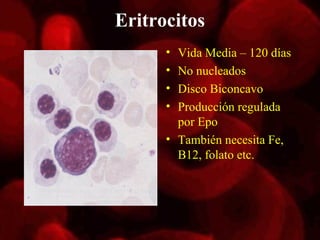
Eritrocitos
      • Vida Media – 120 días
      • No nucleados
      • Disco Biconcavo
      • Producción regulada
        por Epo
      • También necesita Fe,
        B12, folato etc.
Función Eritrocitica
• Transporte de gases respiratorios

    Gran área de Superficie : volume ratio
    Disco Biconcavo Flexible
    Moleculas de hemoglobina en su
  estructura
    Capacidad de glucolisis
Hemograma - 7


                          INDICES ERITROCITARIOS

          1.    Volumen corpuscular medio: (VCM)
                (Hto x 10)/(recuento de eritrocitos x 106)
                V.N. = 90 ±8 fL
          2.    Hemoglobina corpuscular media: (HCM)
                (Hb x 10)/(recuento de eritrocitos x 106)
                V.N. = 30 ±3 pg
          3. Concentración media de hemoglobina corpuscular: (CMHC)
                (Hb x 10)/Hto, o HCM/VCM
                V.N. = 33 ±2 %
          4.    Amplitud de distribución eritrocitaria:
                V.N. = 11,5 – 14,5%


                                                                Dr. Lezama
Hemograma - 8

                   SERIE ROJA

            HEMOGLOBINA
             - Adulto: a) mujeres: 12-16 g/100 mL.
                       b) hombres: 13-17 g/100 mL
             - Gestante: > 11 g/100 ml
             - Niños. De acuerdo a Edad

            HEMATOCRITO
             - Adulto: a) mujeres: 36-46%.
                      b) hombres: 39-52%
             - Gestante: >33 %
             - Niños: Según edad

            HEMATIES
             - Adulto: a) mujeres: 3,5 – 5,0 millones/mm3
                      b) hombres: 4.0 – 5,5 millones/mm3
             - R/N: 5,0 - 6,5 millones/mm3


                                                            Dr. Lezama
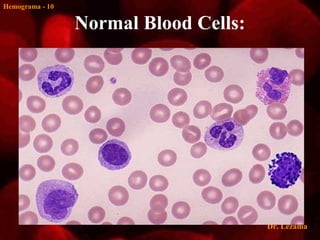
Leucocitos
• Linfocitos
• Monocitos/Macrofagos
• Granulocitos:
    Neutrófilos
    Eosinófilos
    Basófilos
Hemograma - 10

                 Normal Blood Cells:


                                       Dr. Lezama
Hemograma - 11

                          LEUCOCITOS
                    VALORES DE REFERENCIA NORMALES
                        - Adulto: 5.000 – 10.000/µL
                        - R/N: hasta 30.000/µL
                        - 1ª semana: hasta 10.000/µl

                    LEUCOCITOSIS : ↑ leucocitos > 10,000/mm3
                        - infecciones bacterianas
                        - apendicitis
                        - leucemias
                        - embarazo (forma fisiológica)

                    LEUCOPENIA: ↓ de los leucocitos < 5000 (4,000)/mm3
                        - farmacológicas
                        - infecciones víricas
                        - aplasia idiopática
                        - inmune y asociada a colagenosis
                        - congénitas
                        - radiación y tratamientos quimioterápicos


                                                                          Dr. Lezama
Hemograma - 12

                       LEUCOCITOS

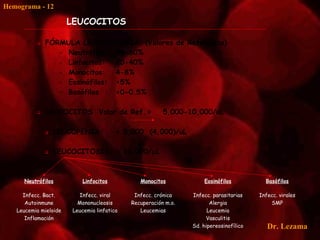
             FÓRMULA LEUCOCITARIA: (Valores de Referencia)
                  - Neutrófilos: 50-60%
                  - Linfocitos:  20-40%
                  - Monocitos: 4-8%
                  - Eosinófilos: <5%
                  - Basófilos : <0-0.5%

             LEUCOCITOS Valor de Ref. =                5,000-10,000/uL

                  LEUCOPENIA:          < 5,000 (4,000)/uL

                  LEUCOCITOSIS: > 10.000/µL


     Neutrófilos            Linfocitos          Monocitos            Eosinófilos           Basófilos

     Infecc. Bact.        Infecc. viral       Infecc. crónica    Infecc. parasitarias    Infecc. virales
      Autoinmune          Mononucleosis      Recuperación m.o.          Alergia              SMP
   Leucemia mieloide    Leucemia linfatica      Leucemias              Leucemia
      Inflamación                                                     Vasculitis
                                                                 Sd. hipereosinofílico      Dr. Lezama
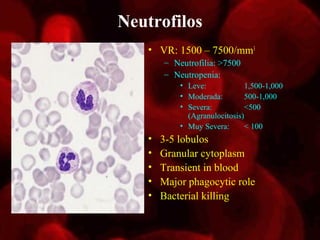
Neutrofilos
   • VR: 1500 – 7500/mm3
       – Neutrofilia: >7500
       – Neutropenia:
           • Leve:             1,500-1,000
           • Moderada:         500-1,000
           • Severa:           <500
             (Agranulocitosis)
           • Muy Severa:       < 100
   •   3-5 lobulos
   •   Granular cytoplasm
   •   Transient in blood
   •   Major phagocytic role
   •   Bacterial killing
NEUTROPENIA
• Neutropenia – reducción en número

Drogas/Quimioterapia/irradiación
Infección Viral
Inherited disorders

Incrementa el riesgo de infección bacteriana
NEUTROFILIA

     Infección Bacteriana
     Inflamación
     Trauma/Hemorragia
Linfocitos
     • Valor de Referencia:
       1500-4000/mm3 (adultos)
     • Conteo varía con la edad
     • Linfocitosis:
        – >4000      (Adultos)
        – >7,000     (Lactantes)
     • Linfopenia:
        – Leve: 1400-1000
        – Moderada: 500-1000
        – Severa: <500
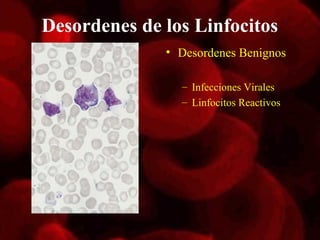
Desordenes de los Linfocitos
              • Desordenes Benignos

                – Infecciones Virales
                – Linfocitos Reactivos
Desordenes de los Linfocitos
              • Malignidades:

              Linfocitosis
              Células atípicas
              Células Inmaduras

              Ejemplo:
              Leucemia Linfocitica
                 Crónica (CLL)
              Lymphoma
Desordenes de los Linfocitos
• Linfopenia   < 1,500/mm3

Falla Medular ejem. Drogas/irradiación
Immunodeficiencia Congénita
AIDS (Acquirida)
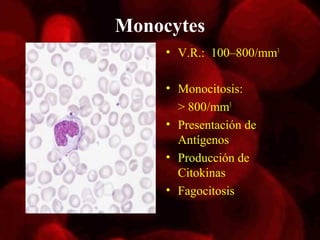
Monocytes
     • V.R.: 100–800/mm3

     • Monocitosis:
       > 800/mm3
     • Presentación de
       Antígenos
     • Producción de
       Citokinas
     • Fagocitosis
Disorders of Monocytes

• MONOCITOSIS:               > 800/mm 3
  – Benigna:
     Chronic bacterial infection eg TB
  – Maligna:
   Leucemia Mielomonocitica Crónica
 (CMML)

• Monocitopenia:         < 100/mm3
  – not really significant
EOSINOFILOS
     • 200 – 500/mm3

     • Nucleos Bilobulados
       gránulos rojo-naranja
     • Acción antiparasitaria
     • Modulación de la
       actividad de
       hipersensibilidad y
       alergias
Disorders of eosinophils
• Eosinophilia     > 500/mm3

Allergic conditions
Parasitic infection
Malignancy
Very rare specific eosinophil malignancy
Basofilos
     • 50 – 200/mm3
     • Núcleo bilobulado
     • Grandes gránulos
       negros
     • Respuesta inflamatoria
     • Hipersensibilidad/aler
       gia
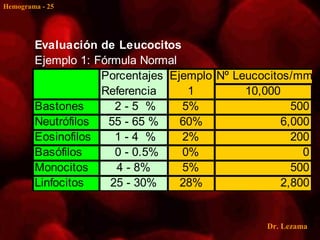
Hemograma - 25


        Evaluación de Leucocitos
        Ejemplo 1: Fórmula Normal
                    Porcentajes Ejemplo Nº Leucocitos/mm3
                    Referencia     1         10,000
        Bastones       2-5 %      5%                  500
        Neutrófilos  55 - 65 %    60%               6,000
        Eosinofilos    1-4 %      2%                  200
        Basófilos      0 - 0.5%   0%                    0
        Monocitos      4 - 8%     5%                  500
        Linfocitos    25 - 30%    28%               2,800


                                                Dr. Lezama
Hemograma - 26


     Evaluación de Leucocitos
     Ejemplo 1: Fórmula Normal
                 Porcentajes Ejemplo Nº Leucocitos/mm3
                 Referencia     1      10,000    2,400
     Bastones       2-5 %      5%          500     120
     Neutrófilos  55 - 65 %    60%       6,000   1,440
     Eosinofilos    1-4 %      2%          200      48
     Basófilos      0 - 0.5%   0%            0       0
     Monocitos      4 - 8%     5%          500     120
     Linfocitos    25 - 30%    28%       2,800     672


                                               Dr. Lezama
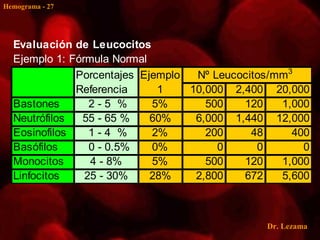
Hemograma - 27


  Evaluación de Leucocitos
  Ejemplo 1: Fórmula Normal
              Porcentajes Ejemplo  Nº Leucocitos/mm3
              Referencia     1    10,000 2,400 20,000
  Bastones       2-5 %      5%       500   120    1,000
  Neutrófilos  55 - 65 %    60%    6,000 1,440 12,000
  Eosinofilos    1-4 %      2%       200     48     400
  Basófilos      0 - 0.5%   0%         0      0       0
  Monocitos      4 - 8%     5%       500   120    1,000
  Linfocitos    25 - 30%    28%    2,800   672    5,600


                                               Dr. Lezama
Hemograma - 28

        Serie Megacariocitica: Plaquetas
      • VALOR REFERENCIA: 150,000-450,000/mm3

      • TROMBOCITOPENIA
           –   Leve:    : 150,000-100,000
           –   Moderada         : 100,000- 50,000
           –   Severa   : < 50,000      (Nivel Hemostático >50,000/mm3)
           –   Muy Severa: < 20,000

      • TROMBOCITOSIS
           – Leve     : > 600,000 – 800,000
           – Moderada : 800,000 – 1’000,000
           – Severa   : > 1’000,000


                                                                   Dr. Lezama
Hemograma - 29

                  SERIE PLAQUETARIA


              Rango de normalidad:
                    150.000-450.000 PLAQ/mm3

              Trombocitosis: Sds. Mieloproliferativos
                           Esplenectomía
                           Infección
                           Tumores
                           Ferropenia, hemorragias

              Trombocitopenia: PTI,PTT
                            Aplasia medular
                            Leucemias agudas


                                                         Dr. Lezama

Hemograma DR LEZAMA

  • 1.
    HEMOGRAMA DR. VÍCTOR LEZAMAN. HOSPITAL BELEN DE TRUJILLO LABORATORIO CLINICO
  • 2.
  • 3.
    Hemograma - 3 Eritropoiesis Early Intermediate Late Proerytroblasto Normoblasto Reticulocito (Pronormoblasto) Polycromatofilo Normoblasto Normoblasto Eritrocito Basofilo Ortocromático Dr. Lezama
  • 4.
    Hemograma - 4 Eritrocito Dr. Lezama
  • 5.
    Eritrocitos • Vida Media – 120 días • No nucleados • Disco Biconcavo • Producción regulada por Epo • También necesita Fe, B12, folato etc.
  • 6.
    Función Eritrocitica • Transportede gases respiratorios Gran área de Superficie : volume ratio Disco Biconcavo Flexible Moleculas de hemoglobina en su estructura Capacidad de glucolisis
  • 7.
    Hemograma - 7 INDICES ERITROCITARIOS 1. Volumen corpuscular medio: (VCM) (Hto x 10)/(recuento de eritrocitos x 106) V.N. = 90 ±8 fL 2. Hemoglobina corpuscular media: (HCM) (Hb x 10)/(recuento de eritrocitos x 106) V.N. = 30 ±3 pg 3. Concentración media de hemoglobina corpuscular: (CMHC) (Hb x 10)/Hto, o HCM/VCM V.N. = 33 ±2 % 4. Amplitud de distribución eritrocitaria: V.N. = 11,5 – 14,5% Dr. Lezama
  • 8.
    Hemograma - 8 SERIE ROJA  HEMOGLOBINA - Adulto: a) mujeres: 12-16 g/100 mL. b) hombres: 13-17 g/100 mL - Gestante: > 11 g/100 ml - Niños. De acuerdo a Edad  HEMATOCRITO - Adulto: a) mujeres: 36-46%. b) hombres: 39-52% - Gestante: >33 % - Niños: Según edad  HEMATIES - Adulto: a) mujeres: 3,5 – 5,0 millones/mm3 b) hombres: 4.0 – 5,5 millones/mm3 - R/N: 5,0 - 6,5 millones/mm3 Dr. Lezama
  • 9.
    Leucocitos • Linfocitos • Monocitos/Macrofagos •Granulocitos: Neutrófilos Eosinófilos Basófilos
  • 10.
    Hemograma - 10 Normal Blood Cells: Dr. Lezama
  • 11.
    Hemograma - 11 LEUCOCITOS  VALORES DE REFERENCIA NORMALES - Adulto: 5.000 – 10.000/µL - R/N: hasta 30.000/µL - 1ª semana: hasta 10.000/µl  LEUCOCITOSIS : ↑ leucocitos > 10,000/mm3 - infecciones bacterianas - apendicitis - leucemias - embarazo (forma fisiológica)  LEUCOPENIA: ↓ de los leucocitos < 5000 (4,000)/mm3 - farmacológicas - infecciones víricas - aplasia idiopática - inmune y asociada a colagenosis - congénitas - radiación y tratamientos quimioterápicos Dr. Lezama
  • 12.
    Hemograma - 12 LEUCOCITOS  FÓRMULA LEUCOCITARIA: (Valores de Referencia) - Neutrófilos: 50-60% - Linfocitos: 20-40% - Monocitos: 4-8% - Eosinófilos: <5% - Basófilos : <0-0.5%  LEUCOCITOS Valor de Ref. = 5,000-10,000/uL  LEUCOPENIA: < 5,000 (4,000)/uL  LEUCOCITOSIS: > 10.000/µL Neutrófilos Linfocitos Monocitos Eosinófilos Basófilos Infecc. Bact. Infecc. viral Infecc. crónica Infecc. parasitarias Infecc. virales Autoinmune Mononucleosis Recuperación m.o. Alergia SMP Leucemia mieloide Leucemia linfatica Leucemias Leucemia Inflamación Vasculitis Sd. hipereosinofílico Dr. Lezama
  • 13.
    Neutrofilos • VR: 1500 – 7500/mm3 – Neutrofilia: >7500 – Neutropenia: • Leve: 1,500-1,000 • Moderada: 500-1,000 • Severa: <500 (Agranulocitosis) • Muy Severa: < 100 • 3-5 lobulos • Granular cytoplasm • Transient in blood • Major phagocytic role • Bacterial killing
  • 14.
    NEUTROPENIA • Neutropenia –reducción en número Drogas/Quimioterapia/irradiación Infección Viral Inherited disorders Incrementa el riesgo de infección bacteriana
  • 15.
    NEUTROFILIA Infección Bacteriana Inflamación Trauma/Hemorragia
  • 16.
    Linfocitos • Valor de Referencia: 1500-4000/mm3 (adultos) • Conteo varía con la edad • Linfocitosis: – >4000 (Adultos) – >7,000 (Lactantes) • Linfopenia: – Leve: 1400-1000 – Moderada: 500-1000 – Severa: <500
  • 17.
    Desordenes de losLinfocitos • Desordenes Benignos – Infecciones Virales – Linfocitos Reactivos
  • 18.
    Desordenes de losLinfocitos • Malignidades: Linfocitosis Células atípicas Células Inmaduras Ejemplo: Leucemia Linfocitica Crónica (CLL) Lymphoma
  • 19.
    Desordenes de losLinfocitos • Linfopenia < 1,500/mm3 Falla Medular ejem. Drogas/irradiación Immunodeficiencia Congénita AIDS (Acquirida)
  • 20.
    Monocytes • V.R.: 100–800/mm3 • Monocitosis: > 800/mm3 • Presentación de Antígenos • Producción de Citokinas • Fagocitosis
  • 21.
    Disorders of Monocytes •MONOCITOSIS: > 800/mm 3 – Benigna: Chronic bacterial infection eg TB – Maligna: Leucemia Mielomonocitica Crónica (CMML) • Monocitopenia: < 100/mm3 – not really significant
  • 22.
    EOSINOFILOS • 200 – 500/mm3 • Nucleos Bilobulados gránulos rojo-naranja • Acción antiparasitaria • Modulación de la actividad de hipersensibilidad y alergias
  • 23.
    Disorders of eosinophils •Eosinophilia > 500/mm3 Allergic conditions Parasitic infection Malignancy Very rare specific eosinophil malignancy
  • 24.
    Basofilos • 50 – 200/mm3 • Núcleo bilobulado • Grandes gránulos negros • Respuesta inflamatoria • Hipersensibilidad/aler gia
  • 25.
    Hemograma - 25 Evaluación de Leucocitos Ejemplo 1: Fórmula Normal Porcentajes Ejemplo Nº Leucocitos/mm3 Referencia 1 10,000 Bastones 2-5 % 5% 500 Neutrófilos 55 - 65 % 60% 6,000 Eosinofilos 1-4 % 2% 200 Basófilos 0 - 0.5% 0% 0 Monocitos 4 - 8% 5% 500 Linfocitos 25 - 30% 28% 2,800 Dr. Lezama
  • 26.
    Hemograma - 26 Evaluación de Leucocitos Ejemplo 1: Fórmula Normal Porcentajes Ejemplo Nº Leucocitos/mm3 Referencia 1 10,000 2,400 Bastones 2-5 % 5% 500 120 Neutrófilos 55 - 65 % 60% 6,000 1,440 Eosinofilos 1-4 % 2% 200 48 Basófilos 0 - 0.5% 0% 0 0 Monocitos 4 - 8% 5% 500 120 Linfocitos 25 - 30% 28% 2,800 672 Dr. Lezama
  • 27.
    Hemograma - 27 Evaluación de Leucocitos Ejemplo 1: Fórmula Normal Porcentajes Ejemplo Nº Leucocitos/mm3 Referencia 1 10,000 2,400 20,000 Bastones 2-5 % 5% 500 120 1,000 Neutrófilos 55 - 65 % 60% 6,000 1,440 12,000 Eosinofilos 1-4 % 2% 200 48 400 Basófilos 0 - 0.5% 0% 0 0 0 Monocitos 4 - 8% 5% 500 120 1,000 Linfocitos 25 - 30% 28% 2,800 672 5,600 Dr. Lezama
  • 28.
    Hemograma - 28 Serie Megacariocitica: Plaquetas • VALOR REFERENCIA: 150,000-450,000/mm3 • TROMBOCITOPENIA – Leve: : 150,000-100,000 – Moderada : 100,000- 50,000 – Severa : < 50,000 (Nivel Hemostático >50,000/mm3) – Muy Severa: < 20,000 • TROMBOCITOSIS – Leve : > 600,000 – 800,000 – Moderada : 800,000 – 1’000,000 – Severa : > 1’000,000 Dr. Lezama
  • 29.
    Hemograma - 29 SERIE PLAQUETARIA  Rango de normalidad: 150.000-450.000 PLAQ/mm3  Trombocitosis: Sds. Mieloproliferativos Esplenectomía Infección Tumores Ferropenia, hemorragias  Trombocitopenia: PTI,PTT Aplasia medular Leucemias agudas Dr. Lezama

Notas del editor

  • #6 Normal lifespan in circulation is 120 days approximately, the cell is then sequestered in the spleen and ‘recycled’ Cell is derived from early erythroblast in BM, in which haemoglobin is gradually synthesised. The nucleus is extruded from the cell in the BM, then the slightly immature cell termed a reticulocyte is released into the circulation where maturation is completed in a couple of days. Production is mainly controlled by erythropoietin, which is induced by the kidney in response to tissue hypoxia. Many other components must also be available such as iron, cobalt, vitamins B12, C, E, B6, thiamine and riboflavin The mature red cell or erythrocyte is enclosed in a membrane which comprises a cytoskeleton, overlaid by a lipid bilayer. The cytoskeleton consists of specialised proteins forming a lattice which supports and maintains the red cell shape and the lipid bilayer acts as a hydrophobic barrier. The major component of the red cells is haemoglobin, which comprises four globin chains , linked to a haem molecule. The normal shape of the red cell is a biconcave disc of approximately 7-8 microns in diameter and about 1.7 microns in thickness
  • #7 The role of theHb contained in the red cell is to reversibly bind to oxygen and release it to the tissues and then to carry carbon dioxide away from the tissues. The cell is well designed to promote gaseous exchange with high surface area, allowing maximum gaseous uptake The flexibility of cell enables it to reach smallest capillaries. Structure of haemoglobin is dynamic, promoting release of oxygen. ATP and NADH are generated by the glycolytic pathway, providing energy to maintain the cellular integrity and activity
  • #10 Leucocytes comprise three major types. The lymphocyte makes up about 20% of the total wbcs, in the normal adult. A higher proportion is seen in children. Monocytes comprise about 5-10% of the total Granulocytes form the largest group, with about 60-70% of the total. Of these the majority are neutrophils, with small populations of eosinophils and basophils.
  • #14 Neutrophils form the major cell type in the peripheral blood, although they only spend about 12-24 hours before migrating to the tissues. They are highly motile cells, which rapidly migrate to the site of infection, in response to factors released by bacteria and activated cells already present at the site. They readily phagocytose and destroy bacteris etc, utilising enzymes and hydrogen peroxide
  • #15 Markedly neutropenic (&lt;0.5 x10 9 /l) are at severe risk of bacterial infection and this is a major cause of concern in patients receiving chemotherapy.
  • #16 Neutrophilia or neutrophil leucocytosis is a common finding, as it represents a rapid response to many conditions. Neutrophils in the peripheral blood consist of two ‘pools’. Some are freely circulating, representing the count measured by the analyser, but a further large marginal pool is also present in the circulation, adherent to the vessel walls. This population can be rapidly mobilised causing a very dramatic increase in the total count. In the longer term, a large reserve pool is also present in the bone marrow, which can be mobilised if required. This slide shows less mature neutrophils showing fewer lobes than usual this is called left shift. The granules are also very marked in response to infection, this is called toxic granulation.
  • #17 Lymphocytes can be split into different functional groups by their antigenic makeup The major types are B and T cells and these cannot be differentiated from the blood film alone. The majority of lymphocytes are small cells with little cytoplasm and well condensed nucleus. A small proportion are larger with more abundant cytoplasm and may show a few azure granules. A small but significant group are the Natural Killer cells, which have a cytotoxic action, these may be the large lymphs seen in the blood film
  • #18 An increase in the age related reference range is termed lymphocytosis. The most common cause is viral infection especially Infectious Mononucleosis (Glandular Fever), which is associated with these large basophilic cells, showing abundant cytoplasm. These cells represent normal T cells which have been activated by the viral infection.
  • #19 A malignant proliferation of lymphocytes is seen in lymphatic leukaemia and occasionally in lymphoma. The cells are mature and appear relatively normal. They are more fragile however, so smear cells may be seen in the blood film. CLL is a fairly benign condition, usually seen in older patients and is often a chance finding, Proliferation of early primitive lymphoid cells is also be seen, this is described as acute leukaemia and carries a less good prognosis.
  • #20 A reduction of lymphocytes can be associated with severe problems of immunity and in certain cases can be life threatening. Eg HIV infection is primarily associated with a reduction in T lymphocytes, leading to severely compromised immune status Severe Combined Immunodeficiency Disease (SCID) is associated with almost complete absence of lymphocyte function and has a very poor outcome.
  • #21 Monocytes only pass transiently through the peripheral blood and most of their lifespan occurs as macrophages in the tissues. They are large cells with a bean or horseshoe shaped nucleus and a greyish cytoplasm. They have a major role in the immune response, where they process and present antigens to the T lymphocytes. They are also major producers of cytokines. They are motile cells which are able to phagocytose foreign material.
  • #22 Mild monocytosis is frequently seen, usually in conjunction with a raised neutrophil count in bacterial infection. In CMML, the monocyte count may be quite high and atypical cells may be seen. Acute leukaemia of monocytoid origin is also recognised, in which very early cells may be seen.
  • #24 Examples of allergic conditions whre eosinophils are commonly raised are asthma, eczema and hay fever. Parasitic infections associated with eosinophilia include intestinal and blood borne worms
  • #29 An immune thrombocytopenia can occur following viral infection or as an apparently spontaneous event. In some cases it is transient and resolves quickly, in others it may become a chronic condition. Patients receiving high dose chemotherapy, may have severely decreased platelets and often require platelet transfusion until their counts have improved.