TEORÍA DE EXPONENTES
potenciación
POTENCIACIÓN
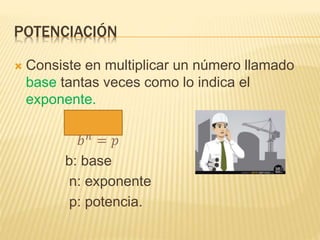
 Consiste en multiplicar un número llamado
base tantas veces como lo indica el
exponente.
𝑏 𝑛
= 𝑝
b: base
n: exponente
p: potencia.
EXPONENTE NATURAL
𝑏 𝑛
= 𝑏. 𝑏. 𝑏 … 𝑏. 𝑏
n veces
b ∊ R ; n ∊ N ; n > 0
EXPONENTE CERO
𝑎0
= 1; 𝑎 ≠ 0
1. 40
= 1
2. (45𝑥12)0
=
3. (−
4
6
)0
=
4. 00
=
EXPONENTE NEGATIVO
𝑎−𝑥
= (
1
𝑎
) 𝑥
=
1
𝑎 𝑥 ; a≠0
1. 5−1
= (
1
4
)1
=
1
4
2. (
3
2
)−3
= (
2
3
)3
=
8
27
PROBLEMAS
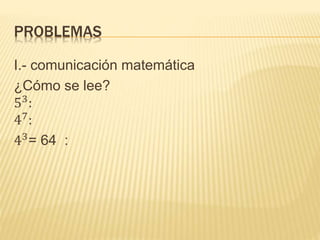
I.- comunicación matemática
¿Cómo se lee?
53
:
47
:
43
= 64 :
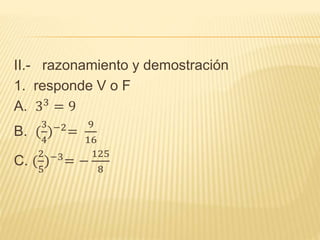
II.- razonamiento y demostración
1. responde V o F
A. 33
= 9
B. (
3
4
)−2
=
9
16
C. (
2
5
)−3
= −
125
8
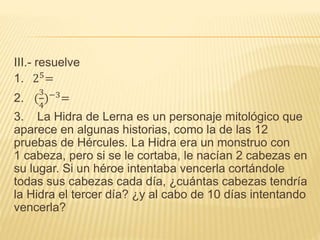
III.- resuelve
1. 25=
2. (
3
4
)−3
=
3. La Hidra de Lerna es un personaje mitológico que
aparece en algunas historias, como la de las 12
pruebas de Hércules. La Hidra era un monstruo con
1 cabeza, pero si se le cortaba, le nacían 2 cabezas en
su lugar. Si un héroe intentaba vencerla cortándole
todas sus cabezas cada día, ¿cuántas cabezas tendría
la Hidra el tercer día? ¿y al cabo de 10 días intentando
vencerla?
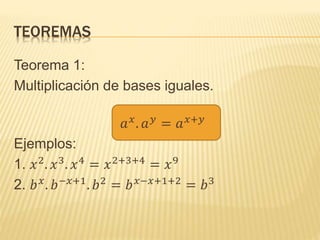
TEOREMAS
Teorema 1:
Multiplicación de bases iguales.
𝑎 𝑥
. 𝑎 𝑦
= 𝑎 𝑥+𝑦
Ejemplos:
1. 𝑥2
. 𝑥3
. 𝑥4
= 𝑥2+3+4
= 𝑥9
2. 𝑏 𝑥
. 𝑏−𝑥+1
. 𝑏2
= 𝑏 𝑥−𝑥+1+2
= 𝑏3
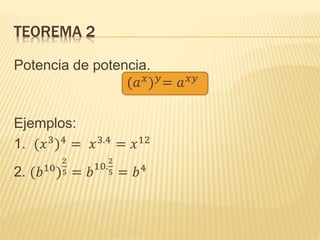
TEOREMA 2
Potencia de potencia.
(𝑎 𝑥
) 𝑦
= 𝑎 𝑥𝑦
Ejemplos:
1. (𝑥3
)4
= 𝑥3.4
= 𝑥12
2. (𝑏10
)
2
5 = 𝑏10.
2
5 = 𝑏4
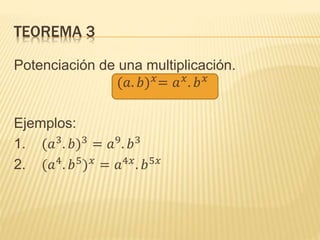
TEOREMA 3
Potenciación de una multiplicación.
(𝑎. 𝑏) 𝑥
= 𝑎 𝑥
. 𝑏 𝑥
Ejemplos:
1. (𝑎3
. 𝑏)3
= 𝑎9
. 𝑏3
2. (𝑎4
. 𝑏5
) 𝑥
= 𝑎4𝑥
. 𝑏5𝑥
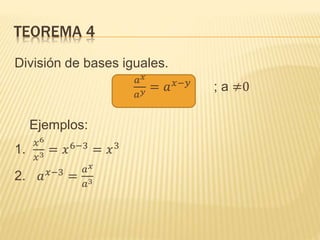
TEOREMA 4
División de bases iguales.
𝑎 𝑥
𝑎 𝑦 = 𝑎 𝑥−𝑦
; a ≠0
Ejemplos:
1.
𝑥6
𝑥3 = 𝑥6−3
= 𝑥3
2. 𝑎 𝑥−3
=
𝑎 𝑥
𝑎3
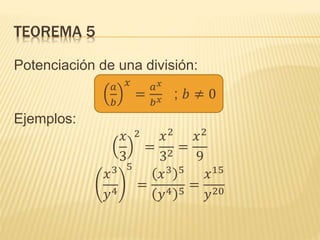
TEOREMA 5
Potenciación de una división:
𝑎
𝑏
𝑥
=
𝑎 𝑥
𝑏 𝑥 ; 𝑏 ≠ 0
Ejemplos:
𝑥
3
2
=
𝑥2
32
=
𝑥2
9
𝑥3
𝑦4
5
=
𝑥3 5
𝑦4 5
=
𝑥15
𝑦20
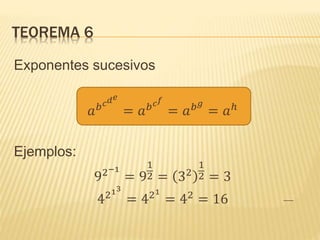
TEOREMA 6
Exponentes sucesivos
𝑎 𝑏 𝑐 𝑑 𝑒
= 𝑎 𝑏 𝑐 𝑓
= 𝑎 𝑏 𝑔
= 𝑎ℎ
Ejemplos:
92−1
= 9
1
2 = 32
1
2 = 3
4213
= 421
= 42
= 16
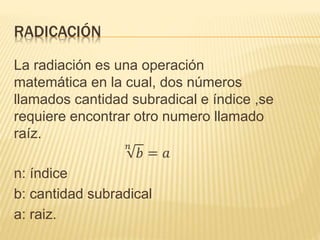
RADICACIÓN
La radiación es una operación
matemática en la cual, dos números
llamados cantidad subradical e índice ,se
requiere encontrar otro numero llamado
raíz.
𝑛
𝑏 = 𝑎
n: índice
b: cantidad subradical
a: raiz.
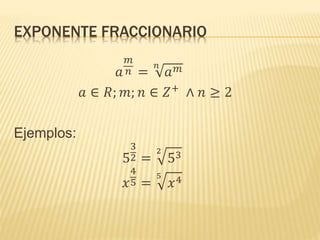
EXPONENTE FRACCIONARIO
𝑎
𝑚
𝑛 =
𝑛
𝑎 𝑚
𝑎 ∈ 𝑅; 𝑚; 𝑛 ∈ 𝑍+
∧ 𝑛 ≥ 2
Ejemplos:
5
3
2 =
2
53
𝑥
4
5 =
5
𝑥4
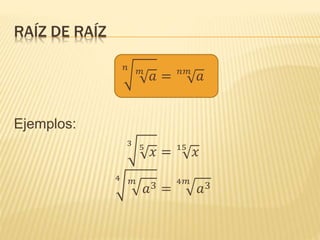
RAÍZ DE RAÍZ
𝑛 𝑚
𝑎 = 𝑛𝑚
𝑎
Ejemplos:
3 5
𝑥 = 15
𝑥
4 𝑚
𝑎3 =
4𝑚
𝑎3
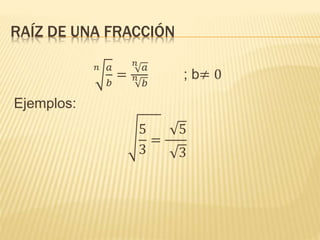
RAÍZ DE UNA FRACCIÓN
𝑛 𝑎
𝑏
=
𝑛
𝑎
𝑛
𝑏
; b≠ 0
Ejemplos:
5
3
=
5
3
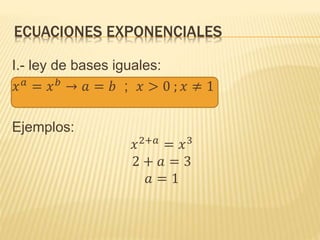
ECUACIONES EXPONENCIALES
I.- ley de bases iguales:
𝑥 𝑎
= 𝑥 𝑏
→ 𝑎 = 𝑏 ; 𝑥 > 0 ; 𝑥 ≠ 1
Ejemplos:
𝑥2+𝑎
= 𝑥3
2 + 𝑎 = 3
𝑎 = 1
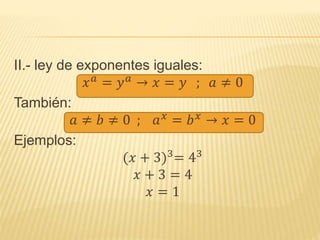
II.- ley de exponentes iguales:
𝑥 𝑎
= 𝑦 𝑎
→ 𝑥 = 𝑦 ; 𝑎 ≠ 0
También:
𝑎 ≠ 𝑏 ≠ 0 ; 𝑎 𝑥
= 𝑏 𝑥
→ 𝑥 = 0
Ejemplos:
(𝑥 + 3)3
= 43
𝑥 + 3 = 4
𝑥 = 1
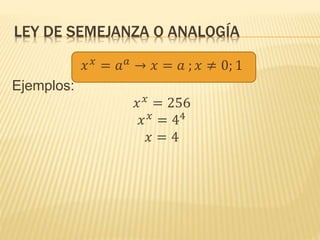
LEY DE SEMEJANZA O ANALOGÍA
𝑥 𝑥
= 𝑎 𝑎
→ 𝑥 = 𝑎 ; 𝑥 ≠ 0; 1
Ejemplos:
𝑥 𝑥
= 256
𝑥 𝑥
= 44
𝑥 = 4

Teoría de exponentes 2°

  • 1.
  • 2.
    POTENCIACIÓN  Consiste enmultiplicar un número llamado base tantas veces como lo indica el exponente. 𝑏 𝑛 = 𝑝 b: base n: exponente p: potencia.
  • 3.
    EXPONENTE NATURAL 𝑏 𝑛 =𝑏. 𝑏. 𝑏 … 𝑏. 𝑏 n veces b ∊ R ; n ∊ N ; n > 0
  • 4.
    EXPONENTE CERO 𝑎0 = 1;𝑎 ≠ 0 1. 40 = 1 2. (45𝑥12)0 = 3. (− 4 6 )0 = 4. 00 =
  • 5.
    EXPONENTE NEGATIVO 𝑎−𝑥 = ( 1 𝑎 )𝑥 = 1 𝑎 𝑥 ; a≠0 1. 5−1 = ( 1 4 )1 = 1 4 2. ( 3 2 )−3 = ( 2 3 )3 = 8 27
  • 6.
  • 7.
    II.- razonamiento ydemostración 1. responde V o F A. 33 = 9 B. ( 3 4 )−2 = 9 16 C. ( 2 5 )−3 = − 125 8
  • 8.
    III.- resuelve 1. 25= 2.( 3 4 )−3 = 3. La Hidra de Lerna es un personaje mitológico que aparece en algunas historias, como la de las 12 pruebas de Hércules. La Hidra era un monstruo con 1 cabeza, pero si se le cortaba, le nacían 2 cabezas en su lugar. Si un héroe intentaba vencerla cortándole todas sus cabezas cada día, ¿cuántas cabezas tendría la Hidra el tercer día? ¿y al cabo de 10 días intentando vencerla?
  • 9.
    TEOREMAS Teorema 1: Multiplicación debases iguales. 𝑎 𝑥 . 𝑎 𝑦 = 𝑎 𝑥+𝑦 Ejemplos: 1. 𝑥2 . 𝑥3 . 𝑥4 = 𝑥2+3+4 = 𝑥9 2. 𝑏 𝑥 . 𝑏−𝑥+1 . 𝑏2 = 𝑏 𝑥−𝑥+1+2 = 𝑏3
  • 10.
    TEOREMA 2 Potencia depotencia. (𝑎 𝑥 ) 𝑦 = 𝑎 𝑥𝑦 Ejemplos: 1. (𝑥3 )4 = 𝑥3.4 = 𝑥12 2. (𝑏10 ) 2 5 = 𝑏10. 2 5 = 𝑏4
  • 11.
    TEOREMA 3 Potenciación deuna multiplicación. (𝑎. 𝑏) 𝑥 = 𝑎 𝑥 . 𝑏 𝑥 Ejemplos: 1. (𝑎3 . 𝑏)3 = 𝑎9 . 𝑏3 2. (𝑎4 . 𝑏5 ) 𝑥 = 𝑎4𝑥 . 𝑏5𝑥
  • 12.
    TEOREMA 4 División debases iguales. 𝑎 𝑥 𝑎 𝑦 = 𝑎 𝑥−𝑦 ; a ≠0 Ejemplos: 1. 𝑥6 𝑥3 = 𝑥6−3 = 𝑥3 2. 𝑎 𝑥−3 = 𝑎 𝑥 𝑎3
  • 13.
    TEOREMA 5 Potenciación deuna división: 𝑎 𝑏 𝑥 = 𝑎 𝑥 𝑏 𝑥 ; 𝑏 ≠ 0 Ejemplos: 𝑥 3 2 = 𝑥2 32 = 𝑥2 9 𝑥3 𝑦4 5 = 𝑥3 5 𝑦4 5 = 𝑥15 𝑦20
  • 14.
    TEOREMA 6 Exponentes sucesivos 𝑎𝑏 𝑐 𝑑 𝑒 = 𝑎 𝑏 𝑐 𝑓 = 𝑎 𝑏 𝑔 = 𝑎ℎ Ejemplos: 92−1 = 9 1 2 = 32 1 2 = 3 4213 = 421 = 42 = 16
  • 15.
    RADICACIÓN La radiación esuna operación matemática en la cual, dos números llamados cantidad subradical e índice ,se requiere encontrar otro numero llamado raíz. 𝑛 𝑏 = 𝑎 n: índice b: cantidad subradical a: raiz.
  • 16.
    EXPONENTE FRACCIONARIO 𝑎 𝑚 𝑛 = 𝑛 𝑎𝑚 𝑎 ∈ 𝑅; 𝑚; 𝑛 ∈ 𝑍+ ∧ 𝑛 ≥ 2 Ejemplos: 5 3 2 = 2 53 𝑥 4 5 = 5 𝑥4
  • 17.
    RAÍZ DE RAÍZ 𝑛𝑚 𝑎 = 𝑛𝑚 𝑎 Ejemplos: 3 5 𝑥 = 15 𝑥 4 𝑚 𝑎3 = 4𝑚 𝑎3
  • 18.
    RAÍZ DE UNAFRACCIÓN 𝑛 𝑎 𝑏 = 𝑛 𝑎 𝑛 𝑏 ; b≠ 0 Ejemplos: 5 3 = 5 3
  • 19.
    ECUACIONES EXPONENCIALES I.- leyde bases iguales: 𝑥 𝑎 = 𝑥 𝑏 → 𝑎 = 𝑏 ; 𝑥 > 0 ; 𝑥 ≠ 1 Ejemplos: 𝑥2+𝑎 = 𝑥3 2 + 𝑎 = 3 𝑎 = 1
  • 20.
    II.- ley deexponentes iguales: 𝑥 𝑎 = 𝑦 𝑎 → 𝑥 = 𝑦 ; 𝑎 ≠ 0 También: 𝑎 ≠ 𝑏 ≠ 0 ; 𝑎 𝑥 = 𝑏 𝑥 → 𝑥 = 0 Ejemplos: (𝑥 + 3)3 = 43 𝑥 + 3 = 4 𝑥 = 1
  • 21.
    LEY DE SEMEJANZAO ANALOGÍA 𝑥 𝑥 = 𝑎 𝑎 → 𝑥 = 𝑎 ; 𝑥 ≠ 0; 1 Ejemplos: 𝑥 𝑥 = 256 𝑥 𝑥 = 44 𝑥 = 4