SEMANA 5

3.

COCIENTES NOTABLES
FACTORIZACIÓN
1.

x15n  50  y15n  10
xn  1  yn  2

Hallar el menor término racional
del cociente notable.
3

A) 11
D) 40

47  23 2
3

4 2

A) 9
D) 5

B) -1
E) 8

7



Por

el

luego:

término

general

Tk 

k 1

Tk  2

....................()

25  k
debe ser mínimo  k  7
;
6
luego en    :
257
6



4.

 T7  23  8

16



  x  2

16



numérico del quinto término para
x=1
A) 729
B) 126
C) 81
D) 243
E) 729

RESOLUCIÓN
Dando la forma de un C.N:
8

 x  22    x  22 




2
2
 x  2   x  2
3

  y 
 x  y 

8

10

9

7

9

 T10  x70y36

10

 T11  x63y40

4

4

G.A. T10  106

Si… x195y140  x190y147  ...
son términos
consecutivos del
desarrollo de un C.N. Halle el
número de términos.
B) 59
E) 65

C) 58

RESOLUCIÓN

; halle el valor

2 x 4
2

4

A) 61
D) 60

En el cociente notable

 x  2

20

RPTA.: B

RPTA.: E
2.

4

7

T11

Por lo que piden:

T7  2

20

T10  x7

efectuando por exponentes
25  k
6

x   y 
x   y 

Hallamos los términos centrales.

 4   2
7 k

3

y

15n  50 15n  10

n6
n1
n2
7

4 2

C) 63

Por la condición necesaria
suficiente se debe de cumplir:

C) 3

7

4  2
3

B) 106
E) 72

RESOLUCIÓN

RESOLUCIÓN
3

Halle el grado absoluto del primer
término central del C.N.

Formando un C.N. de:

  y 

... x5



39

7

20

  y 

 x5

38

7

21

Número de términos = G.A +1

NT  59  1  60
RPTA.: D

5.

En

el

siguiente

notable

cociente

x y
. Calcule el lugar
x2  y3
20

30

que ocupa el término que contiene
a x10.

4

2
2
 T5   x  2   x  2   (x  2)6 (x  2)8

 


T5  36.(1)8  729
x=1 
RPTA.: E

A) sexto
C) octavo
E) décimo

B) quinto
D) cuarto
 

Tk  x

2



6.

20  2k

x

10  k

y 

x

10

k 1

3

x

?

x y
10

3

k 5

El lugar es quinto

Factorizar:


P x  x  x
 x  x  1 x

E) x  1

6

RESOLUCIÓN

3

Aplicando la identidad de Argan a









Luego:
 fac. primos= x4  x2  3

9.

P(x)  x8  x7  x5  x4  x3  1
en
 x  , indique el número de


 

P(x)   x  x  1 x  x  1
 x  x  1  x  x  x  1
P(x)   x  x  1 x  x  1
x  x  1  x 
P(x)   x  x  1 x  x  1
 x  x  x  1
P(x)   x  x  1 x  x  1
 x  x  1  x  1 x  x  1
2

3

2

4

2

3

2

2

3

2

2

2



ax

b

bx

a



F(x)   ax  b  bx  a

RPTA.: A

2

2



3

2

2



F  x   abx2  a2  b2 x  ab , e



P(x)  x  x  1  x  x  x
5

Factorizar:

F(x)  abx2  a2  b2 x  ab

RESOLUCIÓN

7



 x2  1

RESOLUCIÓN

C) 4

4

3



indicar la suma de los T.I. de los
factores primos.
A) a+b
B) a-b
C) a
D) b
E) ab

Luego de factorizar

8

2



1

RPTA.: C

RPTA.: A

factores primos.
A) 5
B) 3
D) 6
E) 2

2

2

 de coef = 1

P(x)  x2  x  1 x2  x  1 x4  x2  1

2



P  x   x6  x4  2x2  1

4

2

P  x   x6  x4  2x2  1 indicar la

RESOLUCIÓN

D) x  2

2

RPTA.: C

suma de coeficientes de un factor
primo.
A) 1
B) 0
C) 1
D) 2
E) -2

4

4



x 1

8.

RPTA.: B

C) x2  3

4



Hay 4 factores primos

Luego de factorizar:
P(x)  x8  x4  1; halle la suma
de los factores primos.
A) x4  x2  3

4





B) x2  3

7.



P(x)  x2  x  1 x2  x  1  x  1

RESOLUCIÓN

10.

Al factorizar:
P(x)  10x2  17xy  3y2  5x  y
Indicar la suma de sus términos
de sus factores primos.
A) 7x-4y+1
B) 7x-1
C) 4x-7y-1
D) 4y-1
E) 5x+2y-1

RESOLUCIÓN


P(x)   x  1  x  1  x  2 x2  3x  2

P(x)  10x2  17xy  3y2  5x  y  0
5x

-y

2x

-3y

1

x
x

0



Factorizar:
3

2

P(x)  12x  8x  3x  2 , e

-3 -2
7

2

14

4

112 2

3
3

Al factorizar:
Calcule el número de factores
algebraicos.
A) 4
B) 3
C) 6
D) 7
E) 8

Aplicando Ruffini

6

2

P(x;y)  x4  4y4

RESOLUCIÓN
8

 x  1  x  2

2

0

RESOLUCIÓN

P(x;y)  x4  4y4  4x2 y2  2xy 

2



P(x;y)  x2  2y2



6
7 2
P(x)  2x  1 6x2  7x  2





3x

12.



P(x;y)  x2  2xy  2y2

2

2x



1

-1

2

2

 2xy  2y2

-8

-4

P(x)  x4  2x2  9 ,
e indicar el número de factores.
A) 2
B) 3
C) 4
D) 5
E) 6

6 13 12
13 12 4
-5 -8 -4

1

5

8

4

1

-2
3

-6
2

-4
0

RESOLUCIÓN
P(x)  x4  2x2  9  4x2  4x2
P(x)  x4  6x2  9  (2x)2


P(x)   x

P(x)  x2  3
2





2

 2x 

2



 2x  3 x2  2x  3

-1
-2

0



Nf  2  2  4

4

1

1
6
-1

1



Factorice

Indique el promedio aritmético de
los T.I. de los factores primos.
4
6
1
A)
B)
C)
3
5
4
3
2
D)
E)
2
3

7

 x

 2xy 

14.

P(x)  x5  5x4  7x3  x2  8x  4

5

2

Nf .A  2  2  1  4  1  3
RPTA.: B

Factorice:

1





P(x)  2x  1 3x  2 2x  1
RPTA.: A

RESOLUCIÓN

2
1

RPTA.: E
13.

indicar un factor primo lineal.
A) 3x +2
B) -3x1
C) -2x+1
D) x+2
E) 4x+3

12
1
2
 12

P(x)   x  1
Luego: M.A 

P(x)  5x  y  2x  3y  1
RPTA.: A

11.





RPTA.: C

0
15.

Factorizar P(x)  x3  x2  x  1
en

(x) , luego indique la cantidad

de factores algebraicos.
A) 2
D) 6

B) 5
E) 7

C) 3
A) 4x2  6x  3
C) 4x2  7
E) 2x² + 3x + 1

RESOLUCIÓN

P(x)  x2  x  1   x  1





P(x)  2x  1  4x2  4x  1  1
7

P(x)   x  1 x  1  x  1

P(x)  2x  1  2x  1  1
7

P(x)   x  1 (x  1)
2

Nf.A  3 2  1  6  1  5
RPTA.: B



Cuántos
presenta:

C) 3

P(x)  y5  y4  1



RPTA.: A

factores

A) 1
D) 3

lineales


 1 x

15

B) 0
E) 6

C) 2

RESOLUCIÓN





P(x;y)  x2  y2  2xy

P(x)  y  y  1 y  y  1
3

 x5



P(x;y)   x  y   x4  y4

Cambio de variable: x5  y

10



19.

RESOLUCIÓN


P(x)   x



y7  y2  1  y2  y  1 y5  y4  y²  y  1

4

B) 4
E) 2

2

Cambio de variable: y=2x+1
un factor es : 4x² + 6x + 3

P(x)  x25  x20  1



2



Calcule la suma de coeficientes,
de un factor primo del polinomio
factorizado.
A) 7
D) 5

D) 4x2  7x  1

RESOLUCIÓN

P(x)   x  1  x2  1

16.

B) 4x2  5x  1





2

 x4  y4

P(x;y)  2 x4  2x3y  3x2y2  2xy3  y4



 x5  1



x²

xy

y2

x²

 coef  3  1

xy

y2

RPTA.: C
17.

Factorice:



2

P(x)  x  x



2



2

 1x

  1  x 
2

2

Indique el número de factores
cuadráticos.
A) 2
B) 3
C) 1
D) 4
E) 5



2

P(x;y)  2 x2  xy  y2



No tiene factores lineales.

20.

Calcule el número de factores
algebraicos en (x) , el polinomio.

RPTA.: B

P(X;Z)  32 x5y2z3

RESOLUCIÓN
P(x)  x2  x4  2x3  1  x2  1  x4  2x2
P(x)  2x3  2x2  2x2 (1  x)
x2  x(1  x)



Son 2 factores cuadráticos

18.

Señale un factor primo de:

RPTA.: A

P(x)  2x  1  4x(x  1)  2
7





A) 23
D) 72

B) 8
E) 71

C) 10

RESOLUCIÓN
NF.A  6  4  1  24  1  23
Ojo: y2 no
parámetro

es

variable,

es

RPTA.: A

Semana 5 cs

  • 1.
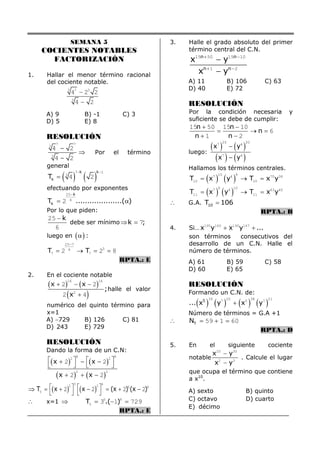
    SEMANA 5 3. COCIENTES NOTABLES FACTORIZACIÓN 1. x15n 50  y15n  10 xn  1  yn  2 Hallar el menor término racional del cociente notable. 3 A) 11 D) 40 47  23 2 3 4 2 A) 9 D) 5 B) -1 E) 8 7  Por el luego: término general Tk  k 1 Tk  2 ....................() 25  k debe ser mínimo  k  7 ; 6 luego en    : 257 6  4.  T7  23  8 16    x  2 16  numérico del quinto término para x=1 A) 729 B) 126 C) 81 D) 243 E) 729 RESOLUCIÓN Dando la forma de un C.N: 8  x  22    x  22      2 2  x  2   x  2 3   y   x  y  8 10 9 7 9  T10  x70y36 10  T11  x63y40 4 4 G.A. T10  106 Si… x195y140  x190y147  ... son términos consecutivos del desarrollo de un C.N. Halle el número de términos. B) 59 E) 65 C) 58 RESOLUCIÓN ; halle el valor 2 x 4 2 4 A) 61 D) 60 En el cociente notable  x  2 20 RPTA.: B RPTA.: E 2. 4 7 T11 Por lo que piden: T7  2 20 T10  x7 efectuando por exponentes 25  k 6 x   y  x   y  Hallamos los términos centrales.  4   2 7 k 3 y 15n  50 15n  10  n6 n1 n2 7 4 2 C) 63 Por la condición necesaria suficiente se debe de cumplir: C) 3 7 4  2 3 B) 106 E) 72 RESOLUCIÓN RESOLUCIÓN 3 Halle el grado absoluto del primer término central del C.N. Formando un C.N. de:   y  ... x5  39 7 20   y   x5 38 7 21 Número de términos = G.A +1 NT  59  1  60 RPTA.: D 5. En el siguiente notable cociente x y . Calcule el lugar x2  y3 20 30 que ocupa el término que contiene a x10. 4 2 2  T5   x  2   x  2   (x  2)6 (x  2)8      T5  36.(1)8  729 x=1  RPTA.: E A) sexto C) octavo E) décimo B) quinto D) cuarto
  • 2.
      Tk x 2   6. 20  2k x 10  k y  x 10 k 1 3 x ? x y 10 3 k 5 El lugar es quinto Factorizar:  P x  x  x  x  x  1 x E) x  1 6 RESOLUCIÓN 3 Aplicando la identidad de Argan a     Luego:  fac. primos= x4  x2  3 9. P(x)  x8  x7  x5  x4  x3  1 en  x  , indique el número de     P(x)   x  x  1 x  x  1  x  x  1  x  x  x  1 P(x)   x  x  1 x  x  1 x  x  1  x  P(x)   x  x  1 x  x  1  x  x  x  1 P(x)   x  x  1 x  x  1  x  x  1  x  1 x  x  1 2 3 2 4 2 3 2 2 3 2 2 2  ax b bx a  F(x)   ax  b  bx  a RPTA.: A 2 2  3 2 2  F  x   abx2  a2  b2 x  ab , e  P(x)  x  x  1  x  x  x 5 Factorizar: F(x)  abx2  a2  b2 x  ab RESOLUCIÓN 7   x2  1 RESOLUCIÓN C) 4 4 3  indicar la suma de los T.I. de los factores primos. A) a+b B) a-b C) a D) b E) ab Luego de factorizar 8 2  1 RPTA.: C RPTA.: A factores primos. A) 5 B) 3 D) 6 E) 2 2 2  de coef = 1 P(x)  x2  x  1 x2  x  1 x4  x2  1 2  P  x   x6  x4  2x2  1 4 2 P  x   x6  x4  2x2  1 indicar la RESOLUCIÓN D) x  2 2 RPTA.: C suma de coeficientes de un factor primo. A) 1 B) 0 C) 1 D) 2 E) -2 4 4  x 1 8. RPTA.: B C) x2  3 4  Hay 4 factores primos Luego de factorizar: P(x)  x8  x4  1; halle la suma de los factores primos. A) x4  x2  3 4   B) x2  3 7.  P(x)  x2  x  1 x2  x  1  x  1 RESOLUCIÓN 10. Al factorizar: P(x)  10x2  17xy  3y2  5x  y Indicar la suma de sus términos de sus factores primos. A) 7x-4y+1 B) 7x-1 C) 4x-7y-1 D) 4y-1 E) 5x+2y-1 RESOLUCIÓN
  • 3.
     P(x)  x  1  x  1  x  2 x2  3x  2 P(x)  10x2  17xy  3y2  5x  y  0 5x -y 2x -3y 1 x x 0  Factorizar: 3 2 P(x)  12x  8x  3x  2 , e -3 -2 7 2 14 4 112 2  3 3 Al factorizar: Calcule el número de factores algebraicos. A) 4 B) 3 C) 6 D) 7 E) 8 Aplicando Ruffini 6 2 P(x;y)  x4  4y4 RESOLUCIÓN 8  x  1  x  2 2 0 RESOLUCIÓN P(x;y)  x4  4y4  4x2 y2  2xy  2  P(x;y)  x2  2y2  6 7 2 P(x)  2x  1 6x2  7x  2   3x 12.  P(x;y)  x2  2xy  2y2 2 2x  1 -1 2 2  2xy  2y2 -8 -4 P(x)  x4  2x2  9 , e indicar el número de factores. A) 2 B) 3 C) 4 D) 5 E) 6 6 13 12 13 12 4 -5 -8 -4 1 5 8 4 1 -2 3 -6 2 -4 0 RESOLUCIÓN P(x)  x4  2x2  9  4x2  4x2 P(x)  x4  6x2  9  (2x)2  P(x)   x P(x)  x2  3 2   2  2x  2   2x  3 x2  2x  3 -1 -2 0  Nf  2  2  4 4 1 1 6 -1 1  Factorice Indique el promedio aritmético de los T.I. de los factores primos. 4 6 1 A) B) C) 3 5 4 3 2 D) E) 2 3 7  x  2xy  14. P(x)  x5  5x4  7x3  x2  8x  4 5 2 Nf .A  2  2  1  4  1  3 RPTA.: B Factorice: 1   P(x)  2x  1 3x  2 2x  1 RPTA.: A RESOLUCIÓN 2 1 RPTA.: E 13. indicar un factor primo lineal. A) 3x +2 B) -3x1 C) -2x+1 D) x+2 E) 4x+3 12 1 2  12 P(x)   x  1 Luego: M.A  P(x)  5x  y  2x  3y  1 RPTA.: A 11.   RPTA.: C 0 15. Factorizar P(x)  x3  x2  x  1 en (x) , luego indique la cantidad de factores algebraicos.
  • 4.
    A) 2 D) 6 B)5 E) 7 C) 3 A) 4x2  6x  3 C) 4x2  7 E) 2x² + 3x + 1 RESOLUCIÓN P(x)  x2  x  1   x  1   P(x)  2x  1  4x2  4x  1  1 7 P(x)   x  1 x  1  x  1 P(x)  2x  1  2x  1  1 7 P(x)   x  1 (x  1) 2 Nf.A  3 2  1  6  1  5 RPTA.: B  Cuántos presenta: C) 3 P(x)  y5  y4  1  RPTA.: A factores A) 1 D) 3 lineales   1 x 15 B) 0 E) 6 C) 2 RESOLUCIÓN   P(x;y)  x2  y2  2xy P(x)  y  y  1 y  y  1 3  x5  P(x;y)   x  y   x4  y4 Cambio de variable: x5  y 10  19. RESOLUCIÓN  P(x)   x  y7  y2  1  y2  y  1 y5  y4  y²  y  1 4 B) 4 E) 2 2 Cambio de variable: y=2x+1 un factor es : 4x² + 6x + 3 P(x)  x25  x20  1  2  Calcule la suma de coeficientes, de un factor primo del polinomio factorizado. A) 7 D) 5 D) 4x2  7x  1 RESOLUCIÓN P(x)   x  1  x2  1 16. B) 4x2  5x  1   2  x4  y4 P(x;y)  2 x4  2x3y  3x2y2  2xy3  y4   x5  1  x² xy y2 x²  coef  3  1 xy y2 RPTA.: C 17. Factorice:  2 P(x)  x  x  2  2  1x   1  x  2 2 Indique el número de factores cuadráticos. A) 2 B) 3 C) 1 D) 4 E) 5  2 P(x;y)  2 x2  xy  y2  No tiene factores lineales. 20. Calcule el número de factores algebraicos en (x) , el polinomio. RPTA.: B P(X;Z)  32 x5y2z3 RESOLUCIÓN P(x)  x2  x4  2x3  1  x2  1  x4  2x2 P(x)  2x3  2x2  2x2 (1  x) x2  x(1  x)  Son 2 factores cuadráticos 18. Señale un factor primo de: RPTA.: A P(x)  2x  1  4x(x  1)  2 7   A) 23 D) 72 B) 8 E) 71 C) 10 RESOLUCIÓN NF.A  6  4  1  24  1  23 Ojo: y2 no parámetro es variable, es RPTA.: A