DELIRIUM
Síndrome Confusional Agudo
Ana María Angel Isaza
R2 Medicina de Emergencias
DMS V.
DEFINICIÓN DE DELIRIUM
Emerg Med Clin N Am 33 (2015) 753–764
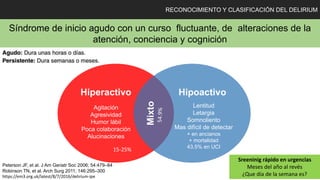
RECONOCIMIENTO Y CLASIFICACIÓN DEL DELIRIUM
Síndrome de inicio agudo con un curso fluctuante, de alteraciones de la
atención, conciencia y cognición
Hiperactivo Hipoactivo
Mixto
Agitación
Agresividad
Humor lábil
Poca colaboración
Alucinaciones
Lentitud
Letargia
Somnoliento
Mas difícil de detectar
+ en ancianos
+ mortalidad
43.5% en UCI
Sreeninig rápido en urgencias
Meses del año al revés
¿Que día de la semana es?
Peterson JF, et al. J Am Geriatr Soc 2006; 54:479–84
Robinson TN, et al. Arch Surg 2011; 146:295–300
https://em3.org.uk/latest/8/7/2016/delirium-ipe
15-25%
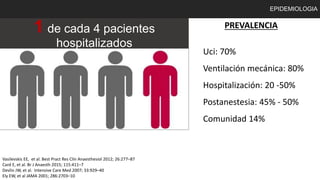
EPIDEMIOLOGIA
1 de cada 4 pacientes
hospitalizados
PREVALENCIA
Uci: 70%
Ventilación mecánica: 80%
Hospitalización: 20 -50%
Postanestesia: 45% - 50%
Comunidad 14%
Vasilevskis EE, et al. Best Pract Res Clin Anaesthesiol 2012; 26:277–87
Card E, et al. Br J Anaesth 2015; 115:411–7
Devlin JW, et al. Intensive Care Med 2007; 33:929–40
Ely EW, et al JAMA 2001; 286:2703–10
FACTORES DE RIESGO; ETIOLOGICOS PRECIPITANTES, PREDISPONENTES
Tayyeb A Tahir, Deepali Mahajan. Delirium. MEDICINE 2016: 44:12
Nivel de
funcionamiento
cognitivo
anterior
comprometido
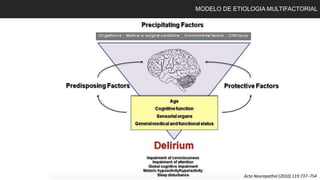
MODELO DE ETIOLOGIA MULTIFACTORIAL
Acta Neuropathol (2010) 119:737–754
NEUROPATOGENESIS: La vía neuroinflamatoria del delirio
Acta Neuropathol (2010) 119:737–754
EVALUACIÓN Y CARÁCTERÍSTICAS CLÍNICAS
EVALUACIÓN
• Historia Clínica
- Estado cognitivo basal: detectar cambios agudos
- Inicio, cambios apetito, el sueño, alucinaciones, problemas de
concentración, comportamiento social, cambios de humor
• Examen físico – neurológico
• Pruebas complementarias
• Descartar otros diagnósticos, revisar antecedentes, tto
• Descartar causas que pongan en peligro la vida (hipotensión,
hipoxia, hipercapnia, hipoglicemia, toxicidad por opiodes)
• Escalas
CARÁCTERÍSTICAS CLÍNICAS
• Inicio agudo
- Súbito, en horas o días
• Curso fluctuante
- Aumentan, disminuyen, desaparecen, regresan en un
periodo de 24h , intervalos de lucidez
• Atención: Inatención
- Dificultad para concentrarse, difícil mantener la
conversación o seguir ordenes, se distrae fácil
• Pensamiento: desorganizado
-Discurso incoherente, desorganizado, irrelevante, poco
claro, repetitivo.
• Conciencia:
-letárgicos, o hiper-alerta
• Déficit cognitivo
-Global o defectos múltiples; desorientación, déficit
memoria, lenguaje
• Percepción:
- Ignora eventos, describe ilusiones o percepciones
erróneas, alucinaciones (30%)
• Psicomotor:
- Hiperactivo, agitación, vigilancia (retiro de drogas), hipo
activo: letargia
• Alteración ciclo del sueño:
- En el día somnolientos, noche insomnio, sueño
fragmentado
• Disturbios emocionales
- Labilidad emocional, miedo, paranoia, depresión ,
apatía, irritabilidad, ansiedad, euforia
• Desorientación
- amnesia
• Cambios en la escritura:
- letra, errores ortografía o palabras, micrografía
1. Factores de riesgo y predisponentes
2. Nivel de conciencia:
- AVPU (Alerta, respuesta: Verbal , Painfull , Unresponsive)
- RASS
S: 84% E: 88% Si menor o igual a – 1 o mayor o igual a 1.
E 99% S 16% para delirium si menor o igual -2º mayor o igual a 2
3. Inatención:
- Días y meses al revés
- Vigilance A test
- Digit cancellation test
4. Cognición:
- Mini mental MMS
- Six ítem screener ( S 63-94%, E 77-85)
- Ottawa 3DY (S: 95% E: 52% )
5. Delirium
EVALUACIÓN
Que día es
En que fecha estamos (date)
World al revés (DLROW)
En que año estamos
Menos de 4: disfunción cognitiva
Acad Emerg Med 2015;22(7):878–82.
INSTRUMENTOS PARA LA MEDICIÓN DEL DELIRIUM
• Subdiagnóstico en especial el delirium hipoactivo
• Herramientas diagnosticas.
• 7 instrumentos validados en paciente critico
• Criterios diagnósticos DSM-5
• Métodos psicométricos
- Confusion Assessment Method (CAM)
- CAM-ICU
- Intensive Care Delirium Screening Checklist (ICDSC).
- Brief-CAM (B-CAM) : cambia la prueba de atencion por la inversion de meses del año
ESCALAS
ESCALAS: CAM
S: 94-100% E 89-95%
Revista medica de costa rica y centroamerica (614) 3 - 7, 2015
Inouye SK,, et al. Clarifying confusion: the confusion assessment method. A new method for detection of delirium. Ann Intern Med 1990;113(12
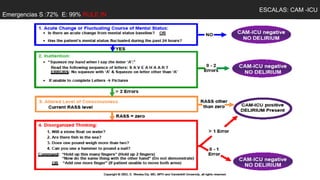
ESCALAS: CAM -ICU
Emergencias S :72% E: 99% RULE IN
ESCALAS
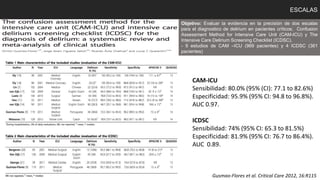
Objetivo: Evaluar la evidencia en la precisión de dos escalas
para el diagnostico de delirium en pacientes críticos; Confusion
Assessment Method for Intensive Care Unit (CAM-ICU) y The
Intensive Care Delirium Screening Checklist (ICDSC).
- 9 estudios de CAM –ICU (969 pacientes) y 4 ICDSC (361
pacientes)
CAM-ICU
Sensibilidad: 80.0% (95% (CI): 77.1 to 82.6%)
Especificidad: 95.9% (95% CI: 94.8 to 96.8%).
AUC 0.97.
ICDSC
Sensibilidad: 74% (95% CI: 65.3 to 81.5%)
Especificidad: 81.9% (95% CI: 76.7 to 86.4%).
AUC 0.89.
Gusmao-Flores et al. Critical Care 2012, 16:R115
(83 x edad (años) - (43 x Indice Barthel)
MODELOS DE PREDICCIÓN CLÍNICA
Age Ageing (2014) 43 (3): 346-351
Rev Med Chile 2014; 142: 826-832
Escala de validación de delirium incidental.
2 estudios prospectivos observacionales (desarrollo 375 ptes y validación 104
ptes).Pacientes hospitalizados de más de 65 años
AUC 0.86 (IC 95% 0.82- 0.91) LR (-) 0.16 LR (+) 3.4
Validación AUC 0.78 ( 95% IC 0.66 -0.90)
Valor -240 VPN: 0.99 E: 74% S: 88%
Score >- 240 Aumenta la probabilidad post test a 45%
Delirium predictive score (DPS)
= [1370 × BUN (mmol/l)/cr (umol/l)] – (4 × Barthel index) Corte -240
= [5 × BUN (mg/dl)/cr (mg/dl)] – (3 × Barthel index) Corte -160
Escala de validación para predecir pacientes con alto riesgo de delirium
2 estudios prospectivos observacionales (desarrollo 542 ptes y validación 85 ptes)
Pacientes hospitalizados de más de 65 años
Después de las 48 h de hospitalización.
Análisis multivariado : edad y estado funcional
AUC 0.83 (IC 0.73 -0.92)
Bajo riesgo: < 1700
Riesgo intermedio 1700-3000
Alto >riesgo 3000
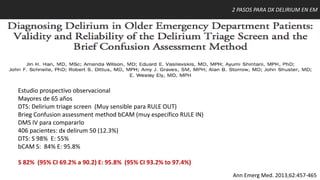
2 PASOS PARA DX DELIRIUM EN EM
Ann Emerg Med. 2013;62:457-465
Estudio prospectivo observacional
Mayores de 65 años
DTS: Delirium triage screen (Muy sensible para RULE OUT)
Brieg Confusion assessment method bCAM (muy específico RULE IN)
DMS IV para compararlo
406 pacientes: dx delirum 50 (12.3%)
DTS: S 98% E: 55%
bCAM S: 84% E: 95.8%
S 82% (95% CI 69.2% a 90.2) E: 95.8% (95% CI 93.2% to 97.4%)
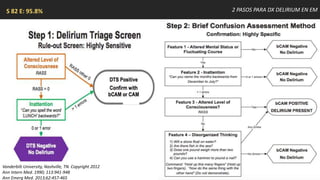
2 PASOS PARA DX DELIRIUM EN EM
Ann Emerg Med. 2013;62:457-465
S 82 E: 95.8%
Vanderbilt University, Nashville, TN. Copyright 2012
Ann Intern Med. 1990; 113:941-948
Ann Emerg Med. 2013;62:457-465
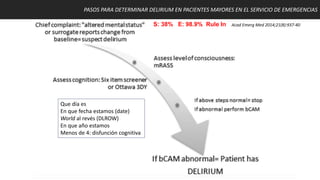
PASOS PARA DETERMINAR DELIRIUM EN PACIENTES MAYORES EN EL SERVICIO DE EMERGENCIAS
S: 38% E: 98.9% Rule In Acad Emerg Med 2014;21(8):937-40
Que día es
En que fecha estamos (date)
World al revés (DLROW)
En que año estamos
Menos de 4: disfunción cognitiva
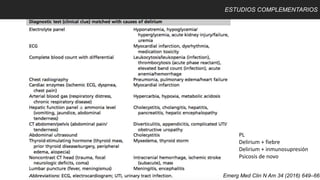
ESTUDIOS COMPLEMENTARIOS
Emerg Med Clin N Am 34 (2016) 649–665
PL
Delirium + fiebre
Delirium + inmunosupresión
Psicosis de novo
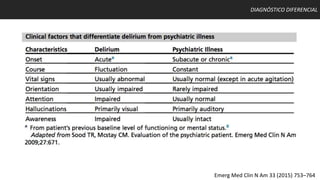
DIAGNÓSTICO DIFERENCIAL
Emerg Med Clin N Am 33 (2015) 753–764
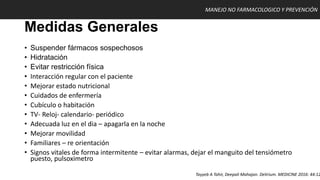
Medidas Generales
• Suspender fármacos sospechosos
• Hidratación
• Evitar restricción física
• Interacción regular con el paciente
• Mejorar estado nutricional
• Cuidados de enfermería
• Cubículo o habitación
• TV- Reloj- calendario- periódico
• Adecuada luz en el dia – apagarla en la noche
• Mejorar movilidad
• Familiares – re orientación
• Signos vitales de forma intermitente – evitar alarmas, dejar el manguito del tensiómetro
puesto, pulsoximetro
MANEJO NO FARMACOLOGICO Y PREVENCIÓN
Tayyeb A Tahir, Deepali Mahajan. Delirium. MEDICINE 2016: 44:12
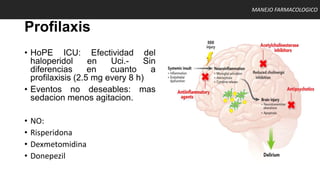
Profilaxis
• HoPE ICU: Efectividad del
haloperidol en Uci.- Sin
diferencias en cuanto a
profilaxisis (2.5 mg every 8 h)
• Eventos no deseables: mas
sedacion menos agitacion.
• NO:
• Risperidona
• Dexmetomidina
• Donepezil
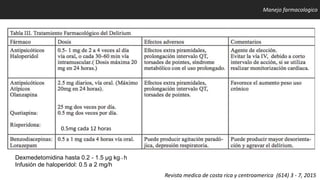
MANEJO FARMACOLOGICO
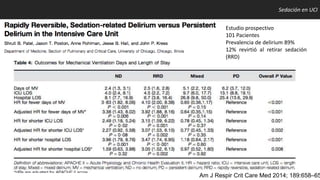
Sedación en UCI
Am J Respir Crit Care Med 2014; 189:658–65
Estudio prospectivo
101 Pacientes
Prevalencia de delirium 89%
12% revirtió al retirar sedación
(RRD)
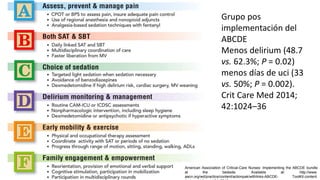
Grupo pos
implementación del
ABCDE
Menos delirium (48.7
vs. 62.3%; P = 0.02)
menos días de uci (33
vs. 50%; P = 0.002).
Crit Care Med 2014;
42:1024–36
American Association of Critical-Care Nurses: Implementing the ABCDE bundle
at the bedside. Available at: http://www.
aacn.org/wd/practice/content/actionpak/withlinks-ABCDE- ToolKit.content.
PACIENTE AGITADO
• Antipsicoticos: IV o IM
• Agitación severa: 1 línea: antipsicóticos HALOPERIDOL 2-5mg IM
• *** Puede combinarse con BZD en EM para un delirium agitado:
Lorazepam 2mg IV o hasta 5mg Midazolam
• Delirium por retiro de alcohol: Diazepam EVITAR antipsicóticos
• BZD en ancianos pueden empeorar el delirium
• Haloperidol: + 4.5mg/día) riesgo de extrapiramidalismo,
Manejo farmacologico
Nobay F, et al. A prospective, double-blind, randomized trial of midazolam versus haloperidol versus lorazepam in the chemical restraint of violent and severely agitated patients. Acad Emerg Med 2004
Rund DA, et al. The use of intramuscular benzodiazepines and antipsychotic agents in the treatment of acute agitation or violence in the emergency department. J Emerg Med 2006.
Rolland B, et al. Treatment of agitation in the emergency depart- ment: benzodiazepines could be safer than antipsychotics in some cases of insufficient medical data. J Emerg Med 2014.
Battaglia et al. Haloperidol, lorazepam, or both for psychotic agitation? A multicenter, prospective, double-blind, emergency department study. Am J Emerg Med 1997
Manejo farmacologico
Revista medica de costa rica y centroamerica (614) 3 - 7, 2015
0.5mg cada 12 horas
Dexmedetomidina hasta 0.2 - 1.5 μg kg−1 h
Infusión de haloperidol: 0.5 a 2 mg/h
Delirium

Delirium

  • 1.
    DELIRIUM Síndrome Confusional Agudo AnaMaría Angel Isaza R2 Medicina de Emergencias
  • 2.
  • 3.
    DEFINICIÓN DE DELIRIUM EmergMed Clin N Am 33 (2015) 753–764
  • 4.
    RECONOCIMIENTO Y CLASIFICACIÓNDEL DELIRIUM Síndrome de inicio agudo con un curso fluctuante, de alteraciones de la atención, conciencia y cognición Hiperactivo Hipoactivo Mixto Agitación Agresividad Humor lábil Poca colaboración Alucinaciones Lentitud Letargia Somnoliento Mas difícil de detectar + en ancianos + mortalidad 43.5% en UCI Sreeninig rápido en urgencias Meses del año al revés ¿Que día de la semana es? Peterson JF, et al. J Am Geriatr Soc 2006; 54:479–84 Robinson TN, et al. Arch Surg 2011; 146:295–300 https://em3.org.uk/latest/8/7/2016/delirium-ipe 15-25%
  • 5.
    EPIDEMIOLOGIA 1 de cada4 pacientes hospitalizados PREVALENCIA Uci: 70% Ventilación mecánica: 80% Hospitalización: 20 -50% Postanestesia: 45% - 50% Comunidad 14% Vasilevskis EE, et al. Best Pract Res Clin Anaesthesiol 2012; 26:277–87 Card E, et al. Br J Anaesth 2015; 115:411–7 Devlin JW, et al. Intensive Care Med 2007; 33:929–40 Ely EW, et al JAMA 2001; 286:2703–10
  • 6.
    FACTORES DE RIESGO;ETIOLOGICOS PRECIPITANTES, PREDISPONENTES Tayyeb A Tahir, Deepali Mahajan. Delirium. MEDICINE 2016: 44:12 Nivel de funcionamiento cognitivo anterior comprometido
  • 7.
    MODELO DE ETIOLOGIAMULTIFACTORIAL Acta Neuropathol (2010) 119:737–754
  • 8.
    NEUROPATOGENESIS: La víaneuroinflamatoria del delirio Acta Neuropathol (2010) 119:737–754
  • 9.
    EVALUACIÓN Y CARÁCTERÍSTICASCLÍNICAS EVALUACIÓN • Historia Clínica - Estado cognitivo basal: detectar cambios agudos - Inicio, cambios apetito, el sueño, alucinaciones, problemas de concentración, comportamiento social, cambios de humor • Examen físico – neurológico • Pruebas complementarias • Descartar otros diagnósticos, revisar antecedentes, tto • Descartar causas que pongan en peligro la vida (hipotensión, hipoxia, hipercapnia, hipoglicemia, toxicidad por opiodes) • Escalas
  • 10.
    CARÁCTERÍSTICAS CLÍNICAS • Inicioagudo - Súbito, en horas o días • Curso fluctuante - Aumentan, disminuyen, desaparecen, regresan en un periodo de 24h , intervalos de lucidez • Atención: Inatención - Dificultad para concentrarse, difícil mantener la conversación o seguir ordenes, se distrae fácil • Pensamiento: desorganizado -Discurso incoherente, desorganizado, irrelevante, poco claro, repetitivo. • Conciencia: -letárgicos, o hiper-alerta • Déficit cognitivo -Global o defectos múltiples; desorientación, déficit memoria, lenguaje • Percepción: - Ignora eventos, describe ilusiones o percepciones erróneas, alucinaciones (30%) • Psicomotor: - Hiperactivo, agitación, vigilancia (retiro de drogas), hipo activo: letargia • Alteración ciclo del sueño: - En el día somnolientos, noche insomnio, sueño fragmentado • Disturbios emocionales - Labilidad emocional, miedo, paranoia, depresión , apatía, irritabilidad, ansiedad, euforia • Desorientación - amnesia • Cambios en la escritura: - letra, errores ortografía o palabras, micrografía
  • 11.
    1. Factores deriesgo y predisponentes 2. Nivel de conciencia: - AVPU (Alerta, respuesta: Verbal , Painfull , Unresponsive) - RASS S: 84% E: 88% Si menor o igual a – 1 o mayor o igual a 1. E 99% S 16% para delirium si menor o igual -2º mayor o igual a 2 3. Inatención: - Días y meses al revés - Vigilance A test - Digit cancellation test 4. Cognición: - Mini mental MMS - Six ítem screener ( S 63-94%, E 77-85) - Ottawa 3DY (S: 95% E: 52% ) 5. Delirium EVALUACIÓN Que día es En que fecha estamos (date) World al revés (DLROW) En que año estamos Menos de 4: disfunción cognitiva Acad Emerg Med 2015;22(7):878–82.
  • 14.
    INSTRUMENTOS PARA LAMEDICIÓN DEL DELIRIUM • Subdiagnóstico en especial el delirium hipoactivo • Herramientas diagnosticas. • 7 instrumentos validados en paciente critico • Criterios diagnósticos DSM-5 • Métodos psicométricos - Confusion Assessment Method (CAM) - CAM-ICU - Intensive Care Delirium Screening Checklist (ICDSC). - Brief-CAM (B-CAM) : cambia la prueba de atencion por la inversion de meses del año ESCALAS
  • 16.
    ESCALAS: CAM S: 94-100%E 89-95% Revista medica de costa rica y centroamerica (614) 3 - 7, 2015 Inouye SK,, et al. Clarifying confusion: the confusion assessment method. A new method for detection of delirium. Ann Intern Med 1990;113(12
  • 17.
    ESCALAS: CAM -ICU EmergenciasS :72% E: 99% RULE IN
  • 18.
    ESCALAS Objetivo: Evaluar laevidencia en la precisión de dos escalas para el diagnostico de delirium en pacientes críticos; Confusion Assessment Method for Intensive Care Unit (CAM-ICU) y The Intensive Care Delirium Screening Checklist (ICDSC). - 9 estudios de CAM –ICU (969 pacientes) y 4 ICDSC (361 pacientes) CAM-ICU Sensibilidad: 80.0% (95% (CI): 77.1 to 82.6%) Especificidad: 95.9% (95% CI: 94.8 to 96.8%). AUC 0.97. ICDSC Sensibilidad: 74% (95% CI: 65.3 to 81.5%) Especificidad: 81.9% (95% CI: 76.7 to 86.4%). AUC 0.89. Gusmao-Flores et al. Critical Care 2012, 16:R115
  • 19.
    (83 x edad(años) - (43 x Indice Barthel) MODELOS DE PREDICCIÓN CLÍNICA Age Ageing (2014) 43 (3): 346-351 Rev Med Chile 2014; 142: 826-832 Escala de validación de delirium incidental. 2 estudios prospectivos observacionales (desarrollo 375 ptes y validación 104 ptes).Pacientes hospitalizados de más de 65 años AUC 0.86 (IC 95% 0.82- 0.91) LR (-) 0.16 LR (+) 3.4 Validación AUC 0.78 ( 95% IC 0.66 -0.90) Valor -240 VPN: 0.99 E: 74% S: 88% Score >- 240 Aumenta la probabilidad post test a 45% Delirium predictive score (DPS) = [1370 × BUN (mmol/l)/cr (umol/l)] – (4 × Barthel index) Corte -240 = [5 × BUN (mg/dl)/cr (mg/dl)] – (3 × Barthel index) Corte -160 Escala de validación para predecir pacientes con alto riesgo de delirium 2 estudios prospectivos observacionales (desarrollo 542 ptes y validación 85 ptes) Pacientes hospitalizados de más de 65 años Después de las 48 h de hospitalización. Análisis multivariado : edad y estado funcional AUC 0.83 (IC 0.73 -0.92) Bajo riesgo: < 1700 Riesgo intermedio 1700-3000 Alto >riesgo 3000
  • 20.
    2 PASOS PARADX DELIRIUM EN EM Ann Emerg Med. 2013;62:457-465 Estudio prospectivo observacional Mayores de 65 años DTS: Delirium triage screen (Muy sensible para RULE OUT) Brieg Confusion assessment method bCAM (muy específico RULE IN) DMS IV para compararlo 406 pacientes: dx delirum 50 (12.3%) DTS: S 98% E: 55% bCAM S: 84% E: 95.8% S 82% (95% CI 69.2% a 90.2) E: 95.8% (95% CI 93.2% to 97.4%)
  • 21.
    2 PASOS PARADX DELIRIUM EN EM Ann Emerg Med. 2013;62:457-465 S 82 E: 95.8% Vanderbilt University, Nashville, TN. Copyright 2012 Ann Intern Med. 1990; 113:941-948 Ann Emerg Med. 2013;62:457-465
  • 22.
    PASOS PARA DETERMINARDELIRIUM EN PACIENTES MAYORES EN EL SERVICIO DE EMERGENCIAS S: 38% E: 98.9% Rule In Acad Emerg Med 2014;21(8):937-40 Que día es En que fecha estamos (date) World al revés (DLROW) En que año estamos Menos de 4: disfunción cognitiva
  • 23.
    ESTUDIOS COMPLEMENTARIOS Emerg MedClin N Am 34 (2016) 649–665 PL Delirium + fiebre Delirium + inmunosupresión Psicosis de novo
  • 24.
  • 25.
    DIAGNÓSTICO DIFERENCIAL Emerg MedClin N Am 33 (2015) 753–764
  • 26.
    Medidas Generales • Suspenderfármacos sospechosos • Hidratación • Evitar restricción física • Interacción regular con el paciente • Mejorar estado nutricional • Cuidados de enfermería • Cubículo o habitación • TV- Reloj- calendario- periódico • Adecuada luz en el dia – apagarla en la noche • Mejorar movilidad • Familiares – re orientación • Signos vitales de forma intermitente – evitar alarmas, dejar el manguito del tensiómetro puesto, pulsoximetro MANEJO NO FARMACOLOGICO Y PREVENCIÓN Tayyeb A Tahir, Deepali Mahajan. Delirium. MEDICINE 2016: 44:12
  • 27.
    Profilaxis • HoPE ICU:Efectividad del haloperidol en Uci.- Sin diferencias en cuanto a profilaxisis (2.5 mg every 8 h) • Eventos no deseables: mas sedacion menos agitacion. • NO: • Risperidona • Dexmetomidina • Donepezil MANEJO FARMACOLOGICO
  • 28.
    Sedación en UCI AmJ Respir Crit Care Med 2014; 189:658–65 Estudio prospectivo 101 Pacientes Prevalencia de delirium 89% 12% revirtió al retirar sedación (RRD)
  • 29.
    Grupo pos implementación del ABCDE Menosdelirium (48.7 vs. 62.3%; P = 0.02) menos días de uci (33 vs. 50%; P = 0.002). Crit Care Med 2014; 42:1024–36 American Association of Critical-Care Nurses: Implementing the ABCDE bundle at the bedside. Available at: http://www. aacn.org/wd/practice/content/actionpak/withlinks-ABCDE- ToolKit.content.
  • 30.
    PACIENTE AGITADO • Antipsicoticos:IV o IM • Agitación severa: 1 línea: antipsicóticos HALOPERIDOL 2-5mg IM • *** Puede combinarse con BZD en EM para un delirium agitado: Lorazepam 2mg IV o hasta 5mg Midazolam • Delirium por retiro de alcohol: Diazepam EVITAR antipsicóticos • BZD en ancianos pueden empeorar el delirium • Haloperidol: + 4.5mg/día) riesgo de extrapiramidalismo, Manejo farmacologico Nobay F, et al. A prospective, double-blind, randomized trial of midazolam versus haloperidol versus lorazepam in the chemical restraint of violent and severely agitated patients. Acad Emerg Med 2004 Rund DA, et al. The use of intramuscular benzodiazepines and antipsychotic agents in the treatment of acute agitation or violence in the emergency department. J Emerg Med 2006. Rolland B, et al. Treatment of agitation in the emergency depart- ment: benzodiazepines could be safer than antipsychotics in some cases of insufficient medical data. J Emerg Med 2014. Battaglia et al. Haloperidol, lorazepam, or both for psychotic agitation? A multicenter, prospective, double-blind, emergency department study. Am J Emerg Med 1997
  • 31.
    Manejo farmacologico Revista medicade costa rica y centroamerica (614) 3 - 7, 2015 0.5mg cada 12 horas Dexmedetomidina hasta 0.2 - 1.5 μg kg−1 h Infusión de haloperidol: 0.5 a 2 mg/h

Notas del editor

  • #3 Síndrome agudo y fluctuante, con alteraciones de la atención, conciencia y cognición, precipitado ya sea por una enfermedad subyacente o un evento en personas vulnerables. Es uno de los trastornos cognitivos más importantes en el anciano Importante la inatención o el cambio en la cognición no puede ser debida al desorden de base (demencia) o al estímulo reducido (sedación, coma). El cambio en el estado mental debe ser agudo y fluctuante a través del día, y puede ocurrir en adición a la enfermedad de base, ejemplo un delirium superpuesto a la demencia o a un acv). El diagnostico no identifica la etiología En mayo de 2013 fue publicada la quinta edición del Manual Diagnóstico y Estadístico de los Trastornos Mentales (DSM-5), Las modificaciones más importantes respecto al delírium fueron: –Centrar el ítem A en la atención (attention, awareness), que según datos empíricos es la más importante de las características nucleares del trastorno2. Con este fin se dejó atrás el término complejo consciousness («conciencia») utilizado en el ítem A del DSM-IV-TR. –Incluir un ítem específico sobre el diagnóstico diferencial con otros trastornos neurocognitivos como la enfermedad de Alzheimer o con un estado de estimulación extremadamente reducido (p. ej., coma). A. Una alteración de la atención (capacidad reducida para dirigir, centrar, mantener o desviar la atención) y la conciencia (orientación reducida al entorno) B. La alteración aparece en poco tiempo (unas horas a pocos dias), constituye un cambio respecto a la atencion y conciencia iniciales y su gravedad tiene a fluctuar a lo largo del dia. C. Una alteracion cognitica adicional (deficit de memoria, de orientación, de lenguaje, de la capacidad visoespacial o de la percepcion) D. Las alteraciones de los criterios A y C no se explican mejor por otra alteracion neurocognitica preexistente, establecida o en curso, ni seceden en el contexot de un nivel de estimulacion extremadamente reducido, como seria el coma. E. En la anamnesis, la exploracion fisica o los analisis clinicos se obtienen eidencia que la alteracion en suna conscecencia fisicologia directa de otra afeccion medica, intoxicacion o una absitneica por alguna sustancia (consumo de doras o medicamento), una exposicion a una toxina o se debe a multiples etiologias.
  • #7 Por ejemplo una persona adulta mayor con deterioro cognitivo de base y pobre estad o de salud (comorbilidades) es vulneraba a delirium por ejemplo con una infeccion. Igual una persona sana con una noxa grave, cirugía mayor,, puede presentarla Pacientes concomorbilidades, especialmente fragilidad, insuficiencia respuratoria estan en alto riesgo, ptes con baja cognicion o reserva fisica poseen menor capacidad para mantener el normal funcionamiento del cerebro en respuesta al estress Un insulto sistémico grande como sepsis, vmi prolongado, cirugía mayor, abdominal de cadera cardiaca, dolor severo aumentan el riesgo de delirium Midazolam lorazepam opiodes fuertes Sedacion prolongada y profunda
  • #9 Actualmente se ha planteado la Hipótesis de neuroinflama- ción en que la inflamación sistémica produciría un aumento en la permeabilidad de la barrera hematoencefálica, permi- tiendo que mediadores inflamatorios, activen la microglía, ésta genera una cascada inflamatoria central que causa neurotoxicidad. También se ha descrito activación endotelial y alteración de la perfusión regional cerebral, con pérdida de la autorregulación. La reactividad de la microglía está modu- lada por señales colinérgicas, que e menor duración. En cambio, en los pacientes AM, especialmente si hay condiciones de neurodegeneración que afecte las vías colinérgicas, como en el Alzheimer, se actinhiben la activación de la microglía, por lo que, en aquellos con vías colinérgicas sanas, como en los jóvenes, se encuentran protegidos y se desarrolla un delirium menos severo y diva la microglía en mayor magnitud, produciéndose un delirium más severo y prolongado (15).
  • #10 Ante todo cuadro confusional agudo, el primer paso es el diagnóstico sindrómico, reconocer que el paciente está realmente confuso. En formas menores puede ser necesario realizar un cuidadoso examen de la función mental para detectarlo. Es necesaria una historia clínica detallada del paciente o referida por familiares y un examen físico y neurológico completo, con el fin de documentar que la confusión está presente e identificar sus síntomas clínicos. El delirium puede ser la primera manifestación de una enfermedad aguda potencialmente grave, incluso antes de la fiebre, taquicardia, taquipnea o hipoxia. En la evaluación inicial en el servicio de urgencia se debe asegurar el ABC: vía aérea, respiración y circulación adecuados. Se deben obtener los signos vitales incluyendo oximetría, hemodinamia, glicemia capilar y temperatura By definition, all delirium is of acute onset. Establishing baseline cognition and behaviour by collateral history (or prior knowledge of a patient) is important in documenting acute change and fluctuation; however, it is often not available and is not always essential for a working diagnosis. Inattention is a core feature in all patients, although mild cases can temporarily lack this because of fluctuation. Inattention can be evident in con- versation, a patient losing track of a topic or being easily distractible. Bedside cognitive testing, such as stating the months of the year backwards, provides a metric that helps in monitoring a patient over time. Acutely altered arousal is common and a wide range of pre- sentations e from extreme combativeness to an unrousable pa- tient e can be observed. Multidomain cognitive impairment is almost always seen in delirium but is non-specific. Hallucinations frequently occur, usually visual in nature and often dis- tressing. Thought disturbance and paranoid ideation can occur. Importantly, these psychotic features are seen in all types of delirium, including the hypoactive form. Proactive questioning is required because patients infrequently volunteer evidence of psychosis. The sleep cycle is regularly affected, commonly with dayenight revers Once delirium is suspected, the first step is to rule out acute, life- threatening physiological disturbance or drug intoxication. Hy- potension, hypoxia, hypercapnia, hypoglycaemia and opioid toxicity, for example, can all present with delirium. It is then necessary to search for underlying causes (often multiple). Comprehensive history, examination and investigations are often not feasible in delirious patients. Although presumed chest and urine infections are common, focused examination is required to avoid overlooking other acute pathology such as cholecystitis, septic joints or ‘silent’ myocardial infarction. The experience of delirium is often extremely distressing, and the level of distress should always be assessed, using interview, observation and informant history
  • #11 Ante todo cuadro confusional agudo, el primer paso es el diagnóstico sindrómico, reconocer que el paciente está realmente confuso. En formas menores puede ser necesario realizar un cuidadoso examen de la función mental para detectarlo. Es necesaria una historia clínica detallada del paciente o referida por familiares y un examen físico y neurológico completo, con el fin de documentar que la confusión está presente e identificar sus síntomas clínicos. By definition, all delirium is of acute onset. Establishing baseline cognition and behaviour by collateral history (or prior knowledge of a patient) is important in documenting acute change and fluctuation; however, it is often not available and is not always essential for a working diagnosis. Inattention is a core feature in all patients, although mild cases can temporarily lack this because of fluctuation. Inattention can be evident in con- versation, a patient losing track of a topic or being easily distractible. Bedside cognitive testing, such as stating the months of the year backwards, provides a metric that helps in monitoring a patient over time. Acutely altered arousal is common and a wide range of pre- sentations e from extreme combativeness to an unrousable pa- tient e can be observed. Multidomain cognitive impairment is almost always seen in delirium but is non-specific. Hallucinations frequently occur, usually visual in nature and often dis- tressing. Thought disturbance and paranoid ideation can occur. Importantly, these psychotic features are seen in all types of delirium, including the hypoactive form. Proactive questioning is required because patients infrequently volunteer evidence of psychosis. The sleep cycle is regularly affected, commonly with dayenight revers Once delirium is suspected, the first step is to rule out acute, life- threatening physiological disturbance or drug intoxication. Hy- potension, hypoxia, hypercapnia, hypoglycaemia and opioid toxicity, for example, can all present with delirium. It is then necessary to search for underlying causes (often multiple). Comprehensive history, examination and investigations are often not feasible in delirious patients. Although presumed chest and urine infections are common, focused examination is required to avoid overlooking other acute pathology such as cholecystitis, septic joints or ‘silent’ myocardial infarction. The experience of delirium is often extremely distressing, and the level of distress should always be assessed, using interview, observation and informant history
  • #12 Que día es En que fecha estamos (date) World al revés (DLROW) En que año estamos Menos de 4: disfunción cognitiva
  • #13 Pacientes > 65 años, puntuación inferior a 23 es considerado anormal. - Pacientes no geriátricos, puntuación inferior a 27 es considerado anormal Puntacion maxima 35
  • #15 Confussion Assessment Method o CAM: Es la escala de tami- zaje más recomendada (20). Se basa en el examen del paciente y el reporte de familiares, enfermera y/o cuidador, el tiempo de aplicación promedio es de 5 minutos. Posee alta sensibilidad 94% (IC=91-97%) y especificidad 89% (IC=85-94%), ha sido validada para ser usado por profesio- nales de salud entrenados y traducido a distintos idiomas. Se basa en identificar la presencia de un cambio en rela- ción al basal del estado mental de carácter agudo y fluc- tuante, luego la presencia de inatención. En seguida, se busca la presencia de cambios en el nivel de conciencia y del contenido del pensamiento. Si el paciente presenta los dos primeros puntos y alguno de los otros (alteración del contenido o nivel de conciencia), se considera un tamizaje positivo. CAM-ICU: Se desarrolló para pacientes en unidades de cuidados críticos, incluso en ventilación mecánica (21). Ha sido validada en Chile (22) y también adaptada al uso en SU y para pacientes con o sin demencia. Es similar al CAM original en la búsqueda de cambio agudo y fluctuante e inatención, pero en seguida, se busca la presencia de cambios en el nivel de conciencia mediante la Escala de Agitación y Sedación de Richmond (RASS), con un puntaje entre +4 y -5, correspon- diendo a un puntaje de +4 a alguien combativo/violento y en otro extremo a alguien sin respuesta a la voz o al estímulo físico un RASS de -5. Solo si el nivel de conciencia es normal, se analiza el contenido del pensamiento, lo que facilita y acorta su aplicación. Para evaluar la atención en personas que
  • #16 he CAM-ICU tool assesses the same four cardinal features as the Confusion Assessment Method— acute changes/ uctuations in mental status, inattention, disorganized thinking, and an altered level of conscious- ness—but in a condensed manner ideal for the ICU setting. To validate the CAM-ICU, assessments were performed in 11 patients (471 total evaluations) by two independent nurses and compared to expert psychiatric assessment using the dSM-IV criteria. e study found sensitivities of 100 and 93% and speci cities of 98 and 100%, respectively.8 e moment in time delirium assessment with the CAM-ICU requires less than 2 min to complete, which has prompted its use in hospital settings outside the ICU. e ICdSC assesses eight diagnostic features of delirium over an entire nursing shift (altered level of consciousness, inattention, disorientation, psychosis, altered psychomotor activity, inappropriate speech/mood, sleep disturbance, and symptom uctuation).30 In its validation, the ICdSC was performed in 93 patients and compared to psychiatric evalu- ation. e presence of four or more of the listed features had 99% sensitivity and 64% speci city for delirium.30 A recent systematic review of studies in ICU patients demon- strated pooled sensitivity of 74% and speci city of 82% for the ICdSC
  • #17 The confusion assessment method (CAM) was first described by Inouye and col- leagues23 in 1990. The goal of the CAM was to “enable non-psychiatry trained clini- cians to identify delirium quickly and accurately in both clinical and research settings.”23 A positive CAM requires the presence of acute onset and fluctuating course and inattention, and either disorganized thinking or altered level of conscious- ness.
  • #18 The Confusion Assessment Method for the Intensive Care Unit (CAM-ICU) was developed for use in mechanically ventilated ICU patients.24,25 The CAM-ICU uses brief and objective measurements for scoring and may be completed rapidly (in less than 2 minutes). For feature 1, the patient must have either an acute change OR a fluc- tuating course of their mental status. This requirement differs from the CAM, which requires an acute onset AND fluctuating course. For feature 2, inattention, the CAM- ICU presents a series of letters, and the patient is instructed to squeeze the rater’s hand whenever an “A” is heard. More than 2 errors is considered abnormal. If the pa- tient has negative evaluations for either feature 1 or feature 2, the test may be stopped, and the patient is considered CAM-ICU negative. If the patient has an abnormal score for feature 1 AND feature 2, the patient is tested for altered level of consciousness using the RASS. If the RASS is not equal to zero, the patient is diagnosed with delirium. If the RASS is zero, 4 objective questions to eval- uate disorganized thinking are asked. More than 1 error diagnoses delirium, 0 to 1 er- rors are consistent with no delirium. The CAM-ICU was tested in ED patients, and emergency physicians applying this technique had a sensitivity of 72% and a specificity of 99%.26 Consequently, this al- gorithm could be used to rule delirium in; however, the sensitivity is too low to use as a screening test in ED patients
  • #19 Gusmao-Flores D, Salluh JI, Chalhub RÁ, Quarantini LC: The confusion assessment method for the intensive care unit (CAM-ICU) and intensive care delirium screening checklist (ICDSC) for the diagnosis of delirium: A systematic review and meta-analysis of clinical studies. Crit Care 2012; 16:R115
  • #20 Análisis multivariado : Delirium asociado a menor estado funcional (índice de barthel) y deshidratación (elevación relación entre urea y cr
  • #22 The Delirium Triage Screen (DTS) was developed to rapidly rule-out delirium and reduce the need for formal delirium assessments. It takes less than 20 seconds to perform and consists of two components: 1) Level of consciousness as measured by the Richmond Agitation Sedation Scale (RASS). 2) Inattention by spelling the word "LUNCH" backwards. If the patient has a RASS of 0 (normal level of consciousness) or makes 0 or 1 errors on “LUNCH” backwards spelling test, then the DTS is considered negative. Because the DTS is 98% sensitive, delirium is ruled out in this case and no additional delirium testing is needed. If the patient has a RASS other than 0 (altered level of consciousness) or makes >1 error on the “LUNCH” backwards spelling test, then the DTS is considered positive. Because the DTS is 55% specific, confirmatory testing is needed using the bCAM or CAM to rule in delirium Similar to the CAM-ICU, the bCAM uses altered mental status or fluctuating course for feature 1. For feature 2, inattention, the bCAM assesses the patient’s ability to recite the months of the year backwards from December to July. Zero and 1 errors are consistent with no delirium. For feature 3, level of consciousness, the bCAM also uses the RASS. Finally, the bCAM uses the same questions for disorganized thinking as the CAM-ICU, but considers any error diag- nostic of delirium. igure 1. The 2-step approach to delirium surveillance for the emergency department: the Delirium Triage Screen (DTS) on the top and Brief Confusion Assessment Method (bCAM) on bottom. Step 1 (DTS) can be integrated into the nurses’ triage assessment. If the DTS result is negative, then delirium is ruled out and no additional testing is needed. If the DTS result is positive, then a confirmatory delirium assessment such as the bCAM should be performed. Both assessments use the Richmond Agitation Sedation Scale (RASS), which assesses for arousal and ranges from -5 (coma) to 4 (combative);25 a score of 0 indicates normal level of consciousness. The DTS is courtesy of Vanderbilt University, Nashville, TN. Copyright 2012. The bCAM is adapted from: Inouye SK, et al. Ann Intern Med. 1990; 113:941-948. Confusion Assessment Method. Copyright 2003, Hospital Elder Life Program, LLC.28,41 Not to be reproduced without permission
  • #23 Han JH, Schnelle JF, Ely EW. The relationship between a chief complaint of “altered mental status” and delirium in older emergency department patients. Acad Emerg Med 2014;21(8):937–40. Han JH, Wilson A, Vasilevskis EE, et al. Diagnosing delirium in older emergency department patients: validity and reliability of the delirium triage screen and the brief confusion assessment method. Ann Emerg Med 2013;62(5):457–65.
  • #24 For example, most if not all delirious patients require elec- trolytes, complete blood count, urinalysis, electrocardiogram, and chest radiography, but certain patients will require further evaluation if clinically warranted, such as non- contrast computed tomography (CT) of the head, CT of abdomen and pelvis, and/or lumbar puncture. Box 2 summarizes diagnostic tests ordered for delirium with clinical clues and causes of delirium. Comprehensive testing is needed at times when the pa- tient presents with coma, multiple complaints, or nonspecific findings. Nonetheless, the authors recommend a targeted diagnostic approach when possible because un- necessary testing and increasing ED length of stay will contribute to further delirium, as discussed further in the next sectio
  • #28 Multiple pathophysiologic processes likely contribute to delirium, and a number of pharmacologic prophylaxis agents have subsequently been studied to decrease delirium incidence ( g. 1).41,42 is includes agents to reduce dopa- mine activity and improve neurotransmitter imbalances (e.g., antipsychotics) and agents that increase cholinergic activity as low cholinergic activity and anticholinergic medi- cations have been linked to delirium (e.g., acetylcholinester- ase inhibitors). e majority of recent animal and human research studies have focused on systemic insults (e.g., sur- gery and sepsis) leading to in ammatory signaling through the blood–brain barrier, resulting in neuroin ammation and neuronal injury.43–48 us, agents to reduce systemic in am- mation and decrease the neuroin ammatory cascade (e.g., steroids and statins) are also being examined
  • #29 The median proportion of ICU days with delirium was 0.57 before versus 0.50 after DIS (P , 0.001). The Confusion Assessment Method for the ICU indicated patients are 10.5 times more likely to have delirium before DIS versus after (P , 0.001). Rapidly reversible, sedation-related delirium showed fewer ventilator (P , 0.001), ICU (P = 0.001), and hospital days (P , 0.001) than persistent delirium. Subjects with no delirium and rapidly reversible, sedation-related delirium were more likelyto be discharged home (P , 0.001). Patients with persistent delirium had increased 1-year mortality versus those with no delirium and rapidly reversible, sedation-related delirium (P , 0.001).
  • #30 e Awakening and Breathing Coordination, delirium Monitoring/Man- agement, and Early Exercise/Mobility (ABCdE) bundle was originally published in 2011
  • #32 Los neurolépticos pueden inducir síndrome neuroléptico maligno, hiperprolactinemia y acatisia, prolongan el intervalo QT, riesgo de arritmias y eventualmente de muerte súbita Estudio comparativo Eligible patients were randomized to dex- medetomidine 0.2–0.7 mcg/kg/h infusion with or without a 1.0 mcg/kg loading dose at physician’s discretion, or hal- operidol 0.5–2 mg/h with or without a 2.5 mg loading dose Infusion rates ranged from 3 to 40 mg/h with mean starting rate of 9±7mg/h and maximum rate of 18±11mg/h for mean duration of 7 ± 3.2 days (range 3–12 days).