¿Cuál es tu
modelo de
negocio?
Introducción


Calle Sant Sebastià, 69 - 07701 Maó, Illes Balears - 971 35 70 21 - www.proquame.com.es - www.facebook.com/proquame
Business
models


Calle Sant Sebastià, 69 - 07701 Maó, Illes Balears - 971 35 70 21 - www.proquame.com.es - www.facebook.com/proquame
Modelo de negocio

 •         Cómo generas ingresos de forma sostenible
 •         Cómo te posicionas en la cadena de valor
           añadido
 •         Cómo sirves (propuesta de valor) a tus clientes
 •         Cómo desarrollas tu estrategia de negocio y la
           poner en práctica


¿Cuál es tu modelo de negocio? – Diciembre 2012
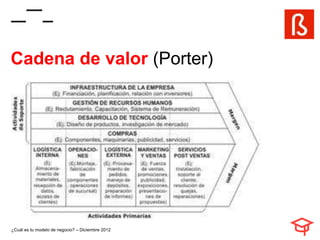
Cadena de valor (Porter)


¿Cuál es tu modelo de negocio? – Diciembre 2012
2 ejemplos:


¿Cuál es tu modelo de negocio? – Diciembre 2012
Una reflexión…

 •         Innovar en modelos de negocio aporta ventajas
           competitivas muy provechosas
 •         Suelen ser innovaciones disruptivas, que
           cambian el status quo del mercado
 •         Los modelos de negocio son cada vez más
           sofisticados… e internet ha venido a complicarlo
           algo más

¿Cuál es tu modelo de negocio? – Diciembre 2012
¿Y en las
TICs?


Calle Sant Sebastià, 69 - 07701 Maó, Illes Balears - 971 35 70 21 - www.proquame.com.es - www.facebook.com/proquame
Brockerage models

 Brokers are market-makers: they bring buyers and sellers together and
 facilitate transactions. Brokers play a frequent role in business-to-business
 (B2B), business-to-consumer (B2C), or consumer-to-consumer (C2C)
 markets. Usually a broker charges a fee or commission for each
 transaction it enables. The formula for fees can vary.


Fuente: http://digitalenterprise.org/models/models.html
¿Cuál es tu modelo de negocio? – Diciembre 2012
Advertising models

 The web advertising model is an extension of the traditional media
 broadcast model. The broadcaster, in this case, a web site, provides
 content (usually, but not necessarily, for free) and services (like email, IM,
 blogs) mixed with advertising messages in the form of banner ads. The
 banner ads may be the major or sole source of revenue for the
 broadcaster. The broadcaster may be a content creator or a distributor of
 content created elsewhere. The advertising model works best when the
 volume of viewer traffic is large or highly specialized.


Fuente: http://digitalenterprise.org/models/models.html
¿Cuál es tu modelo de negocio? – Diciembre 2012
Infomediary models


 Data about consumers and their consumption habits are valuable,
 especially when that information is carefully analyzed and used to target
 marketing campaigns. Independently collected data about producers and
 their products are useful to consumers when considering a purchase.
 Some firms function as infomediaries (information intermediaries)
 assisting buyers and/or sellers understand a given market.


Fuente: http://digitalenterprise.org/models/models.html
¿Cuál es tu modelo de negocio? – Diciembre 2012
Merchant models


 Wholesalers and retailers of goods and services. Sales may be made
 based on list prices or through auction.


Fuente: http://digitalenterprise.org/models/models.html
¿Cuál es tu modelo de negocio? – Diciembre 2012
Manufacturer (direct)
models

 The manufacturer or "direct model", it is predicated on the power of the
 web to allow a manufacturer (i.e., a company that creates a product or
 service) to reach buyers directly and thereby compress the distribution
 channel. The manufacturer model can be based on efficiency, improved
 customer service, and a better understanding of customer preferences.


Fuente: http://digitalenterprise.org/models/models.html
¿Cuál es tu modelo de negocio? – Diciembre 2012
Affiliate models
In contrast to the generalized portal, which seeks to drive a high volume of
traffic to one site, the affiliate model, provides purchase opportunities
wherever people may be surfing. It does this by offering financial incentives
(in the form of a percentage of revenue) to affiliated partner sites. The
affiliates provide purchase-point click-through to the merchant. It is a pay-for-
performance model -- if an affiliate does not generate sales, it represents no
cost to the merchant. The affiliate model is inherently well-suited to the web,
which explains its popularity. Variations include:
• Banner Exchange -- trades banner placement among a network of
    affiliated sites.
• Pay-per-click -- site that pays affiliates for a user click-through.
• Revenue Sharing -- offers a percent-of-sale commission based on a user
    click-through in which the user subsequently purchases a product.
Fuente: http://digitalenterprise.org/models/models.html
¿Cuál es tu modelo de negocio? – Diciembre 2012
Community models


 The viability of the community model is based on user loyalty. Users have
 a high investment in both time and emotion. Revenue can be based on the
 sale of ancillary products and services or voluntary contributions; or
 revenue may be tied to contextual advertising and subscriptions for
 premium services. The Internet is inherently suited to community business
 models and today this is one of the more fertile areas of development, as
 seen in rise of social networking.


Fuente: http://digitalenterprise.org/models/models.html
¿Cuál es tu modelo de negocio? – Diciembre 2012
Subscription models


 Users are charged a periodic -- daily, monthly or annual -- fee to subscribe
 to a service. It is not uncommon for sites to combine free content with
 "premium" (i.e., subscriber- or member-only) content. Subscription fees
 are incurred irrespective of actual usage rates. Subscription and
 advertising models are frequently combined.


Fuente: http://digitalenterprise.org/models/models.html
¿Cuál es tu modelo de negocio? – Diciembre 2012
Utility models
 The utility or "on-demand" model is based on metering usage, or a "pay as
 you go" approach. Unlike subscriber services, metered services are based
 on actual usage rates. Traditionally, metering has been used for essential
 services (e.g., electricity water, long-distance telephone services). Internet
 service providers (ISPs) in some parts of the world operate as utilities,
 charging customers for connection minutes, as opposed to the subscriber
 model common in the U.S.
 • Metered Usage -- measures and bills users based on actual usage of a
    Subscriptions -- allows subscribers to purchase access to content in
    metered portions (e.g., numbers of pages viewed).


Fuente: http://digitalenterprise.org/models/models.html
¿Cuál es tu modelo de negocio? – Diciembre 2012
¿Cómo
modelar mi
negocio?


Calle Sant Sebastià, 69 - 07701 Maó, Illes Balears - 971 35 70 21 - www.proquame.com.es - www.facebook.com/proquame
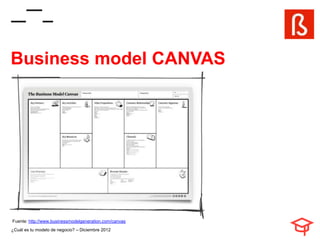
Business model CANVAS


Fuente: http://www.businessmodelgeneration.com/canvas
¿Cuál es tu modelo de negocio? – Diciembre 2012
Business model TOOLKIT


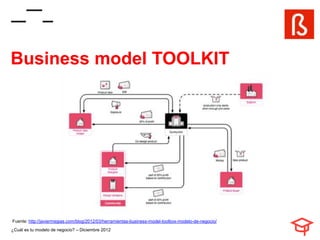
Quirky es un interesante proyecto que funciona de la siguiente manera:
• Cualquiera puede enviar una propuesta de producto a Quirky a cambio del pago de una
  tasa (antes eran 99$, ahora son 10$)
• La comunidad de Quirky mediante algo similar a un proceso de co-diseño ayuda a mejorar
  el concepto, y los productos que más votos reciban pasan a la siguiente fase
• El prototipo del producto se pone a la venta en la web de Quirky, y si se alcanzan
  suficientes reservas (pre-ventas) el producto se produce realmente
• Una vez se cierran las ventas, el comprador recibe su producto a cambio del pago, los
  miembros de la comunidad que ayudaron reciben un 30% de las ventas (en función de su
  contribución) y el otro 30% va a la persona que inicialmente creó el concepto

Fuente: http://javiermegias.com/blog/2012/03/herramientas-business-model-toolbox-modelo-de-negocio/
¿Cuál es tu modelo de negocio? – Diciembre 2012
Business model TOOLKIT


Fuente: http://javiermegias.com/blog/2012/03/herramientas-business-model-toolbox-modelo-de-negocio/
¿Cuál es tu modelo de negocio? – Diciembre 2012
Muchas gracias…
                                  Joan R. Sánchez Tuomala
                                  Socio Consultor
                                  PROQUAME


                                  ¿Cómo contactar conmigo?
                                  C/ Sant Sebastià, 69
                                  07710 – Maó – Islas Baleares
                                  teléfono: +34 971 35 70 21
                                  móbil: +34 630 25 88 76
                                  email: joan@proquame.com.es
                                  linkedin: es.linkedin.com/in/joansancheztuomala
                                  facebook: facebook.com/joansancheztuomala
                                  twitter: twitter.com/joansanchez


Motivación y trabajo en equipo – Noviembre 2012

Modelos de negocio tecnológicos

  • 1.
    ¿Cuál es tu modelode negocio? Introducción Calle Sant Sebastià, 69 - 07701 Maó, Illes Balears - 971 35 70 21 - www.proquame.com.es - www.facebook.com/proquame
  • 2.
    Business models Calle Sant Sebastià,69 - 07701 Maó, Illes Balears - 971 35 70 21 - www.proquame.com.es - www.facebook.com/proquame
  • 3.
    Modelo de negocio • Cómo generas ingresos de forma sostenible • Cómo te posicionas en la cadena de valor añadido • Cómo sirves (propuesta de valor) a tus clientes • Cómo desarrollas tu estrategia de negocio y la poner en práctica ¿Cuál es tu modelo de negocio? – Diciembre 2012
  • 4.
    Cadena de valor(Porter) ¿Cuál es tu modelo de negocio? – Diciembre 2012
  • 5.
    ¿Cuál es tumodelo de negocio? – Diciembre 2012
  • 6.
    2 ejemplos: ¿Cuál estu modelo de negocio? – Diciembre 2012
  • 7.
    Una reflexión… • Innovar en modelos de negocio aporta ventajas competitivas muy provechosas • Suelen ser innovaciones disruptivas, que cambian el status quo del mercado • Los modelos de negocio son cada vez más sofisticados… e internet ha venido a complicarlo algo más ¿Cuál es tu modelo de negocio? – Diciembre 2012
  • 8.
    ¿Y en las TICs? CalleSant Sebastià, 69 - 07701 Maó, Illes Balears - 971 35 70 21 - www.proquame.com.es - www.facebook.com/proquame
  • 9.
    Brockerage models Brokersare market-makers: they bring buyers and sellers together and facilitate transactions. Brokers play a frequent role in business-to-business (B2B), business-to-consumer (B2C), or consumer-to-consumer (C2C) markets. Usually a broker charges a fee or commission for each transaction it enables. The formula for fees can vary. Fuente: http://digitalenterprise.org/models/models.html ¿Cuál es tu modelo de negocio? – Diciembre 2012
  • 10.
    Advertising models Theweb advertising model is an extension of the traditional media broadcast model. The broadcaster, in this case, a web site, provides content (usually, but not necessarily, for free) and services (like email, IM, blogs) mixed with advertising messages in the form of banner ads. The banner ads may be the major or sole source of revenue for the broadcaster. The broadcaster may be a content creator or a distributor of content created elsewhere. The advertising model works best when the volume of viewer traffic is large or highly specialized. Fuente: http://digitalenterprise.org/models/models.html ¿Cuál es tu modelo de negocio? – Diciembre 2012
  • 11.
    Infomediary models Dataabout consumers and their consumption habits are valuable, especially when that information is carefully analyzed and used to target marketing campaigns. Independently collected data about producers and their products are useful to consumers when considering a purchase. Some firms function as infomediaries (information intermediaries) assisting buyers and/or sellers understand a given market. Fuente: http://digitalenterprise.org/models/models.html ¿Cuál es tu modelo de negocio? – Diciembre 2012
  • 12.
    Merchant models Wholesalersand retailers of goods and services. Sales may be made based on list prices or through auction. Fuente: http://digitalenterprise.org/models/models.html ¿Cuál es tu modelo de negocio? – Diciembre 2012
  • 13.
    Manufacturer (direct) models Themanufacturer or "direct model", it is predicated on the power of the web to allow a manufacturer (i.e., a company that creates a product or service) to reach buyers directly and thereby compress the distribution channel. The manufacturer model can be based on efficiency, improved customer service, and a better understanding of customer preferences. Fuente: http://digitalenterprise.org/models/models.html ¿Cuál es tu modelo de negocio? – Diciembre 2012
  • 14.
    Affiliate models In contrastto the generalized portal, which seeks to drive a high volume of traffic to one site, the affiliate model, provides purchase opportunities wherever people may be surfing. It does this by offering financial incentives (in the form of a percentage of revenue) to affiliated partner sites. The affiliates provide purchase-point click-through to the merchant. It is a pay-for- performance model -- if an affiliate does not generate sales, it represents no cost to the merchant. The affiliate model is inherently well-suited to the web, which explains its popularity. Variations include: • Banner Exchange -- trades banner placement among a network of affiliated sites. • Pay-per-click -- site that pays affiliates for a user click-through. • Revenue Sharing -- offers a percent-of-sale commission based on a user click-through in which the user subsequently purchases a product. Fuente: http://digitalenterprise.org/models/models.html ¿Cuál es tu modelo de negocio? – Diciembre 2012
  • 15.
    Community models Theviability of the community model is based on user loyalty. Users have a high investment in both time and emotion. Revenue can be based on the sale of ancillary products and services or voluntary contributions; or revenue may be tied to contextual advertising and subscriptions for premium services. The Internet is inherently suited to community business models and today this is one of the more fertile areas of development, as seen in rise of social networking. Fuente: http://digitalenterprise.org/models/models.html ¿Cuál es tu modelo de negocio? – Diciembre 2012
  • 16.
    Subscription models Usersare charged a periodic -- daily, monthly or annual -- fee to subscribe to a service. It is not uncommon for sites to combine free content with "premium" (i.e., subscriber- or member-only) content. Subscription fees are incurred irrespective of actual usage rates. Subscription and advertising models are frequently combined. Fuente: http://digitalenterprise.org/models/models.html ¿Cuál es tu modelo de negocio? – Diciembre 2012
  • 17.
    Utility models Theutility or "on-demand" model is based on metering usage, or a "pay as you go" approach. Unlike subscriber services, metered services are based on actual usage rates. Traditionally, metering has been used for essential services (e.g., electricity water, long-distance telephone services). Internet service providers (ISPs) in some parts of the world operate as utilities, charging customers for connection minutes, as opposed to the subscriber model common in the U.S. • Metered Usage -- measures and bills users based on actual usage of a Subscriptions -- allows subscribers to purchase access to content in metered portions (e.g., numbers of pages viewed). Fuente: http://digitalenterprise.org/models/models.html ¿Cuál es tu modelo de negocio? – Diciembre 2012
  • 18.
    ¿Cómo modelar mi negocio? Calle SantSebastià, 69 - 07701 Maó, Illes Balears - 971 35 70 21 - www.proquame.com.es - www.facebook.com/proquame
  • 19.
    Business model CANVAS Fuente:http://www.businessmodelgeneration.com/canvas ¿Cuál es tu modelo de negocio? – Diciembre 2012
  • 20.
    Business model TOOLKIT Quirkyes un interesante proyecto que funciona de la siguiente manera: • Cualquiera puede enviar una propuesta de producto a Quirky a cambio del pago de una tasa (antes eran 99$, ahora son 10$) • La comunidad de Quirky mediante algo similar a un proceso de co-diseño ayuda a mejorar el concepto, y los productos que más votos reciban pasan a la siguiente fase • El prototipo del producto se pone a la venta en la web de Quirky, y si se alcanzan suficientes reservas (pre-ventas) el producto se produce realmente • Una vez se cierran las ventas, el comprador recibe su producto a cambio del pago, los miembros de la comunidad que ayudaron reciben un 30% de las ventas (en función de su contribución) y el otro 30% va a la persona que inicialmente creó el concepto Fuente: http://javiermegias.com/blog/2012/03/herramientas-business-model-toolbox-modelo-de-negocio/ ¿Cuál es tu modelo de negocio? – Diciembre 2012
  • 21.
    Business model TOOLKIT Fuente:http://javiermegias.com/blog/2012/03/herramientas-business-model-toolbox-modelo-de-negocio/ ¿Cuál es tu modelo de negocio? – Diciembre 2012
  • 22.
    Muchas gracias… Joan R. Sánchez Tuomala Socio Consultor PROQUAME ¿Cómo contactar conmigo? C/ Sant Sebastià, 69 07710 – Maó – Islas Baleares teléfono: +34 971 35 70 21 móbil: +34 630 25 88 76 email: joan@proquame.com.es linkedin: es.linkedin.com/in/joansancheztuomala facebook: facebook.com/joansancheztuomala twitter: twitter.com/joansanchez Motivación y trabajo en equipo – Noviembre 2012