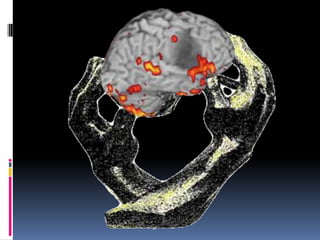
FISIOLOGIA DEL SNCJavier BenítezAnestesiólogo  Universidad NacionalHospital Universitario del Valle – Universidad del Valle
FISIOLOGICAMENTE IGUALES
Flujo sanguíneo y autorregulación cerebralMetabolismo cerebralPresión intracraneana  y Barrera HematoencefálicaAplicaciones
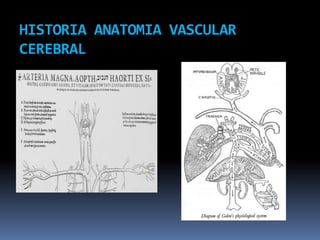
HISTORIA ANATOMIA VASCULAR CEREBRAL
CONSIDERACIONES GENERALESPeso cerebral: 1400 gr2-3% del peso corporal totalRecibe el 15-20% del gasto cardiacoCélulas gliales son el 50% pero tan solo consumen el 10% de la energía.FSC promedio es de 50 cc/100gr/minCMRO2: FSC X AVDO2PPC: PAM-PIC
CONSIDERACIONES SOBRE FSCGenevie Florence, Jean Michel Guerit, Bernar Gueden. EEG and ESP  to prevent cerebral ischemia in the operating room. Clinical neurophysiology.34. 2004: 17-32
AUTORREGULACION CEREBRAL
TEORIAS DE LA AUTORREGULACION CEREBRALTEORIA MIOGENICATEORIA METABOLICATEORIA NEUROGENICA
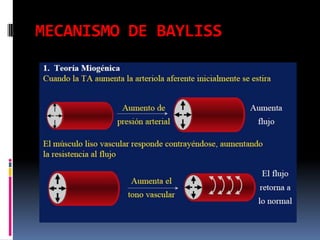
MECANISMO DE BAYLISS
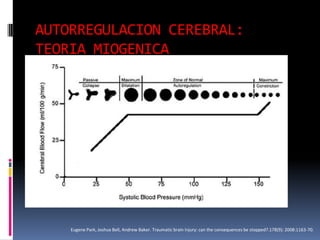
AUTORREGULACION CEREBRAL: TEORIA MIOGENICAEugene Park, Joshua Bell, Andrew Baker. Traumatic brain injury: can the consequences be stopped?.178(9): 2008:1163-70.
TEORIA MIOGENICA: MECANISMO DE BAYLISSH+TromboxanoProstaglandinasEndotelinasOxido nítrico
TEORIA METABOLICA
TEORIA METABOLICALa respuesta vasomotora mediada por el CO2 es dada por el efecto local de H+ Es un mecanismo temporal : 8 horasOtros factores que afectan el FSC: Temperatura ( cambio del 6%  del CMO2 por      cada grado)Reología de los eritrocitos
APLICACIÓN CLINICA:EFECTOS DE LA HIPERVENTILACIONColes Jp, Minhas PS, Fryer TD, et al. Effect of hyperventilation on cerebral blood flow in traumatic head injury: clinical relevance and monitoring correlates. Critical Care Med 2002; 30:1950-1959.
TEORIA NEUROGENICAMecanismo no claroRol del sistema nervioso simpáticoEstimulación alfa adrenérgica
TEORIA NEUROGENICA
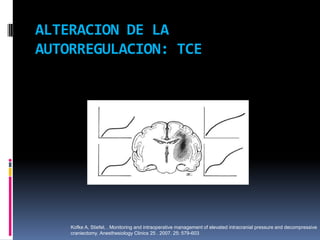
ALTERACION DE LA AUTORREGULACION: TCEKofke A, Stiefel, . Monitoring and intraoperative management of elevated intracranial pressure and decompressive craniectomy. Anesthesiology Clinics 25 . 2007. 25: 579-603
ALTERACIONES DEL FSC EJEMPLOS CLINICOS: TCEMartin y cols han definido 3 fases hemodinámica: Disminución del FSC en las primeras horas (40-60%): 0 díasHiperemia: primeros días (1-3 día)Vasoespasmo: 4-14 díaPPC objetivo
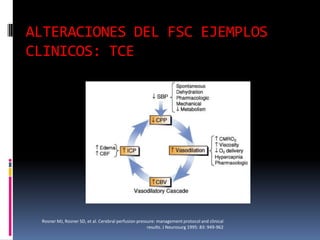
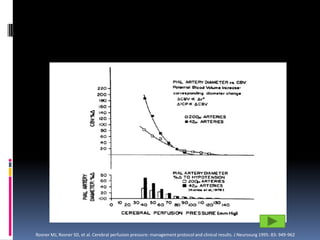
ALTERACIONES DEL FSC EJEMPLOS CLINICOS: TCERosner MJ, Rosner SD, et al. Cerebral perfusion pressure: management protocol and clinical results. J Neurosurg 1995: 83: 949-962
Rosner MJ, Rosner SD, et al. Cerebral perfusion pressure: management protocol and clinical results. J Neurosurg 1995: 83: 949-962
ALTERACIONES DEL FSC EJEMPLOS CLINICOS: CONVULSIONESPenfield en 1930 lo describióAumento del FSC en el periodo de crisisDisminución del FSC en el posictal
FSC: PACIENTE HIPERTENSO
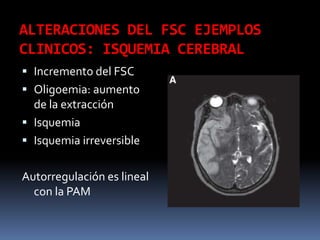
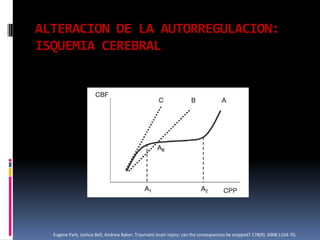
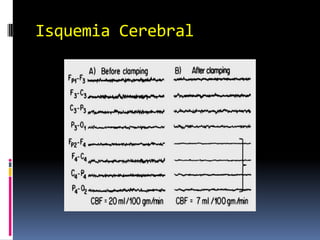
ALTERACIONES DEL FSC EJEMPLOS CLINICOS: ISQUEMIA CEREBRALIncremento del FSCOligoemia: aumento de la extracciónIsquemiaIsquemia irreversibleAutorregulación es lineal con la PAM
ALTERACION DE LA AUTORREGULACION: ISQUEMIA CEREBRAL        Eugene Park, Joshua Bell, Andrew Baker. Traumatic brain injury: can the consequences be stopped?.178(9): 2008:1163-70.
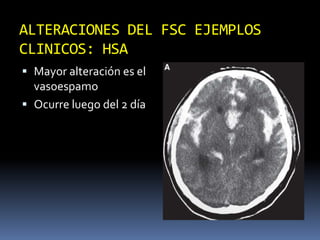
ALTERACIONES DEL FSC EJEMPLOS CLINICOS: HSAMayor alteración es el vasoespamoOcurre luego del 2 día
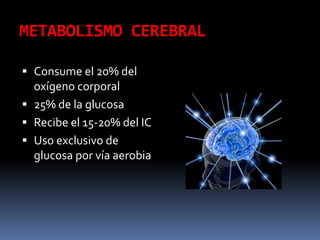
METABOLISMO CEREBRALConsume el 20% del oxígeno corporal25% de la glucosa Recibe el 15-20% del ICUso exclusivo de glucosa por vía aerobia
METABOLISMO CEREBRALTransporte de la glucosaÍndice aeróbico: 5,5CetonasMetabolismo cerebral en ayuno prolongadoCompartimientos  energéticos
VALORES NORMALES
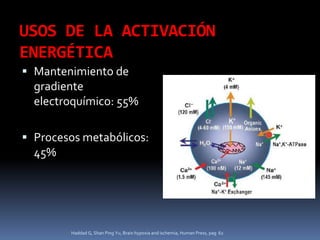
USOS DE LA ACTIVACIÓN ENERGÉTICAMantenimiento de gradiente electroquímico: 55%Procesos metabólicos: 45%Haddad G, Shan Ping Yu, Brain hypoxia and ischemia, Human Press, pag  62
APLICACIÓN CLINICA: ENCEFALOPATIA HIPOXICAHaddad G, Shan Ping Yu, Brain hypoxia and ischemia, Human Press, pag 34
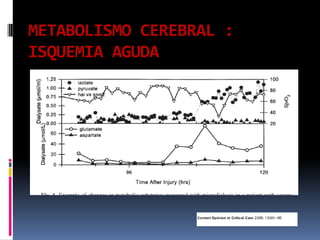
METABOLISMO CEREBRAL : ISQUEMIA AGUDA
METABOLISMO CEREBRAL : ISQUEMIA AGUDA                                Isquemia      Patrón de hipoperfusión compensada                         (    Extracción de O2)                Patrón de isquemia e infarto                       (Falla CMO2 y  Lactato)
Isquemia Cerebral
METABOLISMO EN TCEEl TCE condiciona una mayor interacción entre el FSC y el metabolismo cerebral.Desacoplamiento FSC- CMO2Hipermetabolismo inicial minutos después del traumaHipometabolismo posterior
METABOLISMO CEREBRAL EN TCEHipermetabolismo de la glucosa en zonas alejadas: hipocampoHipermetabolismo de la glucosa durante las convulsionesCaracterísticamente  en muchos pacientes hay predominio del metabolismo anaeróbio El grado de reducción del CMO2 es proporcional al glasgowCMRG y glasgow
PRESION INTRACRANEANA: COMPARTIMIENTOS-DOCTRINA DE MONROE KELLIE
NUEVA FASE CURVA P/VL.A Steiner, PJ Andrews. Monitoring the injured brain: IPC and CBF BJA 97(1): 26-38
EJEMPLOS DE LA DOCTRINA MONROE KELLIE
BARRERA HEMATOENCEFALICA: CONSIDERACIONES BASICASAG de Boer,PJ Gaillard, Drug targeting to the brain, pag 335, annals review
CONSIDERACIONES GENERALES DE LA BHEAG de Boer,PJ Gaillard, Drug targeting to the brain, pag 335, annals review
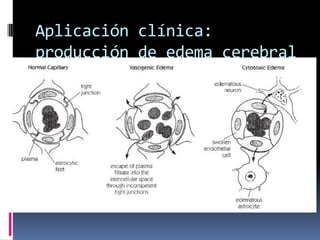
Aplicación clínica: producción de edema cerebral
OTROS TIPOS DE EDEMA CEREBRALOBSTRUCTIVOOSMOTICO
GRACIAS

Fisiologia del snc

  • 1.
    FISIOLOGIA DEL SNCJavierBenítezAnestesiólogo Universidad NacionalHospital Universitario del Valle – Universidad del Valle
  • 3.
  • 4.
    Flujo sanguíneo yautorregulación cerebralMetabolismo cerebralPresión intracraneana y Barrera HematoencefálicaAplicaciones
  • 5.
  • 7.
    CONSIDERACIONES GENERALESPeso cerebral:1400 gr2-3% del peso corporal totalRecibe el 15-20% del gasto cardiacoCélulas gliales son el 50% pero tan solo consumen el 10% de la energía.FSC promedio es de 50 cc/100gr/minCMRO2: FSC X AVDO2PPC: PAM-PIC
  • 8.
    CONSIDERACIONES SOBRE FSCGenevieFlorence, Jean Michel Guerit, Bernar Gueden. EEG and ESP to prevent cerebral ischemia in the operating room. Clinical neurophysiology.34. 2004: 17-32
  • 9.
  • 10.
    TEORIAS DE LAAUTORREGULACION CEREBRALTEORIA MIOGENICATEORIA METABOLICATEORIA NEUROGENICA
  • 11.
  • 12.
    AUTORREGULACION CEREBRAL: TEORIAMIOGENICAEugene Park, Joshua Bell, Andrew Baker. Traumatic brain injury: can the consequences be stopped?.178(9): 2008:1163-70.
  • 13.
    TEORIA MIOGENICA: MECANISMODE BAYLISSH+TromboxanoProstaglandinasEndotelinasOxido nítrico
  • 14.
  • 15.
    TEORIA METABOLICALa respuestavasomotora mediada por el CO2 es dada por el efecto local de H+ Es un mecanismo temporal : 8 horasOtros factores que afectan el FSC: Temperatura ( cambio del 6% del CMO2 por cada grado)Reología de los eritrocitos
  • 16.
    APLICACIÓN CLINICA:EFECTOS DELA HIPERVENTILACIONColes Jp, Minhas PS, Fryer TD, et al. Effect of hyperventilation on cerebral blood flow in traumatic head injury: clinical relevance and monitoring correlates. Critical Care Med 2002; 30:1950-1959.
  • 17.
    TEORIA NEUROGENICAMecanismo noclaroRol del sistema nervioso simpáticoEstimulación alfa adrenérgica
  • 18.
  • 19.
    ALTERACION DE LAAUTORREGULACION: TCEKofke A, Stiefel, . Monitoring and intraoperative management of elevated intracranial pressure and decompressive craniectomy. Anesthesiology Clinics 25 . 2007. 25: 579-603
  • 20.
    ALTERACIONES DEL FSCEJEMPLOS CLINICOS: TCEMartin y cols han definido 3 fases hemodinámica: Disminución del FSC en las primeras horas (40-60%): 0 díasHiperemia: primeros días (1-3 día)Vasoespasmo: 4-14 díaPPC objetivo
  • 21.
    ALTERACIONES DEL FSCEJEMPLOS CLINICOS: TCERosner MJ, Rosner SD, et al. Cerebral perfusion pressure: management protocol and clinical results. J Neurosurg 1995: 83: 949-962
  • 22.
    Rosner MJ, RosnerSD, et al. Cerebral perfusion pressure: management protocol and clinical results. J Neurosurg 1995: 83: 949-962
  • 23.
    ALTERACIONES DEL FSCEJEMPLOS CLINICOS: CONVULSIONESPenfield en 1930 lo describióAumento del FSC en el periodo de crisisDisminución del FSC en el posictal
  • 24.
  • 25.
    ALTERACIONES DEL FSCEJEMPLOS CLINICOS: ISQUEMIA CEREBRALIncremento del FSCOligoemia: aumento de la extracciónIsquemiaIsquemia irreversibleAutorregulación es lineal con la PAM
  • 26.
    ALTERACION DE LAAUTORREGULACION: ISQUEMIA CEREBRAL Eugene Park, Joshua Bell, Andrew Baker. Traumatic brain injury: can the consequences be stopped?.178(9): 2008:1163-70.
  • 27.
    ALTERACIONES DEL FSCEJEMPLOS CLINICOS: HSAMayor alteración es el vasoespamoOcurre luego del 2 día
  • 29.
    METABOLISMO CEREBRALConsume el20% del oxígeno corporal25% de la glucosa Recibe el 15-20% del ICUso exclusivo de glucosa por vía aerobia
  • 30.
    METABOLISMO CEREBRALTransporte dela glucosaÍndice aeróbico: 5,5CetonasMetabolismo cerebral en ayuno prolongadoCompartimientos energéticos
  • 31.
  • 32.
    USOS DE LAACTIVACIÓN ENERGÉTICAMantenimiento de gradiente electroquímico: 55%Procesos metabólicos: 45%Haddad G, Shan Ping Yu, Brain hypoxia and ischemia, Human Press, pag 62
  • 33.
    APLICACIÓN CLINICA: ENCEFALOPATIAHIPOXICAHaddad G, Shan Ping Yu, Brain hypoxia and ischemia, Human Press, pag 34
  • 34.
  • 35.
    METABOLISMO CEREBRAL :ISQUEMIA AGUDA Isquemia Patrón de hipoperfusión compensada ( Extracción de O2) Patrón de isquemia e infarto (Falla CMO2 y Lactato)
  • 36.
  • 37.
    METABOLISMO EN TCEElTCE condiciona una mayor interacción entre el FSC y el metabolismo cerebral.Desacoplamiento FSC- CMO2Hipermetabolismo inicial minutos después del traumaHipometabolismo posterior
  • 38.
    METABOLISMO CEREBRAL ENTCEHipermetabolismo de la glucosa en zonas alejadas: hipocampoHipermetabolismo de la glucosa durante las convulsionesCaracterísticamente en muchos pacientes hay predominio del metabolismo anaeróbio El grado de reducción del CMO2 es proporcional al glasgowCMRG y glasgow
  • 39.
  • 41.
    NUEVA FASE CURVAP/VL.A Steiner, PJ Andrews. Monitoring the injured brain: IPC and CBF BJA 97(1): 26-38
  • 42.
    EJEMPLOS DE LADOCTRINA MONROE KELLIE
  • 43.
    BARRERA HEMATOENCEFALICA: CONSIDERACIONESBASICASAG de Boer,PJ Gaillard, Drug targeting to the brain, pag 335, annals review
  • 44.
    CONSIDERACIONES GENERALES DELA BHEAG de Boer,PJ Gaillard, Drug targeting to the brain, pag 335, annals review
  • 45.
  • 47.
    OTROS TIPOS DEEDEMA CEREBRALOBSTRUCTIVOOSMOTICO
  • 48.