ACTUALIZACIÓN EN DIAGNÓSTICO Y
TRATAMIENTO DE ERGE
Dr. Julián Zilli García.
Médico Residente de Segundo año.
Cirugía General.
Agosto 2013.
• Concepto de reflujo
• Fisiológico v/s Patológico
• Concepto de ERGE
DEFINICIÓN
http://www.medicinenet.com/gastroesophageal_reflux_disease_gerd/article.htm
Medicina Interna FARRERAS ROZMAN 14 edicion 2000.
1.- Ubicación
ANATOMÍA
Mediastino
superior
Mediastino
inferior
T10
http://www.uvs.sld.cu/profesores/supercursos/plonearticlemultipage.200
6-04-03.3815988329/diapositiva-2
http://www.uvs.sld.cu/profesores/supercursos/plonearticlemultipage.2006-
04-03.3815988329/relaciones-y-constricciones-normales-del-esofago
1.- Ubicación
ANATOMÍA
EES M. cricofaríngeo
Botón Ao/ Bronquio principal izq
EEI Hiato diafragmático
Zonas de estrechez
http://www.facmed.unam.mx/deptos/anatomia/computo/Finaleso/estrecha.html
1.5cm
1.6cm
1.9cm
Medicina Interna FARRERAS ROZMAN 14 edicion 2000.
2.- Histología
ANATOMÍA
4 capas
Mucosa
Submucosa
Muscular propia
Adventicia / Serosa
http://www.fcnym.unlp.edu.ar/catedras/histologia/archivos%20MatDid/
Atlas%20Di%20Fiore/difiore.html
3.- Irrigación
ANATOMÍA
Arterial Venoso
Shwartz, seymour; Principios de Cirugía, editorial Mc g GauHill, 9° edición, 2011, Capítilo n°25: Esófago y Hernias diafragmáticas, págs 808, 809
4.- Inervación
ANATOMÍA
ExtrínsecaIntrínseca
http://www.facmed.unam.mx/deptos/anatomia/computo/Finaleso/inervacion.html
- Anillo diafragmático hiatal
- Esófago abdominal
- Ángulo de His
- AA y BB
- H: GASTR y MOT
FISIOLOGÍA
- Aumento de PIA
- Volumen gástrico
- Vaciamiento gástrico
- BA y AB
- H: CCK, EST, GLUC, PROG, SS, SECR
Mecanismos de cierre
Mecanismos de apertura
BARRERA
ANTI
REFLUJO
http://es.dreamstime.com/foto-de-archivo-
torso-humano-image2863610
Medicina Interna FARRERAS ROZMAN 14 edicion 2000.
PATOGÉNESIS
FACTOR
ANATÓMICO
DISMINUCIÓN
DEL TONO
EEI
RETRASO DEL
VACIAMIENTO
GÁSTRICO
AUMENTO DE
LA PIA
INSUFICIENCIA
MOTORA
ESOFÁGICA
PÉRDIDA DEL
PERISTALTISMO
RESISTENCIA
DE LA MUCOSA
ESOFÁGICA
IATROGÉNICO
MULTIFACTORIAL
Medicina Interna FARRERAS ROZMAN 14 edicion 2000.
FACTORES DE RIESGO
• Edad
• Sexo
• Raza
• Embarazo
• Enfermedades
• Obesidad
• Dieta
• Ejercicio físico
• Tabaco/Alcohol
• Fármacos
• Hernia hiatal
• Genética (40%)
• Cx esofágica previa
• Alt. neurológica
“REFLUJO MIXTO”
Kahrilas, Peter J., Gastroesophageal Reflux Disease, 2008, The New England Journal of Medicine 359;16
MANIFESTACIONES CLÍNICAS
1. ST. Típicos:
GRADO 1 Eritema , erosiones superficiales
GRADO 2 Erosiones confluentes
GRADO 3 Erosiones confluentes y circunferenciales
GRADO 4 Ulceraciones, fibrosis, estenosis
GRADO 5 Barrett
Esofagitis
por reflujo
• Pirosis
• Regurgitación
• Dolor epigástrico
Savary miller
Kahrilas, Peter J., Gastroesophageal Reflux Disease, 2008, The New England Journal of Medicine 359;16
MANIFESTACIONES CLÍNICAS
2. ST. Atípicos:
• Dolor torácico NC
• Disfagia orofaríngea
• Disfagia esofágica
• Tos crónica
• Ronquera
• Asma
• Sangrado oculto
• Pérdida de peso
• Neumonía recurrente
• Anorexia
• Anemia
• Alt. del sueño
• Desgaste del esmalte dental
• Sialorrea
• Náuseas
• Vómitos
Kahrilas, Peter J., Gastroesophageal Reflux Disease, 2008, The New England Journal of Medicine 359;16
MANIFESTACIONES CLÍNICAS
2. Síntomas Atípicos:
• Dolor torácico
• Disfagia
• Disfagia esofágica
• Tos crónica
• Voz ronca
• Asma
• Sangrado oculto
• Pérdida de peso
• Neumonía recurrente
• Anorexia
• Anemia
• Al. del sueño
• Desgaste del esmalte dental
• Sialorrea
• Náuseas
• Vómitos
ALARMA
Kahrilas, Peter J., Gastroesophageal Reflux Disease, 2008, The New England Journal of Medicine 359;16
HISTORIA NATURAL
DISPLASIA
REFLUJO
PATOLÓGICO
ERGE
ESÓFAGO DE
BARRET
ADENO
CARCINOMA
Kahrilas, Peter J., Gastroesophageal Reflux Disease, 2008, The New England Journal of Medicine 359;16
HISTORIA NATURAL
http://www.google.com/search?q=endoscopia+digestiva+alta&hl=es&prmd=imvns&source=lnms&tbm=isch&ei=xMGTTs6rCYTW0QHD2fXVBw&sa=X&oi=mode_link&ct=mode&cd=2&ved=0CB
QQ_AUoAQ&biw=1280&bih=699#hl=es&tbm=isch&sa=1&q=adenocarcinomas+esofago&pbx=1&oq=adenocarcinomas+esofago&aq=f&aqi=&aql=&gs_sm=e&gs_upl=201800l206425l0l206615l2
3l22l0l11l11l3l461l3196l2-3.3.3l9l0&bav=on.2,or.r_gc.r_pw.r_cp.,cf.osb&fp=fb51e3e1c01d09a6&biw=1280&bih=699
• Mundial 5%
• USA 20%
• Europa 18%
• Asia 5%
EPIDEMIOLOGÍA
• Incidencia de 5,4/1000 casos al año (USA)
• Sintomáticos: 25% mensual, 12% semanal, 5% diario
• 27% se automedica más de dos veces al mes
• 7/10 personas sintomáticas consultan (RU)
• 40% sintomáticos Dg de esofagitis (Suecia)
• 33% ADULTOS SINTOMÁTICOS
Manterola, Carlos; Bustos, Luis; Vial, Manuel. Prevalencia de ERGE en población general urbana adulta; Revista Chilena de cirugía. Vol 57-n°6, Diciembre 2005; pag 476
1. Asintomáticos
2. Sintomáticos con reflujo FS
3. ERGE sin esofagitis
4. Esofagitis con o sin ST
CLÍNICA
Kahrilas, Peter J., Gastroesophageal Reflux Disease, 2008, The New England Journal of Medicine 359;16
CLÍNICA
¿A QUIENES SE LES
DEBE INDICAR UN
ESTUDIO
COMPLEMENTARIO?
1. Asintomáticos
2. Sintomáticos con reflujo FS
3. ERGE sin esofagitis
4. Esofagitis con o sin ST
Kahrilas, Peter J., Gastroesophageal Reflux Disease, 2008, The New England Journal of Medicine 359;16
CLÍNICA
¿A QUIENES SE LES DEBE
INDICAR UN ESTUDIO
COMPLEMENTARIO?
1. Asintomáticos
2. Sintomáticos con reflujo FS
3. ERGE sin esofagitis
4. Esofagitis con o sin ST
St. de alarma
St. atípicos de ERGE
Refractariedad al Tto médico
Considerando Tto quirúrgico
Kahrilas, Peter J., Gastroesophageal Reflux Disease, 2008, The New England Journal of Medicine 359;16
TÉCNICAS DIAGNÓSTICAS
A) MONITORIZACIÓN PH 24 HRS
• Estudio ambulatorio funcional
• Cuantifica frecuencia-duración del RGE
• Relación posición e ingesta
• Capacidad de eliminación de RGE
• 2 tipos:
CONVENCIONAL SN 5cm bajo EEI
DE ALTA RESOLUCIÓN cápsula en UGE
Información
va a un holter
Correlaciona
exposición y
síntomas
Kahrilas, Peter J., Gastroesophageal Reflux Disease, 2008, The New England Journal of Medicine 359;16
TÉCNICAS DIAGNÓSTICAS
A) MONITORIZACIÓN PH 24 HRS
DE ALTA RESOLUCIÓN
Martínez, Luisa; Munitiz, Vicente, Ortiz, Ángeles. Monitorización ambulatoria del pH esofágico con pH-metría sin sonda (sistema Bravo). Estiudio de tolerancia, seguridad y
eficacia. Published in Cir Esp. 2008;84:201-9.-vol.84 núm 04
TÉCNICAS DIAGNÓSTICAS
A) MONITORIZACIÓN PH 24 HRS
- RGE sintomáticos con EDA(-)
- Refractariedad al Tto
- Evaluar correlación ST-RGE
- Documentar RGE pre-post Cx
INDICACIONES
CONSIDERACIONES
PREVIAS
Desayuno normal
Almuerzo liviano 12pm
Suspender Fcos 7d antes
http://www.telefonica.net/web2/funcionales/phmetria.htm
Kahrilas, Peter J., Gastroesophageal Reflux Disease, 2008, The New England Journal of Medicine 359;16
Tiempo% exposición (pH<4 )
N° total episodios de RGE
N° de episodios >5min
TÉCNICAS DIAGNÓSTICAS
A) MONITORIZACIÓN PH 24 HRS
INTERPRETACIÓN
VENTAJAS
Dg de ERGE
Correlación St-RGE
Valora efectividad al Tto
DESVENTAJAS
No muestra lesión mucosa
No valora reflujo alcalino
Kahrilas, Peter J., Gastroesophageal Reflux Disease, 2008, The New England Journal of Medicine 359;16
TÉCNICAS DIAGNÓSTICAS
A) MONITORIZACIÓN PH 24 HRS
INTERPRETACIÓN
http://www.telefonica.net/web2/funcionales/phmetria.htm
TÉCNICAS DIAGNÓSTICAS
A) MONITORIZACIÓN PH 24 HRS
INTERPRETACIÓN
http://www.telefonica.net/web2/funcionales/phmetria.htm
TÉCNICAS DIAGNÓSTICAS
B) IMPEDANCIOMETRIA (IIM)
• Medida de conductividad de víscera hueca y contenido
• Detecta resist. al FCA entre electrodos
• Registra reflujo ácido/no ácido
• Diferencia líquido( )/gas( )
• Útil en pacientes más complejos
VENTAJAS SOBRE PHETRÍA
Kahrilas, Peter J., Gastroesophageal Reflux Disease, 2008, The New England Journal of Medicine 359;16
TÉCNICAS DIAGNÓSTICAS
C) MANOMETRÍA
• Estudio de presiones y motilidad
• SN con sensores detecta de presión
• Dura 30-45 min
• Acostado
• Útil en Dg de trastornos motores del esófago
Kahrilas, Peter J., Gastroesophageal Reflux Disease, 2008, The New England Journal of Medicine 359;16
TÉCNICAS DIAGNÓSTICAS
C) MANOMETRÍA
• Evalúa deglución
EES y EEI
Presión EEI<6mmhg
Segmento intraabdominal <1cm
Longitud total EEI<2cm
PARÁMETROS
http://www.telefonica.net/web2/funcionales/manometriaesofagica.htm
Kahrilas, Peter J., Gastroesophageal Reflux Disease, 2008,
The New England Journal of Medicine 359;16
Shwartz, seymour; Principios de Cirugía, editorial Mc g GauHill, 9° edición, 2011, Capítilo n°25: Esófago y Hernias diafragmáticas, pag 818
TÉCNICAS DIAGNÓSTICAS
C) MANOMETRÍA
http://mujer-bonita.net/tag/endoscopia-digestiva
TÉCNICAS DIAGNÓSTICAS
D) ENDOSCOPÍA DIGESTIVA ALTA
• Indoloro (anestesia local, sedación ev)
• Dura 5min
• Evalúa
• Descarta otras patologías
• Permite biopsia y Tto
Presencia/severidad esofagitis
Lesiones ulceradas
Esófago de barrett
Gastrointestinal Endoscopy. April 2005.Vol. 65. Number 4.
TÉCNICAS DIAGNÓSTICAS
E) RADIOGRAFÍA CON BARIO
• Transición EG seriada
• Contraste radio opaco
• Sensible, fácil acceso
• Poco específica falsos(+)
• Evalúa
Anatomía
Motilidad EG
Deglución http://www.mednet.cl/link.cgi/Medwave/PuestaDia/Cursos/3246
http://www.guiasgastro.net/cgibin/wbdcgi.exe/gastro/guis_completa.go_doc?pident=5&ptipo=normal&pident_guia=2
TÉCNICAS DIAGNÓSTICAS
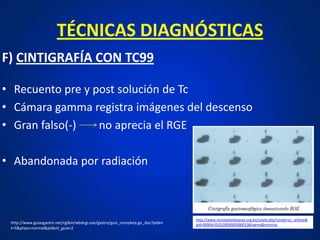
F) CINTIGRAFÍA CON TC99
• Recuento pre y post solución de Tc
• Cámara gamma registra imágenes del descenso
• Gran falso(-) no aprecia el RGE
• Abandonada por radiación
http://www.revistasbolivianas.org.bo/scielo.php?script=sci_arttext&
pid=S0004-05252009000300013&lng=es&nrm=isohttp://www.guiasgastro.net/cgibin/wbdcgi.exe/gastro/guis_completa.go_doc?piden
t=5&ptipo=normal&pident_guia=2
TÉCNICAS DIAGNÓSTICAS
G) BILITEC
• Cuantifica niveles de bilis en esófago
• Dg reflujo biliar
• Duración 24Hrs
• Correlación St-actividad-posición
http://www.guiasgastro.net/cgibin/wbdcgi.exe/gastro/guis_completa.go_doc?pident=5&ptipo=normal&pident_guia=2
TÉCNICAS DIAGNÓSTICAS
G) BILITEC
http://www.saintluc.be/en/services/foregut/duodenogastric-reflux.php
TÉCNICAS DIAGNÓSTICAS
F) PRUEBA DE BERNSTEIN
• Perfusión de ácido en esófago
• SN hasta porción ½ torácica
SF 150gotas/min x 5 min
Sustituido por HCL 0.1N
molestias en 10mins = esofagitis
• Abandonado
http://www.iqb.es/digestivo/pruebas/bernstein.htm
http://www.guiasgastro.net/cgibin/wbdcgi.exe/gastro/guis_completa.go_doc?piden
t=5&ptipo=normal&pident_guia=2
TRATAMIENTO
1.- MÉDICO
a) Modificaciones en el estilo de vida
EVITAR
• Cabecera <10cm de inclinación
• Decúbito postprandial
• Comer 3-4 antes de dormir
• Comidas copiosas
• Grasas, chocolate, menta, alcohol
• Sobrepeso
• Tabaco
• Ropa ajustada
• Sedentarismo
• Fármacos de riesgo
De Vault KR. Overview of medical therapy for gastroesophageal reflux disease Gastroenterol Clinic. North ARM 1999; 28: 831-45
Klinkenberg-Knol EC, Nelis F, DentJ, Suel P,Mitchell B, Prichard P et al. Long term omeprazole treatment in resistant
gastroesophageal reflux disease: efficacy, safety, and influence on gastric mucosa. Gastroenterology 2000:118:661-69.
TRATAMIENTO
1.- MÉDICO
b) Farmacológico
OBJETIVOS
• Reducir exposición al contenido gástrico
• Aliviar síntomas
• Curar esofagitis
• Prevenir y tratar complicaciones
Estenosis pilórica
Úlceras
Barrett
HDAKlinkenberg-Knol EC, Nelis F, DentJ, Suel P,Mitchell B, Prichard P et al. Long term omeprazole treatment in resistant
gastroesophageal reflux disease: efficacy, safety, and influence on gastric mucosa. Gastroenterology 2000:118:661-69.
TRATAMIENTO
1.- MÉDICO
b) Farmacológico
ANTISECRETORES
Klinkenberg-Knol EC, Nelis F, DentJ, Suel P,Mitchell B, Prichard P et al. Long term omeprazole treatment in resistant gastroesophageal reflux disease: efficacy, safety, and influence on gastric
mucosa. Gastroenterology 2000:118:661-69.
IBP antiH2
Mejoría 50% 25%
Supresión HCl >90% 70%
Curación esofagitis
4S
67-85% 26-45%
8S 85-96% 40-60%
Indicación -Esofagitis erosiva
-ERGE
-Esofagitis no erosiva
• Dosis:
• Duración: 4-12 sem (según gravedad)
• Fracaso: persistencia St >12 sem (comprobar cumplimiento)
TRATAMIENTO
-Omeprazol: 20 mg
-Lansoprazol: 30 mg
-Pantoprazol: 40 mg
-Esomeprazol: 40 mg
-Ranitidina: 150-300 mg
1.- MÉDICO
b) Farmacológico
Klinkenberg-Knol EC, Nelis F, DentJ, Suel P,Mitchell B, Prichard P et al. Long term omeprazole treatment in resistant gastroesophageal reflux disease: efficacy, safety, and influence on gastric
mucosa. Gastroenterology 2000:118:661-69.
TRATAMIENTO
1.- MÉDICO
b) Farmacológico
PROCINÉTICOS ANTIÁCIDOS
•Aumentan:
-act colinérgica en céls musc esofágicas
-peristalsis esofágica
-vaciamiento gástrico
-tono del EEI
•Ej: Cisaprida, Domperidona, Metoclopramida,
Betanecol
•Cisaprida: 63% curación esofagitis Grado I-II
•Neutralizan HCL
•Inhiben Pepsina
•Mejoran constipación
•Precaución con patología renal
De Vault KR. Overview of medical therapy for gastroesophageal reflux disease Gastroenterol Clinic. North ARM 1999; 28: 831-45
TRATAMIENTO
1.- MÉDICO
b) Farmacológico
ALCALINOS Y
AC. ALGÍNICO
PROTECTORES DE
LA MUCOSA
•Adherencia a exudados proteicos de
lesiones ulceradas
•Inhibe pepsina
•Actúa como quelante de sales biliares
•Útil en reflujo alcalino
•Ej: Sucralfato
•Solos o asociados
•Ác. Algínico: barrera mecánica al flotar
sobre el contenido gástrico
•Control puntual de síntomas leves
De Vault KR. Overview of medical therapy for gastroesophageal reflux disease Gastroenterol Clinic. North ARM 1999; 28: 831-45
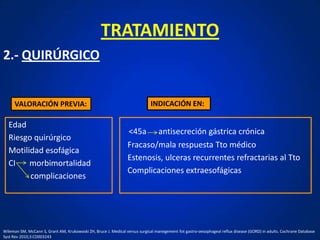
TRATAMIENTO
2.- QUIRÚRGICO
<45a antisecreción gástrica crónica
Fracaso/mala respuesta Tto médico
Estenosis, ulceras recurrentes refractarias al Tto
Complicaciones extraesofágicas
Edad
Riesgo quirúrgico
Motilidad esofágica
CI morbimortalidad
complicaciones
VALORACIÓN PREVIA: INDICACIÓN EN:
Wileman SM, McCann S, Grant AM, Krukowoski ZH, Bruce J. Medical versus surgical manegement fot gastro-oesophageal reflux disease (GORD) in adults. Cochrane Database
Syst Rev 2010;3:CD003243
TRATAMIENTO
1.- QUIRÚRGICO
PROCEDIMIENTO ABORDAJE CARACTERÍSTICAS
Nissen Torácico
Abdominal abierto
Laparoscópico
Pliegue completo del estómago alrededor del esófago
Belsey Tórax Acentuación de ángulo GE, anclaje de estómago bajo
diafragma
Hill Abdomen abierto
Laparoscópico
Pliegue lateral del estómago alrededor del esófago, anclaje
al pilar del diafragma
Gastroplastía
de Collis
Abdomen Alargamiento esofágico creando tubo con mucosa gástrica
Angelchik Abdominal Anillo de silicona alrededor del esófago bajo diafragma
Wileman SM, McCann S, Grant AM, Krukowoski ZH, Bruce J. Medical versus surgical manegement fot gastro-oesophageal reflux disease (GORD) in adults. Cochrane Database
Syst Rev 2010;3:CD003243
TRATAMIENTO
1.- QUIRÚRGICO
• Complicaciones
-Disfagia
-Sd de retención gaseosa
distención abdominal
flatulencia
hipo
-Imposibilidad para vomitar
-Hernia paraesofágica
INTRAOPERATORIAS EXTRAOPERATORIAS
-Perforación esofágica
-Lesión hepática
-Perforación gástrica
-Sangrado
-Lesión esplénica
-Esplenectomía
-Neumotórax
-Enfisema mediastínico
Wileman SM, McCann S, Grant AM, Krukowoski ZH, Bruce J. Medical versus surgical manegement fot gastro-oesophageal reflux disease (GORD) in adults. Cochrane Database
Syst Rev 2010;3:CD003243
TRATAMIENTO
1.- QUIRÚRGICO
http://www.taringa.net/posts/salud-bienestar/9039101/cirugia-funduplicatura-
de-nissen.html
http://www.aecirujanos.es/publicados_por_la_AEC/guia_cirugia_endoscopica/cap27_endosc
opica.pdf
- Posición adecuada
- Colocar trocars
- Crear neumoperitoneo
- Exponer campo operatorio
- Disección hiato
- Cierre pilares
TÉCNICA
Tratamiento de Enfermedades Gastroenterologicas. Asociación Española de
Gastroenterología. Cap 3: ERGE. Ponce García J y Garrigues Gil V.
• No mortalidad trans ni posquirúrgica-
• Estancia intrahospitalaria promedio de 5 días.
• Seguimiento por 49 meses, pacientes
asintomáticos.
• No recurrencias.
• Alternativa para pacientes cuyas morbilidades
contraindiquen acceso laparoscópico.
Markakis et al. BMC Surgery 2013, 13:24
Belsey – Mark IV
BMC Surgery 2013, 13:24
• RGE relativamente frecuente
• No existe correlación entre síntomas y lesión en la mucosa
• El diagóstico gold standard es la Phmetría 24hrs (S/E 96%)
• La impedanciometria puede llegar a desplazar a la Phmetría
• Tto médico>Tto quirúrgico
• Eficacia: IBP>antiH2
• >supresión ácida, >curación de las lesiones de la mucosa
• Técnica de funduplicatura de Nissen
CONCLUSIONES
Gastrointestinal Endoscopy. April 2005.Vol. 65. Number 4.
Kahrilas, Peter J., Gastroesophageal Reflux Disease, 2008, The New England Journal of
Medicine 359;16
Martínez, Luisa; Munitiz, Vicente, Ortiz, Ángeles. Monitorización ambulatoria del pH
esofágico con pH-metría sin sonda (sistema Bravo). Estudio de tolerancia, seguridad y
eficacia. Published in Cir Esp. 2008;84:201-9.-vol.84 núm 04
Visible Endoscopy and histologic changes in the cardia, before and after complete Barrett’s
esophagus ablation. Gastrointestinal Endoscopy. April 2005.
http://www.guiasgastro.net/cgibin/wbdcgi.exe/gastro/guis_completa.go_doc?pident=5&pti
po=normal&pident_guia=2
Medicina Interna FARRERAS ROZMAN 14 edición 2000.
BIBLIOGRAFÍA
Markakis C, Tomos P, Spartalis ED, Lampropoulos P, Grigorakos L, Dimitroulis D, Lachanas E, Agathos EA. The
Belsey Mark IV: an operation with an enduring role in the management of complicated hiatal hernia. BMC
Surg 2013 Jul 5;13:24.
Wileman SM, McCann S, Grant AM, Krukowoski ZH, Bruce J. Medical versus surgical manegement fot gastro-
oesophageal reflux disease (GORD) in adults. Cochrane Database Syst Rev 2010;3:CD003243
Tratamiento de Enfermedades Gastroenterologicas. Asociación Española de Gastroenterología. Cap 3: ERGE.
Ponce García J y Garrigues Gil V.
Klinkenberg-Knol EC, Nelis F, DentJ, Suel P,Mitchell B, Prichard P et al. Long term omeprazole treatment in
resistant gastroesophageal reflux disease: efficacy, safety, and influence on gastric mucosa. Gastroenterology
2000:118:661-69.
De Vault KR. Overview of medical therapy for gastroesophageal reflux disease Gastroenterol Clinic. North Am
1999; 28: 831-45
BIBLIOGRAFÍA
ACTUALIZACIÓN EN DIAGNÓSTICO Y
TRATAMIENTO DE ERGE
Dr. Julián Zilli García.
Médico Residente de Segundo año.
Cirugía General.
Agosto 2013.

ERGE - Brevario

  • 1.
    ACTUALIZACIÓN EN DIAGNÓSTICOY TRATAMIENTO DE ERGE Dr. Julián Zilli García. Médico Residente de Segundo año. Cirugía General. Agosto 2013.
  • 2.
    • Concepto dereflujo • Fisiológico v/s Patológico • Concepto de ERGE DEFINICIÓN http://www.medicinenet.com/gastroesophageal_reflux_disease_gerd/article.htm Medicina Interna FARRERAS ROZMAN 14 edicion 2000.
  • 3.
  • 4.
    1.- Ubicación ANATOMÍA EES M.cricofaríngeo Botón Ao/ Bronquio principal izq EEI Hiato diafragmático Zonas de estrechez http://www.facmed.unam.mx/deptos/anatomia/computo/Finaleso/estrecha.html 1.5cm 1.6cm 1.9cm Medicina Interna FARRERAS ROZMAN 14 edicion 2000.
  • 5.
    2.- Histología ANATOMÍA 4 capas Mucosa Submucosa Muscularpropia Adventicia / Serosa http://www.fcnym.unlp.edu.ar/catedras/histologia/archivos%20MatDid/ Atlas%20Di%20Fiore/difiore.html
  • 6.
    3.- Irrigación ANATOMÍA Arterial Venoso Shwartz,seymour; Principios de Cirugía, editorial Mc g GauHill, 9° edición, 2011, Capítilo n°25: Esófago y Hernias diafragmáticas, págs 808, 809
  • 7.
  • 8.
    - Anillo diafragmáticohiatal - Esófago abdominal - Ángulo de His - AA y BB - H: GASTR y MOT FISIOLOGÍA - Aumento de PIA - Volumen gástrico - Vaciamiento gástrico - BA y AB - H: CCK, EST, GLUC, PROG, SS, SECR Mecanismos de cierre Mecanismos de apertura BARRERA ANTI REFLUJO http://es.dreamstime.com/foto-de-archivo- torso-humano-image2863610 Medicina Interna FARRERAS ROZMAN 14 edicion 2000.
  • 9.
    PATOGÉNESIS FACTOR ANATÓMICO DISMINUCIÓN DEL TONO EEI RETRASO DEL VACIAMIENTO GÁSTRICO AUMENTODE LA PIA INSUFICIENCIA MOTORA ESOFÁGICA PÉRDIDA DEL PERISTALTISMO RESISTENCIA DE LA MUCOSA ESOFÁGICA IATROGÉNICO MULTIFACTORIAL Medicina Interna FARRERAS ROZMAN 14 edicion 2000.
  • 10.
    FACTORES DE RIESGO •Edad • Sexo • Raza • Embarazo • Enfermedades • Obesidad • Dieta • Ejercicio físico • Tabaco/Alcohol • Fármacos • Hernia hiatal • Genética (40%) • Cx esofágica previa • Alt. neurológica “REFLUJO MIXTO” Kahrilas, Peter J., Gastroesophageal Reflux Disease, 2008, The New England Journal of Medicine 359;16
  • 11.
    MANIFESTACIONES CLÍNICAS 1. ST.Típicos: GRADO 1 Eritema , erosiones superficiales GRADO 2 Erosiones confluentes GRADO 3 Erosiones confluentes y circunferenciales GRADO 4 Ulceraciones, fibrosis, estenosis GRADO 5 Barrett Esofagitis por reflujo • Pirosis • Regurgitación • Dolor epigástrico Savary miller Kahrilas, Peter J., Gastroesophageal Reflux Disease, 2008, The New England Journal of Medicine 359;16
  • 12.
    MANIFESTACIONES CLÍNICAS 2. ST.Atípicos: • Dolor torácico NC • Disfagia orofaríngea • Disfagia esofágica • Tos crónica • Ronquera • Asma • Sangrado oculto • Pérdida de peso • Neumonía recurrente • Anorexia • Anemia • Alt. del sueño • Desgaste del esmalte dental • Sialorrea • Náuseas • Vómitos Kahrilas, Peter J., Gastroesophageal Reflux Disease, 2008, The New England Journal of Medicine 359;16
  • 13.
    MANIFESTACIONES CLÍNICAS 2. SíntomasAtípicos: • Dolor torácico • Disfagia • Disfagia esofágica • Tos crónica • Voz ronca • Asma • Sangrado oculto • Pérdida de peso • Neumonía recurrente • Anorexia • Anemia • Al. del sueño • Desgaste del esmalte dental • Sialorrea • Náuseas • Vómitos ALARMA Kahrilas, Peter J., Gastroesophageal Reflux Disease, 2008, The New England Journal of Medicine 359;16
  • 14.
    HISTORIA NATURAL DISPLASIA REFLUJO PATOLÓGICO ERGE ESÓFAGO DE BARRET ADENO CARCINOMA Kahrilas,Peter J., Gastroesophageal Reflux Disease, 2008, The New England Journal of Medicine 359;16
  • 15.
  • 16.
    • Mundial 5% •USA 20% • Europa 18% • Asia 5% EPIDEMIOLOGÍA • Incidencia de 5,4/1000 casos al año (USA) • Sintomáticos: 25% mensual, 12% semanal, 5% diario • 27% se automedica más de dos veces al mes • 7/10 personas sintomáticas consultan (RU) • 40% sintomáticos Dg de esofagitis (Suecia) • 33% ADULTOS SINTOMÁTICOS Manterola, Carlos; Bustos, Luis; Vial, Manuel. Prevalencia de ERGE en población general urbana adulta; Revista Chilena de cirugía. Vol 57-n°6, Diciembre 2005; pag 476
  • 17.
    1. Asintomáticos 2. Sintomáticoscon reflujo FS 3. ERGE sin esofagitis 4. Esofagitis con o sin ST CLÍNICA Kahrilas, Peter J., Gastroesophageal Reflux Disease, 2008, The New England Journal of Medicine 359;16
  • 18.
    CLÍNICA ¿A QUIENES SELES DEBE INDICAR UN ESTUDIO COMPLEMENTARIO? 1. Asintomáticos 2. Sintomáticos con reflujo FS 3. ERGE sin esofagitis 4. Esofagitis con o sin ST Kahrilas, Peter J., Gastroesophageal Reflux Disease, 2008, The New England Journal of Medicine 359;16
  • 19.
    CLÍNICA ¿A QUIENES SELES DEBE INDICAR UN ESTUDIO COMPLEMENTARIO? 1. Asintomáticos 2. Sintomáticos con reflujo FS 3. ERGE sin esofagitis 4. Esofagitis con o sin ST St. de alarma St. atípicos de ERGE Refractariedad al Tto médico Considerando Tto quirúrgico Kahrilas, Peter J., Gastroesophageal Reflux Disease, 2008, The New England Journal of Medicine 359;16
  • 20.
    TÉCNICAS DIAGNÓSTICAS A) MONITORIZACIÓNPH 24 HRS • Estudio ambulatorio funcional • Cuantifica frecuencia-duración del RGE • Relación posición e ingesta • Capacidad de eliminación de RGE • 2 tipos: CONVENCIONAL SN 5cm bajo EEI DE ALTA RESOLUCIÓN cápsula en UGE Información va a un holter Correlaciona exposición y síntomas Kahrilas, Peter J., Gastroesophageal Reflux Disease, 2008, The New England Journal of Medicine 359;16
  • 21.
    TÉCNICAS DIAGNÓSTICAS A) MONITORIZACIÓNPH 24 HRS DE ALTA RESOLUCIÓN Martínez, Luisa; Munitiz, Vicente, Ortiz, Ángeles. Monitorización ambulatoria del pH esofágico con pH-metría sin sonda (sistema Bravo). Estiudio de tolerancia, seguridad y eficacia. Published in Cir Esp. 2008;84:201-9.-vol.84 núm 04
  • 22.
    TÉCNICAS DIAGNÓSTICAS A) MONITORIZACIÓNPH 24 HRS - RGE sintomáticos con EDA(-) - Refractariedad al Tto - Evaluar correlación ST-RGE - Documentar RGE pre-post Cx INDICACIONES CONSIDERACIONES PREVIAS Desayuno normal Almuerzo liviano 12pm Suspender Fcos 7d antes http://www.telefonica.net/web2/funcionales/phmetria.htm Kahrilas, Peter J., Gastroesophageal Reflux Disease, 2008, The New England Journal of Medicine 359;16
  • 23.
    Tiempo% exposición (pH<4) N° total episodios de RGE N° de episodios >5min TÉCNICAS DIAGNÓSTICAS A) MONITORIZACIÓN PH 24 HRS INTERPRETACIÓN VENTAJAS Dg de ERGE Correlación St-RGE Valora efectividad al Tto DESVENTAJAS No muestra lesión mucosa No valora reflujo alcalino Kahrilas, Peter J., Gastroesophageal Reflux Disease, 2008, The New England Journal of Medicine 359;16
  • 24.
    TÉCNICAS DIAGNÓSTICAS A) MONITORIZACIÓNPH 24 HRS INTERPRETACIÓN http://www.telefonica.net/web2/funcionales/phmetria.htm
  • 25.
    TÉCNICAS DIAGNÓSTICAS A) MONITORIZACIÓNPH 24 HRS INTERPRETACIÓN http://www.telefonica.net/web2/funcionales/phmetria.htm
  • 26.
    TÉCNICAS DIAGNÓSTICAS B) IMPEDANCIOMETRIA(IIM) • Medida de conductividad de víscera hueca y contenido • Detecta resist. al FCA entre electrodos • Registra reflujo ácido/no ácido • Diferencia líquido( )/gas( ) • Útil en pacientes más complejos VENTAJAS SOBRE PHETRÍA Kahrilas, Peter J., Gastroesophageal Reflux Disease, 2008, The New England Journal of Medicine 359;16
  • 27.
    TÉCNICAS DIAGNÓSTICAS C) MANOMETRÍA •Estudio de presiones y motilidad • SN con sensores detecta de presión • Dura 30-45 min • Acostado • Útil en Dg de trastornos motores del esófago Kahrilas, Peter J., Gastroesophageal Reflux Disease, 2008, The New England Journal of Medicine 359;16
  • 28.
    TÉCNICAS DIAGNÓSTICAS C) MANOMETRÍA •Evalúa deglución EES y EEI Presión EEI<6mmhg Segmento intraabdominal <1cm Longitud total EEI<2cm PARÁMETROS http://www.telefonica.net/web2/funcionales/manometriaesofagica.htm Kahrilas, Peter J., Gastroesophageal Reflux Disease, 2008, The New England Journal of Medicine 359;16
  • 29.
    Shwartz, seymour; Principiosde Cirugía, editorial Mc g GauHill, 9° edición, 2011, Capítilo n°25: Esófago y Hernias diafragmáticas, pag 818 TÉCNICAS DIAGNÓSTICAS C) MANOMETRÍA
  • 30.
    http://mujer-bonita.net/tag/endoscopia-digestiva TÉCNICAS DIAGNÓSTICAS D) ENDOSCOPÍADIGESTIVA ALTA • Indoloro (anestesia local, sedación ev) • Dura 5min • Evalúa • Descarta otras patologías • Permite biopsia y Tto Presencia/severidad esofagitis Lesiones ulceradas Esófago de barrett Gastrointestinal Endoscopy. April 2005.Vol. 65. Number 4.
  • 31.
    TÉCNICAS DIAGNÓSTICAS E) RADIOGRAFÍACON BARIO • Transición EG seriada • Contraste radio opaco • Sensible, fácil acceso • Poco específica falsos(+) • Evalúa Anatomía Motilidad EG Deglución http://www.mednet.cl/link.cgi/Medwave/PuestaDia/Cursos/3246 http://www.guiasgastro.net/cgibin/wbdcgi.exe/gastro/guis_completa.go_doc?pident=5&ptipo=normal&pident_guia=2
  • 32.
    TÉCNICAS DIAGNÓSTICAS F) CINTIGRAFÍACON TC99 • Recuento pre y post solución de Tc • Cámara gamma registra imágenes del descenso • Gran falso(-) no aprecia el RGE • Abandonada por radiación http://www.revistasbolivianas.org.bo/scielo.php?script=sci_arttext& pid=S0004-05252009000300013&lng=es&nrm=isohttp://www.guiasgastro.net/cgibin/wbdcgi.exe/gastro/guis_completa.go_doc?piden t=5&ptipo=normal&pident_guia=2
  • 33.
    TÉCNICAS DIAGNÓSTICAS G) BILITEC •Cuantifica niveles de bilis en esófago • Dg reflujo biliar • Duración 24Hrs • Correlación St-actividad-posición http://www.guiasgastro.net/cgibin/wbdcgi.exe/gastro/guis_completa.go_doc?pident=5&ptipo=normal&pident_guia=2
  • 34.
  • 35.
    TÉCNICAS DIAGNÓSTICAS F) PRUEBADE BERNSTEIN • Perfusión de ácido en esófago • SN hasta porción ½ torácica SF 150gotas/min x 5 min Sustituido por HCL 0.1N molestias en 10mins = esofagitis • Abandonado http://www.iqb.es/digestivo/pruebas/bernstein.htm http://www.guiasgastro.net/cgibin/wbdcgi.exe/gastro/guis_completa.go_doc?piden t=5&ptipo=normal&pident_guia=2
  • 36.
    TRATAMIENTO 1.- MÉDICO a) Modificacionesen el estilo de vida EVITAR • Cabecera <10cm de inclinación • Decúbito postprandial • Comer 3-4 antes de dormir • Comidas copiosas • Grasas, chocolate, menta, alcohol • Sobrepeso • Tabaco • Ropa ajustada • Sedentarismo • Fármacos de riesgo De Vault KR. Overview of medical therapy for gastroesophageal reflux disease Gastroenterol Clinic. North ARM 1999; 28: 831-45 Klinkenberg-Knol EC, Nelis F, DentJ, Suel P,Mitchell B, Prichard P et al. Long term omeprazole treatment in resistant gastroesophageal reflux disease: efficacy, safety, and influence on gastric mucosa. Gastroenterology 2000:118:661-69.
  • 37.
    TRATAMIENTO 1.- MÉDICO b) Farmacológico OBJETIVOS •Reducir exposición al contenido gástrico • Aliviar síntomas • Curar esofagitis • Prevenir y tratar complicaciones Estenosis pilórica Úlceras Barrett HDAKlinkenberg-Knol EC, Nelis F, DentJ, Suel P,Mitchell B, Prichard P et al. Long term omeprazole treatment in resistant gastroesophageal reflux disease: efficacy, safety, and influence on gastric mucosa. Gastroenterology 2000:118:661-69.
  • 38.
    TRATAMIENTO 1.- MÉDICO b) Farmacológico ANTISECRETORES Klinkenberg-KnolEC, Nelis F, DentJ, Suel P,Mitchell B, Prichard P et al. Long term omeprazole treatment in resistant gastroesophageal reflux disease: efficacy, safety, and influence on gastric mucosa. Gastroenterology 2000:118:661-69. IBP antiH2 Mejoría 50% 25% Supresión HCl >90% 70% Curación esofagitis 4S 67-85% 26-45% 8S 85-96% 40-60% Indicación -Esofagitis erosiva -ERGE -Esofagitis no erosiva
  • 39.
    • Dosis: • Duración:4-12 sem (según gravedad) • Fracaso: persistencia St >12 sem (comprobar cumplimiento) TRATAMIENTO -Omeprazol: 20 mg -Lansoprazol: 30 mg -Pantoprazol: 40 mg -Esomeprazol: 40 mg -Ranitidina: 150-300 mg 1.- MÉDICO b) Farmacológico Klinkenberg-Knol EC, Nelis F, DentJ, Suel P,Mitchell B, Prichard P et al. Long term omeprazole treatment in resistant gastroesophageal reflux disease: efficacy, safety, and influence on gastric mucosa. Gastroenterology 2000:118:661-69.
  • 40.
    TRATAMIENTO 1.- MÉDICO b) Farmacológico PROCINÉTICOSANTIÁCIDOS •Aumentan: -act colinérgica en céls musc esofágicas -peristalsis esofágica -vaciamiento gástrico -tono del EEI •Ej: Cisaprida, Domperidona, Metoclopramida, Betanecol •Cisaprida: 63% curación esofagitis Grado I-II •Neutralizan HCL •Inhiben Pepsina •Mejoran constipación •Precaución con patología renal De Vault KR. Overview of medical therapy for gastroesophageal reflux disease Gastroenterol Clinic. North ARM 1999; 28: 831-45
  • 41.
    TRATAMIENTO 1.- MÉDICO b) Farmacológico ALCALINOSY AC. ALGÍNICO PROTECTORES DE LA MUCOSA •Adherencia a exudados proteicos de lesiones ulceradas •Inhibe pepsina •Actúa como quelante de sales biliares •Útil en reflujo alcalino •Ej: Sucralfato •Solos o asociados •Ác. Algínico: barrera mecánica al flotar sobre el contenido gástrico •Control puntual de síntomas leves De Vault KR. Overview of medical therapy for gastroesophageal reflux disease Gastroenterol Clinic. North ARM 1999; 28: 831-45
  • 42.
    TRATAMIENTO 2.- QUIRÚRGICO <45a antisecrecióngástrica crónica Fracaso/mala respuesta Tto médico Estenosis, ulceras recurrentes refractarias al Tto Complicaciones extraesofágicas Edad Riesgo quirúrgico Motilidad esofágica CI morbimortalidad complicaciones VALORACIÓN PREVIA: INDICACIÓN EN: Wileman SM, McCann S, Grant AM, Krukowoski ZH, Bruce J. Medical versus surgical manegement fot gastro-oesophageal reflux disease (GORD) in adults. Cochrane Database Syst Rev 2010;3:CD003243
  • 43.
    TRATAMIENTO 1.- QUIRÚRGICO PROCEDIMIENTO ABORDAJECARACTERÍSTICAS Nissen Torácico Abdominal abierto Laparoscópico Pliegue completo del estómago alrededor del esófago Belsey Tórax Acentuación de ángulo GE, anclaje de estómago bajo diafragma Hill Abdomen abierto Laparoscópico Pliegue lateral del estómago alrededor del esófago, anclaje al pilar del diafragma Gastroplastía de Collis Abdomen Alargamiento esofágico creando tubo con mucosa gástrica Angelchik Abdominal Anillo de silicona alrededor del esófago bajo diafragma Wileman SM, McCann S, Grant AM, Krukowoski ZH, Bruce J. Medical versus surgical manegement fot gastro-oesophageal reflux disease (GORD) in adults. Cochrane Database Syst Rev 2010;3:CD003243
  • 44.
    TRATAMIENTO 1.- QUIRÚRGICO • Complicaciones -Disfagia -Sdde retención gaseosa distención abdominal flatulencia hipo -Imposibilidad para vomitar -Hernia paraesofágica INTRAOPERATORIAS EXTRAOPERATORIAS -Perforación esofágica -Lesión hepática -Perforación gástrica -Sangrado -Lesión esplénica -Esplenectomía -Neumotórax -Enfisema mediastínico Wileman SM, McCann S, Grant AM, Krukowoski ZH, Bruce J. Medical versus surgical manegement fot gastro-oesophageal reflux disease (GORD) in adults. Cochrane Database Syst Rev 2010;3:CD003243
  • 45.
    TRATAMIENTO 1.- QUIRÚRGICO http://www.taringa.net/posts/salud-bienestar/9039101/cirugia-funduplicatura- de-nissen.html http://www.aecirujanos.es/publicados_por_la_AEC/guia_cirugia_endoscopica/cap27_endosc opica.pdf - Posiciónadecuada - Colocar trocars - Crear neumoperitoneo - Exponer campo operatorio - Disección hiato - Cierre pilares TÉCNICA Tratamiento de Enfermedades Gastroenterologicas. Asociación Española de Gastroenterología. Cap 3: ERGE. Ponce García J y Garrigues Gil V.
  • 46.
    • No mortalidadtrans ni posquirúrgica- • Estancia intrahospitalaria promedio de 5 días. • Seguimiento por 49 meses, pacientes asintomáticos. • No recurrencias. • Alternativa para pacientes cuyas morbilidades contraindiquen acceso laparoscópico. Markakis et al. BMC Surgery 2013, 13:24
  • 47.
    Belsey – MarkIV BMC Surgery 2013, 13:24
  • 48.
    • RGE relativamentefrecuente • No existe correlación entre síntomas y lesión en la mucosa • El diagóstico gold standard es la Phmetría 24hrs (S/E 96%) • La impedanciometria puede llegar a desplazar a la Phmetría • Tto médico>Tto quirúrgico • Eficacia: IBP>antiH2 • >supresión ácida, >curación de las lesiones de la mucosa • Técnica de funduplicatura de Nissen CONCLUSIONES
  • 49.
    Gastrointestinal Endoscopy. April2005.Vol. 65. Number 4. Kahrilas, Peter J., Gastroesophageal Reflux Disease, 2008, The New England Journal of Medicine 359;16 Martínez, Luisa; Munitiz, Vicente, Ortiz, Ángeles. Monitorización ambulatoria del pH esofágico con pH-metría sin sonda (sistema Bravo). Estudio de tolerancia, seguridad y eficacia. Published in Cir Esp. 2008;84:201-9.-vol.84 núm 04 Visible Endoscopy and histologic changes in the cardia, before and after complete Barrett’s esophagus ablation. Gastrointestinal Endoscopy. April 2005. http://www.guiasgastro.net/cgibin/wbdcgi.exe/gastro/guis_completa.go_doc?pident=5&pti po=normal&pident_guia=2 Medicina Interna FARRERAS ROZMAN 14 edición 2000. BIBLIOGRAFÍA
  • 50.
    Markakis C, TomosP, Spartalis ED, Lampropoulos P, Grigorakos L, Dimitroulis D, Lachanas E, Agathos EA. The Belsey Mark IV: an operation with an enduring role in the management of complicated hiatal hernia. BMC Surg 2013 Jul 5;13:24. Wileman SM, McCann S, Grant AM, Krukowoski ZH, Bruce J. Medical versus surgical manegement fot gastro- oesophageal reflux disease (GORD) in adults. Cochrane Database Syst Rev 2010;3:CD003243 Tratamiento de Enfermedades Gastroenterologicas. Asociación Española de Gastroenterología. Cap 3: ERGE. Ponce García J y Garrigues Gil V. Klinkenberg-Knol EC, Nelis F, DentJ, Suel P,Mitchell B, Prichard P et al. Long term omeprazole treatment in resistant gastroesophageal reflux disease: efficacy, safety, and influence on gastric mucosa. Gastroenterology 2000:118:661-69. De Vault KR. Overview of medical therapy for gastroesophageal reflux disease Gastroenterol Clinic. North Am 1999; 28: 831-45 BIBLIOGRAFÍA
  • 51.
    ACTUALIZACIÓN EN DIAGNÓSTICOY TRATAMIENTO DE ERGE Dr. Julián Zilli García. Médico Residente de Segundo año. Cirugía General. Agosto 2013.