ACTUALIZACION TERAPEUTICA DE
CEFALEA EN LA EMBARAZADA

Interna Romina Verdugo
Interno Eduardo Neira
Internado neurología HFBC
INTRODUCCIÓN
   • Más del 90% tienen un dolor de cabeza pre-
     existente
   • menos del 10% desarrollan dolor de cabeza de
     nueva aparición
   • La migraña mejora en 2 de cada 3 embarazadas,
     en el 30% se mantiene y 5% empeora.


(1)Contemporary management of migrainous disorders in pregnancy Stephen A. Contaga and Cheryl Bushnellb,
Current Opinion in Obstetrics and Gynecology USA 2010, 22:437–445
(2)Migraña y gestación: una relación compleja, Hospital Universitario Marqués España, Rev Neurol 2010
FR migraña durante embarazo
   •   IMC pregestacional > 25
   •   < 5 hrs sueño por la noche
   •   Desempleo
   •   Depresión
   •   Asma
   •   HTA
   •   Suspensión ISRS


Contemporary management of migrainous disorders in pregnancy Stephen A. Contaga and Cheryl
Bushnellb, Current Opinion in Obstetrics and Gynecology USA 2010, 22:437–445
CEFALEAS PRIMARIAS
   • migraña y cefalea tensional
   • Generalmente durante el 1° semestre
   • mejora durante las últimas etapas del embarazo
     (aprox 50-80% migraña y 30% tensional)


Contemporary management of migrainous disorders in pregnancy Stephen A. Contaga and Cheryl
Bushnellb, Current Opinion in Obstetrics and Gynecology USA 2010, 22:437–445
CEFALEAS SECUNDARIAS
   • En cualquier momento durante el embarazo,
     más frecuentemente en el tercer trimestre.

   • Causas: ACV, trombosis venosa central,
     malformaciones arterio venosas, TU cerebral ,
     hipertension intracraneal benigna


Contemporary management of migrainous disorders in pregnancy Stephen A. Contaga and Cheryl
Bushnellb, Current Opinion in Obstetrics and Gynecology USA 2010, 22:437–445
MANEJO NO FARMACOLÓGICO
       • Dieta:
           ▫ Evitar la hipoglicemia
           ▫ Reconocer comidas que puedan desencadenar
             cefalea
           ▫ Adecuada hidratación
       •   Sueño adecuado (> 6 hrs)
       •   Evitar situaciones estresantes
       •   Ejercicio aeróbico moderado
       •   No fumar
       •   Acupuntura
1. Non-pharmacological management of migraine during pregnancy Gisella Airola Neurol Sci (2010) 31 (Suppl 1):S63–S65
2. Contemporary management of migrainous disorders in pregnancy Stephen A. Contaga and Cheryl Bushnellb, Current Opinion
in Obstetrics and Gynecology USA 2010, 22:437–445
MEDIDAS FARMACOLÓGICAS
 • Manejar:
     ▫ cuadro agudo y prevención
 • Evaluar su necesidad según:
     ▫   Frecuencia (>2 veces a la sem)
     ▫   intensidad de la migraña
     ▫   duración de los síntomas
     ▫   síntomas asociados
     ▫   grado de discapacidad
     ▫   interferencia con las actividades de la vida diaria.


Contemporary management of migrainous disorders in pregnancy Stephen A. Contaga and Cheryl Bushnellb,
Current Opinion in Obstetrics and Gynecology USA 2010, 22:437–445
OPCIONES DE TRATAMIENTO
       • Métodos para determinar riesgo terapia
         farmacológica
       • Más utilizado: Sistema evaluación de riesgo de la
         FDA (1996).
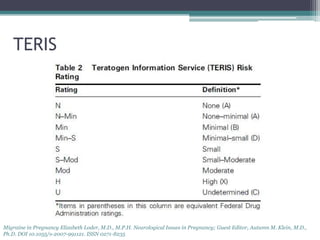
       • Otros: Servicio de información teratogénica
         (TERIS), que clasifica fármacos de acuerdo a
         riesgo teratogénico y no por escala de
         riesgo/beneficio

Migraine in Pregnancy Elizabeth Loder, M.D., M.P.H. Neurological Issues in Pregnancy; Guest Editor, Autumn M. Klein,
M.D., Ph.D. DOI 10.1055/s-2007-991121. ISSN 0271-8235
FDA


Migraine in Pregnancy Elizabeth Loder, M.D., M.P.H. Neurological Issues in Pregnancy; Guest Editor, Autumn M. Klein, M.D.,
Ph.D. DOI 10.1055/s-2007-991121. ISSN 0271-8235
TERIS


Migraine in Pregnancy Elizabeth Loder, M.D., M.P.H. Neurological Issues in Pregnancy; Guest Editor, Autumn M. Klein, M.D.,
Ph.D. DOI 10.1055/s-2007-991121. ISSN 0271-8235
Tratamiento sintomáticos
TRIPTANES
       • Clasificación C de acuerdo a FDA.

       • Investigación más reciente: no existen casos de
         teratogenia secundarios a su uso.

       • El mas indicado en los estudios es el
         Sumatriptan
       • Usado durante el segundo y tercer trimestre ha
         presentado casos de hemorragia postparto por
         útero atónico
Migraine in Pregnancy Elizabeth Loder, M.D., M.P.H. Neurological Issues in Pregnancy; Guest Editor, Autumn M. Klein, M.D.,
Ph.D. DOI 10.1055/s-2007-991121. ISSN 0271-8235
Loder E. Safety of sumatriptan in pregnancy: a review of the data so far. CNS Drugs 2003;17:1–7
ERGOTAMINA
        • Contraindicación basada en estudios que
          demuestran disminución importante del flujo
          uterino  hipoxia fetal y RCIU .                                      (1)


        • Existen reportes de casos de malformaciones
          especificas relacionadas a uso de ergotamina                                                          (2)


(1)Acs N, Banhidy F, Puho E, Czeizel AE. A possible dosedependent teratogenic effect of ergotamine. Reprod Toxicol 2006;22:551–
552
(2) Raymond GV. Teratogen update: ergot and ergotamine. Teratology 1995;51:344–347
AINEs
• En general, se evita uso en embarazo,
  particularmente durante        3er trimestre (cierre
  precoz ducto arterioso)
• FDA: C en el 1° y 2° trimestre y la categoría D en el
  tercer trimestre
• Paracetamol (clase A) eficacia es <10% en migraña
• Fármacos que se deben evitar: Inhibidores de
  síntesis de PGs (AAS, Indometacina)
- AAS en bajas dosis y ocasionalmente puede ser
  usada.
• AINEs menos potentes: Ibuprofeno, se puede
  administrar con seguridad en primer trimestre.
(1) Migraña y gestación: una relación compleja, Hospital Universitario Marqués España, Rev Neurol 2010
(2)Contemporary management of migrainous disorders in pregnancy Stephen A. Contaga and Cheryl Bushnellb,
Current Opinion in Obstetrics and Gynecology USA 2010, 22:437–445
BARBITÚRICOS Y BENZODIAZEPINAS


     • Limitación a su uso mejor avalada.
     • Frecuentemente asociadas a abuso.
     • BZD: Sd. Abstinencia neonatal
     • Barbitúricos: Efectos en desarrollo neurológico.


Reinisch JM, Sanders SA, Mortensen EL, Rubin DB. In utero exposure to phenobarbital and intelligence deficits in adult men.
JAMA 1995;274:1518–1525
Holmes LB, Coull BA, Dorfman J, Rosenberger PB. The correlation of deficits in IQ with midface and digit hypoplasia in
children exposed in utero to anticonvulsant drugs. J Pediatr 2005;146:118–122
OTROS
   • Productos naturales poco estudiados.
   • Hierba de Santa María: posible teratogenia(1)
   • Metoclopramida, domperidona, proclorperacina,
     clorpromacina: Exposición sin asociación riesgo
     significativo de malformaciones congénitas
     mayores (2)
   • Náuseas tratadas con Vit B6: sin evidencia de
     teratogenia.
   - Terapia combinada más efectiva.
(1) Yao M, Ritchie HE, Brown-Woodman PD. A reproductive screening test of feverfew: is a full reproductive study
warranted? Reprod Toxicol 2006;22:688–693.
(2) Ilan Matok, M.Sc.Pharm., Rafael Gorodischer, M.D., Gideon Koren, M.D., Eyal Sheiner, M.D., Ph.D., Arnon Wiznitzer,
M.D., and Amalia Levy, M.P.H., Ph.D. The Safety of Metoclopramide Use in the First Trimester of Pregnancy . N Engl J Med
OTROS
 • Opiaceos: categoria C, eficacia limitada, riesgo
   de dependencia materna y fetal
 • Corticoides: en ocasiones son útiles para los
   ataques prolongados de migraña.
 - Prednisona v/s Dexametasona porque la última
   atraviesa placenta más fácilmente.
 - Evidencia: 1er trimestre, no hay riesgo teratogénico
   importante.

(1)Gur C, Diav-Citrin O, Shechtman S, Arnon J, Ornoy A. Pregnancy outcome after first trimester exposure to corticosteroids: a
prospective controlled study. Reprod Toxicol 2004;18:93–101
(2)Leung TN, Lam PM, Ng PC, Lau TK. Repeated courses of antenatal corticosteroids: is it justified? Acta Obstet Gynecol Scand
2003;82:589–596
(3)Contemporary management of migrainous disorders in pregnancy Stephen A. Contaga and Cheryl Bushnellb, Current
TRATAMIENTO PREVENTIVO
       • Beta-bloqueadores     (Propanolol*,     timolol)
         preferido como terapia preventiva de la cefalea
         en embarazadas.
       • FDA: Clase C
       • Se    han    reportado    eventos     adversos,
         principalmente    retardo   del     crecimiento
         intrauterino


Buchanan TM, Ramadan NM. Prophylactic pharmacotherapy for migraine headaches. Semin Neurol 2006;26:188–198
Pfaffenrath V, Rehm M. Migraine in pregnancy: what are the safest treatment options? Drug Saf 1998;19:383–388
TRATAMIENTO PREVENTIVO
  • Antiepilepticos:
      ▫ Topiramato (clase C) DE 2° LINEA, Evitar en 1°
        tri.
      ▫ Ac. Valproico (clase D) NO RECOMENDADO
      ▫ Menor riesgo en monoterapia y bajas dosis
  • Antidepresivos
      ▫ De 2° linea, amitriptilina y fluoxetina solo
        recomendado en el 2° trimestre, clase C
      ▫ Riesgo de HT pulmonar primaria en el RN
Contemporary management of migrainous disorders in pregnancy Stephen A. Contaga and Cheryl Bushnellb, Current
Opinion in Obstetrics and Gynecology USA 2010, 22:437–445
FCOS DURANTE EL EMBARAZO


Medication Use in the Treatment of Migraine During Pregnancy and Lactation Current Pain & Headache Reports 2009, 13:392–
398 Current Medicine Group LLC ISSN 1531-3433
FCOS DURANTE EL EMBARAZO


1. Medication Use in the Treatment of Migraine During Pregnancy and Lactation Current Pain & Headache Reports 2009,
13:392–398 Current Medicine Group LLC ISSN 1531-3433
FCOS DURANTE EL EMBARAZO


1. Medication Use in the Treatment of Migraine During Pregnancy and Lactation Current Pain & Headache Reports 2009,
13:392–398 Current Medicine Group LLC ISSN 1531-3433
FCOS DURANTE EL EMBARAZO Y
      LACTANCIA


Headache and Pregnancy, Rukmini Menon, MD, and Cheryl D. Bushnell, MD, MHS , The Neurologist • Volume 14, Number 2,
March 2008
FCOS DURANTE EL EMBARAZO Y
      LACTANCIA


Headache and Pregnancy, Rukmini Menon, MD, and Cheryl D. Bushnell, MD, MHS , The Neurologist • Volume 14, Number 2,
March 2008
CEFALEA POST PARTO
  • PRIMARIA: migraña y tensional
  • SECUNDARIA: Cefalea post punción dural,
    trombosis de seno venoso, ACV

  • incidencia global es difícil de determinar (cefalea
    leves no se reportan)
  • 39% reportaron cefalea en la 1° semana post parto,
    la mayoría es tensional, 4,7% post puncion, 8,1%
    causa indeterminada(Canada, cohortes)
  • 34% migrañas recurrentes en la primera semana
    posparto y el 55% en el primer mes(Estudio
    prospectivo italiano)
Postpartum headache, A.M. Klein, E. Loder, Department of Neurology, Harvard Medical School, Boston, MA,
USA, 2010
BANDERAS ROJAS


Postpartum headache, A.M. Klein, E. Loder, Department of Neurology, Harvard Medical School, Boston, MA,
USA, 2010
DIAG. DIFERENCIAL


Postpartum headache, A.M. Klein, E. Loder, Department of Neurology, Harvard Medical School, Boston, MA,
Cefalea y embarazo

Cefalea y embarazo

  • 1.
    ACTUALIZACION TERAPEUTICA DE CEFALEAEN LA EMBARAZADA Interna Romina Verdugo Interno Eduardo Neira Internado neurología HFBC
  • 2.
    INTRODUCCIÓN • Más del 90% tienen un dolor de cabeza pre- existente • menos del 10% desarrollan dolor de cabeza de nueva aparición • La migraña mejora en 2 de cada 3 embarazadas, en el 30% se mantiene y 5% empeora. (1)Contemporary management of migrainous disorders in pregnancy Stephen A. Contaga and Cheryl Bushnellb, Current Opinion in Obstetrics and Gynecology USA 2010, 22:437–445 (2)Migraña y gestación: una relación compleja, Hospital Universitario Marqués España, Rev Neurol 2010
  • 3.
    FR migraña duranteembarazo • IMC pregestacional > 25 • < 5 hrs sueño por la noche • Desempleo • Depresión • Asma • HTA • Suspensión ISRS Contemporary management of migrainous disorders in pregnancy Stephen A. Contaga and Cheryl Bushnellb, Current Opinion in Obstetrics and Gynecology USA 2010, 22:437–445
  • 4.
    CEFALEAS PRIMARIAS • migraña y cefalea tensional • Generalmente durante el 1° semestre • mejora durante las últimas etapas del embarazo (aprox 50-80% migraña y 30% tensional) Contemporary management of migrainous disorders in pregnancy Stephen A. Contaga and Cheryl Bushnellb, Current Opinion in Obstetrics and Gynecology USA 2010, 22:437–445
  • 5.
    CEFALEAS SECUNDARIAS • En cualquier momento durante el embarazo, más frecuentemente en el tercer trimestre. • Causas: ACV, trombosis venosa central, malformaciones arterio venosas, TU cerebral , hipertension intracraneal benigna Contemporary management of migrainous disorders in pregnancy Stephen A. Contaga and Cheryl Bushnellb, Current Opinion in Obstetrics and Gynecology USA 2010, 22:437–445
  • 6.
    MANEJO NO FARMACOLÓGICO • Dieta: ▫ Evitar la hipoglicemia ▫ Reconocer comidas que puedan desencadenar cefalea ▫ Adecuada hidratación • Sueño adecuado (> 6 hrs) • Evitar situaciones estresantes • Ejercicio aeróbico moderado • No fumar • Acupuntura 1. Non-pharmacological management of migraine during pregnancy Gisella Airola Neurol Sci (2010) 31 (Suppl 1):S63–S65 2. Contemporary management of migrainous disorders in pregnancy Stephen A. Contaga and Cheryl Bushnellb, Current Opinion in Obstetrics and Gynecology USA 2010, 22:437–445
  • 7.
    MEDIDAS FARMACOLÓGICAS •Manejar: ▫ cuadro agudo y prevención • Evaluar su necesidad según: ▫ Frecuencia (>2 veces a la sem) ▫ intensidad de la migraña ▫ duración de los síntomas ▫ síntomas asociados ▫ grado de discapacidad ▫ interferencia con las actividades de la vida diaria. Contemporary management of migrainous disorders in pregnancy Stephen A. Contaga and Cheryl Bushnellb, Current Opinion in Obstetrics and Gynecology USA 2010, 22:437–445
  • 8.
    OPCIONES DE TRATAMIENTO • Métodos para determinar riesgo terapia farmacológica • Más utilizado: Sistema evaluación de riesgo de la FDA (1996). • Otros: Servicio de información teratogénica (TERIS), que clasifica fármacos de acuerdo a riesgo teratogénico y no por escala de riesgo/beneficio Migraine in Pregnancy Elizabeth Loder, M.D., M.P.H. Neurological Issues in Pregnancy; Guest Editor, Autumn M. Klein, M.D., Ph.D. DOI 10.1055/s-2007-991121. ISSN 0271-8235
  • 9.
    FDA Migraine in PregnancyElizabeth Loder, M.D., M.P.H. Neurological Issues in Pregnancy; Guest Editor, Autumn M. Klein, M.D., Ph.D. DOI 10.1055/s-2007-991121. ISSN 0271-8235
  • 10.
    TERIS Migraine in PregnancyElizabeth Loder, M.D., M.P.H. Neurological Issues in Pregnancy; Guest Editor, Autumn M. Klein, M.D., Ph.D. DOI 10.1055/s-2007-991121. ISSN 0271-8235
  • 11.
  • 12.
    TRIPTANES • Clasificación C de acuerdo a FDA. • Investigación más reciente: no existen casos de teratogenia secundarios a su uso. • El mas indicado en los estudios es el Sumatriptan • Usado durante el segundo y tercer trimestre ha presentado casos de hemorragia postparto por útero atónico Migraine in Pregnancy Elizabeth Loder, M.D., M.P.H. Neurological Issues in Pregnancy; Guest Editor, Autumn M. Klein, M.D., Ph.D. DOI 10.1055/s-2007-991121. ISSN 0271-8235 Loder E. Safety of sumatriptan in pregnancy: a review of the data so far. CNS Drugs 2003;17:1–7
  • 13.
    ERGOTAMINA • Contraindicación basada en estudios que demuestran disminución importante del flujo uterino  hipoxia fetal y RCIU . (1) • Existen reportes de casos de malformaciones especificas relacionadas a uso de ergotamina (2) (1)Acs N, Banhidy F, Puho E, Czeizel AE. A possible dosedependent teratogenic effect of ergotamine. Reprod Toxicol 2006;22:551– 552 (2) Raymond GV. Teratogen update: ergot and ergotamine. Teratology 1995;51:344–347
  • 14.
    AINEs • En general,se evita uso en embarazo, particularmente durante 3er trimestre (cierre precoz ducto arterioso) • FDA: C en el 1° y 2° trimestre y la categoría D en el tercer trimestre • Paracetamol (clase A) eficacia es <10% en migraña • Fármacos que se deben evitar: Inhibidores de síntesis de PGs (AAS, Indometacina) - AAS en bajas dosis y ocasionalmente puede ser usada. • AINEs menos potentes: Ibuprofeno, se puede administrar con seguridad en primer trimestre. (1) Migraña y gestación: una relación compleja, Hospital Universitario Marqués España, Rev Neurol 2010 (2)Contemporary management of migrainous disorders in pregnancy Stephen A. Contaga and Cheryl Bushnellb, Current Opinion in Obstetrics and Gynecology USA 2010, 22:437–445
  • 15.
    BARBITÚRICOS Y BENZODIAZEPINAS • Limitación a su uso mejor avalada. • Frecuentemente asociadas a abuso. • BZD: Sd. Abstinencia neonatal • Barbitúricos: Efectos en desarrollo neurológico. Reinisch JM, Sanders SA, Mortensen EL, Rubin DB. In utero exposure to phenobarbital and intelligence deficits in adult men. JAMA 1995;274:1518–1525 Holmes LB, Coull BA, Dorfman J, Rosenberger PB. The correlation of deficits in IQ with midface and digit hypoplasia in children exposed in utero to anticonvulsant drugs. J Pediatr 2005;146:118–122
  • 16.
    OTROS • Productos naturales poco estudiados. • Hierba de Santa María: posible teratogenia(1) • Metoclopramida, domperidona, proclorperacina, clorpromacina: Exposición sin asociación riesgo significativo de malformaciones congénitas mayores (2) • Náuseas tratadas con Vit B6: sin evidencia de teratogenia. - Terapia combinada más efectiva. (1) Yao M, Ritchie HE, Brown-Woodman PD. A reproductive screening test of feverfew: is a full reproductive study warranted? Reprod Toxicol 2006;22:688–693. (2) Ilan Matok, M.Sc.Pharm., Rafael Gorodischer, M.D., Gideon Koren, M.D., Eyal Sheiner, M.D., Ph.D., Arnon Wiznitzer, M.D., and Amalia Levy, M.P.H., Ph.D. The Safety of Metoclopramide Use in the First Trimester of Pregnancy . N Engl J Med
  • 17.
    OTROS • Opiaceos:categoria C, eficacia limitada, riesgo de dependencia materna y fetal • Corticoides: en ocasiones son útiles para los ataques prolongados de migraña. - Prednisona v/s Dexametasona porque la última atraviesa placenta más fácilmente. - Evidencia: 1er trimestre, no hay riesgo teratogénico importante. (1)Gur C, Diav-Citrin O, Shechtman S, Arnon J, Ornoy A. Pregnancy outcome after first trimester exposure to corticosteroids: a prospective controlled study. Reprod Toxicol 2004;18:93–101 (2)Leung TN, Lam PM, Ng PC, Lau TK. Repeated courses of antenatal corticosteroids: is it justified? Acta Obstet Gynecol Scand 2003;82:589–596 (3)Contemporary management of migrainous disorders in pregnancy Stephen A. Contaga and Cheryl Bushnellb, Current
  • 18.
    TRATAMIENTO PREVENTIVO • Beta-bloqueadores (Propanolol*, timolol) preferido como terapia preventiva de la cefalea en embarazadas. • FDA: Clase C • Se han reportado eventos adversos, principalmente retardo del crecimiento intrauterino Buchanan TM, Ramadan NM. Prophylactic pharmacotherapy for migraine headaches. Semin Neurol 2006;26:188–198 Pfaffenrath V, Rehm M. Migraine in pregnancy: what are the safest treatment options? Drug Saf 1998;19:383–388
  • 19.
    TRATAMIENTO PREVENTIVO • Antiepilepticos: ▫ Topiramato (clase C) DE 2° LINEA, Evitar en 1° tri. ▫ Ac. Valproico (clase D) NO RECOMENDADO ▫ Menor riesgo en monoterapia y bajas dosis • Antidepresivos ▫ De 2° linea, amitriptilina y fluoxetina solo recomendado en el 2° trimestre, clase C ▫ Riesgo de HT pulmonar primaria en el RN Contemporary management of migrainous disorders in pregnancy Stephen A. Contaga and Cheryl Bushnellb, Current Opinion in Obstetrics and Gynecology USA 2010, 22:437–445
  • 20.
    FCOS DURANTE ELEMBARAZO Medication Use in the Treatment of Migraine During Pregnancy and Lactation Current Pain & Headache Reports 2009, 13:392– 398 Current Medicine Group LLC ISSN 1531-3433
  • 21.
    FCOS DURANTE ELEMBARAZO 1. Medication Use in the Treatment of Migraine During Pregnancy and Lactation Current Pain & Headache Reports 2009, 13:392–398 Current Medicine Group LLC ISSN 1531-3433
  • 22.
    FCOS DURANTE ELEMBARAZO 1. Medication Use in the Treatment of Migraine During Pregnancy and Lactation Current Pain & Headache Reports 2009, 13:392–398 Current Medicine Group LLC ISSN 1531-3433
  • 23.
    FCOS DURANTE ELEMBARAZO Y LACTANCIA Headache and Pregnancy, Rukmini Menon, MD, and Cheryl D. Bushnell, MD, MHS , The Neurologist • Volume 14, Number 2, March 2008
  • 24.
    FCOS DURANTE ELEMBARAZO Y LACTANCIA Headache and Pregnancy, Rukmini Menon, MD, and Cheryl D. Bushnell, MD, MHS , The Neurologist • Volume 14, Number 2, March 2008
  • 25.
    CEFALEA POST PARTO • PRIMARIA: migraña y tensional • SECUNDARIA: Cefalea post punción dural, trombosis de seno venoso, ACV • incidencia global es difícil de determinar (cefalea leves no se reportan) • 39% reportaron cefalea en la 1° semana post parto, la mayoría es tensional, 4,7% post puncion, 8,1% causa indeterminada(Canada, cohortes) • 34% migrañas recurrentes en la primera semana posparto y el 55% en el primer mes(Estudio prospectivo italiano) Postpartum headache, A.M. Klein, E. Loder, Department of Neurology, Harvard Medical School, Boston, MA, USA, 2010
  • 26.
    BANDERAS ROJAS Postpartum headache,A.M. Klein, E. Loder, Department of Neurology, Harvard Medical School, Boston, MA, USA, 2010
  • 27.
    DIAG. DIFERENCIAL Postpartum headache,A.M. Klein, E. Loder, Department of Neurology, Harvard Medical School, Boston, MA,